


Aviation Dissertation Topics for 2026

Questions Students Are Asking About Aviation Dissertation Topics
The questions below have been gathered from student forums, academic discussion boards, and higher education communities. They reflect the real concerns students face when trying to narrow down their dissertation focus in aviation.
- What are the most relevant aviation dissertation topics for 2026?
- How do I choose aviation research topics that are current and academically strong?
- Are there aviation dissertation topics suitable for undergraduate level?
- What makes a good masters aviation dissertation topic in today’s industry?
- Where can I find aviation dissertation topics with examples and clear research aims?
- What are the latest aviation research topics related to sustainability and technology?
- Can I get aviation dissertation topics on airline operations specifically?
- How do I structure my research objectives once I choose an aviation thesis topic?
If any of these questions reflect your situation, this post is written for you.
Why Choosing the Right Aviation Dissertation Topic Matters
Choosing a dissertation topic in aviation is one of the most important academic decisions a student can make. Aviation is a broad, technically complex, and globally significant industry. Getting your topic right means your research will be relevant, original, and capable of contributing to real academic or professional knowledge.
Many students feel overwhelmed at this stage. They either pick topics that are far too broad to research meaningfully, or they select areas where there is already an overabundance of existing literature. Neither approach serves the student well.
A well-chosen aviation dissertation topic should be narrow enough to explore thoroughly within your word count, grounded in current industry challenges, and connected to established academic literature. Whether you are writing at undergraduate, master’s, or PhD level, your topic should reflect your academic stage and demonstrate your ability to engage critically with complex issues.
Students who feel unsure about where to start often benefit from seeking online dissertation help at this early stage, as expert guidance can save weeks of confusion and redirect energy into productive research.
Download Aviation Dissertation Topics PDF
Students who want a personalised selection of dissertation topics curated by academic subject specialists can access a downloadable PDF version of this topic list. The PDF is prepared based on your field, academic level, and research interests. Students receive this resource after completing a short form, which allows the team to tailor the topic suggestions to individual research needs. This is particularly useful for those at the proposal stage who need focused, expert-reviewed ideas rather than a generic list.
Key Research Areas in Aviation You Can Explore
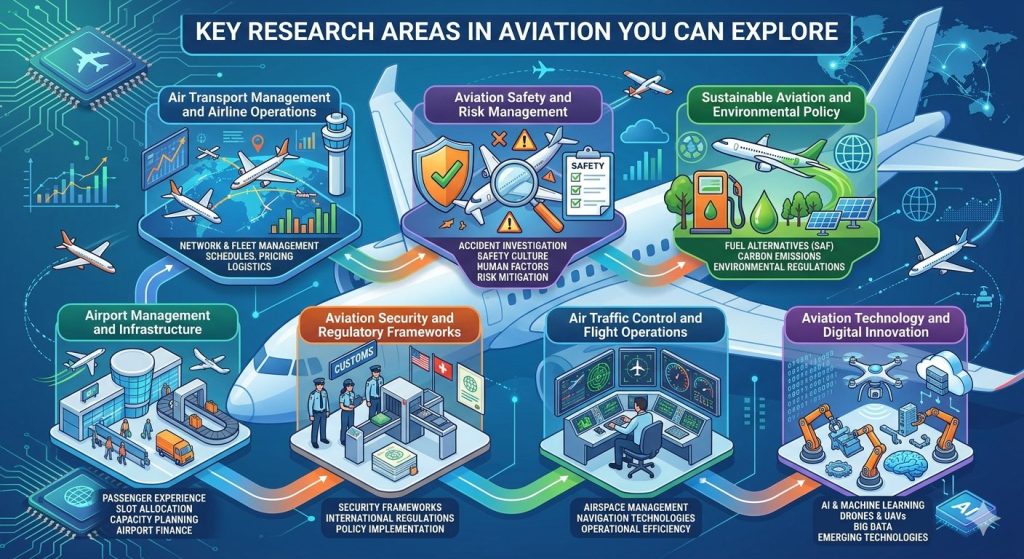
Aviation as an academic field spans multiple disciplines. Understanding the core research areas helps you position your topic correctly and ensures your dissertation fits within an established area of academic inquiry.
Air Transport Management and Airline Operations
This area covers how airlines manage their networks, fleets, schedules, pricing, and customer service. Research here often intersects with economics, logistics, and operations management.
Aviation Safety and Risk Management
Safety is the most critical pillar of the aviation industry. Research in this domain examines accident investigation, safety culture, human factors, regulatory compliance, and risk mitigation frameworks.
Sustainable Aviation and Environmental Policy
With growing pressure to reduce carbon emissions, sustainability has become one of the most active areas of aviation research. Topics here explore fuel alternatives, carbon offsetting, environmental regulation, and the social responsibility of airlines.
Airport Management and Infrastructure
This area focuses on how airports are planned, operated, and managed. Research might cover passenger experience, ground operations, slot allocation, capacity planning, or airport financing.
Aviation Security and Regulatory Frameworks
Aviation security is shaped by international regulations and national policies. Research in this area examines how security frameworks are developed, implemented, and evaluated across different aviation contexts.
Air Traffic Control and Flight Operations
This domain is relevant to both technical and managerial research, covering airspace management, navigation technologies, communication systems, and operational efficiency.
Aviation Technology and Digital Innovation
Emerging technologies such as artificial intelligence, unmanned aerial vehicles (UAVs), blockchain, and big data are transforming aviation operations. Research in this area bridges technology and management.
Five Dissertation Topic Examples with Research Aims and Objectives
Understanding how a strong dissertation topic is structured helps students build confidence before selecting their own. The following examples are presented with a research aim and a set of objectives.
Example 1: Sustainable Aviation Fuel Adoption in European Low-Cost Carriers
Research Aim: To examine the barriers and enablers of sustainable aviation fuel (SAF) adoption among low-cost carriers operating within the European Union.
Research Objectives:
- To identify the regulatory and economic factors that influence SAF uptake decisions among low-cost carriers
- To evaluate how existing environmental policy frameworks support or hinder SAF implementation
- To assess airline management strategies for transitioning towards sustainable fuel alternatives
Example 2: The Impact of Human Factors on Aviation Safety Culture in Regional Airlines
Research Aim: To investigate how human factors contribute to safety culture development within regional airline operations.
Research Objectives:
- To analyse existing models of safety culture in the context of regional airline environments
- To explore how crew resource management training shapes safety behaviours
- To identify organisational practices that strengthen human factor awareness in smaller airline operations
Example 3: Digital Transformation and Passenger Experience at International Airports
Research Aim: To assess how digital innovation is reshaping passenger experience across major international airports.
Research Objectives:
- To evaluate the adoption of self-service and automation technologies at selected international airports
- To examine passenger perceptions of digital check-in, biometrics, and smart wayfinding systems
- To determine how airport management strategies align digital investment with passenger satisfaction outcomes
Example 4: Air Traffic Control Modernisation and Its Effect on Airspace Efficiency
Research Aim: To explore the relationship between air traffic control modernisation programmes and the improvement of airspace efficiency.
Research Objectives:
- To review international ATC modernisation initiatives and their technical components
- To assess the operational outcomes of upgraded ATC systems in selected airspace regions
- To identify challenges in implementing new ATC technologies within existing regulatory structures
Example 5: Cybersecurity Risks in Connected Aircraft Systems
Research Aim: To examine the cybersecurity vulnerabilities present in increasingly connected commercial aircraft systems.
Research Objectives:
- To identify the key cybersecurity risks associated with aircraft connectivity and onboard digital systems
- To evaluate current regulatory responses to aviation cybersecurity at national and international levels
- To propose a framework for enhancing cybersecurity governance within commercial aviation operations
80 Aviation Dissertation Topics for 2026
The following topics are organised by subfield and numbered in fixed ranges. Each topic is original, academically focused, and designed to support undergraduate, master’s, or PhD-level research in 2026.
Sustainable Aviation and Environmental Research
- The feasibility of hydrogen-powered commercial aircraft in short-haul European routes by 2040
- Carbon offsetting schemes in commercial aviation: effectiveness and academic critique
- The role of CORSIA in shaping international aviation emissions policy post-2025
- Barriers to sustainable aviation fuel adoption in developing nations
- Electric aircraft technology and its implications for regional aviation networks
- Environmental certification requirements and their influence on aircraft manufacturing decisions
- Green airport infrastructure development: a comparative study across Asia and Europe
- Noise pollution management strategies at major urban airports
- The impact of aviation’s non-CO2 emissions on climate change policy discussions
- Airline sustainability reporting standards: consistency, transparency, and academic evaluation
Aviation Safety and Risk Management
- The role of safety management systems in reducing incident rates at regional airlines
- Fatigue risk management in long-haul flight operations: a regulatory analysis
- Human error classification frameworks and their application in aviation accident investigations
- Safety culture maturity models in commercial airline organisations
- The effectiveness of crew resource management programmes in reducing cockpit communication errors
- Runway incursion prevention strategies at high-traffic international airports
- Aviation safety oversight in low-income countries: challenges and reform pathways
- The influence of organisational culture on safety reporting behaviour among aviation staff
- Risk management frameworks for unmanned aerial vehicle operations in urban airspace
- Mental health disclosure policies for pilots: balancing safety obligations with employment rights
Airline Management and Operations
- Revenue management strategies and their effect on seat yield in full-service carriers
- The impact of fuel price volatility on airline strategic planning and route development
- Alliance membership and its effect on operational efficiency in mid-sized carriers
- Low-cost carrier business model sustainability in post-pandemic travel markets
- Fleet standardisation strategies and their financial implications for airline operators
- The role of codeshare agreements in expanding airline network coverage
- Airline schedule reliability and its relationship to passenger loyalty outcomes
- Ground handling outsourcing decisions and their effect on turnaround time performance
- The influence of dynamic pricing models on consumer behaviour in airline ticket purchasing
- Crew scheduling optimisation using data-driven approaches in commercial aviation
Airport Management and Infrastructure Planning
- Airport capacity constraints and their economic impact on national aviation markets
- Privatisation of airport management: a comparative evaluation of outcomes across regions
- Passenger terminal design and its relationship to operational flow efficiency
- Slot allocation reform at capacity-constrained airports in the post-pandemic era
- The financial sustainability of regional airports in rural and remote locations
- Smart airport technology adoption and its effect on ground operations management
- Retail and non-aeronautical revenue strategies in airport commercial development
- Airport master planning frameworks: a review of long-term infrastructure decision-making
- The impact of airline bankruptcies on airport financial stability and route continuity
- Accessibility and inclusive design standards in modern airport terminal development
Aviation Security and Regulatory Frameworks
- The effectiveness of behaviour detection programmes in airport security screening
- International harmonisation of aviation security standards: progress and persistent gaps
- Insider threat management strategies within airport operational environments
- Biometric technology adoption in aviation security: privacy concerns and operational benefits
- The regulatory response to drone incursions in controlled airspace
- Counter-terrorism financing frameworks and their application in aviation logistics
- Cargo security screening standards and compliance across international freight hubs
- The role of intelligence sharing in preventing aviation security threats
- Security culture development among ground staff at international airports
- Regulatory oversight of private aviation and business jet operations in security-sensitive regions
Air Traffic Management and Flight Operations
- The single European sky initiative: progress, challenges, and future implementation gaps
- Performance-based navigation adoption and its impact on fuel efficiency in commercial flights
- Remote tower technology and its application in managing low-traffic aerodromes
- Free route airspace concepts and their effect on airline fuel consumption
- The role of datalink communications in reducing pilot-controller voice communication errors
- Airspace redesign projects and their relationship to environmental noise reduction outcomes
- Conflict detection and resolution tools in advanced air traffic management systems
- The operational integration of commercial unmanned aircraft systems into controlled airspace
- Weather-related delay management strategies in high-density air traffic environments
- Air traffic flow management decisions and their downstream effects on airline punctuality metrics
Aviation Technology and Digital Innovation
- Artificial intelligence applications in predictive maintenance for commercial aircraft
- Blockchain technology adoption in aviation supply chain management and parts traceability
- Big data analytics and its role in airline customer experience personalisation strategies
- The integration of Internet of Things devices in airport operations management
- Machine learning applications in aviation safety event prediction and early warning systems
- Digital twin technology in aircraft design, testing, and lifecycle management
- Cybersecurity governance frameworks for airline information systems and passenger data protection
- The use of augmented reality in aircraft maintenance training programmes
- Advanced air mobility vehicles and the regulatory challenges they present to existing frameworks
- Autonomous ground vehicle deployment at airports: operational benefits and safety considerations
Aviation Human Factors and Workforce Studies
- The impact of automation on pilot skills and manual flying proficiency in modern cockpits
- Diversity and inclusion strategies in aviation workforce recruitment and retention
- Cross-cultural communication challenges in multinational airline crew environments
- Pilot shortage projections and the academic critique of global training pipeline capacity
- Wellbeing initiatives in aviation organisations and their effect on staff retention outcomes
- The influence of shift work on cognitive performance among air traffic controllers
- Career pathway development for women in technical aviation roles
- Training effectiveness evaluation frameworks used in airline type-rating programmes
- Leadership behaviour patterns in aviation organisations and their safety implications
- The mental health support infrastructure available to commercial airline crews post-pandemic
How to Choose the Right Aviation Dissertation Topic for Your Level
Selecting a topic depends heavily on your academic level. At undergraduate level, your dissertation should demonstrate that you understand a focused aviation topic, can engage with academic literature, and can present original analysis within a defined scope. Topics numbered in the safety, management, and sustainability sections are well suited to this level.
At master’s level, you are expected to produce original insights. Masters aviation dissertation topics should reflect current industry challenges, require primary or secondary data analysis, and demonstrate methodological rigour. Topics involving digital transformation, regulatory analysis, or workforce studies work well at this stage.
PhD-level research demands a substantial original contribution to knowledge. Topics involving systemic frameworks, longitudinal analysis, or policy modelling are more appropriate. Areas such as airspace integration of autonomous systems or sustainability governance present strong PhD-level potential.
Students at any level who need structured aviation dissertation help early in the process often find that aligning their topic with their methodology from the start saves significant time during the writing phase.
Conclusion: Approach Your Aviation Dissertation with Confidence
Choosing a dissertation topic in aviation does not have to be a source of anxiety. This field offers a rich and growing body of research problems, from the technical challenges of integrating new aircraft technologies to the policy questions surrounding environmental regulation and workforce sustainability.
The 80 topics presented in this post cover the full breadth of aviation as an academic discipline. Each one is designed to support focused, academically credible research at undergraduate, master’s, or PhD level in 2026. Whether your interest lies in airline operations, air traffic management, aviation security, or sustainability, there is a relevant and researchable topic here for you.
Topic selection is the foundation of a strong dissertation. Take the time to choose carefully, align your topic with your academic level, and ensure it connects with current debates in the field. When you approach this process with intention and the right support, you give your research the best possible start.
