


Dissertation Research Question Examples by Method and Level

A good dissertation research question is open, focused and answerable with data you can realistically get. It also fits your method: a number-based question needs numbers, and a meaning-based question needs people or documents that can explain things.
Below you will find examples for quantitative, qualitative, mixed methods and literature-based projects, written at undergraduate, master’s and PhD scale. Copy the pattern, not the wording, and agree the final question with your supervisor.
What makes a research question strong enough for a dissertation?
Strong questions share five traits: they are clear, focused, answerable, relevant and significant. They also cannot be settled with a simple yes or no. If your question can be answered in one word, rewrite it so it asks how, what, why or to what extent.
| Weak version | What is wrong | Stronger version |
|---|---|---|
| Is social media bad for students? | Yes or no, and far too broad | How does daily social media use relate to self-reported sleep quality among first-year undergraduates at one UK university? |
| Do nurses get stressed? | Yes or no, no setting or measure | What proportion of newly qualified nurses on acute wards report moderate or high burnout, and does this differ between day and night shifts? |
| Why is leadership important? | An essay title, not a researchable question | How do line managers in a mid-sized retail firm describe the leadership behaviours that help their teams cope with change? |
| The effects of Brexit on business | A topic, with no question, group or time frame | How have small UK food exporters changed their supplier choices since 2021, and what reasons do owners give? |
Which type of question fits which method?
Start by deciding what you want to find out, because the verb in your question points to the method. A Toronto Metropolitan University guide groups quantitative questions into explanatory, descriptive and comparative types, and treats qualitative questions as a separate family that seeks meaning and understanding rather than counts. You can read more in its guide to formulating a research question.
| You want to | Question type | Opening words that fit | Usual method |
|---|---|---|---|
| Count or measure something | Descriptive | How many, what percentage, to what extent | Survey, secondary data |
| Compare groups | Comparative | What is the difference between | Survey, secondary data, experiment |
| Test a link between variables | Relationship | Is there a relationship between, how well does X predict Y | Correlation, regression |
| Test whether X changes Y | Explanatory | How does X affect Y | Experiment, quasi-experiment |
| Understand experiences or meanings | Qualitative | How do people describe, experience, make sense of | Interviews, focus groups, document analysis |
| Measure, then explain why | Mixed methods | Which, and how do participants explain | Survey followed by interviews |
If you are still choosing the method itself, our guide on how to write a methodology for a dissertation explains how the question, method and analysis fit together.
Quantitative research question examples
Quantitative questions name variables, a group and a setting. They are usually descriptive, comparative, relationship-based or explanatory, and they need data you can measure or already have.
| Level | Subject | Example question | Type |
|---|---|---|---|
| Undergraduate | Business | How do customers aged 18 to 25 rate delivery speed, price and sustainability when buying clothes online? | Descriptive |
| Undergraduate | Psychology | Is there a relationship between weekly part-time working hours and self-reported academic stress among second-year students? | Relationship |
| Master’s | Education | Do students who complete weekly low-stakes quizzes score higher in end-of-term assessments than students who do not, after allowing for prior attainment? | Explanatory |
| Master’s | Nursing | What is the difference in reported burnout between day-shift and night-shift nurses on acute wards in one NHS trust? | Comparative |
| PhD | Economics | To what extent does firm size moderate the relationship between research and development spending and productivity growth in UK manufacturing over ten years? | Relationship |
| PhD | Public health | Which neighbourhood-level factors best predict missed hospital appointments across English regions, and do the predictors differ by age group? | Relationship |
Before you commit, check that you can name the test you will use and the sample size you can reach. Our statistics dissertation help is there if you want a second opinion on whether your question suits the data.
Qualitative research question examples
Qualitative questions are exploratory. They use words such as experience, describe, perceive or make sense of, and they name who is being asked and where. Avoid wording that assumes the answer.
| Level | Subject | Example question | Likely method |
|---|---|---|---|
| Undergraduate | Sociology | How do first-generation students describe their sense of belonging during their first term at university? | Semi-structured interviews |
| Undergraduate | Education | How do primary teachers in one school describe using classroom assistants during reading lessons? | Interviews |
| Master’s | Nursing | What barriers do community nurses report when supporting people with dementia who live alone? | Interviews, thematic analysis |
| Master’s | HRM | How do line managers in a mid-sized retail firm make sense of hybrid working policies? | Interviews or focus groups |
| PhD | Criminology | How do people leaving prison make sense of resettlement support, and how do those meanings change over their first year in the community? | Repeated interviews |
| PhD | Psychology | How do adults with long-term pain construct their identity at work, and what shapes whether they disclose their condition? | Interpretative or narrative analysis |
Qualitative projects usually need ethics approval before you recruit anyone, so build that time into your plan. If you want help choosing between thematic analysis and other approaches, see our dissertation methodology help.
Mixed methods research question examples
A mixed methods question has a number part and a meaning part, and your reader should be able to see why you need both. One common pattern from a Kansas State University research guide runs quantitative first, such as a survey, then qualitative second, such as interviews, to explore the reasons behind the results before the two sets of findings are brought together. The guide is on the Kansas State mixed methods page. A New York University guide adds a useful first check: ask why combining the two approaches suits your objectives.
- Undergraduate, housing: How satisfied are tenants of one housing association with repairs, and what reasons do dissatisfied tenants give?
- Master’s, marketing: Which social media features do online shoppers say increase their trust in a brand, and how do they explain those choices in their own words?
- PhD, education: To what extent do attendance patterns predict attainment in secondary schools in one region, and how do pupils, parents and teachers explain the patterns that the data cannot?
Keep the strands in proportion. At undergraduate level, a short survey and a handful of interviews is usually enough. Two full studies stitched together can strain a word count.
Research question examples for literature-based, document and secondary data projects
Not every dissertation collects new data. Check your course handbook, because some programmes accept a literature-based or secondary-data project and others expect primary research.
- Literature review: What does published research say about the effect of school-based mindfulness programmes on pupils’ attention, and where do studies disagree?
- Systematic review (PICO style): In adults with type 2 diabetes, do structured group education programmes, compared with usual care, improve blood sugar control?
- Document analysis: How do large UK retailers describe climate risk in their annual reports, and how has that language changed between 2019 and 2024?
- Secondary data: How did average household energy spending differ across UK regions between 2019 and 2023, using published national survey data?
For health and social care reviews, a framework can turn a topic into a searchable question. An Imperial College London library guide lists PICO (population, intervention, comparison, outcome) for effectiveness questions and PEO (population, exposure, outcome) for risk questions, along with SPIDER (sample, phenomenon of interest, design, evaluation, research type) and others. See the Imperial College question frameworks guide for the full list and when each is used.
How does the same topic change at undergraduate, master’s and PhD level?
Level changes scope, depth and independence, not the basic skill of asking a clear question. One University of Hull online study page says undergraduate theses are generally under 10,000 words and postgraduate dissertations usually around 15,000, with postgraduate work expected to critically assess several perspectives and contribute to debates in the field. Your own handbook sets your word count, so use it as the final guide. The page is the University of Hull undergraduate and postgraduate comparison.
Here is one topic, hybrid working, pitched three ways.
- Undergraduate (one setting, describe): How do office workers in one company describe the effect of remote working on communication with colleagues?
- Master’s (several settings, compare and critique): How do hybrid working arrangements affect team communication and perceived inclusion in mid-sized UK service firms, and do experiences differ by job level?
- PhD (explain mechanisms, build theory): What mechanisms explain differences in how hybrid working shapes career progression across UK professional services, and how do organisational policies change those mechanisms?
Notice what grows: the number of settings, the number of variables or themes, and the demand to explain rather than describe. If your question feels too big, cut the setting or the group before you cut the method.
How do sub-questions turn one question into a plan?
A main question is usually too broad to answer in one step, so you break it into narrower sub-questions that your data can answer one by one. The University of Hull library guide explains that together they should let you answer the main question, and that they can draw on literature, primary research or both. The guide is the University of Hull research questions guide.
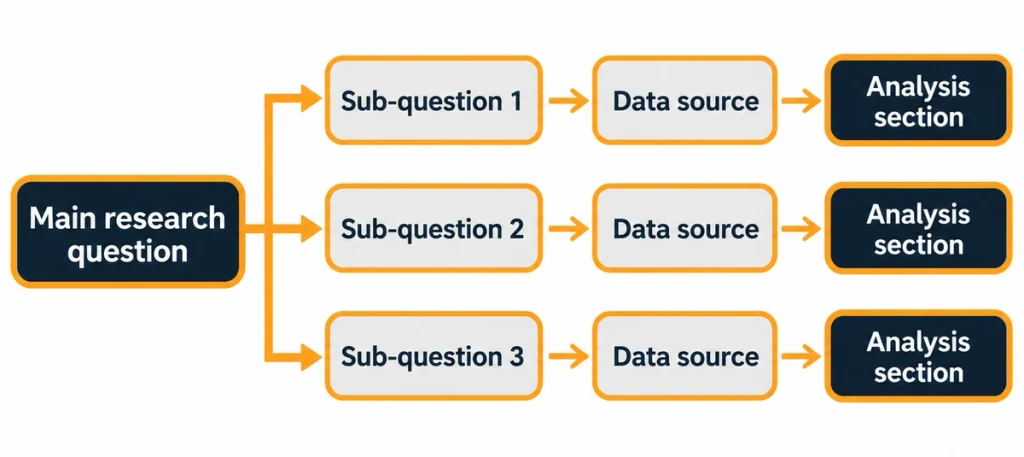
Main question: How do first-year students at one university use online study groups, and how useful do they find them?
- Which platforms do students use for study groups, and how often?
- What do students say they gain from online groups compared with meeting in person?
- What problems, such as unequal contribution, do students report?
Each sub-question should map to one aim, one data source and one section of your analysis. For how many to include, read our guide on how many research questions a dissertation should have.
Should I use a research question or a hypothesis?
A research question asks what, how or why. A hypothesis is a testable statement you expect to be true or false. The University of Hull guide says research questions are more common in the humanities, social sciences and business, and hypotheses more common in the sciences, though that is not a strict rule. Ask your supervisor which your department expects.
| Research question | Hypothesis |
|---|---|
| How does weekly exercise relate to self-reported stress among part-time postgraduate students? | Part-time postgraduate students who exercise at least three times a week report lower stress than those who exercise less. |
How can I test my question before I commit?
- Answer it in one sentence. If you cannot say what data would answer it, the question is not ready.
- Check access. Name your sample, dataset or documents, and how you will reach them in your time frame.
- Check the verb. Does it match your method, from the picker table above?
- Check the literature. A good question grows from a gap you found while reading, unless your method is a systematic review.
- Cut the double question. If it contains two questions joined by “and”, split it or drop one.
It is also normal for your question to shift as you read. Prospects, the UK graduate careers service, advises raising any major change with your supervisor early, which you can see in its seven steps to writing a dissertation. Our guide on how to choose a dissertation topic covers the step before the question.
Where can I see how real UK dissertations handle their questions?
Reading marked work shows you how a question is stated and then answered. The University of Leeds library publishes dissertation examples by school, many with marks and some with notes on how the work could have scored higher. Some are viewable on campus only, not every school is included, and the library warns that module requirements may have changed, so check your current guidelines. See the University of Leeds dissertation examples page. We also list where to find real UK dissertations in our guide to dissertation examples from UK universities.
Questions students ask about dissertation research questions
What are some good research questions to use in a dissertation?
Good ones name a group, a setting and a focus, and they start with how, what or to what extent. For example: “How do first-generation students describe their sense of belonging during their first term at university?” The tables above give you more across subjects and levels.
Can my dissertation research question be a yes or no question?
It is better not to. A yes or no question closes the discussion early. Reword “Does X affect Y?” as “How does X affect Y?” or “To what extent does X affect Y?” so your analysis has something to explain.
Can I use these examples as my own research question?
Use them as patterns. Change the group, place, time period or variables so the question fits your course and data, then agree the wording with your supervisor before you start collecting evidence.
Does a qualitative dissertation need a hypothesis?
Usually not. Qualitative work explores meanings and experiences, so open research questions and sub-questions are the norm. Hypotheses suit studies that test a measurable expectation, and your department may have its own preference.
How do I know my question is the right size for my level?
Compare it with your word count and time. If you cannot see how to answer it within those limits, narrow the group, setting or number of variables. Level mainly changes depth and independence, so your supervisor is the best judge of scope.
Turn your topic into a question you can defend
If you have a topic and a deadline but your question keeps getting rejected or rewritten, tell us your subject, level and method and we will help you work out what is wrong and how to fix it. We can support the question, the proposal and the method that goes with it, through research proposal help, methodology help and literature review help.
Message OnlineDissertationHelp on WhatsApp
Tell us your topic and research question
Tell us what you need and we will reply with a quote.
