


Banking and Finance Dissertation Topics for 2026

Choosing a research project is often the most stressful part of university life. You want something that interests you, but it also needs to satisfy your supervisors and look great on a CV. We have looked through dozens of academic forums and student discussion platforms to see what is currently on your mind.
Before we dive into the list, here are the most common questions students are asking right now:
- “How do I find a research topic that is actually relevant for 2026?”
- “What are some narrow banking topics that haven’t been over-researched?”
- “Is Fintech still a good area for a Master’s dissertation?”
- “How can I make sure my finance topic is suitable for a PhD proposal?”
- “What are the biggest emerging trends in global banking this year?”
Choosing the right dissertation topic in banking and finance is a vital step in your academic journey. This choice defines your final year of study and can even shape your future career path. A well-selected topic shows that you understand current market challenges, such as the rise of artificial intelligence and the shift towards sustainable investing. This post will help you move from feeling overwhelmed to feeling confident about your research direction.
Why Choosing the Right Banking and Finance Topic Matters
Your dissertation is more than just a long essay. It is a piece of independent research that proves you can think critically about complex financial systems. In the fast-moving world of 2026, the finance sector is changing daily. If you pick a topic that is too broad or outdated, your research may lack impact.
A strong topic allows you to explore specific problems, such as how banks manage digital fraud or how green finance helps the environment. By focusing on a narrow area, you can provide fresh insights that contribute to the wider academic community. This level of focus is exactly what markers look for at undergraduate and postgraduate levels.
Download Banking and Finance Dissertation Topics PDF
To make your research journey even easier, you can access a comprehensive list of dissertation ideas in a portable format. We offer a downloadable PDF that features a curated selection of topics designed by academic experts. This resource is perfect for students who want to review their options offline or share ideas with their supervisors.
By completing a short form with your basic details, you will receive this personalised list directly. This allows you to browse through various subfields at your own pace and find the perfect fit for your academic level. It is a simple way to jumpstart your brainstorming process and ensure your research stays on the right track.
Key Research Areas in Banking and Finance
Before you pick a specific title, it is helpful to understand the main “pillars” of research in this field for 2026. These areas represent the most significant challenges and innovations currently facing the industry.
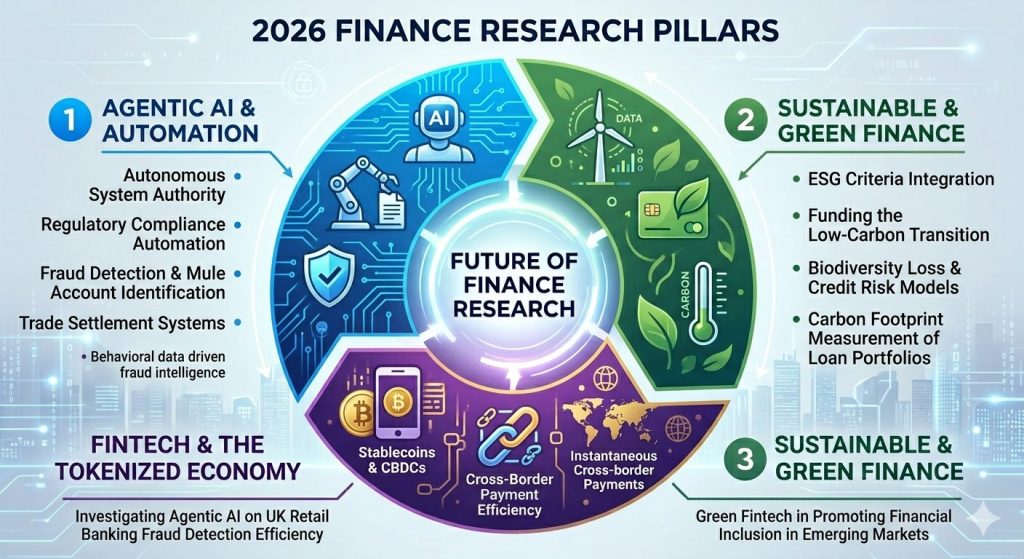
The Rise of Agentic AI and Automation
Banking is moving beyond simple chatbots. We are now seeing “agentic AI” systems that have transactional authority. Research in this area looks at how autonomous systems handle compliance, fraud detection, and even trade settlements.
Sustainable and Green Finance
Environmental, Social, and Governance (ESG) criteria are no longer optional. This area explores how banks fund the transition to a low-carbon economy and how they measure the carbon footprint of their loan portfolios.
Fintech and the Tokenized Economy
The 2026 financial landscape is heavily influenced by tokenization and digital assets. Research here focuses on stablecoins, central bank digital currencies (CBDCs), and how blockchain technology is making cross-border payments faster and cheaper.
Unique Banking and Finance Dissertation Topics With Research Aims
To help you see how a topic is structured, here are five detailed examples. Each includes a research aim and specific objectives.
1. The Impact of Agentic AI on Fraud Detection Efficiency in UK Retail Banking
- Research Aim: To evaluate how autonomous AI agents improve the speed and accuracy of identifying mule accounts compared to traditional machine learning models.
- Research Objectives:
- To analyse the current limitations of rule-based fraud detection systems in the UK.
- To assess the performance of agentic AI in processing real-time behavioral data.
2. Investigating the Role of Green Fintech in Promoting Financial Inclusion in Emerging Markets
- Research Aim: To explore how mobile-based green finance tools help underbanked populations access renewable energy technology.
- Research Objectives:
- To identify the barriers to adopting green fintech in rural communities.
- To examine the correlation between microfinance access and the adoption of solar home systems.
3. A Study of Tokenization and its Effect on Liquidity in Private Credit Markets
- Research Aim: To determine if the tokenization of private debt assets leads to higher trading volumes and lower costs for institutional investors.
- Research Objectives:
- To compare the settlement times of traditional private credit versus on-chain assets.
- To evaluate the regulatory challenges of integrating tokenized assets into standard banking cores.
4. Behavioral Biases and the Adoption of Robo-Advisors Among Gen Z Investors
- Research Aim: To investigate how overconfidence and herd behavior influence how young investors interact with automated wealth management platforms.
- Research Objectives:
- To identify the primary behavioral biases present in Gen Z retail investors.
- To assess the effectiveness of robo-advisor nudges in mitigating these biases.
5. Central Bank Digital Currencies (CBDCs) and the Future of Commercial Bank Deposits
- Research Aim: To model the potential impact of a “Digital Pound” on the deposit-taking and lending capacity of traditional UK banks.
- Research Objectives:
- To explore the risk of “digital bank runs” during periods of financial stress.
- To propose strategies for commercial banks to remain competitive in a CBDC-led economy.
80 Comprehensive Banking and Finance Dissertation Topics for 2026
Fintech and Digital Transformation
- The influence of Open Banking APIs on the competitive advantage of neo-banks in Europe.
- Assessing the security risks of biometric authentication in mobile banking apps.
- The role of cloud-powered AI in reducing operational downtime for global investment banks.
- How embedded finance is changing the revenue models of non-financial e-commerce platforms.
- Evaluating the effectiveness of “Buy Now, Pay Later” (BNPL) regulations in protecting vulnerable consumers.
- The impact of smart contracts on reducing legal costs in syndicated loan markets.
- A comparative analysis of user experience (UX) design in traditional versus digital-only banks.
- How “invisible payments” are reshaping consumer spending habits in the UK.
- The evolution of peer-to-peer (P2P) lending platforms after the 2025 regulatory shifts.
- Investigating the integration of 5G technology in high-frequency trading infrastructure.
Sustainable Finance and ESG
- The relationship between ESG reporting transparency and stock price volatility.
- How green bonds contribute to the financing of urban reforestation projects in the UK.
- Assessing the risk of “greenwashing” in the marketing of sustainable investment funds.
- The impact of carbon pricing on the credit risk models of commercial banks.
- A study of natural capital accounting frameworks in the agricultural banking sector.
- How sustainable banking practices influence the loyalty of “Gen Alpha” customers.
- The role of the European Central Bank (ECB) in standardizing climate-related financial disclosures.
- Evaluating the performance of ESG-themed Exchange Traded Funds (ETFs) against traditional benchmarks.
- The impact of biodiversity loss on the long-term stability of the global insurance industry.
- How impact investing is transforming the private equity landscape in emerging economies.
Corporate Finance and Governance
- The effect of board gender diversity on the risk-taking behavior of FTSE 100 firms.
- How CEO compensation structures influence long-term investment in Research and Development.
- An analysis of capital structure decisions in tech startups during high-interest-rate environments.
- The impact of corporate tax avoidance on the reputation and market value of global brands.
- Investigating the effectiveness of independent audit committees in preventing financial fraud.
- How dual-class share structures affect the rights of minority shareholders in IPOs.
- The role of institutional investors in driving corporate social responsibility (CSR) initiatives.
- An evaluation of the “significant risk transfer” (SRT) market in modern bank capital management.
- The impact of hostile takeovers on the employee productivity of target firms.
- How digital corporate governance tools improve the transparency of annual general meetings.
Risk Management and Banking Regulation
- The effectiveness of Basel IV standards in mitigating systemic risk in the Asian banking sector.
- Assessing the cybersecurity resilience of cross-border payment systems against quantum computing threats.
- The impact of “stress testing” on the dividend policies of major UK banks.
- How real-time data analytics improve the accuracy of credit scoring for Small and Medium Enterprises (SMEs).
- The role of RegTech in automating Anti-Money Laundering (AML) compliance checks.
- Investigating the “contagion effect” of regional bank failures on global financial stability.
- The impact of rising interest rates on the default rates of residential mortgage portfolios.
- How behavioral data-driven fraud intelligence identifies dormant mule accounts.
- The effectiveness of “ring-fencing” regulations in protecting retail deposits from investment banking losses.
- Assessing the liquidity coverage ratio (LCR) requirements for banks holding volatile digital assets.
Investment Banking and Financial Markets
- The impact of dark pools on the price discovery process in equity markets.
- How algorithmic trading influences market volatility during periods of geopolitical tension.
- A study of the “SPAC” (Special Purpose Acquisition Company) revival and its long-term performance.
- The role of hedge funds in providing liquidity to the private credit market.
- Evaluating the accuracy of AI-driven predictive models in forecasting currency exchange rates.
- The impact of “meme stock” trading on the risk management strategies of retail brokerages.
- How tokenized real estate assets are democratising access to property investment.
- The relationship between central bank “forward guidance” and bond market stability.
- An analysis of the “carry trade” strategy in the 2026 global economic environment.
- How the tokenization of gold is affecting its status as a safe-haven asset.
Islamic Banking and Finance
- A comparative study of risk-sharing models in Islamic versus conventional banking.
- The challenges of standardizing “Sharia-compliant” fintech products globally.
- How “Sukuk” (Islamic bonds) are being used to fund green energy projects.
- The impact of profit-sharing investment accounts on the liquidity of Islamic banks.
- Assessing the role of “Zakat” and “Waqf” in promoting financial inclusion.
- The effectiveness of Islamic microfinance in reducing poverty in Southeast Asia.
- How digital transformation is affecting the traditional “Mudarabah” contract structure.
- A study of the governance challenges in dual-banking systems where Islamic and conventional banks coexist.
- The impact of Sharia-compliant robo-advisors on the wealth management sector.
- Evaluating the resilience of Islamic banks during global financial crises.
Behavioral Finance and Consumer Choice
- The influence of social media influencers on the investment choices of retail traders.
- How “loss aversion” affects the adoption of life insurance products among young adults.
- A study of the “anchoring effect” in the pricing of residential properties.
- How gamification features in banking apps influence the saving habits of Gen Z.
- The impact of financial literacy programs on the credit card debt levels of university students.
- Investigating the “herding behavior” in the cryptocurrency market during 2026.
- How the “disposition effect” influences the timing of stock sales among amateur investors.
- The role of emotional intelligence in the decision-making process of professional fund managers.
- Assessing the impact of “nudge theory” on increasing pension fund contributions.
- How cognitive biases affect the valuation of tech companies with no revenue.
Emerging Markets and Economic Development
- The impact of mobile money services on the economic growth of Sub-Saharan Africa.
- How Chinese “agentic AI” systems are influencing banking standards in the Belt and Road Initiative.
- The role of development banks in financing infrastructure projects in Latin America.
- Assessing the impact of foreign direct investment (FDI) on the banking stability of emerging markets.
- The effect of currency devaluations on the debt sustainability of developing nations.
- How microfinance 2.0 is using blockchain to lower interest rates for small borrowers.
- The role of the BRICS+ New Development Bank in challenging traditional Western financial institutions.
- Investigating the impact of “remittances” on the financial depth of small island nations.
- How digital identification systems are helping the “unbanked” access formal credit.
- The impact of trade wars on the cross-border lending activities of emerging market banks.
If you are looking for professional assistance to refine these ideas, an Online Dissertation Writing Service can provide the guidance you need. Furthermore, exploring Finance Dissertation Topics from previous years can help you identify gaps in the existing research.
Conclusion
Selecting a topic for your banking and finance dissertation is a significant milestone. The field is currently at a turning point, with technology and sustainability playing larger roles than ever before. Whether you are interested in the technical side of AI or the ethical side of green finance, there is a wealth of research waiting to be done.
Approach your project with a sense of curiosity and integrity. By choosing a narrow, well-defined topic, you set yourself up for academic success and provide a valuable contribution to the financial world. Remember to consult with your supervisors early and use the resources available to you to make an informed choice.
