


Information Systems Management Dissertation Topics for 2026

Common Questions Students Ask Before Choosing a Topic
Students often turn to academic forums and discussion platforms when they feel stuck at the topic selection stage. These questions reflect real concerns that come up again and again:
- How do I choose the right topic in Information Systems Management for my degree level?
- What makes a dissertation topic relevant in 2026?
- Are there specific areas in Information Systems Management that universities prefer?
- How narrow should my topic be for undergraduate, MSc, or PhD research?
- Can I combine business and technology in one dissertation topic?
- What are the current trends in Information Systems Management research?
- How do I know if my topic is researchable and not too broad?
If you are asking these questions, you are not behind. You are at the exact stage where good decisions shape your final grade.
Why Choosing the Right Dissertation Topic in Information Systems Management Matters
A dissertation topic is not just a title. It defines your research direction, your methodology, and the depth of your academic contribution.
In Information Systems Management, the stakes are higher because the field sits between technology and business strategy. A weak topic leads to vague research questions and poor analysis. A strong topic gives you clarity, focus, and a clear academic argument.
Your topic must meet three core expectations:
- Academic relevance: It should align with established theories and frameworks
- Practical significance: It should connect to real-world organisational challenges
- Research feasibility: You must be able to collect and analyse data within your timeframe
Many students rush this stage and later struggle with structure, literature review, or methodology. If you are already considering structured online dissertation help, it usually means your topic lacks clarity.
Download Information Systems Management Dissertation Topics PDF
If you want a more personalised approach, you can access a curated PDF that includes tailored dissertation topics based on your academic level and research interest.
This document is typically prepared by academic experts after reviewing your preferences through a short form. It helps you move beyond generic ideas and focus on topics that align with your university expectations.
Students who feel uncertain about narrowing their ideas often combine this step with dissertation writing services to ensure their topic is both academically strong and practically manageable.
Key Research Areas in Information Systems Management
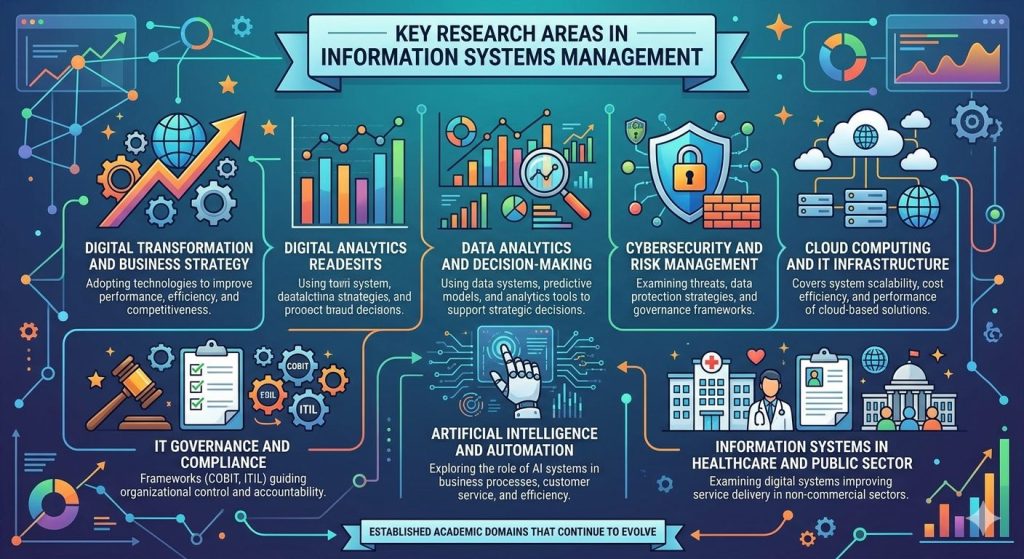
Before choosing a topic, you need to understand the major research domains within the field. These are not trends. These are established academic areas that continue to evolve.
Digital Transformation and Business Strategy
Focuses on how organisations adopt digital technologies to improve performance, efficiency, and competitiveness.
Data Analytics and Decision-Making
Explores how organisations use data systems, predictive models, and analytics tools to support strategic decisions.
Cybersecurity and Risk Management
Examines threats, data protection strategies, and governance frameworks in digital environments.
Cloud Computing and IT Infrastructure
Covers system scalability, cost efficiency, and performance of cloud-based solutions.
IT Governance and Compliance
Focuses on frameworks such as COBIT and ITIL that guide organisational control and accountability.
Artificial Intelligence and Automation
Explores the role of AI systems in business processes, customer service, and operational efficiency.
Information Systems in Healthcare and Public Sector
Examines how digital systems improve service delivery in non-commercial sectors.
Example Dissertation Topics with Aim and Objectives
1. The Role of Artificial Intelligence in Business Decision-Making
Aim:
To examine how AI systems influence managerial decision-making processes.
Objectives:
- Analyse the effectiveness of AI tools in strategic decisions
- Evaluate challenges in AI adoption within organisations
- Assess the impact on decision accuracy
2. Cybersecurity Risk Management in Financial Institutions
Aim:
To evaluate cybersecurity strategies used in financial organisations.
Objectives:
- Identify common cybersecurity threats
- Analyse risk mitigation frameworks
- Assess organisational preparedness
3. Cloud Computing Adoption in SMEs
Aim:
To explore the benefits and challenges of cloud adoption in small businesses.
Objectives:
- Examine cost implications
- Analyse performance improvements
- Identify barriers to adoption
4. Big Data Analytics in Supply Chain Management
Aim:
To investigate how big data improves supply chain efficiency.
Objectives:
- Evaluate data-driven decision-making
- Analyse operational improvements
- Identify implementation challenges
5. IT Governance and Organisational Performance
Aim:
To assess how IT governance frameworks influence business performance.
Objectives:
- Analyse governance structures
- Evaluate compliance practices
- Measure performance outcomes
80 Information Systems Management Dissertation Topics for 2026
Digital Transformation and Strategy
- Digital transformation strategies in multinational organisations
- Impact of digital maturity on organisational performance
- Role of leadership in digital transformation success
- Digital innovation and competitive advantage
- Barriers to digital transformation in developing economies
- Digital ecosystems and business model innovation
- Role of ERP systems in organisational transformation
- Measuring ROI of digital transformation initiatives
- Change management in digital transformation projects
- Impact of remote work technologies on business operations
Data Analytics and Business Intelligence
- Predictive analytics in financial decision-making
- Role of big data in marketing strategy
- Data-driven decision-making in healthcare systems
- Challenges of data quality in business intelligence
- Real-time analytics in supply chain management
- Ethical implications of data analytics
- Data visualisation tools in executive decision-making
- Machine learning in customer behaviour analysis
- Data governance frameworks in organisations
- Impact of analytics on operational efficiency
Cybersecurity and Risk Management
- Cybersecurity frameworks in financial institutions
- Human factors in cybersecurity breaches
- Risk management strategies in cloud environments
- Data privacy regulations and organisational compliance
- Cybersecurity awareness among employees
- Impact of ransomware attacks on business continuity
- Security challenges in IoT systems
- Role of AI in cybersecurity defence
- Insider threats and organisational risk
- Cybersecurity investment and business performance
Cloud Computing and IT Infrastructure
- Cloud adoption in SMEs
- Cost-benefit analysis of cloud migration
- Hybrid cloud strategies in large enterprises
- Cloud security challenges and solutions
- Performance evaluation of cloud-based systems
- Role of cloud computing in remote work
- Vendor selection strategies in cloud services
- Cloud computing in public sector organisations
- Scalability challenges in cloud infrastructure
- Impact of cloud systems on IT governance
Artificial Intelligence and Automation
- AI adoption in customer service systems
- Automation and workforce transformation
- AI ethics in business applications
- Chatbots and customer engagement
- AI-driven supply chain optimisation
- Robotic process automation in finance
- AI in predictive maintenance systems
- Bias in machine learning algorithms
- AI implementation challenges in organisations
- Impact of automation on organisational efficiency
IT Governance and Compliance
- IT governance frameworks in multinational firms
- Role of COBIT in organisational control
- IT compliance and regulatory requirements
- Governance challenges in digital transformation
- IT risk management frameworks
- Board-level involvement in IT governance
- Impact of governance on IT performance
- Audit practices in information systems
- Governance in cloud computing environments
- Role of IT governance in cybersecurity
Information Systems in Healthcare and Public Sector
- Electronic health records and patient care quality
- Digital transformation in public sector services
- Health information systems and data security
- Telemedicine and information systems integration
- Role of IS in pandemic response management
- Public sector IT infrastructure challenges
- Data sharing in healthcare systems
- Government digital services and user experience
- IT systems in smart cities development
- Ethical issues in healthcare information systems
Emerging Technologies and Future Trends
- Blockchain applications in information systems
- Internet of Things in smart organisations
- Edge computing and real-time data processing
- Quantum computing and business implications
- Digital twins in industrial systems
- Augmented reality in business operations
- Green IT and sustainable information systems
- 5G technology and organisational transformation
- Metaverse applications in business environments
- Future of work and digital collaboration tools
Conclusion
Choosing a dissertation topic in Information Systems Management is not about picking something that sounds impressive. It is about selecting a research problem that you can understand, analyse, and defend academically.
A strong topic aligns with current research areas, fits your academic level, and allows you to apply appropriate methodology. When you get this right, every other part of your dissertation becomes easier to manage.
If you feel uncertain, it is usually because your topic is too broad or not clearly defined. Fix that first. Once your direction is clear, your research will naturally follow.
Approach your dissertation with structure, discipline, and critical thinking. That is what universities assess, and that is what will set your work apart.
