


Innovation Management Dissertation Topics for 2026

Students often share similar concerns when choosing a dissertation topic. These questions are gathered from academic forums and student discussion platforms where confusion about topic selection is common:
- How do I choose a strong and researchable topic in innovation management?
- What are the latest innovation management dissertation topics for 2026?
- Which topics are suitable for undergraduate, MSc, or PhD level research?
- How do I make sure my topic is relevant to current industry trends?
- What makes a dissertation topic academically strong and acceptable?
- Can I find focused and narrow research ideas instead of broad topics?
- How do I align my topic with real-world innovation challenges?
Introduction
Choosing the right dissertation topic in innovation management is one of the most important academic decisions you will make. Your topic shapes your research direction, determines the quality of your analysis, and directly influences your final grade. A weak or overly broad topic often leads to poor structure, limited findings, and lack of academic depth.
Innovation management focuses on how organisations create, develop, and implement new ideas, products, and processes. As industries rapidly evolve through digital transformation, sustainability pressures, and global competition, the demand for well-researched innovation studies continues to grow. This makes selecting relevant Innovation Management Dissertation Topics critical for academic success.
Download Innovation Management Dissertation Topics PDF
Students often prefer having a structured list of ideas they can review offline. A downloadable PDF version of innovation management dissertation topics allows you to explore curated and academically refined research ideas in one place.
This resource is typically tailored by academic experts based on your level of study and research interests. After completing a short form, students receive a personalised topic list that helps them narrow their focus and move forward with confidence. Many learners also combine this with online dissertation help to refine their proposals and ensure alignment with university standards.
Why Choosing the Right Dissertation Topic in Innovation Management Matters
A dissertation is not just a final assignment. It is a demonstration of your ability to think critically, apply theory, and contribute to knowledge.
A strong topic in innovation management should:
- Address a real problem or gap in research
- Be specific and manageable within your timeframe
- Align with your academic level
- Allow access to relevant data or case studies
- Reflect current industry or technological trends
Students often make the mistake of choosing trendy topics without understanding their scope. This leads to weak arguments and unclear research direction. If you feel uncertain, seeking online dissertation help early can prevent major issues later.
Key Research Areas in Innovation Management
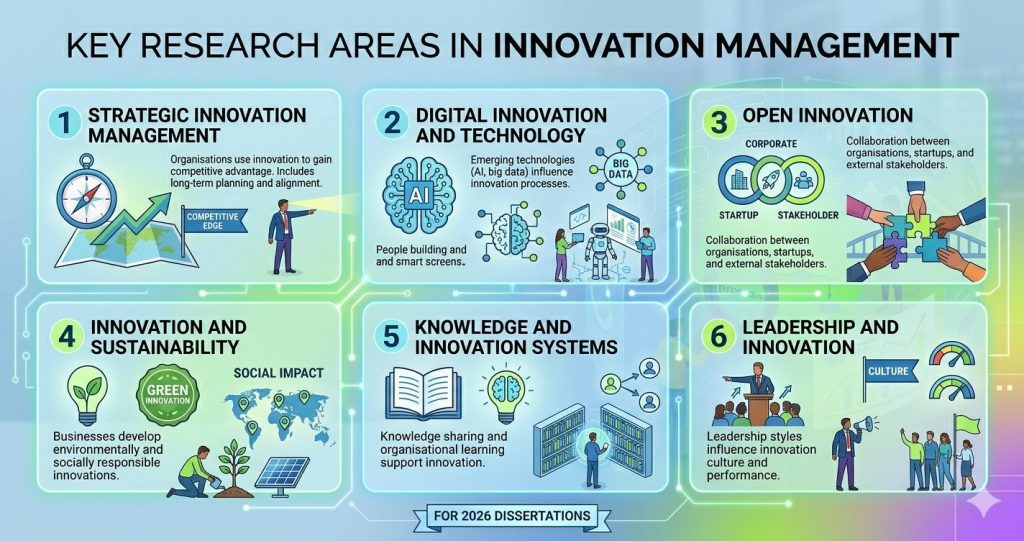
Innovation management is a broad field. Understanding its main areas helps you choose a focused topic.
Strategic Innovation Management
This area studies how organisations use innovation to gain competitive advantage. It includes long-term planning and innovation strategy alignment.
Digital Innovation and Technology
Focuses on how emerging technologies such as artificial intelligence and big data influence innovation processes.
Open Innovation
Explores collaboration between organisations, startups, and external stakeholders to drive innovation.
Innovation and Sustainability
Examines how businesses develop environmentally and socially responsible innovations.
Knowledge and Innovation Systems
Looks at how knowledge sharing and organisational learning support innovation.
Leadership and Innovation
Studies how leadership styles influence innovation culture and performance.
Five Innovation Management Dissertation Topics with Research Aims
1. The Role of Artificial Intelligence in Business Innovation
Aim: To analyse how AI technologies influence organisational innovation strategies.
Objectives:
- Examine AI adoption in innovation processes
- Evaluate its impact on decision making
- Identify challenges in implementation
2. Open Innovation in SMEs
Aim: To explore how small firms use external collaboration to innovate.
Objectives:
- Identify key collaboration models
- Analyse benefits and risks
- Assess impact on business growth
3. Innovation Strategy and Competitive Advantage
Aim: To investigate how innovation strategies create market advantage.
Objectives:
- Analyse strategic frameworks
- Evaluate real-world case studies
- Identify best practices
4. Digital Transformation and Innovation Performance
Aim: To study the relationship between digital tools and innovation outcomes.
Objectives:
- Examine digital adoption levels
- Measure innovation performance
- Identify barriers to transformation
5. Sustainable Innovation in Manufacturing
Aim: To assess how sustainability drives innovation in production industries.
Objectives:
- Analyse eco-innovation practices
- Evaluate environmental impact
- Identify cost and efficiency outcomes
List of 80 Innovation Management Dissertation Topics for 2026
Emerging Trends in Innovation Management
- The impact of AI-driven innovation on organisational performance
- Blockchain applications in innovation ecosystems
- Innovation strategies in the era of digital disruption
- The role of big data in innovation decision making
- Innovation in remote work environments
- The influence of Industry 4.0 on innovation processes
- Innovation management in platform-based businesses
- The role of startups in disruptive innovation
- Innovation trends in global supply chains
- The future of innovation management in smart cities
Leadership’s Role in Driving Innovation
- Transformational leadership and innovation outcomes
- Leadership styles and employee creativity
- The role of leadership in innovation culture development
- Ethical leadership and innovation sustainability
- Leadership challenges in digital innovation
- Gender diversity in leadership and innovation performance
- Leadership influence on innovation adoption
- Decision making styles in innovative organisations
- Leadership and risk-taking in innovation
- The role of leaders in managing innovation failure
The Impact of Technology on Innovation
- Artificial intelligence in innovation management systems
- Cloud computing and collaborative innovation
- The role of IoT in product innovation
- Cybersecurity challenges in innovation processes
- Digital platforms and innovation scalability
- Automation and innovation efficiency
- Technology adoption and innovation success
- Innovation in fintech industries
- Virtual reality in innovation design processes
- The role of machine learning in R&D
Strategies for Managing Innovation
- Innovation strategy in multinational corporations
- Agile innovation management frameworks
- Innovation portfolio management techniques
- Risk management in innovation projects
- Resource allocation in innovation processes
- Innovation strategy alignment with business goals
- Measuring innovation performance metrics
- Innovation strategy in crisis situations
- The role of experimentation in innovation
- Strategic partnerships for innovation success
Innovation and Organisational Change
- Managing resistance to innovation
- Organisational culture and innovation adoption
- Change management in innovation initiatives
- Innovation-driven organisational transformation
- Employee engagement in innovation processes
- The role of HR in fostering innovation
- Innovation and organisational learning
- Managing innovation in traditional industries
- Innovation and workplace flexibility
- The impact of organisational structure on innovation
Open Innovation
- Open innovation models in large firms
- Crowdsourcing as a tool for innovation
- Collaboration between universities and industries
- Innovation networks and knowledge sharing
- Open innovation in healthcare
- Intellectual property challenges in open innovation
- Innovation through strategic alliances
- Customer involvement in innovation
- Digital platforms for open innovation
- The role of innovation hubs and incubators
Case Studies in Innovation Management
- Innovation strategies of global tech companies
- Case study of innovation in the automotive industry
- Innovation practices in emerging markets
- Failure case studies in innovation management
- Innovation in the pharmaceutical sector
- Case study of sustainable innovation practices
- Innovation in e-commerce companies
- Innovation strategies in startups
- Public sector innovation case studies
- Innovation in service-based industries
Knowledge Management and Innovation
- Knowledge sharing and innovation performance
- The role of organisational learning in innovation
- Knowledge management systems in innovation
- Innovation through employee training programmes
- Tacit knowledge and innovation development
- Knowledge transfer in multinational firms
- Digital knowledge management tools and innovation
- Knowledge retention and innovation continuity
- The role of data analytics in knowledge-driven innovation
- Knowledge management challenges in innovation processes
Conclusion
Selecting a dissertation topic in innovation management requires more than choosing something interesting. It demands clarity, focus, and academic relevance. A well-defined topic allows you to build strong arguments, apply theory effectively, and contribute meaningful insights to the field.
The topics provided here reflect current research directions and practical challenges in innovation management. Whether you are working at undergraduate, MSc, or PhD level, your success depends on how well you refine your topic and align it with research objectives.
Approach your dissertation as an opportunity to explore real-world innovation problems. Stay focused, think critically, and ensure your research remains structured and academically sound. With the right topic, the entire research process becomes more manageable and rewarding.
