


Leadership and Management Dissertation Topics for 2026

Questions Students Commonly Ask Before Choosing a Topic
These questions reflect real concerns gathered from student forums and academic discussion spaces. If you feel stuck, you are not alone.
- How do I choose a strong dissertation topic in leadership and management for 2026?
- What makes a topic suitable for undergraduate, MSc, or PhD level research?
- Are there current trends in leadership that universities expect me to explore?
- How narrow should my topic be to meet academic standards?
- Can I align my topic with real-world organisational challenges?
- What are good dissertation topics for leadership and management MSc students?
- How do I turn a broad idea into a clear research aim and objectives?
- Are there topic ideas that work well for UK-based research proposals?
- What mistakes should I avoid when selecting my topic?
Introduction
Choosing the right Hospitality Management Dissertation Topics might seem like the priority at first glance, but for leadership and management students, topic selection carries even greater academic weight. Your dissertation topic defines your research direction, shapes your methodology, and determines how your work contributes to existing knowledge.
In leadership and management, a weak topic leads to vague arguments and poor analysis. A strong topic, however, allows you to explore real organisational challenges, apply theory to practice, and demonstrate critical thinking. Universities expect your topic to be relevant, researchable, and aligned with current academic debates.
This guide helps you move from confusion to clarity by showing you how to select, structure, and refine your dissertation topic for 2026.
Download Leadership and Management Dissertation Topics PDF
Many students struggle because they try to finalise a topic without guidance. A curated PDF can help you avoid that mistake.
You can receive a personalised list of leadership and management dissertation topics pdf options prepared by academic experts. This resource is typically shared after completing a short academic form and is designed to match your level of study and research interests.
Use it as a starting point, not a shortcut. Your final topic still needs critical thinking and refinement.
Why Choosing the Right Dissertation Topic in Leadership and Management Matters
Your dissertation is not just another assignment. It is your most important academic project.
Here is why your topic matters:
- It determines the depth of your research
- It influences your ability to collect meaningful data
- It shapes your final grade
- It reflects your academic and professional interests
Students often search for Leadership and Management Dissertation Topics without understanding that universities assess more than just originality. They look for clarity, feasibility, and relevance.
A poor topic is usually:
- Too broad
- Too vague
- Lacking academic grounding
A strong topic is:
- Focused on a specific issue
- Backed by theory
- Aligned with current organisational challenges
If your topic cannot answer a clear research question, it will fail under academic scrutiny.
Key Research Areas in Leadership and Management
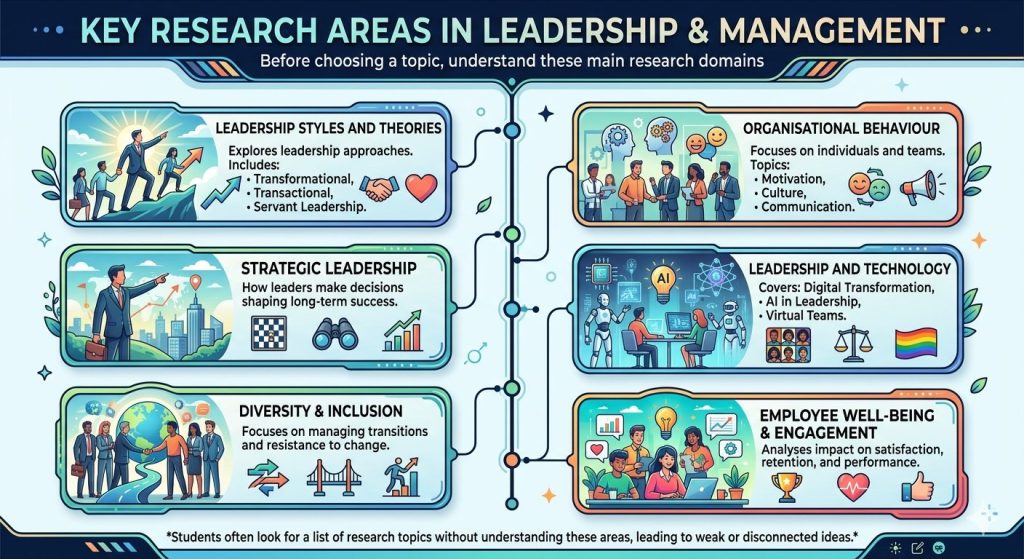
Before choosing a topic, you need to understand the main research domains in the field.
Leadership Styles and Theories
This area explores how different leadership approaches influence organisational outcomes. It includes transformational, transactional, and servant leadership.
Organisational Behaviour
Focuses on how individuals and teams behave within organisations. Topics include motivation, culture, and communication.
Strategic Leadership
Examines how leaders make decisions that shape long-term organisational success.
Leadership and Technology
Covers digital transformation, AI in leadership, and virtual team management.
Diversity and Inclusion
Explores how leadership affects workplace equality and inclusion.
Change Management
Focuses on how leaders manage organisational transitions and resistance to change.
Employee Well-being and Engagement
Analyses how leadership impacts satisfaction, retention, and performance.
Students often look for a list of research topics in leadership and management, but without understanding these areas, they end up choosing weak or disconnected ideas.
Five Example Dissertation Topics with Aims and Objectives
These examples show how to structure a strong topic.
1. The Impact of Transformational Leadership on Employee Performance in SMEs
Aim: To evaluate how transformational leadership influences employee productivity in small and medium enterprises.
Objectives:
- To analyse leadership behaviours in SMEs
- To measure employee performance outcomes
- To assess the relationship between leadership style and productivity
2. Leadership in Remote Work Environments
Aim: To examine how leadership strategies affect team performance in remote settings.
Objectives:
- To identify challenges in remote leadership
- To explore communication strategies used by leaders
- To evaluate their impact on team efficiency
3. The Role of Emotional Intelligence in Leadership Effectiveness
Aim: To investigate how emotional intelligence contributes to leadership success.
Objectives:
- To measure emotional intelligence levels in managers
- To analyse leadership effectiveness indicators
- To identify correlations between the two
4. Leadership and Employee Well-being in High-Stress Industries
Aim: To explore how leadership approaches affect employee well-being.
Objectives:
- To identify stress factors in the workplace
- To examine leadership responses
- To evaluate employee well-being outcomes
5. Ethical Leadership and Corporate Governance
Aim: To assess the role of ethical leadership in improving governance practices.
Objectives:
80 Leadership and Management Dissertation Topics for 2026
Leadership Development and Training
- Evaluating leadership training programmes in multinational organisations
- The effectiveness of coaching in leadership development
- Leadership skill gaps in early career managers
- The role of mentoring in leadership growth
- Digital learning tools in leadership training
- Leadership development in public sector organisations
- The impact of leadership workshops on decision-making skills
- Gender differences in leadership training outcomes
- Leadership development strategies in SMEs
- Measuring ROI of leadership training programmes
Leadership in Remote and Hybrid Work
- Leadership challenges in hybrid work environments
- Virtual leadership and team productivity
- Communication strategies in remote leadership
- Trust-building in virtual teams
- Leadership styles in remote organisations
- Managing performance in distributed teams
- Employee engagement in remote work settings
- Leadership adaptability in hybrid workplaces
- Digital tools and leadership effectiveness
- Remote leadership and organisational culture
Leadership and Organisational Change
- Leadership strategies during organisational restructuring
- Managing resistance to change
- Leadership roles in digital transformation
- Change leadership in crisis situations
- Leadership communication during change
- Employee perception of change leadership
- Leadership approaches in mergers and acquisitions
- The impact of leadership on change success rates
- Change management frameworks and leadership
- Leadership behaviour during organisational transitions
Leadership and Employee Well-being
- Leadership impact on employee mental health
- Work-life balance and leadership support
- Leadership styles and burnout levels
- Psychological safety in teams
- Leadership and employee satisfaction
- Stress management through leadership practices
- Leadership influence on workplace morale
- Employee retention and leadership behaviour
- Leadership and workplace flexibility
- Well-being initiatives led by managers
Emotional Intelligence and Leadership
- Emotional intelligence in senior leadership
- EI and decision-making effectiveness
- Leadership empathy and employee engagement
- EI training and leadership outcomes
- Emotional intelligence in crisis leadership
- EI and conflict resolution
- Leadership self-awareness and performance
- Emotional intelligence in cross-cultural teams
- EI and organisational communication
- Measuring emotional intelligence in leaders
Strategic Decision-Making in Leadership
- Leadership decision-making under uncertainty
- Strategic leadership in competitive markets
- Data-driven decision-making in management
- Leadership biases in decision-making
- Ethical decision-making in leadership
- Risk management and leadership strategies
- Leadership and innovation decisions
- Strategic planning and leadership roles
- Decision-making in global organisations
- Leadership accountability in strategic decisions
Diversity and Inclusion in Leadership
- Gender diversity in leadership roles
- Inclusive leadership practices in organisations
- Cultural diversity and leadership effectiveness
- Leadership strategies for equality in workplaces
- Barriers to diversity in leadership positions
- Inclusive leadership and team performance
- Leadership approaches to workplace discrimination
- Diversity policies and leadership outcomes
- Leadership and minority representation
- Inclusive leadership in global organisations
Technology and Innovation in Leadership
- AI and leadership decision-making
- Digital transformation and leadership roles
- Leadership in tech-driven organisations
- Innovation leadership in startups
- Technology adoption and leadership strategies
- Leadership challenges in Industry 4.0
- Digital leadership competencies
- Innovation culture and leadership
- Leadership in data-driven organisations
- Future leadership trends in digital environments
Conclusion
Selecting the right dissertation topic in leadership and management is not a quick decision. It requires clarity, research awareness, and alignment with academic standards.
A strong topic allows you to:
- Explore real organisational issues
- Apply theory effectively
- Produce meaningful research
Whether you are working on thesis topics on leadership and management for MA students or planning a PhD proposal, your success depends on how well you define your research focus.
Approach your dissertation with discipline and critical thinking. If your topic is clear, your research will follow.
