


Digital Marketing Dissertation Topics for 2026

The following questions are gathered from student forums, Reddit academic threads, and university discussion boards. They reflect how real students search for dissertation guidance online.
- What are the best digital marketing dissertation topics for 2026?
- How do I choose a dissertation topic for digital marketing at master’s level?
- What is the best topic for research in marketing right now?
- Are there digital marketing dissertation topics for MSc students that still have research gaps?
- Which digital marketing research topics are suitable for a PhD proposal?
- How narrow should my digital marketing thesis topic be?
- What emerging trends in digital marketing can I base my dissertation on this year?
Why Choosing the Right Digital Marketing Dissertation Topic Matters in 2026
Selecting the right dissertation topic is one of the most consequential decisions you will make as a student. It shapes your research direction, determines the depth of contribution you can make, and directly influences how examiners assess your academic rigour.
Digital marketing is one of the fastest-evolving disciplines in business and communication studies. Consumer behaviour is shifting rapidly. Artificial intelligence is transforming how brands communicate. Data privacy legislation is reshaping the rules of online advertising. Against this backdrop, choosing a focused and current digital marketing research topic is not just about passing an assessment. It is about contributing meaningfully to a field that will define how businesses operate for decades to come.
This guide presents 80 carefully structured dissertation topics in digital marketing, organised by subfield. Whether you are writing at undergraduate, master’s, or doctoral level, this resource helps you move from confusion to clarity with confidence.
Download Digital Marketing Dissertation Topics PDF
Students who want a personalised selection of dissertation topics can request a downloadable PDF curated by academic subject specialists. The PDF is tailored to your level of study and area of interest within digital marketing.
To receive your copy, complete a short academic preferences form. Our team reviews your responses and sends a focused topic list directly to your inbox, saving you hours of independent research and helping you start your proposal with a well-grounded foundation.
Key Research Areas in Digital Marketing Students Can Explore
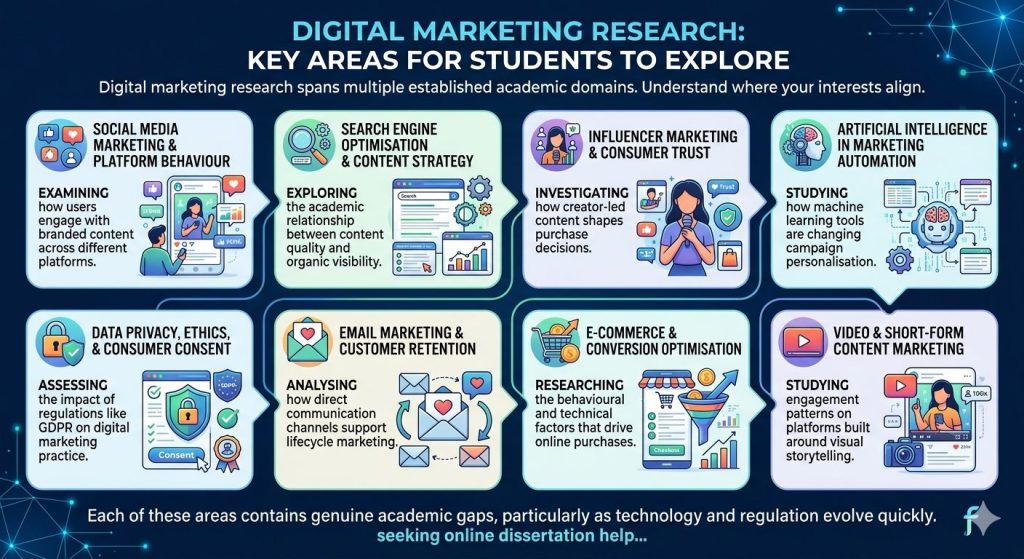
Digital marketing research spans multiple established academic domains. Before selecting a topic, it helps to understand where your interests align within the broader discipline.
- Social media marketing and platform behaviour — examining how users engage with branded content across different platforms
- Search engine optimisation and content strategy — exploring the academic relationship between content quality and organic visibility
- Influencer marketing and consumer trust — investigating how creator-led content shapes purchase decisions
- Artificial intelligence in marketing automation — studying how machine learning tools are changing campaign personalisation
- Data privacy, ethics, and consumer consent — assessing the impact of regulations like GDPR on digital marketing practice
- Email marketing and customer retention — analysing how direct communication channels support lifecycle marketing
- E-commerce and conversion optimisation — researching the behavioural and technical factors that drive online purchases
- Video and short-form content marketing — studying engagement patterns on platforms built around visual storytelling
Each of these areas contains genuine academic gaps, particularly as technology and regulation evolve quickly. If you are struggling to narrow down your focus, seeking online dissertation help from an academic adviser can help you identify which direction aligns best with your skills and your institution’s available supervision expertise.
Five Example Digital Marketing Thesis Topics With Research Aims and Objectives
Understanding how to frame a dissertation topic academically is just as important as choosing the right subject. Below are five structured examples showing how a well-formed topic should read at proposal stage.
Example 1: AI-Driven Personalisation in E-Commerce
Research Aim
To examine how artificial intelligence personalisation tools influence purchase intent among UK online shoppers aged 18 to 35.
Research Objectives
- To identify the primary AI personalisation features used by leading UK e-commerce platforms
- To measure the relationship between personalised product recommendations and conversion rates
- To assess consumer attitudes towards data use in AI-powered shopping experiences
Example 2: Influencer Credibility and Brand Trust on Instagram
Research Aim
To investigate whether the perceived authenticity of micro-influencers generates stronger brand trust than macro-influencer campaigns among Gen Z consumers.
Research Objectives
- To compare engagement metrics between micro and macro-influencer campaigns in the UK fashion sector
- To analyse qualitative responses from Gen Z consumers on influencer authenticity
- To determine which influencer credibility factors most strongly predict purchase intention
Example 3: GDPR Compliance and Email Marketing Effectiveness
Research Aim
To evaluate how GDPR-compliant consent practices have affected open rates and customer engagement in UK B2C email marketing since 2018.
Research Objectives
- To track longitudinal changes in email open and click-through rates post-GDPR
- To analyse how opt-in language and consent framing affect subscriber list quality
- To compare email performance outcomes between GDPR-compliant and non-compliant campaigns
Example 4: TikTok Short-Form Video and Consumer Purchase Behaviour
Research Aim
To explore how short-form video content on TikTok influences impulsive purchase behaviour among young adult consumers in the United Kingdom.
Research Objectives
- To identify content characteristics that predict purchase action following TikTok video exposure
- To examine the role of social proof and virality in driving TikTok-led purchasing decisions
- To assess differences in impulsive buying behaviour between TikTok users and non-users aged 18 to 24
Example 5: Voice Search Optimisation and Consumer Search Intent
Research Aim
To assess how the adoption of voice search technology is reshaping consumer search intent patterns and the implications for SEO strategy in the UK retail sector.
Research Objectives
- To compare keyword intent patterns between voice and text-based search queries in the retail context
- To evaluate how UK retail brands have adapted their SEO strategies in response to voice search growth
- To recommend a framework for voice search optimisation applicable to medium-sized e-commerce businesses
80 Unique Digital Marketing Dissertation Topics for 2026
The following topics are organised under themed subheadings. Each topic is narrow enough to support a focused dissertation, yet broad enough to carry a full research methodology. These topics suit undergraduate, MSc, and PhD researchers depending on depth of investigation chosen.
Social Media Marketing and Consumer Behaviour
- How Instagram’s algorithmic feed changes affect organic reach for small business brands in the UK
- The effect of social media comment moderation on brand perception in the UK fast food sector
- How LinkedIn content strategy influences B2B lead generation among UK technology startups
- The relationship between Pinterest engagement and offline purchase behaviour in UK home décor retail
- How social proof mechanisms on Facebook Marketplace affect consumer trust in second-hand goods
- The impact of disappearing content formats on audience engagement metrics across social platforms
- Social media fatigue and its effect on brand unfollowing behaviour among UK millennials
- How user-generated content campaigns affect brand authenticity perceptions in the UK beauty industry
- The role of Twitter/X engagement in political brand building among UK non-profit organisations
- Comparing audience engagement patterns between organic and paid social media posts in the UK healthcare sector
Influencer Marketing and Creator Economy
- How nano-influencer campaigns perform compared to celebrity endorsements in the UK skincare market
- The effect of disclosed versus undisclosed paid partnerships on consumer trust on Instagram
- How virtual influencers affect brand trust among Gen Z consumers in the UK fashion sector
- The role of influencer audience demographics in determining campaign ROI for UK fitness brands
- How long-term brand-influencer relationships affect follower loyalty compared to one-off collaborations
- Examining influencer churn rates and their implications for sustained digital marketing investment
- The credibility gap between celebrity influencers and subject-matter expert influencers in financial services marketing
- How TikTok creator partnerships influence product trial rates in the UK food and beverage sector
- The effect of influencer controversy on brand association and consumer behaviour post-crisis
- Assessing the academic validity of influencer marketing ROI measurement frameworks used by UK agencies
Artificial Intelligence and Marketing Automation
- How AI-generated product descriptions affect click-through rates compared to human-written copy in UK e-commerce
- The effectiveness of AI chatbots in reducing cart abandonment rates on UK retail websites
- How predictive analytics tools influence campaign budget allocation decisions among UK digital marketers
- Consumer attitudes towards AI-curated content feeds and the perceived loss of editorial control
- The use of sentiment analysis tools in brand reputation monitoring within UK financial services firms
- How programmatic advertising AI affects ad relevance and click-through rates in the UK media sector
- Evaluating the accuracy of AI-powered customer lifetime value prediction models in B2C retail
- How marketing automation platforms affect campaign personalisation outcomes for UK SMEs
- The ethical implications of using generative AI to create emotionally targeted advertising content
- How AI dynamic pricing strategies on e-commerce platforms influence consumer fairness perceptions
Data Privacy, Ethics, and Digital Consent
- How the removal of third-party cookies is reshaping digital advertising strategy in the UK publishing sector
- Consumer awareness of data collection practices and its effect on brand loyalty in UK retail
- How GDPR has changed email marketing consent practices among UK B2B software companies
- The relationship between transparent privacy policies and consumer willingness to share personal data
- How cookie consent banner design influences user opt-in rates on UK news websites
- The effect of high-profile data breaches on long-term consumer engagement with affected brands
- Evaluating ethical frameworks applied to behavioural retargeting in the UK insurance industry
- How first-party data strategies are being implemented by UK retail brands post-cookie era
- The impact of Apple’s App Tracking Transparency framework on mobile advertising performance in the UK
- Consumer understanding of algorithmic profiling and its influence on trust in personalised advertising
Search Engine Optimisation and Content Marketing
- How Google’s Helpful Content Update has affected organic traffic for UK affiliate marketing websites
- The relationship between content depth, dwell time, and search ranking position for UK travel blogs
- How structured data markup affects rich snippet visibility and CTR for UK e-commerce product pages
- Assessing the long-term ROI of content marketing compared to paid search for UK B2B companies
- How topical authority building affects domain rankings within competitive UK legal services niches
- The effect of AI-generated blog content on organic search performance and user engagement signals
- How local SEO strategy affects foot traffic conversion for UK multi-location retail chains
- Voice search query patterns and their implications for long-tail keyword strategy in UK healthcare content
- How video SEO on YouTube influences cross-platform brand awareness for UK educational institutions
- The academic relationship between page experience signals and search ranking volatility in UK news publishing
E-Commerce, Conversion Optimisation, and Customer Experience
- How social commerce features on Instagram Shopping affect purchase completion rates among UK consumers
- The effect of live commerce streaming on impulse buying behaviour in the UK fashion retail sector
- How personalised homepage layouts affect average order value on UK grocery e-commerce platforms
- The relationship between checkout UX design and cart abandonment rates on UK mobile commerce sites
- How product review authenticity signals affect conversion rates on UK comparison shopping platforms
- Assessing the role of augmented reality try-on features in reducing return rates for UK online apparel retailers
- The effect of subscription model marketing messages on customer lifetime value in UK SaaS businesses
- How omnichannel loyalty programme design influences repeat purchase behaviour among UK consumers
- The relationship between personalised post-purchase email sequences and customer retention rates in UK DTC brands
- How scarcity and urgency messaging in digital advertising affects purchase decision-making among UK consumers
Video Marketing, Podcasting, and Audio Strategy
- How YouTube pre-roll ad formats affect brand recall compared to mid-roll placements in the UK market
- The relationship between podcast sponsorship frequency and listener purchase intent in UK personal finance content
- How short-form video content length affects completion rates and brand message retention on TikTok
- Evaluating the effectiveness of branded podcast series as a content marketing tool for UK professional services firms
- How YouTube Shorts affects subscriber growth and channel authority for UK independent content creators
- The role of video testimonials in reducing consumer purchase anxiety on UK direct-to-consumer websites
- How live video Q&A formats on social platforms affect audience trust in UK health and wellness brands
- Assessing whether interactive video advertising increases brand engagement compared to passive formats in UK digital campaigns
- How behind-the-scenes video content affects employer branding perception among graduate job seekers in the UK
- The effect of subtitle inclusion on video engagement and accessibility metrics for UK educational content publishers
Email Marketing, CRM, and Retention Strategy
- How subject line personalisation using first-name tokens affects email open rates in UK retail campaigns
- The relationship between email send frequency and unsubscribe rates among UK subscription box customers
- How behavioural trigger emails affect re-engagement rates among lapsed customers in UK leisure and travel
- Evaluating the effectiveness of progressive profiling in CRM data enrichment for UK B2B marketers
- How email segmentation depth affects campaign revenue per recipient for UK mid-market fashion retailers
- The academic case for integrating SMS and email channels in a unified retention strategy for UK fintech brands
- How welcome email sequence design influences 30-day retention rates for UK SaaS free-trial users
- Assessing consumer receptivity to AI-generated email content versus human-written newsletters in the UK charity sector
- The effect of dark mode email design on open and click-through rates across UK mobile email clients
- How customer win-back campaign messaging strategies affect reactivation rates in UK subscription streaming services
How to Choose a Dissertation Topic for Digital Marketing
Many students ask how to choose a dissertation topic for digital marketing and feel overwhelmed by the sheer number of options. The most effective starting point is to align your topic with three things: your own genuine interest, the availability of data or participants, and the existence of a demonstrable research gap.
A topic you are genuinely curious about will sustain your motivation across months of research. A topic where data is accessible means your methodology will be practically achievable. And a topic with a clear gap in existing literature will satisfy your academic examiners that your work adds real value.
Start by reading five to ten recent journal articles in the area you find most interesting. Note what the authors say is missing from their research. Those gaps are your entry points.
If you are completing a dissertation at MSc level, seek out digital marketing dissertation topics for MSc students that are achievable within a single academic year. Narrow your scope. A study of TikTok marketing in one specific sector is far more manageable than a broad study of all social media marketing across all industries.
For PhD researchers, the interesting digital marketing PhD topics tend to sit at the intersection of disciplines, for example where behavioural economics meets algorithmic decision-making, or where communication theory meets AI-generated content. Cross-disciplinary topics often produce more original contributions.
What Is the Best Topic for Research in Marketing?
There is no single best topic for research in marketing. The best topic is the one that is current, researchable, and personally meaningful to you as a scholar.
That said, in 2026, the most academically rich areas in digital marketing research include the ethical dimensions of AI-powered advertising, the evolving relationship between data privacy law and personalisation strategy, and the impact of short-form video on consumer psychology. These areas are generating substantial academic debate and have significant practical implications for industry, which means your findings will hold both scholarly and professional value.
Students who access online dissertation help at the topic selection stage consistently report higher confidence in their proposal submissions. Having expert guidance during this phase reduces the risk of choosing a topic that is too broad, too narrow, or already exhaustively covered in existing literature.
Conclusion
Digital marketing is a discipline that rewards curious, rigorous, and critically engaged researchers. The 80 topics presented in this guide reflect the genuine complexity of the field and the academic opportunities it holds for students working at every level of study in 2026.
Choosing a focused, well-framed dissertation topic is not just an administrative step. It is an academic act that demonstrates your understanding of the field, your awareness of existing literature, and your ability to position your own contribution meaningfully. Take this stage seriously and invest time in reading widely before you commit to a direction.
Use this guide as a starting point, not a final answer. The strongest dissertations tend to come from students who allow their research questions to evolve through reading, rather than selecting a title from a list and treating it as fixed. Be prepared to refine your focus as you engage more deeply with the literature.
Whatever level you are studying at, approach your dissertation with intellectual honesty, methodological care, and a commitment to producing work that genuinely advances understanding in your chosen area. The field of digital marketing needs thoughtful, evidence-based research, and your dissertation is an opportunity to contribute to that body of knowledge.

A lot of students choose topics that are too broad at first, so the breakdown into specific research areas is actually really practical. I think subjects like short-form video marketing and influencer trust still have plenty of room for fresh case studies and updated analysis.