


Rehabilitation Nursing Dissertation Topics for 2026

Questions Students Are Asking About Rehabilitation Nursing Dissertations
The following questions have been gathered from student forums, academic discussion boards, and higher education communities. They reflect what real students search for when choosing their dissertation topics.
- What are the best rehabilitation nursing dissertation topics for 2026?
- How do I choose a rehabilitation dissertation topic that suits my academic level?
- What research topics in rehabilitation nursing are currently relevant and fundable?
- Can I find a list of rehabilitation nursing dissertation topics that are original and not overdone?
- What topics in rehabilitation nursing for my MSc dissertation will impress my supervisor?
- How do I structure a research aim and objectives for a rehabilitation nursing topic?
- Is there a way to get a personalised list of rehabilitation nursing dissertation topics?
If you have asked yourself any of these questions, this post is designed to answer them clearly and practically.
Why Choosing the Right Dissertation Topic in Rehabilitation Nursing Matters
Rehabilitation nursing sits at the intersection of clinical practice, patient-centred care, and long-term recovery science. Choosing the right dissertation topic is not simply a procedural step. It shapes the entire trajectory of your research experience, the depth of your literature review, and the academic contribution you make.
Students often underestimate how narrowly focused a strong dissertation topic must be. A topic that is too broad leads to unfocused research, while a topic that is too vague fails to generate meaningful findings. Your dissertation is an opportunity to contribute something specific and useful to the field of rehabilitation nursing, and that begins with a deliberate and informed topic selection.
Whether you are at undergraduate level exploring foundational concepts, or you are looking for topics in rehabilitation nursing for your MSc dissertation, the quality of your question shapes everything that follows. Academic supervisors look for evidence that students understand the current landscape of the field and can identify a genuine gap in the existing literature.
Download Rehabilitation Nursing Dissertation Topics PDF
Many students prefer to have a curated reference they can return to throughout the topic-selection process. A downloadable PDF containing a personalised list of rehabilitation nursing dissertation topics, compiled by academic subject specialists, is available to students who complete a short information form. The list is tailored to your academic level, area of interest, and current research priorities in the field. This resource is particularly useful if you are still exploring ideas or need structured guidance before consulting your supervisor.
Key Research Areas in Reabilitation Nursing You Can Explore
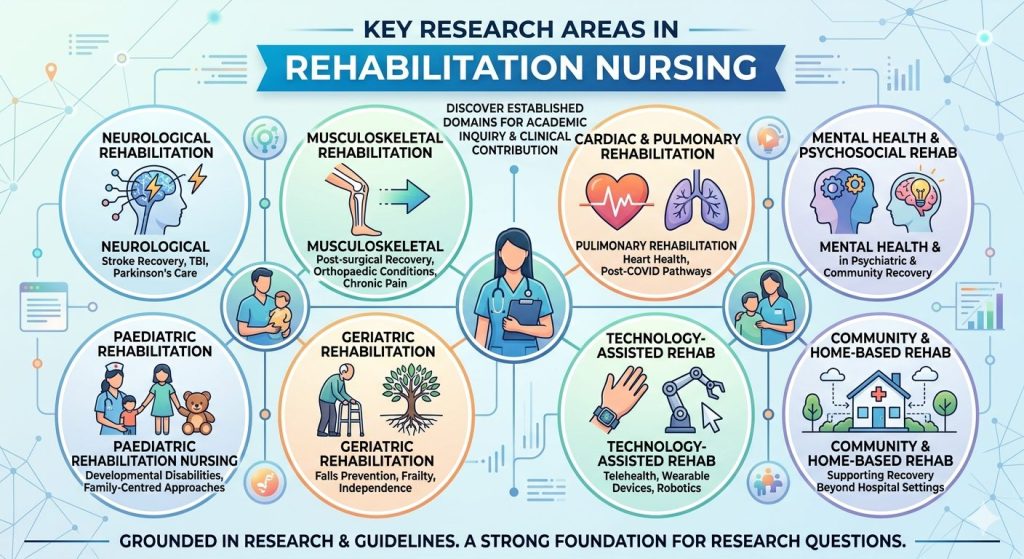
Before selecting a topic, it helps to understand the established domains within rehabilitation nursing. These are the areas where academic inquiry is active, where clinical need is evident, and where your dissertation can make a genuine contribution.
- Neurological rehabilitation, including stroke recovery, traumatic brain injury, and Parkinson’s disease nursing care
- Musculoskeletal rehabilitation, covering post-surgical recovery, orthopaedic conditions, and chronic pain management
- Cardiac and pulmonary rehabilitation, with growing interest in post-COVID recovery pathways
- Mental health and psychosocial rehabilitation, integrating nursing roles in psychiatric and community-based recovery
- Paediatric rehabilitation nursing, addressing developmental disabilities and family-centred approaches
- Geriatric rehabilitation, focused on falls prevention, frailty, and independence among older adults
- Technology-assisted rehabilitation, including telehealth, wearable devices, and robotics in nursing practice
- Community and home-based rehabilitation, exploring how nurses support recovery beyond hospital settings
These areas are grounded in published academic research and clinical guidelines. They provide a strong foundation for any student seeking online dissertation help to identify a research-worthy question.
Five Example Dissertation Topics With Aims and Objectives
Understanding how a dissertation topic translates into a formal academic structure is essential before you begin. Below are five examples across different subfields of rehabilitation nursing. Each includes a research aim and two to three clearly defined objectives.
Example 1: Stroke Rehabilitation Nursing
Topic: The role of goal-setting in nurse-led stroke rehabilitation: a qualitative exploration of patient experiences in NHS acute settings.
Aim: To examine how collaborative goal-setting between rehabilitation nurses and stroke patients influences motivation and recovery outcomes.
Objectives:
- To explore patient perceptions of goal-setting conversations during stroke rehabilitation
- To identify the facilitators and barriers experienced by rehabilitation nurses when implementing goal-setting frameworks
- To analyse how institutional factors within NHS settings shape goal-setting practice
Example 2: Cardiac Rehabilitation Nursing
Topic: Nurses’ contribution to cardiac rehabilitation adherence in post-myocardial infarction patients: a systematic review.
Aim: To evaluate the evidence on how rehabilitation nurses improve patient adherence to cardiac rehabilitation programmes following a heart attack.
Objectives:
- To systematically identify and appraise existing literature on nursing interventions in cardiac rehabilitation adherence
- To examine which nurse-led approaches demonstrate the strongest evidence for improving adherence
- To highlight gaps in current research that warrant further investigation
Example 3: Mental Health Rehabilitation Nursing
Topic: Recovery-oriented nursing practice in community mental health rehabilitation: perceptions of service users and nursing staff.
Aim: To investigate how recovery-oriented approaches are understood and applied by rehabilitation nurses in community mental health settings.
Objectives:
- To explore service user perspectives on what constitutes meaningful recovery support from nurses
- To assess nursing staff understanding of recovery-oriented frameworks in practice
- To compare staff and service user accounts to identify alignment and disconnect
Example 4: Geriatric Rehabilitation Nursing
Topic: The effectiveness of nurse-led exercise programmes in reducing falls risk among hospitalised older adults undergoing rehabilitation.
Aim: To assess the clinical impact of nurse-initiated exercise interventions on falls incidence in elderly patients receiving inpatient rehabilitation.
Objectives:
- To review current evidence on nurse-delivered exercise protocols for falls prevention in older adults
- To evaluate the feasibility of implementing such programmes in UK rehabilitation wards
- To identify outcome measures most commonly used to assess falls risk in this population
Example 5: Technology in Rehabilitation Nursing
Topic: Nurses’ confidence and competence in using telehealth tools within post-operative rehabilitation: a mixed-methods study.
Aim: To understand how rehabilitation nurses perceive and use telehealth technologies in supporting patients during the post-operative recovery phase.
Objectives:
- To measure self-reported confidence levels among rehabilitation nurses using telehealth platforms
- To identify training needs and institutional barriers related to telehealth adoption
- To explore patient satisfaction with nurse-delivered telehealth support during rehabilitation
80 Rehabilitation Nursing Dissertation Topics for 2026
The following topics are organised by subfield. Each one is original, narrowly focused, and suitable for undergraduate, master’s, or doctoral-level research in 2026. Students looking for a comprehensive list of rehabilitation nursing dissertation topics will find this section particularly useful.
Stroke and Neurological Rehabilitation Nursing
- Nurse-led early mobilisation protocols and their impact on functional recovery in acute stroke patients: a retrospective cohort analysis
- Exploring rehabilitation nurses’ knowledge of dysphagia management in post-stroke patients in community hospitals
- Patient experiences of nurse-facilitated aphasia support during inpatient stroke rehabilitation: a phenomenological study
- The contribution of rehabilitation nursing to reducing hospital readmission rates in stroke survivors discharged to community care
- How rehabilitation nurses assess and manage fatigue in patients recovering from ischaemic stroke: a qualitative inquiry
- Exploring the use of standardised nursing assessments in predicting functional independence at discharge from stroke rehabilitation units
- Family caregiver education delivered by rehabilitation nurses following stroke: a scoping review of current practices
- Nurse perceptions of person-centred goal planning in neurological rehabilitation wards across NHS Trusts
- Exploring nursing-specific barriers to implementing evidence-based continence care during stroke rehabilitation
- The role of rehabilitation nurses in delivering psychological support to patients with post-stroke depression: staff and patient perspectives
Musculoskeletal and Orthopaedic Rehabilitation Nursing
- Nursing assessment practices for chronic pain in patients undergoing hip replacement rehabilitation: a qualitative study
- The impact of nurse-led pre-operative education on post-operative rehabilitation engagement following total knee arthroplasty
- Rehabilitation nurses’ knowledge of osteoporosis management in patients recovering from fragility fractures: a survey-based study
- Patient-reported outcomes and nurse-delivered education following spinal cord injury rehabilitation in tertiary centres
- Exploring the nursing role in managing complex wound care during musculoskeletal rehabilitation: a case study approach
- How rehabilitation nursing practice addresses the psychosocial needs of patients with chronic low back pain
- Nurse-led walking programmes in post-amputation rehabilitation: a systematic review of evidence from high-income countries
- The experience of older adults with multiple joint conditions receiving nurse-led rehabilitation in residential care settings
- Exploring how rehabilitation nurses balance clinical and administrative responsibilities on busy orthopaedic wards
- Nursing staff perceptions of shared decision-making in the discharge planning process for patients with complex musculoskeletal injuries
Cardiac and Pulmonary Rehabilitation Nursing
- Nurses’ role in supporting behaviour change in patients enrolled in Phase III cardiac rehabilitation programmes
- Patient perceptions of nurse-led group education sessions in pulmonary rehabilitation: a qualitative exploration
- The effectiveness of nurse-initiated smoking cessation support within cardiac rehabilitation pathways: a scoping review
- Rehabilitation nursing approaches to managing breathlessness in patients with COPD enrolled in community pulmonary rehabilitation
- Long COVID rehabilitation nursing: exploring how nurses address fatigue and breathlessness in recovery clinics
- Nurse-delivered dietary counselling within cardiac rehabilitation: a systematic review of evidence for improving lipid profiles
- Exploring the mental health dimension of cardiac rehabilitation nursing: patient anxiety and nurse response
- The impact of pandemic-era telehealth adaptations on nurse-patient relationships in cardiac rehabilitation services
- Exploring nursing documentation practices and their adequacy in capturing rehabilitation progress in pulmonary patients
- Barriers to female patients’ engagement in cardiac rehabilitation and the nursing role in addressing gender-specific factors
Mental Health and Psychosocial Rehabilitation Nursing
- How rehabilitation nurses in secure mental health settings support patients in developing independent living skills
- Exploring the therapeutic relationship between mental health rehabilitation nurses and patients with treatment-resistant conditions
- Rehabilitation nursing in dual diagnosis services: challenges and strategies in supporting patients with co-occurring mental health and substance use disorders
- The impact of trauma-informed nursing practice on patient outcomes in community mental health rehabilitation programmes
- Nurse-led social skills training in psychiatric rehabilitation wards: a mixed-methods evaluation
- Perceptions of autonomy and control among patients receiving long-term mental health rehabilitation nursing care
- Exploring how rehabilitation nurses document and communicate psychosocial recovery goals across multidisciplinary teams
- The role of rehabilitation nurses in preventing relapse following discharge from acute mental health inpatient care
- Nursing staff experiences of moral distress in long-stay psychiatric rehabilitation settings
- How mental health rehabilitation nurses support the transition of patients from hospital to supported community living
Geriatric and Older Adult Rehabilitation Nursing
- Nurse-facilitated reminiscence therapy as a component of cognitive rehabilitation in older adults with mild dementia
- The nursing role in managing polypharmacy during inpatient rehabilitation of frail older adults: a cross-sectional study
- Older patients’ experiences of dignity and respect during nurse-delivered rehabilitation in acute hospital settings
- Exploring rehabilitation nurses’ knowledge and application of frailty screening tools in elderly inpatient populations
- The impact of continuity of nursing care on rehabilitation engagement and outcomes in older adults with hip fractures
- Nurse-led nutritional assessment and intervention in rehabilitation wards for older adults: a quality improvement evaluation
- Patient and family perspectives on discharge planning processes led by rehabilitation nurses in geriatric care units
- Exploring how rehabilitation nursing practice supports older adults living with chronic pain in residential care
- The role of nurse education in reducing catheter-associated urinary tract infections during prolonged rehabilitation in elderly patients
- How rehabilitation nurses in care home settings manage residents’ post-hospitalisation recovery: a qualitative inquiry
Paediatric Rehabilitation Nursing
- Family-centred nursing care in paediatric rehabilitation: parental experiences in specialist disability units
- The nursing role in supporting children with acquired brain injuries during school reintegration from rehabilitation settings
- Exploring paediatric rehabilitation nurses’ confidence in communicating with non-verbal children using augmentative communication tools
- Nurse-delivered pain management strategies in paediatric musculoskeletal rehabilitation: a systematic review
- How rehabilitation nursing teams address transition planning for adolescents with complex physical disabilities moving to adult services
- Parental perspectives on the emotional support provided by nursing staff during inpatient paediatric rehabilitation
- The role of play in nurse-facilitated rehabilitation for children recovering from orthopaedic surgery
- Exploring nursing documentation of developmental goals in paediatric neurological rehabilitation settings
- Nurse knowledge of safeguarding procedures in paediatric rehabilitation units: a survey-based assessment
- Exploring the challenges rehabilitation nurses face when managing feeding difficulties in children with cerebral palsy
Technology and Innovation in Rehabilitation Nursing
- Rehabilitation nurses’ attitudes towards using artificial intelligence tools to monitor patient progress in post-surgical recovery
- Exploring the implementation of wearable activity trackers in nurse-led rehabilitation programmes: barriers and facilitators
- Patient satisfaction with nurse-delivered virtual rehabilitation consultations following orthopaedic procedures: a survey study
- The readiness of rehabilitation nursing staff to adopt robotic-assisted mobility devices in clinical practice
- Nurse perceptions of electronic patient record systems and their impact on rehabilitation care planning accuracy
- Exploring how digital health literacy among rehabilitation nurses influences the uptake of telehealth in rural settings
- The use of virtual reality in rehabilitation nursing for pain management: a scoping review of clinical applications
- Nurse-led remote monitoring of cardiac rehabilitation patients using mHealth applications: a systematic review
- Exploring the data privacy concerns of rehabilitation nursing staff in the context of digitised patient monitoring
- How rehabilitation nurses in community settings are adapting to hybrid care models that combine in-person and digital contact
Community and Home-Based Rehabilitation Nursing
- District nurses’ role in supporting stroke survivors’ independence following early supported discharge from hospital
- Exploring the experiences of rehabilitation nurses delivering home-based palliative rehabilitation to patients with advanced cancer
- Community rehabilitation nurses’ perceptions of their role identity within multidisciplinary care teams
- The effectiveness of nurse-led self-management education programmes for patients with COPD in the community: a systematic review
- Exploring how community rehabilitation nurses assess and manage depression in patients with chronic long-term conditions
- Carer burden and nursing support strategies in the context of home-based neurological rehabilitation: a qualitative exploration
- Nurse-led case management models in intermediate care rehabilitation: patient outcomes and staff satisfaction
- Exploring how rehabilitation nurses in primary care address health inequalities in underserved urban populations
- The role of rehabilitation nursing in facilitating medication adherence among community-dwelling patients following joint replacement
- How community rehabilitation nurses support patients with learning disabilities to achieve meaningful daily living goals
How to Choose the Right Rehabilitation Dissertation Topic for Your Level
Not every topic listed above will suit every academic level. Choosing well requires you to consider your resources, timeline, and the depth of inquiry expected at your stage of study.
Undergraduate students should focus on topics where existing literature is accessible and where a systematic or scoping review is a viable methodology. Topics that require large clinical samples or longitudinal data collection are likely too ambitious for a final-year undergraduate project.
Master’s students looking for the right rehabilitation dissertation topic for nursing at MSc level should consider topics that allow for primary data collection, such as interviews, questionnaires, or mixed-methods designs. Your topic should reflect an emerging area of clinical need and demonstrate your ability to critically engage with current evidence.
PhD researchers should identify topics where a genuine gap exists in the academic literature and where their contribution would advance nursing practice, policy, or theory. Topics involving multi-site data collection, longitudinal study designs, or the development of new assessment frameworks are particularly appropriate at doctoral level.
If you are still uncertain, seeking online dissertation help from a qualified academic professional can clarify your thinking and help you avoid common early-stage mistakes.
Conclusion
Selecting the right dissertation topic in rehabilitation nursing is one of the most consequential academic decisions you will make. The field is rich with clinical complexity, evolving practice, and genuine research need. Whether your interest lies in stroke recovery, geriatric care, mental health rehabilitation, or digital innovation in nursing practice, there is a researchable question waiting to be explored.
The 80 research topics in rehabilitation nursing presented in this post are designed to inspire rather than prescribe. Use them as a starting point, adapt them to your clinical experience, and discuss them with your academic supervisor. The best dissertation topics are those that genuinely interest the researcher, because sustained intellectual curiosity is what carries a student through the months of reading, writing, and revision that a dissertation demands.
Approach your topic selection with patience, rigour, and confidence. The field of rehabilitation nursing needs well-designed, evidence-informed research, and your dissertation has the potential to contribute to that body of knowledge in a meaningful way.
