


School Nursing Dissertation Topics for 2026

What Students Are Asking About School Nursing Dissertations
The questions below have been gathered from student forums, academic discussion boards, and university support platforms. They reflect the real concerns students face when they begin their dissertation journey in school nursing.
- What are some good research topics in school nursing for 2026?
- How do I find dissertation topics in school nursing that are relevant and original?
- Which school nursing dissertation topics are suitable for undergraduate students?
- What makes a school nursing topic strong enough for a master’s or PhD thesis?
- Are there any underexplored areas in school nursing worth researching?
- How do I narrow down my school nursing research idea into a focused dissertation topic?
If you have asked any of these questions, this post is written for you.
Why Choosing the Right School Nursing Dissertation Topic Matters
Choosing a dissertation topic is one of the most important academic decisions you will make. In the field of school nursing, this decision carries particular weight. School nurses work at the intersection of public health, child development, safeguarding, and educational inclusion. A well-chosen topic allows you to contribute meaningfully to this field while demonstrating your academic capability.
Many students feel overwhelmed at this stage, and understandably so. The range of issues school nurses encounter, from chronic illness management to mental health first response, is broad. Without proper direction, students often settle for topics that are either too vague or already heavily researched. This post is designed to help you avoid that mistake.
If you are searching for online dissertation help, understanding how to structure a researchable and academically relevant topic is the best place to start. A focused topic makes your literature review manageable, your methodology clearer, and your overall contribution more meaningful.
The best dissertation topics in school nursing for 2026 will reflect the evolving demands placed on school health services, including post-pandemic recovery, digital health integration, neurodiversity support, and health inequalities in educational settings.
Download School Nursing Dissertation Topics PDF
Students who want a personalised list of school nursing dissertation topics can access a curated PDF prepared by academic experts. This resource is designed to save you time and help you find a topic that matches your academic level and research interests. After completing a short form with your details and area of focus, the PDF is sent directly to you. It includes topics tailored to undergraduate, master’s, and PhD level, covering a wide range of subfields in school nursing.
Key Research Areas in School Nursing
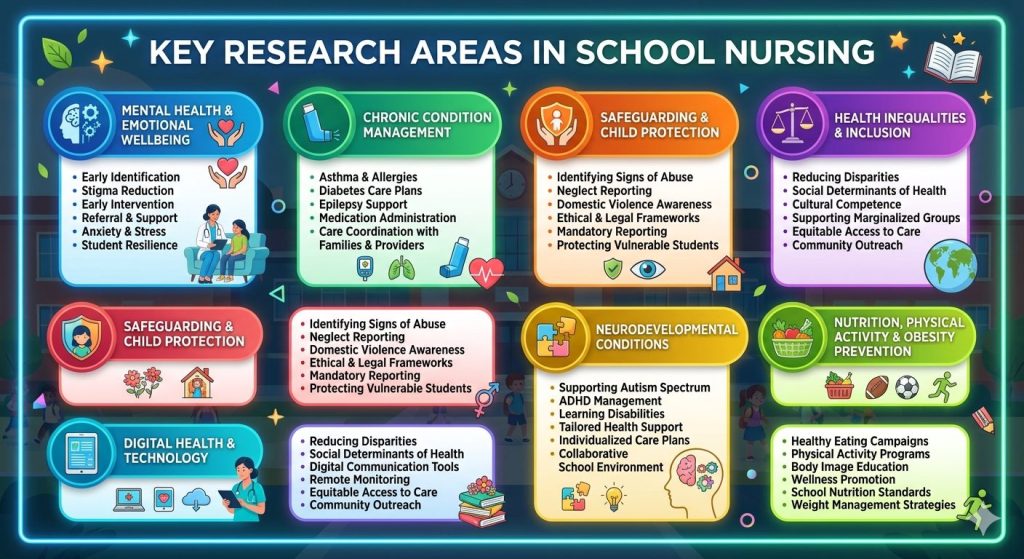
Before selecting a topic, it helps to understand the main research areas within school nursing. These domains are well established in academic literature and continue to generate important research questions.
Mental Health and Emotional Wellbeing School nurses are increasingly expected to identify, refer, and support students with mental health challenges. Research in this area focuses on early intervention, stigma reduction, and the nurse’s scope within the school environment.
Chronic Condition Management Many children in schools live with conditions such as asthma, diabetes, epilepsy, and anaphylaxis. Research examines how school nurses manage these conditions and coordinate with families and healthcare providers.
Safeguarding and Child Protection School nurses play a frontline role in identifying signs of neglect, abuse, and domestic violence. Research in this area is ethically complex and practically significant.
Health Inequalities and Inclusion Socioeconomic background, ethnicity, disability, and geography all affect children’s health outcomes. School nursing research increasingly examines how nurses can address and reduce these disparities.
Digital Health and Technology Telehealth, electronic health records, and digital communication tools are transforming school health services. Research explores both the benefits and the risks of this shift.
Sexual and Reproductive Health Education School nurses contribute to RSE delivery. Research here examines effectiveness, cultural sensitivity, and the nurse’s role relative to teaching staff.
Neurodevelopmental Conditions Children with ADHD, autism spectrum conditions, and learning disabilities require tailored health support. School nurses often bridge the gap between educational and clinical care.
Nutrition, Physical Activity, and Obesity Prevention Childhood obesity remains a public health priority. School nurses engage in health promotion work related to diet, physical activity, and body image.
Five Example Dissertation Topics with Research Aims and Objectives
The following examples are intended to show you how a well-structured dissertation topic is built. Each example includes a research aim and two to three objectives to guide your thinking.
Example 1: Mental Health Identification in Secondary Schools
Topic: The role of school nurses in the early identification of anxiety disorders among secondary school students in England.
Research Aim: To examine how school nurses identify, assess, and refer students showing signs of anxiety disorder in secondary school settings.
Objectives:
- To explore the tools and frameworks school nurses use to identify anxiety in adolescent students
- To evaluate the barriers school nurses face when referring students to CAMHS or alternative support services
- To assess how school nurses collaborate with teaching staff and parents in the identification process
Example 2: Asthma Management in Primary Schools
Topic: School nurse involvement in asthma management plans for primary school children: a qualitative study of parental and nurse perspectives.
Research Aim: To understand how school nurses contribute to the development and monitoring of asthma management plans in primary school settings.
Objectives:
- To examine the responsibilities school nurses hold in relation to individual asthma care plans
- To explore how parents and school nurses communicate about asthma management
- To identify gaps in current practice and areas for improvement in asthma care coordination
Example 3: Health Inequalities and School Nursing
Topic: How do school nurses address health inequalities among pupils from low-income families in urban primary schools?
Research Aim: To investigate the strategies school nurses use to identify and respond to health inequalities among children from socioeconomically disadvantaged backgrounds.
Objectives:
- To identify the health needs most commonly observed by school nurses in low-income school populations
- To explore the interventions school nurses implement to reduce health disparities in primary school settings
- To examine how school nursing practice aligns with national policies on child health equity
Example 4: Digital Health in School Nursing Practice
Topic: Exploring school nurses’ experiences of using telehealth tools for student consultations in post-pandemic UK secondary schools.
Research Aim: To assess how school nurses in the United Kingdom have adopted and adapted telehealth consultations following the COVID-19 pandemic.
Objectives:
- To document the range of digital health tools currently used by school nurses in secondary school settings
- To explore school nurses’ perceptions of telehealth effectiveness and limitations
- To identify professional development needs related to digital health among school nursing practitioners
Example 5: Neurodiversity and School Health Support
Topic: The school nurse’s role in supporting pupils with autism spectrum conditions: perspectives from nurses, parents, and educational staff.
Research Aim: To explore how school nurses support the health and wellbeing needs of autistic pupils in mainstream educational settings.
Objectives:
- To describe the health-related challenges faced by autistic pupils in mainstream schools
- To examine how school nurses coordinate care between education, health, and family systems
- To identify what additional training or resources school nurses require to effectively support autistic students
80 School Nursing Dissertation Topics for 2026
The following topics are organised by subfield. Each is suitable for undergraduate, master’s, or PhD level research proposals, depending on the depth and methodology applied.
Mental Health and Emotional Wellbeing in Schools
- School nurses’ experiences of managing crisis situations involving student self-harm in secondary schools
- The effectiveness of school nurse-led stress management workshops for Year 10 and Year 11 students
- Barriers to school nurses identifying depression in male adolescents: a qualitative exploration
- How school nurses respond to students disclosing suicidal ideation: a practice audit
- The role of school nurses in supporting pupils transitioning from CAMHS back into mainstream schooling
- School nurse perceptions of the Mental Health Support Teams programme in England
- Exploring emotional health screening tools used by school nurses at primary-secondary transition points
- The relationship between school nurses and school counsellors: boundaries, referrals, and collaboration
- How school nurses address anxiety related to academic pressure and examination performance
- The impact of school nurse mental health training on student referral outcomes in urban secondary schools
Chronic Illness and Long-Term Conditions
- School nurses’ knowledge and confidence in managing anaphylaxis in pupils with severe food allergies
- Supporting pupils with Type 1 diabetes in full-time educational settings: the school nurse’s perspective
- How school nurses facilitate epilepsy care plans and emergency medication administration in schools
- The experiences of school nurses managing pupils with sickle cell disease in inclusive classroom settings
- The role of school nurses in supporting children with eczema and its effect on school attendance
- School nurse involvement in supporting students with juvenile idiopathic arthritis: a case study approach
- How school nurses collaborate with community paediatric teams to support children with complex health needs
- School nurses’ experiences of managing pupils using insulin pumps or continuous glucose monitoring devices
- The impact of poorly controlled asthma on educational attainment and the school nurse’s role in prevention
- How school nursing practice aligns with the Every Child Matters framework in chronic illness management
Safeguarding and Child Protection
- School nurses’ confidence in recognising indicators of emotional abuse among primary school pupils
- The role of school nurses in identifying and reporting female genital mutilation: a practice gap analysis
- How school nurses navigate professional uncertainty when suspected neglect does not meet referral thresholds
- School nurses’ experiences of working with children in temporary or emergency accommodation
- The training needs of school nurses in identifying signs of child sexual exploitation
- How school nurses manage disclosure situations without compromising the therapeutic relationship
- School nurse involvement in multi-agency safeguarding hubs: roles, challenges, and outcomes
- The impact of domestic violence on children’s health and the school nurse’s safeguarding response
- How school nurses support looked-after children with complex health and social needs
- Safeguarding documentation practices among school nurses: a review of consistency and accuracy
Health Inequalities and Social Determinants of Health
- How school nurses address food insecurity and its health consequences among pupils in deprived areas
- The role of school nurses in improving health outcomes for Gypsy, Roma, and Traveller children
- School nurse interventions to support children with no recourse to public funds accessing health services
- How socioeconomic deprivation influences the scope and workload of school nurses in urban settings
- The contribution of school nurses to reducing oral health inequalities among children in low-income communities
- School nurse strategies for engaging families who distrust healthcare services in marginalised communities
- How school nursing practice responds to the health needs of newly arrived asylum-seeking children
- The impact of poverty on children’s sleep health and the school nurse’s awareness and response
- Health literacy among parents of school-age children and the school nurse’s role in improving it
- Racial and ethnic disparities in school nurse referral rates: a critical analysis
Sexual and Reproductive Health
- How school nurses contribute to relationships and sex education delivery in secondary schools in England
- School nurse perspectives on discussing contraception with students under the age of 16
- The role of school nurses in supporting pregnant pupils to remain in full-time education
- School nurses’ experiences of addressing sexually transmitted infections among adolescent pupils
- How school nurses support LGBTQ+ students in accessing inclusive sexual health information
- The effectiveness of school nurse-led sexual health drop-in sessions in reducing teenage pregnancy rates
- School nurses’ knowledge and confidence in discussing consent and healthy relationships with students
- How school nurses manage parental objections to reproductive health conversations with their children
- The role of school nurses in early identification of signs of sexual coercion among adolescent students
- School nurse practice in supporting students with gender dysphoria accessing appropriate health services
Neurodevelopmental Conditions and Special Educational Needs
- School nurses’ understanding of sensory processing difficulties and their impact on classroom participation
- The role of school nurses in supporting pupils awaiting ADHD diagnosis during the assessment process
- How school nurses contribute to education, health and care plans for pupils with complex needs
- School nurse experiences of supporting students with acquired brain injury reintegrating into school
- The involvement of school nurses in transitions planning for pupils with special educational needs moving into adulthood
- How school nurses communicate health information to pupils with intellectual disabilities in accessible formats
- School nurse training needs in identifying and supporting pupils with foetal alcohol spectrum disorder
- The role of school nurses in recognising and responding to pathological demand avoidance in school settings
- School nurses’ experiences of working within specialist provisions for pupils with severe learning difficulties
- The impact of school nurses on reducing school exclusions related to unmet health and neurodevelopmental needs
Nutrition, Physical Activity, and Obesity
- How school nurses approach conversations about weight with pupils and families without causing harm
- The role of school nurses in supporting pupils with eating disorders to continue school attendance
- School nurse perceptions of the effectiveness of the National Child Measurement Programme
- How school nurses use motivational interviewing to support healthier lifestyle choices among adolescents
- The relationship between food poverty and childhood obesity and how school nurses navigate this complexity
- School nurse involvement in school food environment policies: influence, barriers, and outcomes
- How school nurses identify and respond to the health impacts of ultra-processed food consumption in school-age children
- The experiences of school nurses supporting pupils with coeliac disease managing dietary needs at school
- Physical activity promotion by school nurses: strategies, barriers, and student engagement
- How school nurses support children with orthopaedic or mobility conditions to participate in physical education
Digital Health, Workforce, and Practice Development
- School nurses’ experiences of using electronic patient record systems and their impact on care quality
- How social media influences adolescent health behaviour and the school nurse’s role in digital health literacy
- The professional identity of school nurses within multi-disciplinary educational and health teams
- Moral distress among school nurses: sources, responses, and implications for workforce retention
- The impact of caseload size on school nurse wellbeing and quality of care in English schools
- How school nursing services are commissioned and the implications for practice variation across local authorities
- Newly qualified school nurses’ experiences of transitioning from acute care to community school nursing
- The role of school nurses in delivering health education via digital platforms following the pandemic
- School nurses’ perceptions of their professional autonomy and decision-making authority in school settings
- How continuing professional development opportunities influence school nurse confidence and clinical practice
Conclusion
School nursing is a dynamic, evolving, and deeply important professional field. The dissertation topics presented in this post reflect the real issues school nurses face in 2026, ranging from mental health support and safeguarding to health inequalities and digital practice.
Choosing a focused, well-structured dissertation topic is not just a procedural step. It shapes your entire research journey and determines the quality of your academic contribution. The best school nursing dissertation topics for 2026 are those that are narrow enough to be researchable, grounded in current professional challenges, and aligned with your own academic interests and capabilities.
Whether you are at undergraduate, master’s, or doctoral level, this list of dissertation topics in school nursing is designed to help you begin with confidence. Take your time reviewing each subfield, identify where your interest is strongest, and then narrow your focus using the example topics and objectives provided throughout this post.
Academic integrity, careful methodology, and original thinking will define the success of your dissertation more than any single topic choice. Approach your research with curiosity, rigour, and a genuine commitment to improving outcomes for children and young people in educational settings.
If you need further support identifying the right topic, specialist dissertation help is available from academic professionals who understand the unique demands of school nursing research at every level.
