


Tourism Dissertation Topics for 2026

Questions Students Are Asking About Tourism Dissertation Topics
These are some of the most common questions gathered from student forums and academic discussion platforms. If you have been searching for guidance, you are not alone.
- What are the best tourism dissertation topics for 2026?
- How do I choose a tourism research topic that is original and academically strong?
- What tourism dissertation topics are suitable for an undergraduate thesis?
- Can I get tourism dissertation topics for an MSc or PhD-level proposal?
- What are the trending research areas in tourism right now?
- How narrow should my tourism research topic be?
- Are there tourism research topics ideas for college students that are manageable within a limited timeframe?
These questions reflect real concerns. This post is designed to answer all of them clearly and practically.
Why Choosing the Right Tourism Dissertation Topic Matters
Tourism is one of the most dynamic and globally significant industries in the world. It sits at the intersection of economics, culture, sustainability, public policy, and human behaviour. When you choose a dissertation topic in this field, you are not simply completing an academic requirement. You are contributing to a real body of knowledge that shapes travel policy, destination management, and hospitality strategy.
Choosing the wrong topic, one that is too broad, too vague, or already over-researched, can weaken your entire dissertation before you write a single chapter. A well-chosen topic, on the other hand, gives you focus, academic credibility, and a genuine chance to make a contribution to the field.
For students who feel stuck or overwhelmed, accessing online dissertation help early in the process can make a significant difference. Guidance from experienced academic professionals helps you frame your research question with precision and confidence.
Download Tourism Dissertation Topics PDF
Students often find it helpful to have a curated list of dissertation topics in one place. A downloadable PDF containing a personalised selection of tourism research topics, reviewed and compiled by academic subject experts, is available for students at all levels.
After completing a short form, you will receive a tailored PDF that reflects your academic level, research interests, and degree programme. This resource is particularly useful if you are unsure where to begin or want expert input before committing to a topic.
Key Research Areas in Tourism That Students Can Explore
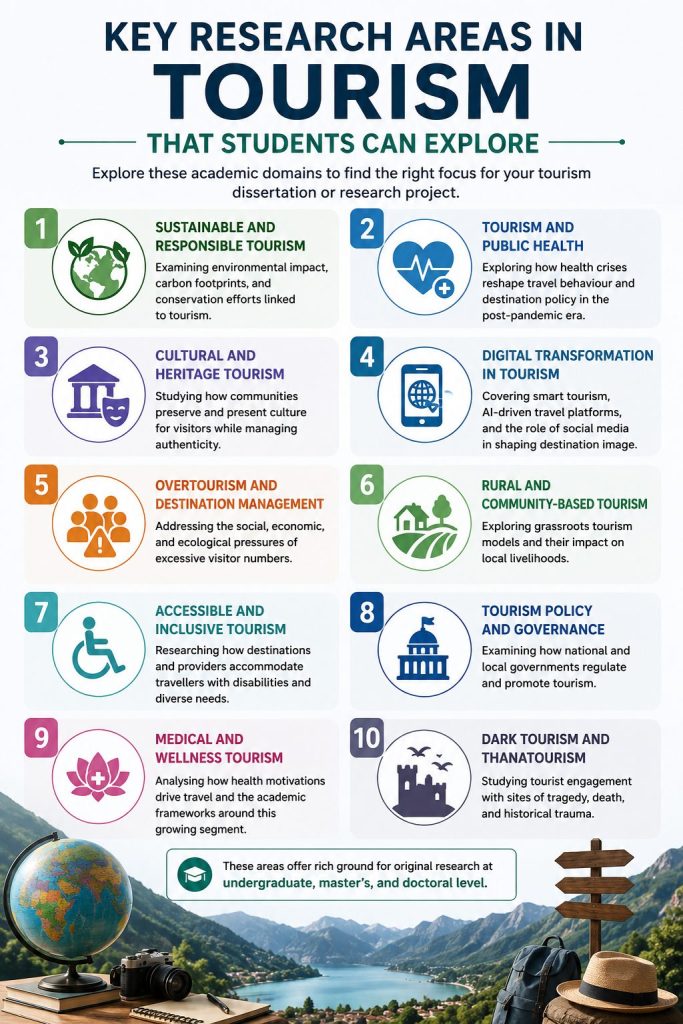
Before selecting your topic, it helps to understand the main academic domains within tourism studies. These areas are grounded in established academic literature and current research directions.
- Sustainable and responsible tourism — examining environmental impact, carbon footprints, and conservation efforts linked to tourism
- Tourism and public health — particularly relevant in the post-pandemic era, exploring how health crises reshape travel behaviour and destination policy
- Cultural and heritage tourism — studying how communities preserve and present culture for visitors while managing authenticity
- Digital transformation in tourism — covering smart tourism, AI-driven travel platforms, and the role of social media in shaping destination image
- Overtourism and destination management — addressing the social, economic, and ecological pressures of excessive visitor numbers
- Rural and community-based tourism — exploring grassroots tourism models and their impact on local livelihoods
- Accessible and inclusive tourism — researching how destinations and providers accommodate travellers with disabilities and diverse needs
- Tourism policy and governance — examining how national and local governments regulate and promote tourism
- Medical and wellness tourism — analysing how health motivations drive travel and the academic frameworks around this growing segment
- Dark tourism and thanatourism — studying tourist engagement with sites of tragedy, death, and historical trauma
These areas offer rich ground for original research at undergraduate, master’s, and doctoral level.
Five Example Dissertation Topics With Research Aims and Objectives
The following examples are designed to show you how a strong dissertation topic is structured. Each includes a research aim and two to three research objectives
Example 1: Sustainable Tourism in Coastal Destinations
Topic: Evaluating the effectiveness of sustainable tourism policies in managing environmental impact at coastal destinations in the United Kingdom.
Research Aim: To assess how current sustainability frameworks influence environmental outcomes at UK coastal tourist sites.
Research Objectives:
- To identify the sustainability policies in place at three major UK coastal destinations
- To evaluate tourist awareness and compliance with these policies
- To recommend improvements based on gaps identified in the literature and fieldwork
Example 2: Social Media and Destination Image
Topic: The role of Instagram in shaping destination image perception among Generation Z travellers in 2026.
Research Aim: To examine how user-generated content on Instagram influences how young travellers perceive and choose destinations.
Research Objectives:
- To analyse content patterns related to travel destinations posted by Generation Z users
- To measure the relationship between social media exposure and destination selection decisions
- To determine whether algorithmically promoted content distorts authentic destination representation
Example 3: Overtourism in European Heritage Sites
Topic: Exploring resident attitudes towards overtourism and its management at UNESCO World Heritage Sites in Southern Europe.
Research Aim: To understand how local communities experience and respond to overtourism at heavily visited heritage destinations.
Research Objectives:
- To document resident perceptions of overcrowding and its social consequences
- To evaluate management strategies currently used to redistribute tourist flows
- To identify community-led solutions with potential for policy adoption
Example 4: Wellness Tourism and Post-Pandemic Recovery
Topic: Examining the growth of wellness tourism as a recovery strategy for destinations affected by the COVID-19 pandemic.
Research Aim: To explore how wellness-focused tourism products have been developed and marketed by destinations recovering from pandemic-induced decline.
Research Objectives:
- To assess the scale of wellness tourism growth in selected destinations between 2022 and 2026
- To evaluate the marketing strategies used to attract wellness tourists
- To identify gaps between visitor expectations and the actual wellness experiences delivered
Example 5: Dark Tourism and Ethical Considerations
Topic: Ethical tensions in the commercialisation of dark tourism: a case study of World War II memorial sites in Western Europe.
Research Aim: To critically examine how commercialisation affects the ethical integrity of dark tourism experiences at war memorial sites.
Research Objectives:
- To identify the forms of commercialisation present at selected memorial sites
- To gather visitor and site manager perspectives on ethical concerns
- To propose a framework for ethically responsible dark tourism management
80 Tourism Dissertation Topics for 2026
The following 80 tourism research topics are original, academically sound, and suitable for 2026-level research. They are organised under subfield headings and numbered in fixed ranges. Topics have been designed to be narrow in focus, non-repetitive, and appropriate across undergraduate, master’s, and PhD levels.
Sustainable and Eco-Tourism
- The effectiveness of carbon offset programmes offered by airline-tourism partnerships in reducing net tourist emissions
- Evaluating volunteer tourism as a sustainable model: benefits and exploitation in sub-Saharan Africa
- The influence of eco-certification schemes on tourist accommodation choices in Southeast Asia
- Barriers to sustainable tourist behaviour in luxury resort settings in the Maldives
- Local community exclusion in eco-tourism: a case study from the Amazon basin
- Comparing the environmental footprints of cruise tourism and land-based holiday packages in the Mediterranean
- The role of wildlife tourism in funding conservation in southern African game reserves
- How national parks in the UK balance visitor access with ecological preservation
- Green-washing in the tourism industry: tourist perceptions and regulatory gaps
- The long-term viability of community-based eco-tourism in Pacific island nations
Cultural and Heritage Tourism
- The tension between commercialisation and authenticity in indigenous cultural tourism in Australia
- Visitor management at UNESCO World Heritage Sites: a comparison of strategies in Asia and Europe
- How diaspora tourism shapes identity and reconnection among second-generation immigrants
- The role of intangible heritage in attracting cultural tourists to rural destinations in Wales
- Managing tourist behaviour at sacred religious sites in India: policies and outcomes
- Reconstructed history and tourist experience at living history museums in Scandinavia
- The impact of digital interpretation tools on visitor engagement at heritage sites
- Resident attitudes towards heritage tourism development in post-conflict zones in the Balkans
- The influence of literary tourism on visitor numbers and destination image in Ireland
- Cultural appropriation in tourism souvenir markets: a study of Indigenous craft commodification
Digital Transformation and Smart Tourism
- The adoption of artificial intelligence in personalising travel recommendations for independent travellers
- How blockchain technology could transform trust and transparency in online tourism bookings
- Tourist willingness to share personal data for improved smart tourism services in smart cities
- The impact of online review platforms on small hospitality businesses in rural destinations
- Chatbot use in tourism customer service: tourist satisfaction and service quality perceptions
- Augmented reality applications in heritage tourism: enhancing or diminishing authenticity
- Social media influencer marketing and its measurable effect on destination visitor numbers
- Digital nomad tourism and its economic impact on mid-sized European cities
- The role of metaverse platforms in reshaping virtual tourism experiences
- Cybersecurity risks in digital tourism platforms and their implications for consumer trust
Tourism Policy and Governance
- A comparative analysis of overtourism management policies in Barcelona and Venice
- The effectiveness of tourist taxes in funding sustainable destination management in European cities
- How Brexit has reshaped tourism flows and policy between the UK and the European Union
- National tourism strategies in the Global South: gaps between policy ambition and implementation
- The governance of tourism in small island developing states: lessons from the Caribbean
- Government responses to social media-driven destination trends: policy challenges and opportunities
- Tourism and geopolitical risk: how political instability affects destination marketing strategies
- The role of public-private partnerships in tourism infrastructure development in sub-Saharan Africa
- Regulatory frameworks for Airbnb and short-term rentals in major tourism cities
- Tourism governance during and after climate-related natural disasters in coastal destinations
Medical, Wellness, and Health Tourism
- Motivations behind medical tourism in developing nations: a patient perspective study
- The ethical implications of medical tourism for healthcare systems in destination countries
- Wellness tourism and mental health: does nature-based tourism improve psychological wellbeing?
- The growth of fertility tourism and its regulatory challenges in Europe
- Dental tourism in Eastern Europe: quality, risk, and patient decision-making
- How wellness resorts market mindfulness-based experiences to international tourists
- The intersection of ageing populations and the rise of retirement and health tourism
- Post-pandemic shifts in tourist health consciousness and their effect on destination choice
- The role of spa and thermal tourism in regional economic development in Central Europe
- Evaluating the quality standards of medical tourism facilities against international benchmarks
Dark Tourism and Sensitive Heritage
- Visitor motivations at Holocaust memorial sites: education, curiosity, or grief tourism?
- How prison tourism navigates the boundary between entertainment and respect for victims
- The ethics of social media content creation at dark tourism sites
- Dark tourism as a tool for post-conflict reconciliation: the case of Rwanda
- Comparing tourist experiences at Hiroshima and Nagasaki as sites of nuclear memory
- Disaster tourism at Chernobyl: risk perception and the appeal of extreme environments
- The commercialisation of slavery heritage sites in the American South: a critical analysis
- Managing child-friendly access to dark tourism sites without sanitising historical truth
- Resident perceptions of dark tourism development in communities with traumatic histories
- Evaluating interpretive frameworks used at sites of mass atrocity in Southeast Asia
Rural and Community-Based Tourism
- The viability of agri-tourism as a diversification strategy for small farms in the UK
- How rural tourism development affects youth migration patterns in remote communities
- Women’s leadership in community-based tourism enterprises in rural East Africa
- Evaluating the economic spillover of rural tourism on local food supply chains
- The role of walking and cycling trails in stimulating rural tourism economies in Ireland
- Digital connectivity barriers and their effect on rural tourism marketing capabilities
- Community ownership models in tourism: lessons from cooperatives in Spain and Portugal
- Seasonal dependency in rural tourism and its social consequences for host communities
- How village homestay programmes affect cultural preservation in rural Southeast Asia
- The contribution of film-induced tourism to rural destination development in Scotland
Accessible, Inclusive, and Ethical Tourism
- Barriers to accessible tourism for wheelchair users at major European airports
- The adequacy of sensory-inclusive tourism provision at theme parks and attractions in the UK
- How LGBTQ+ travel platforms shape destination perceptions and safety expectations
- Tourism and poverty alleviation: does pro-poor tourism deliver measurable outcomes?
- Child labour in the tourism supply chain: awareness, regulation, and tourist responsibility
- The effectiveness of fair trade tourism certification in ensuring ethical supply chains
- Gentrification driven by tourism in urban neighbourhoods: a community impact analysis
- How travel insurance companies address the needs of tourists with chronic health conditions
- Animal welfare standards in wildlife tourism: comparing regulatory approaches across continents
- The social inclusion of marginalised groups through domestic tourism programmes in South Africa
How to Choose the Right Tourism Research Topic for Your Level
Selecting a topic is not just about finding something that sounds interesting. Your topic must match your academic level, available resources, and the time you have to complete your research.
Undergraduate Level
At undergraduate level, tourism dissertation topics for undergraduate students should be focused and manageable. Avoid topics requiring access to restricted data, complex statistical modelling, or international fieldwork. A topic examining a single destination, policy, or visitor group tends to work well.
Master’s Level
At MSc level, you are expected to demonstrate independent critical thinking and methodological awareness. Topics in public health nursing for an MSc dissertation, medical tourism, digital transformation, and governance frameworks are strong choices. Your literature review should be comprehensive, and your methodology should be clearly justified.
PhD Level
Doctoral research demands genuine originality. You should aim to fill a documented gap in existing literature. Research topics in tourism for PhD candidates often involve longitudinal studies, comparative cross-national analyses, or theoretical framework development. Choose a topic you can sustain interest in for three to five years.
Conclusion
Choosing the right dissertation topic in tourism is one of the most important decisions you will make during your academic journey. The field of tourism is vast, complex, and evolving quickly, which means there is no shortage of original, timely, and meaningful research questions available to you.
The 80 tourism research topics in this post have been selected to reflect both current academic priorities and real-world relevance. Whether you are preparing a tourism dissertation topics undergraduate proposal, working on a master’s thesis, or developing a PhD research plan, the ideas here can serve as a strong starting point.
Take your time. Read widely. Narrow your focus. And approach your dissertation with curiosity, rigour, and confidence. If you need further support, exploring professional dissertation guidance can help you move from a vague idea to a fully developed research proposal.
