


Tax Accounting Dissertation Topics for 2026
Questions Students Are Asking About Tax Accounting Dissertation Topics
The following questions have been gathered from student forums, academic discussion boards, and university help communities. They reflect how real students think and search when they feel stuck choosing a dissertation topic in tax accounting or taxation research.
- What are the best tax accounting dissertation topics for 2026?
- How do I choose a taxation dissertation topic that is academically strong?
- Are there any good masters taxation dissertation topics related to corporate tax?
- What are the latest taxation research topics that examiners find relevant?
- Can you give me tax accounting dissertation topics with examples of research aims and objectives?
- Which tax accounting research topics work best at undergraduate level?
- How do I narrow down my dissertation idea in taxation without making it too broad?
- Are there dissertation topics related to digital taxation or international tax law?
Why Choosing the Right Dissertation Topic in Tax Accounting Matters
Choosing the right dissertation topic is one of the most important decisions you will make during your academic journey. In tax accounting, this decision carries even more weight because the field is constantly shifting. Tax laws change, new digital business models emerge, and international agreements reshape how corporations and individuals are taxed around the world.
A well-chosen topic does more than satisfy your examiner. It positions you as a thoughtful researcher who understands the real-world implications of taxation policy, compliance, and planning. It also shows that you can engage with live debates in accounting and finance, rather than simply reviewing what others have already said.
If you are unsure where to begin, seeking online dissertation help from academic professionals can give you a clearer starting point and save you considerable time in the early stages of your research.
Whether you are writing at undergraduate, master’s, or PhD level, your dissertation topic must be narrow enough to be manageable, relevant enough to contribute something meaningful, and grounded in established academic literature. This post will help you find exactly that.
Download Tax Accounting Dissertation Topics PDF
Students who want a curated and personalised list of dissertation topics in tax accounting can receive a downloadable PDF prepared by academic subject specialists. The PDF contains topics matched to your level of study, research interest, and available time. You can access this resource after completing a short online form where you share a few details about your academic background and topic preferences.
Key Research Areas in Tax Accounting You Can Explore
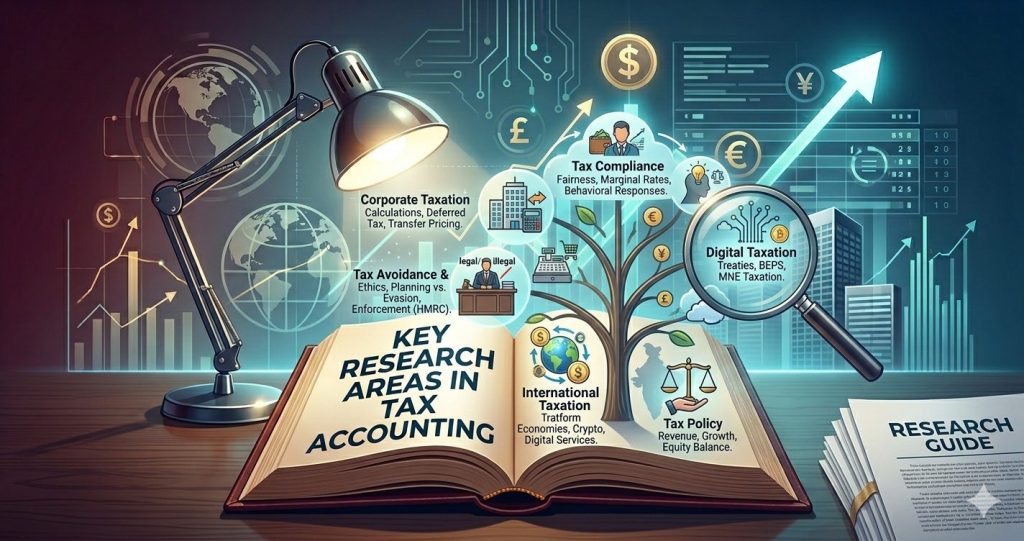
Before selecting a specific dissertation topic, it helps to understand the major research areas within the field. Tax accounting is broader than many students initially assume. Below are the core subfields where current academic debate is active and where original research is both possible and welcome.
- Corporate taxation examines how businesses calculate, report, and manage their tax obligations, including deferred tax accounting and transfer pricing.
- Personal income tax focuses on individual taxpayers, including issues of fairness, marginal rates, and behavioural responses to tax policy.
- Tax compliance looks at why individuals and companies comply with or avoid tax obligations, drawing on psychology, economics, and legal frameworks.
- Tax avoidance and evasion explores the legal and ethical boundaries of tax planning, as well as enforcement mechanisms by bodies such as HMRC.
- VAT and indirect taxes covers the structure, impact, and reform of consumption-based taxes across different economies.
- International taxation includes cross-border tax treaties, base erosion and profit shifting (BEPS), and the taxation of multinational enterprises.
- Digital taxation addresses how tax systems are adapting to platform economies, cryptocurrency, and the digital services sector.
- Tax policy examines how governments design and reform tax systems to balance revenue generation, economic growth, and social equity.
Five Example Tax Accounting Dissertation Topics with Research Aims and Objectives
The examples below demonstrate how a strong dissertation topic is structured at an academic level. Each one includes a research aim and two to three objectives to show you how a focused, researchable topic is built.
Example 1: Corporate Tax Avoidance in FTSE 100 Companies
Research Aim: To examine the tax avoidance strategies used by FTSE 100 companies and assess their alignment with current HMRC regulations.
Research Objectives:
- To identify the most common tax avoidance mechanisms reported in FTSE 100 annual reports between 2020 and 2024.
- To evaluate whether existing UK legislation is sufficient to address aggressive tax planning by large corporations.
- To assess stakeholder perceptions of corporate tax behaviour in relation to corporate social responsibility.
Example 2: The Impact of Digital Taxation on SMEs in the UK
Research Aim: To investigate how the introduction of digital taxation frameworks has affected the financial reporting and compliance burden of small and medium-sized enterprises in the UK.
Research Objectives:
- To review current digital tax regulations relevant to UK-based SMEs.
- To analyse how digital taxation affects cash flow management and administrative costs for small businesses.
- To identify gaps in guidance provided by HMRC to SMEs navigating digital tax compliance.
Example 3: VAT Compliance Challenges Post-Brexit
Research Aim: To explore the VAT compliance challenges faced by UK businesses operating in EU markets following Brexit.
Research Objectives:
- To document the key changes in VAT rules affecting UK-EU cross-border trade since January 2021.
- To assess the financial and operational impact of new VAT obligations on UK exporters.
- To recommend policy adjustments that could reduce compliance complexity for affected businesses.
Example 4: Transfer Pricing and Profit Shifting in Multinational Corporations
Research Aim: To analyse how transfer pricing practices contribute to profit shifting in multinational corporations operating in developing economies.
Research Objectives:
- To review existing literature on BEPS and transfer pricing in emerging markets.
- To evaluate the adequacy of OECD guidelines in preventing abusive transfer pricing arrangements.
- To examine case studies of profit shifting in selected African and Asian economies.
Example 5: Behavioural Factors Influencing Personal Income Tax Compliance
Research Aim: To investigate the psychological and social factors that influence personal income tax compliance behaviour among UK self-employed individuals.
Research Objectives:
- To identify the primary motivators and deterrents of tax compliance among self-employed workers.
- To compare compliance attitudes across age groups and income brackets.
- To assess the role of HMRC communication strategies in shaping taxpayer behaviour.
80 Tax Accounting Dissertation Topics for 2026
The following taxation dissertation topics are organised into subfields. All topics are original, narrowly focused, and suitable for 2026-level research. They are numbered in fixed ranges to make navigation easy.
Corporate Tax Dissertation Topics
- How do FTSE 100 companies justify their effective tax rates in annual sustainability reports?
- The role of deferred tax assets in shaping earnings management strategies among UK listed firms.
- How has the UK’s corporate tax rate increase to 25% in 2023 affected foreign direct investment decisions?
- An analysis of tax consolidation regimes and their effect on intra-group profit shifting.
- How do small UK companies manage corporation tax obligations during periods of economic downturn?
- The relationship between corporate governance quality and effective corporate tax planning.
- Evaluating the OECD’s Pillar Two global minimum tax and its implications for UK multinationals.
- How does thin capitalisation affect corporate tax liabilities in private equity-backed firms?
- A comparative analysis of corporate tax incentives for research and development in the UK and Germany.
- The extent to which UK corporate tax policy aligns with principles of horizontal equity.
Tax Avoidance and Evasion Research Topics
- How effective have the UK’s General Anti-Abuse Rules been in curbing aggressive tax avoidance?
- The role of professional advisers in facilitating tax avoidance schemes: an ethical analysis.
- A critical evaluation of HMRC’s Promote strategy and its impact on tax avoidance enablers.
- Tax evasion in the gig economy: identifying enforcement gaps in HMRC’s digital compliance frameworks.
- How do naming and shaming policies affect corporate tax behaviour in the UK?
- An examination of offshore tax shelters used by high-net-worth individuals post-Common Reporting Standard.
- How do behavioural nudges in HMRC correspondence reduce tax evasion among sole traders?
- The effectiveness of whistleblower incentives in exposing tax fraud in the financial services sector.
- How do changes in penalty structures influence tax compliance decisions among small businesses?
- A comparative study of tax avoidance regulation in the UK, Ireland, and the Netherlands.
International Taxation Dissertation Topics
- How are developing nations responding to the OECD’s Base Erosion and Profit Shifting framework?
- The impact of tax treaties on foreign direct investment flows between the UK and emerging economies.
- An analysis of country-by-country reporting requirements and their effectiveness in reducing profit shifting.
- How does the digital services tax differ across G20 nations and what does this mean for global commerce?
- The challenges of implementing a global minimum corporate tax rate in low-income jurisdictions.
- How do tax havens respond to international pressure from the EU’s list of non-cooperative jurisdictions?
- Evaluating the impact of BEPS Action 13 on the transparency of multinational tax reporting.
- The role of bilateral investment treaties in limiting host countries’ tax policy autonomy.
- How does international tax competition affect public service funding in sub-Saharan Africa?
- A legal and economic analysis of the UN Model Tax Convention versus the OECD Model in developing country contexts.
VAT and Indirect Tax Topics
- How have businesses adapted their VAT compliance systems following the UK’s Making Tax Digital initiative?
- The distributional effects of VAT policy reforms on low-income households in the UK.
- An analysis of VAT fraud through missing trader intra-community schemes and current countermeasures.
- How does the UK’s VAT treatment of digital services compare with EU frameworks post-Brexit?
- The administrative burden of VAT compliance for micro-enterprises in the UK retail sector.
- Evaluating the case for reduced VAT rates on environmentally sustainable goods and services.
- How does VAT registration threshold policy affect the growth decisions of small UK businesses?
- The challenges of VAT compliance for UK businesses selling cross-border through e-commerce platforms.
- An examination of the flat-rate VAT scheme and its financial impact on service-sector SMEs.
- How effectively does the UK’s VAT reverse charge mechanism counter fraud in the construction industry?
Personal Income Tax and Individual Taxation Topics
- How do marginal income tax rates affect labour supply decisions among UK professionals aged 40 to 60?
- The impact of personal allowance freezes on middle-income earners in the UK between 2022 and 2026.
- How does the child benefit tax charge affect financial planning decisions for dual-income families?
- An analysis of self-assessment tax return errors among first-time filers and the role of digital guidance.
- The effectiveness of tax credits in reducing in-work poverty among UK households with dependent children.
- How do high earners respond to changes in the additional rate of income tax?
- A gender analysis of personal tax burdens and pension savings among UK self-employed workers.
- How does tax residency complexity affect personal income tax obligations for UK expatriates?
- The impact of the High Income Child Benefit Charge on decision-making among high-earning parents.
- Evaluating HMRC’s approach to tax debt recovery among individuals in financial hardship.
Tax Compliance and Tax Policy Topics
- How do trust in government and perceived fairness influence voluntary tax compliance in the UK?
- The role of tax morale in shaping compliance behaviour among ethnic minority small business owners in England.
- How has Making Tax Digital affected accounting practices and compliance costs for UK landlords?
- The relationship between tax literacy and filing accuracy among UK university graduates entering self-employment.
- How do simplified tax regimes affect compliance rates among informal sector workers in developing economies?
- An evaluation of automatic exchange of information frameworks and their role in promoting global tax compliance.
- How does the complexity of UK inheritance tax rules affect estate planning behaviour among elderly taxpayers?
- The influence of social norms on tax compliance decisions: evidence from UK survey data.
- How has the UK’s off-payroll working legislation (IR35) affected compliance among contractors and consultants?
- A comparative study of tax compliance costs for sole traders in the UK and Australia.
Digital Taxation and Emerging Areas
- How should cryptocurrency gains be classified and taxed under current UK income and capital gains tax frameworks?
- The adequacy of UK tax law in addressing non-fungible token transactions and digital asset disposals.
- How do platform economy workers manage their tax obligations under current HMRC guidance?
- An analysis of the UK’s Digital Services Tax and its effect on the pricing strategies of global tech companies.
- How are tax authorities using artificial intelligence to detect non-compliance in digital business models?
- The challenges of taxing subscription-based software services across multiple jurisdictions.
- How does the rise of decentralised finance challenge existing frameworks for VAT and income tax?
- The effectiveness of HMRC’s Connect system in identifying undeclared income from online marketplaces.
- How should the UK tax system treat income earned by influencers and content creators on digital platforms?
- An evaluation of digital tax reporting obligations for online retailers under Making Tax Digital for VAT.
Tax Planning Strategies and Accounting Practice Topics
- How do listed UK companies use tax planning strategies to manage their effective tax rates over a business cycle?
- The role of tax planning in capital structure decisions among UK manufacturing firms.
- How do accounting standards interact with tax legislation to create permanent and temporary differences in corporate tax reporting?
- An analysis of pension contribution tax relief as a tax planning tool among UK higher earners.
- How does enterprise investment scheme relief influence investment behaviour in early-stage UK businesses?
- The use of employee ownership trusts as a tax-efficient business succession strategy in the UK.
- How do agricultural tax reliefs shape land ownership and estate planning decisions in rural England?
- An evaluation of the annual investment allowance and its effectiveness as a stimulus for capital expenditure.
- How does entrepreneurs’ relief (now Business Asset Disposal Relief) affect the sale decisions of UK business owners?
- A critical analysis of anti-avoidance provisions in the UK’s controlled foreign company rules and their effectiveness.
How to Select the Right Tax Accounting Dissertation Topic for Your Level
Choosing between these taxation research topics depends on your academic level, available time, and access to data or primary sources. Here is a straightforward guide.
Undergraduate Level
At undergraduate level, your dissertation is typically shorter and more focused. Choose a topic that is narrow, local, and data-rich. Topics around personal income tax compliance, Making Tax Digital, VAT registration, or HMRC enforcement work well because secondary data and published reports are widely available.
Master’s Level
Masters taxation dissertation topics should demonstrate a deeper engagement with academic literature and independent critical thinking. You are expected to design a methodology, collect or analyse data, and draw conclusions that go beyond summarising existing research. Topics on corporate tax avoidance, international tax compliance, transfer pricing, and digital taxation are particularly strong at this level.
PhD Level
At PhD level, you must contribute original knowledge to the field. Topics in international tax policy reform, behavioural tax compliance, or emerging digital tax frameworks allow you to engage with unresolved academic debates. You will need to justify your methodological choices rigorously and engage with both quantitative and qualitative research traditions.
If you feel uncertain about how to position your research at the right level, speaking with a specialist in taxation research support can help you define the boundaries of your study before you begin.
What Makes a Strong Tax Accounting Dissertation Topic?
Many students ask what separates a good topic from a great one. The answer comes down to three things: focus, feasibility, and relevance.
Focus means your topic is specific enough to be answered within the word count and time available. “Corporate taxation in the UK” is too broad. “The effect of the 2023 corporation tax increase on retained earnings decisions in UK SMEs” is focused and researchable.
Feasibility means you can actually gather the data, literature, or evidence you need. If your topic requires access to confidentil company data you cannot obtain, it will fail at the methodology stage.
Relevance means your topic connects to a real, unresolved issue in tax accounting today. Examiners want to know why your research matters. Topics linked to current debates around the digital economy, global minimum tax, and tax fairness are especially relevant for 2026.
Conclusion
Tax accounting is one of the most dynamic and policy-relevant fields in accounting and finance today. The topics covered in this post reflect the full breadth of where the discipline is heading: from corporate tax transparency and international profit shifting to digital taxation and behavioural compliance research.
Selecting the right topic requires more than picking something that sounds interesting. It requires you to think carefully about what is academically possible, what is currently debated in the literature, and what your chosen methodology can realistically deliver.
This post has given you a structured framework: from understanding the key research areas and seeing worked examples with aims and objectives, to browsing 80 original and focused tax accounting dissertation topics for 2026. Use these as a starting point, not a final answer. Every strong dissertation begins with a conversation, a question, and a genuine curiosity to find out something new.
If you are still unsure about narrowing your focus or developing your research proposal, professional tax accounting assignment help is available from subject specialists who understand both academic standards and real-world tax practice.
Whatever stage you are at, approach your dissertation with confidence. With the right topic and a clear research plan, you have everything you need to produce work that is genuinely worth reading.
