


Archaeology Dissertation Topics for 2026
What Students Are Asking About Archaeology Dissertation Topics
Students across forums such as The Student Room, Reddit’s r/archaeology, and academic discussion boards regularly post questions when they feel stuck choosing a dissertation topic. Below are some of the most common questions gathered from those platforms. This post answers every one of them.
- “What are the best archaeology dissertation topics for 2026?”
- “How do I choose an archaeology research topic that is narrow enough for a master’s dissertation?”
- “What topics in archaeology are relevant to current global debates?”
- “Can I write my dissertation on ancient civilisations and still make it original?”
- “What are the latest archaeology research topics suitable for a PhD proposal?”
- “Are there good undergraduate archaeology dissertation topics that do not require extensive fieldwork?”
- “How do I write research aims and objectives for an archaeology thesis?”
- “Where can I find archaeology dissertation topics with examples already worked out?”
If any of these questions sound familiar, you are in the right place.
Why Choosing the Right Archaeology Dissertation Topic Matters
Choosing the right dissertation topic is one of the most important decisions you will make during your academic journey. In archaeology, this decision carries extra weight because the field sits at the intersection of history, science, social theory, and cultural heritage. A poorly chosen topic can leave you struggling to find enough primary or secondary sources, or worse, writing a dissertation that feels too broad to argue convincingly.
A well-chosen topic, on the other hand, gives your research direction. It helps you formulate a clear research question, identify the right methodology, and contribute something meaningful to the discipline. Whether you are working on archaeological dissertation topics for your undergraduate final year, your master’s thesis, or a PhD proposal, topic selection shapes everything that follows.
Many students turn to online dissertation help early in the process, and that is a wise decision. Getting guidance before you commit to a topic can save you months of confusion.
Download Archaeology Dissertation Topics PDF
Students who want a curated, personalised list of archaeology dissertation topics can access a downloadable PDF prepared by academic subject specialists. The PDF contains a refined selection of topics matched to your level of study, research interests, and institutional requirements. You can receive this resource by completing a short online form. Once submitted, the list is compiled and sent directly to you.
Key Research Areas in Archaeology Students Can Explore
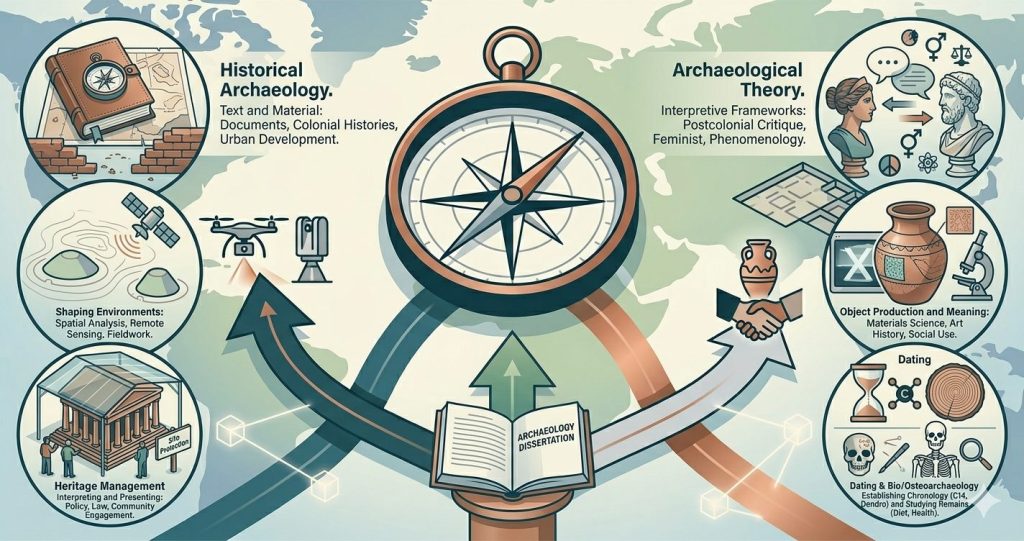
Before choosing a specific topic, it helps to understand the major subfields within archaeology. Each area opens up a different set of research questions, methods, and debates.
Historical Archaeology examines periods covered by written records, often exploring the relationship between documentary evidence and material culture. It is a strong area for students interested in colonial histories and urban development.
Landscape Archaeology focuses on how human communities shaped and responded to their environments over time. It draws on spatial analysis, remote sensing, and fieldwork research.
Heritage Management is a rapidly growing field concerned with how societies protect, interpret, and present the archaeological record. It connects strongly to policy, law, and community engagement.
Archaeological Theory covers how we interpret the past and what assumptions underpin our research. Topics here often engage with postcolonial critique, feminist archaeology, and phenomenology.
Artefact Analysis involves the close study of objects, including their production, use, and meaning. It intersects with materials science, art history, and social archaeology.
Dating Techniques such as carbon dating, dendrochronology, and luminescence dating are central to any research that needs to establish chronology. These methods are especially relevant in topics dealing with ancient civilisations.
Bioarchaeology and Osteoarchaeology focus on human remains and what they reveal about health, diet, identity, and social organisation.
Each of these areas contains dozens of viable dissertation topics, and many of the best research ideas sit across two or more of them.
Five Example Archaeology Dissertation Topics with Aims and Objectives
The following five examples are designed to show you how a strong archaeology dissertation topic is structured. Each includes a research aim and two to three objectives to guide your thinking.
Example 1: Roman Urban Planning and Social Organisation in Roman Britain
Research Aim: To examine how urban spatial layouts in Roman Britain reflected and reinforced social hierarchies during the first to fourth centuries CE.
Research Objectives:
- To analyse the spatial organisation of public buildings and domestic spaces in selected Roman towns using published excavation reports.
- To assess how social status influenced access to civic amenities such as baths and forums.
- To evaluate how archaeological evidence compares with Roman documentary sources on urban social norms.
Example 2: The Role of Mortuary Practices in Expressing Identity in Anglo-Saxon England
Research Aim: To investigate how burial customs in Anglo-Saxon England communicated social identity, gender, and ethnic affiliation.
Research Objectives:
- To catalogue and compare grave goods from a selection of fifth to seventh century cemeteries using published osteological and artefact data.
- To assess gendered patterns in burial practice and their relationship to skeletal sex.
- To critically evaluate the use of ethnic identity as an interpretive framework in Anglo-Saxon archaeology.
Example 3: Heritage Management and Indigenous Communities in Post-Colonial Contexts
Research Aim: To explore how heritage management frameworks in post-colonial nations address the rights and interests of indigenous communities.
Research Objectives:
- To review existing legislative frameworks governing indigenous archaeological heritage in Australia, Canada, and South Africa.
- To analyse case studies where communities have led or contested heritage decisions.
- To recommend policy considerations that promote community-centred heritage management.
Example 4: Landscape Change and Agricultural Intensification in the Bronze Age Levant
Research Aim: To examine how Bronze Age communities in the Levant adapted their agricultural landscapes in response to climatic and demographic pressures.
Research Objectives:
- To evaluate environmental and palaeobotanical data from published excavations across the southern Levant.
- To identify spatial patterns in settlement distribution relative to agricultural land potential.
- To assess how landscape archaeology methods contribute to understanding Bronze Age agrarian economies.
Example 5: Digital Technologies in Public Archaeology and Community Engagement
Research Aim: To assess how digital tools such as 3D modelling and augmented reality are transforming public engagement with archaeological heritage.
Research Objectives:
- To review current applications of digital heritage tools in museum and field contexts.
- To evaluate user engagement data from digital heritage projects in the United Kingdom and Europe.
- To identify barriers and opportunities in scaling digital public archaeology initiatives.
80 Archaeology Dissertation Topics for 2026
The following 80 topics are organised by subfield. They are suitable for undergraduate, master’s, and PhD-level research and reflect current directions in the discipline. Students looking for archaeology dissertation topics with examples already structured will find the section above helpful alongside this list.
Ancient Civilisations and Classical Archaeology
- The political symbolism of monumental architecture in ancient Egyptian state formation.
- Trade network reconstruction in the Bronze Age Aegean using provenance analysis of ceramics.
- Social differentiation in Mesopotamian urban centres as reflected in domestic archaeological assemblages.
- The role of water management systems in sustaining Classic Maya civilisation.
- Reassessing the collapse of the Bronze Age palatial economies through a climate archaeology lens.
- Funerary iconography and elite identity in pre-Columbian Andean cultures.
- Comparing state religion and ritual landscape in Achaemenid Persia and Ptolemaic Egypt.
- The integration of conquered populations in the Roman Empire as evidenced by material culture.
- Agricultural surplus and storage strategies in Minoan Crete during the Neopalatial period.
- Urban identity and civic pride in Hellenistic city planning as reflected in archaeological remains.
Prehistoric and Early Human Archaeology
- The cognitive implications of symbolic behaviour in the Middle Stone Age of southern Africa.
- Neanderthal social organisation and its evidence in European cave deposits.
- Diet reconstruction in early Homo sapiens communities using stable isotope analysis.
- The spread of the Neolithic package across Europe and its local adaptations in north-western Britain.
- Lithic technology variation as an indicator of cultural transmission in Palaeolithic Europe.
- Shell middens and coastal forager behaviour in late Pleistocene South Africa.
- The role of fire in Homo erectus camp organisation in the Lower Palaeolithic.
- Intergroup conflict and its evidence in Neolithic skeletal populations across central Europe.
- Landscape use and mobility strategies in Mesolithic hunter-gatherer communities in Scandinavia.
- The origins of symbolic thinking in anatomically modern humans: a comparative analysis of African and European evidence.
British and European Historical Archaeology
- Post-medieval rural settlement abandonment in England and its social drivers as evidenced by earthwork surveys.
- Material culture and identity negotiation in Viking-Age Britain.
- The archaeology of poverty in nineteenth-century industrial towns in northern England.
- Domestic space and gender in medieval English peasant households.
- The archaeological evidence for plague impact on fourteenth-century European rural communities.
- Monastic economy and agricultural management in Norman England as seen through granary excavations.
- Urban expansion and its material footprint in early modern London.
- The archaeology of religious conversion in Anglo-Saxon Northumbria.
- Landscape memory and place-names in Iron Age to Romano-British transitions in Wales.
- Craft specialisation and workshop organisation in Roman-period urban centres in Gaul.
Heritage Management and Cultural Policy
- Community archaeology and the ethics of inclusion: a case study approach in England.
- The impact of Brexit on cross-border heritage management between the Republic of Ireland and Northern Ireland.
- UNESCO World Heritage designation and its economic effects on host communities in sub-Saharan Africa.
- Digital repatriation of cultural objects and its implications for museum ethics and international law.
- Local authority heritage funding cuts and their impact on archaeology in England since 2010.
- The role of environmental impact assessments in commercial archaeology in the United Kingdom.
- Balancing tourism and conservation at iconic archaeological sites in southern Europe.
- Indigenous land rights and their intersection with cultural heritage protection in Canada.
- The politics of dark heritage sites and how they are interpreted for public audiences.
- Crowdfunding and community heritage projects: assessing democratic participation in archaeological research.
Bioarchaeology and Osteoarchaeology
- Palaeopathology and occupational stress markers in Roman-period agricultural populations in Britain.
- Stable isotope evidence for weaning practices and infant diet in Iron Age Central Europe.
- Skeletal evidence for interpersonal violence in Bronze Age Britain: patterns and interpretations.
- Bioarchaeological approaches to understanding social inequality in medieval monastic communities.
- Migration and mobility in late antique populations of the western Roman Empire using isotopic analysis.
- Reconstructing childhood health in Neolithic farming communities using dental and skeletal markers.
- The identification of infectious disease in pre-industrial European urban burial assemblages.
- Sex estimation methods in fragmentary skeletal remains: a critical assessment of current techniques.
- Cranial modification practices and social identity in pre-Columbian South America.
- Analysing demographic collapse in post-conquest indigenous populations of Mesoamerica through bioarchaeological data.
Landscape and Environmental Archaeology
- Palaeoenvironmental reconstruction of Bronze Age wetland landscapes in Somerset using pollen analysis.
- Human-induced deforestation and its archaeological signatures in Neolithic Britain.
- Remote sensing and LiDAR applications in detecting hidden archaeological features in forested landscapes.
- Ritual deposition and the significance of watery places in Iron Age northern Europe.
- Post-glacial recolonisation of northern Europe and the evidence from early Holocene sites.
- Alluvial archaeology and the recovery of ephemeral sites in river valley contexts.
- The archaeology of transhumance and seasonal movement in upland Britain during the medieval period.
- Geoarchaeological approaches to understanding site formation processes in tell sites of the Near East.
- Dryland farming strategies in the ancient Near East during periods of prolonged aridity.
- Coastal erosion and its threat to submerged prehistoric landscape sites around the British Isles.
Artefact Analysis and Material Culture Studies
- Pottery production and distribution networks in Late Iron Age southern Britain: a technological study.
- The social life of Roman glass vessels in provincial British contexts.
- Coin use and monetisation in the late Roman periphery: evidence from frontier zone hoards.
- Textile production and gender in Viking-Age Scandinavia as evidenced by loom weights and spindle whorls.
- The circulation of prestige objects in Early Bronze Age Europe and its social implications.
- Stone tool curation behaviour among late Neanderthal populations in southwestern France.
- Metalwork deposition in the British Late Bronze Age: ritual, economy, or both?
- Pigment use and wall painting traditions in Pompeian domestic contexts: a compositional analysis.
- Ceramic chaîne opératoire approaches to understanding Neolithic social boundaries in Atlantic Europe.
- The reuse and curation of ancient objects in Anglo-Saxon England as evidence for ancestral memory.
Digital and Public Archaeology
- The ethics and accuracy of algorithmic reconstruction in photogrammetric heritage documentation.
- Volunteer-collected data in citizen science archaeology projects and its methodological reliability.
- Virtual reality as a tool for communicating archaeological interpretation to non-specialist audiences.
- Social media and community-building in public archaeology: assessing impact and reach.
- Open-access archaeological data repositories and their role in promoting reproducible research.
- Archaeological gaming and digital heritage: how video games represent and distort the ancient past.
- Machine learning applications in ceramic classification: opportunities and limitations.
- The use of drone technology in monitoring archaeological site degradation in conflict zones.
- Evaluating the public impact of community excavation projects in urban England.
- Blockchain and provenance documentation as tools for combating the illicit antiquities trade.
How to Choose the Right Archaeology Dissertation Topic for Your Level
Undergraduate Archaeology Dissertation Topics
At undergraduate level, your supervisor will expect a focused and manageable topic. You are unlikely to have access to unpublished site reports or large research budgets, so choose a topic that can be answered using published excavation reports, museum collections, or existing datasets. Topics in artefact analysis, historical archaeology, and public archaeology are particularly well-suited because the secondary literature is rich and accessible.
Archaeology dissertation topics for undergraduate students also benefit from being tied to local or national contexts, making it easier to visit relevant sites or collections in person where possible.
Masters Archaeology Dissertation Topics
At master’s level, you are expected to demonstrate methodological awareness and engage critically with archaeological theory. Many masters archaeology dissertation topics benefit from a comparative approach, drawing on evidence from two or more sites, regions, or periods. You may also be expected to situate your work within a broader theoretical debate, whether that relates to social complexity, identity, landscape, or post-colonial critique.
If you are feeling overwhelmed by topic selection, accessing archaeology research assistance from an academic subject specialist can help you identify where your interests align with current gaps in the literature.
PhD Archaeology Dissertation Topics
PhD research must make an original contribution to knowledge. At this level, your topic should emerge from a thorough reading of the literature and an identified gap or problem. The best PhD topics in archaeology often bridge subfields, for example combining environmental data with social theory, or integrating skeletal analysis with textual sources. Many successful PhD proposals also engage with methodological innovation, asking not just what happened in the past but how we can know it more precisely.
Conclusion
Selecting a strong dissertation topic in archaeology is the first step towards producing research you can be proud of. Whether you are at undergraduate, master’s, or PhD level, the key is to choose a topic that is specific enough to argue clearly, relevant to current debates in the discipline, and suited to the resources and time you have available.
The 80 topics in this post cover a wide range of ancient history dissertation topics and contemporary research directions, from fieldwork research in prehistoric landscapes to digital applications in public engagement. Wherever your interests lie, there is a topic in this list that can be shaped into a viable dissertation proposal.
Approach your dissertation with intellectual curiosity, academic rigour, and confidence in your ability to contribute to one of the most fascinating fields of human inquiry. If you need further support with your research proposal or writing process, exploring options for structured dissertation help UK can make the process significantly less stressful.
