


Architecture Dissertation Topics for 2026

Questions Students Are Asking About Architecture Dissertation Topics
The following questions have been gathered from student forums, academic discussion boards, and architecture research communities. They reflect the genuine concerns that students share when they begin thinking about dissertation topic selection.
- What are the best architecture dissertation topics for 2026 that my supervisor will approve?
- How do I choose a topic that is specific enough for a master’s dissertation but still relevant to current practice?
- Are there architecture thesis topics that focus on sustainability and climate change?
- What makes an architecture dissertation topic suitable for PhD-level research?
- Can I find architecture dissertation topics with examples that show me how to structure my research aim and objectives?
- Are there architecture dissertation topics on sustainable design that are still original enough to research?
- Where can I find the latest architecture research topics that reflect what the profession actually needs?
- How do I know whether my architecture research topic is too broad or too narrow?
Introduction: Why Your Dissertation Topic Shapes Your Entire Research Journey
Choosing the right topic is one of the most important decisions you will make as an architecture student. A well-chosen topic does far more than satisfy an academic requirement. It positions your research within the wider scholarly conversation, signals your intellectual interests to future employers, and forms the foundation of every research decision that follows.
Architecture as a discipline sits at the intersection of art, technology, society, and environment. This breadth is exciting, but it also means that students face a genuinely wide landscape of possibilities. Without a clear direction, that freedom can feel overwhelming. Students who struggle with topic selection often find that the root problem is not a lack of ideas. It is a lack of structure and guidance.
This post is designed to provide that structure. Whether you are working at undergraduate, master’s, or PhD level, the guidance here will help you understand the current research landscape, identify areas that match your interests and skills, and approach your dissertation with confidence. If you feel you need further support along the way, there are experienced professionals offering online dissertation help who can work alongside you throughout the process.
Download Architecture Dissertation Topics PDF
Many students find it helpful to have a curated, organised list of dissertation topics they can return to during the early stages of planning. A downloadable PDF containing a personalised selection of architecture dissertation topics, prepared by academic experts, is available for students who complete a short request form. The PDF is tailored to your academic level, research interests, and preferred subfield within architecture. This resource has helped many students narrow down their focus and approach their topic selection with far greater clarity.
Why Choosing the Right Architecture Dissertation Topic Matters
The topic you choose sets the scope and direction of your entire dissertation. A topic that is too broad will result in research that lacks depth. A topic that is too narrow may leave you without sufficient academic literature to engage with. A topic that is poorly connected to current debates within the field may struggle to find an audience and may not meet the expectations of your assessment panel.
Architecture dissertation topics that are well chosen tend to share several qualities. They are original without being eccentric. They are grounded in real-world issues while also engaging with theoretical frameworks. They are researchable within the constraints of your programme and timeline. And they speak to questions that matter to the profession, whether those questions concern practice, policy, technology, society, or environment.
Choosing wisely also gives your supervisory relationship a stronger foundation. Supervisors are more engaged when students bring focused, informed topic ideas to early meetings. This post is designed to help you arrive at those meetings well-prepared.
Key Research Areas in Architecture for 2026
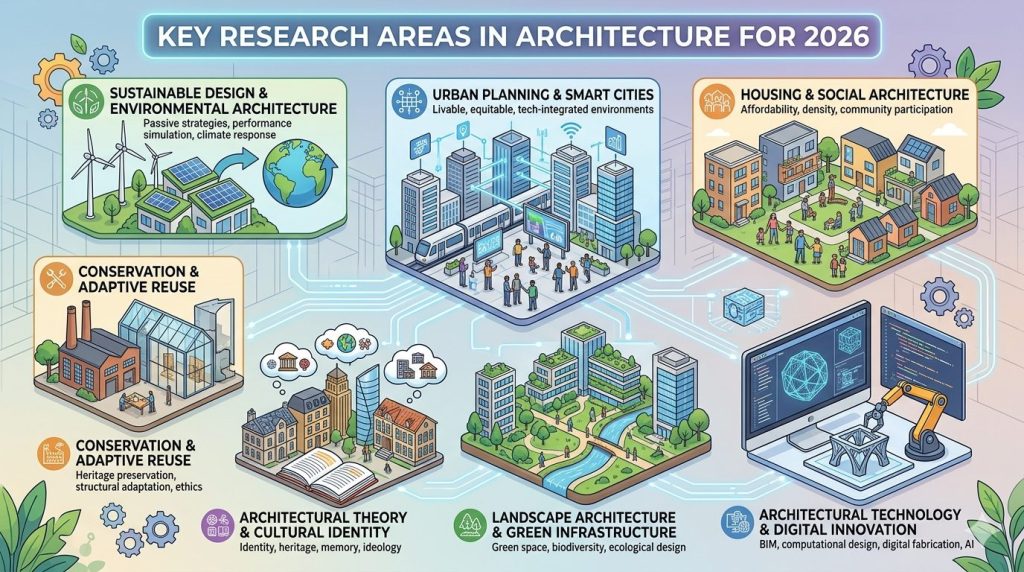
Architecture research spans a wide range of established academic domains. The following areas represent the most active and academically productive directions for 2026-level research. Students at all levels can find suitable dissertation topics within these fields.
Sustainable Design and Environmental Architecture This area explores how buildings can be designed to reduce environmental impact, improve energy performance, and respond to climate change. Research here often engages with passive design strategies, building performance simulation, and the social dimensions of environmental responsibility.
Urban Planning and Smart Cities As cities continue to grow and evolve, the relationship between architectural design and urban infrastructure becomes increasingly important. Research in this area examines how architecture contributes to liveable, equitable, and technologically integrated urban environments.
Housing and Social Architecture Housing sits at the heart of architectural practice and policy. Research in this area investigates affordability, density, typology, community participation, and the relationship between housing design and social outcomes.
Architectural Technology and Digital Innovation Digital tools have transformed architectural practice. Research here explores building information modelling, computational design, parametric architecture, digital fabrication, and the use of artificial intelligence in the design process.
Landscape Architecture and Green Infrastructure This area examines the relationship between architecture and the natural environment, focusing on green space, ecological design, biodiversity, and the integration of landscape thinking into urban development.
Architectural Theory and Cultural Identity Architecture carries cultural meaning. Research in this area examines how buildings express identity, heritage, memory, and ideology, and how architectural discourse shapes and is shaped by broader social and philosophical debates.
Conservation and Adaptive Reuse The transformation of existing buildings for new uses is one of the most pressing concerns in contemporary practice. Research here engages with heritage preservation, structural adaptation, and the ethics of intervention.
Architecture Dissertation Topics with Examples
The following five examples are designed to show you how a strong dissertation topic is structured at the research proposal stage. Each topic includes a clearly written research aim and between two and three research objectives.
Example 1
Topic: The Role of Passive Cooling Strategies in Reducing Energy Consumption in Residential Buildings in Hot Arid Climates
Research Aim: To evaluate the effectiveness of passive cooling design strategies in reducing mechanical cooling dependency in residential buildings located in hot arid climatic zones.
Research Objectives:
- To identify and compare passive cooling strategies currently applied in residential architecture in hot arid regions
- To assess the measurable impact of these strategies on indoor thermal comfort and energy performance
- To develop a set of design recommendations for architects working on low-energy housing in similar climatic contexts
Example 2
Topic: Adaptive Reuse of Post-Industrial Heritage Buildings as Community Cultural Spaces: A Case Study Approach
Research Aim: To examine how post-industrial heritage buildings can be successfully converted into community cultural spaces while preserving architectural and historical significance.
Research Objectives:
- To analyse a set of completed adaptive reuse projects across different European cities
- To identify the design, regulatory, and community engagement factors that contribute to successful conversion outcomes
- To critically assess the balance between preservation principles and contemporary functional requirements
Example 3
Topic: The Impact of Biophilic Design Principles on Occupant Wellbeing in Urban Office Environments
Research Aim: To investigate the relationship between biophilic design elements and the physical and psychological wellbeing of office workers in urban settings.
Research Objectives:
- To review existing evidence linking biophilic design to measurable wellbeing outcomes in workplace settings
- To conduct post-occupancy evaluations in selected office buildings with varying levels of biophilic design integrationTo propose practical guidelines for incorporating biophilic principles into urban office design
Example 4
Topic: Parametric Design as a Tool for Optimising Natural Light Distribution in Complex Roof Structures
Research Aim: To explore the potential of parametric design tools in achieving optimised natural light distribution within architecturally complex roof configurations.
Research Objectives:
- To review current parametric approaches used for daylighting analysis in architectural design
- To test and compare parametric modelling outputs against physical daylighting measurements in selected buildings
- To assess the practical limitations of parametric daylighting tools for use in professional architectural practice
Example 5
Topic: Public Space Design and Social Inclusion: How Architectural Decision-Making Shapes Access for Marginalised Communities
Research Aim: To critically examine how architectural and planning decisions in the design of public space affect the accessibility and social inclusion of marginalised urban communities.
Research Objectives:
- To review theoretical frameworks linking public space design with social inclusion and exclusion
- To conduct observational and interview-based fieldwork in selected public spaces across urban areas with diverse demographic profiles
- To evaluate the extent to which inclusive design principles are embedded in current public space policy and practice
80 Architecture Dissertation Topics for 2026
The following 80 topics are organised by research subfield. Each topic is designed to be narrow enough for rigorous academic research while remaining connected to current disciplinary debates. These topics are suitable for undergraduate, master’s, and PhD proposals, though the depth and scope of your engagement will naturally vary by level.
Sustainable Design and Green Buildings
- Evaluating the long-term thermal performance of rammed earth construction in contemporary UK residential buildings
- The effectiveness of green roofs in managing urban stormwater runoff: a comparative analysis of European case studies
- Passive house standards and their applicability to social housing delivery in temperate coastal climates
- How photovoltaic integration affects architectural form and facade aesthetics in commercial buildings
- The role of cross-laminated timber in reducing embodied carbon in mid-rise residential construction
- Thermal mass as a passive design strategy for reducing overheating risk in UK dwellings post-2025 building regulations
- Life cycle assessment as a design tool: how early-stage carbon analysis influences architectural decision-making
- Net-zero retrofitting of Victorian terrace housing: barriers, enablers, and design strategies
- The use of phase-change materials in building envelopes for improving thermal comfort without mechanical cooling
- How low-carbon material specifications are affecting procurement decisions in public sector building projects
Urban Planning, Smart Cities, and Housing
- The role of architecture in creating walkable neighbourhoods: lessons from recent mixed-use urban developments
- How smart city infrastructure is reshaping public space design in post-pandemic cities
- The architectural dimensions of the fifteen-minute city concept: possibilities and limitations in practice
- Community land trusts as a model for delivering affordable housing: spatial and design implications
- Density without overcrowding: architectural strategies for high-density low-rise housing in urban areas
- The impact of permitted development rights on urban morphology and local architectural character in England
- Temporary housing solutions for displaced populations: how design affects dignity and community formation
- Designing for demographic change: how housing typologies are responding to ageing populations in European cities
- The relationship between street-level retail continuity and urban vitality in newly developed mixed-use districts
- Vertical urbanism in high-density cities: social implications of tall residential living in Hong Kong and Singapore
Architectural Technology and Digital Innovation
- The use of building information modelling in reducing construction waste during the design and coordination phase
- Computational generative design and its effects on structural efficiency in long-span roof structures
- How digital fabrication tools are influencing material experimentation in architectural education
- The integration of artificial intelligence in early-stage architectural concept generation: possibilities and ethical questions
- 3D printing technologies and their emerging application in affordable housing construction
- Drone-based survey methods and their accuracy for use in conservation and heritage documentation
- How augmented reality tools are changing client communication and design review processes in architectural practice
- Parametric environmental optimisation in facade design: a comparison of computational tool outputs with post-occupancy data
- The role of digital twin technology in facility management and building performance optimisation
- Machine learning applications for predicting building energy performance during schematic design
Landscape Architecture and Environmental Design
- Ecological connectivity in urban landscape design: how green corridors support biodiversity in dense cities
- The therapeutic potential of landscape design in mental health facility settings: evidence from post-occupancy studies
- Urban heat island mitigation through landscape intervention: a review of strategy effectiveness in Southern European cities
- Rain gardens and sustainable drainage systems as architectural landscape elements in urban regeneration projects
- The design of urban parks in post-industrial brownfield sites: balancing ecological remediation with public accessibility
- How landscape architecture is responding to rising sea levels in low-lying coastal urban areas
- Edible urban landscapes: the role of food-productive design in improving community health and social cohesion
- Designing urban forests: the architectural and ecological considerations of integrating tree canopy into the built environment
- The place of landscape in masterplanning: how green infrastructure is embedded in large-scale residential developments
- Sensory landscape design for users with visual impairments: principles, practice, and evaluation
Architectural Theory, Cultural Identity, and Heritage
- Postcolonial architecture in West Africa: how national institutions are asserting cultural identity through building design
- The architectural representation of national memory: a comparative study of memorial architecture in Germany and Japan
- How architectural theory has engaged with gender and spatial justice over the past three decades
- The aesthetics of vernacular architecture and their influence on contemporary regionalist design movements
- Sacred space in secular societies: the architectural design of multi-faith buildings in diverse urban contexts
- The influence of critical regionalism on contemporary architectural practice in South Asia
- How architects negotiate authenticity in the restoration of modernist heritage buildings
- The representation of disability in architectural discourse: how mainstream theory has historically excluded access as a design value
- Architecture and political power: how authoritarian regimes have used monumental public buildings to assert ideological authority
- The architectural identity of diaspora communities: how migrant communities shape built environments in host cities
Conservation, Adaptive Reuse, and Retrofitting
- Adaptive reuse of redundant churches in post-industrial British towns: design strategies and community outcomes
- The ethics of intervention in listed buildings: how conservation policy shapes architectural decision-making
- Retrofitting brutalist social housing blocks for energy performance: technical strategies and heritage tensions
- The role of community participation in shaping adaptive reuse projects in culturally significant heritage sites
- How fire safety regulations following the Grenfell Tower inquiry have affected the design and retrofitting of residential high-rise buildings
- The structural challenges of converting former industrial buildings to residential use: a comparative technical analysis
- Balancing contemporary insertion with heritage preservation: design approaches in World Heritage Site buffer zones
- How climate change is creating new conservation challenges for historic building fabric and materials
- The economic viability of heritage-led regeneration: what the architectural evidence tells us about long-term community benefit
- Reversibility as a conservation principle: how temporary and demountable interventions are changing heritage practice
Housing Design, Social Architecture, and Inclusive Design
- Designing for neurodiversity: how sensory considerations are influencing residential and educational building design
- The spatial implications of right-to-buy policy on social housing estate design and maintenance in England
- Co-housing models in Scandinavia and their transferability to British urban contexts
- How domestic spatial standards in new-build housing affect occupant health and wellbeing
- The role of architecture in reducing social isolation in purpose-built housing for older adults
- Designing trauma-informed domestic spaces: principles, evidence, and practice in refuge and recovery housing
- The contribution of self-build housing to community identity and neighbourhood quality in rural areas
- How architectural programming processes in public housing projects engage with resident experience and preference
- Multigenerational housing design: spatial strategies for accommodating extended families in dense urban environments
- The architectural consequences of short-term rental platforms on urban residential neighbourhoods
Environmental Architecture, Climate Adaptation, and Resilience
- Designing for flood resilience: how architectural strategies are evolving in response to increased flood frequency in the UK
- The contribution of blue-green infrastructure to urban climate adaptation in mid-sized British cities
- Passive survivability as a design criterion: how buildings can maintain habitable conditions during prolonged power outages
- The architectural response to extreme heat events: how public buildings are being designed or retrofitted for cooling without air conditioning
- Designing healthcare buildings for pandemic preparedness: lessons from COVID-19 for spatial flexibility and infection control
- The role of embodied carbon accounting in shaping material choices in net-zero building targets post-2025
- How architects are incorporating circular economy principles into the design and specification of new commercial buildings
- Wildfire-resilient architecture: design strategies for buildings in high-risk interface zones in Southern Europe and Australia
- Designing for displacement: how temporary and transitional architecture is responding to climate-driven migration
- The role of prefabrication and modular construction in delivering climate-resilient affordable housing at scale
How to Choose the Right Architecture Dissertation Topic for Your Level
Selecting a topic is not a one-step process. It involves reading, conversation with supervisors, and honest reflection on your own interests and skills.
At undergraduate level, your dissertation should demonstrate that you can engage critically with a defined body of literature and apply a clear methodological approach. Topics that are too ambitious in scope will create difficulties within the time and word count available to you. Focus on a specific question that you can research thoroughly.
At master’s level, your topic should reflect a deeper familiarity with the discipline and an ability to generate original analysis. You are expected to engage with primary sources and to position your argument within the scholarly conversation in your subfield. Architecture thesis topics at this level benefit from a clear theoretical framework and a robust methodological design.
At PhD level, your topic must make an original contribution to knowledge. It should be firmly grounded in a literature gap that you can identify and articulate clearly. Students seeking architecture research assistance at this level often benefit from early discussions with potential supervisors before formally applying.
Students working across all three levels often find that speaking to someone with expertise in dissertation structure helps them sharpen their ideas before they commit to a direction. Access to structured architecture assignment help during the planning stage can save significant time and reduce the anxiety that often accompanies topic selection.
Conclusion: Approach Your Architecture Dissertation with Confidence
Choosing an architecture dissertation topic is both an intellectual challenge and an opportunity. The decision you make will shape months of reading, thinking, writing, and reflection. It will also, in many cases, introduce you to the area of the discipline that will continue to interest you long after your degree is complete.
The 80 topics presented in this post are designed to help you recognise the breadth of what is possible and the depth of what is required. Each one points toward a real question that the discipline is currently working to answer. Each one is specific enough to be researchable and connected enough to matter.
Use this post as a starting point rather than a final destination. Read around the areas that interest you most. Talk to your tutors and supervisors. Revisit your own experience and ask what you already know that might give you a distinctive perspective. The strongest dissertations are always the ones where the student has found a genuine intellectual investment in the question they are pursuing.
Architecture is a discipline that shapes the world people live in. Your dissertation is your opportunity to contribute something thoughtful and rigorous to that ongoing project. Approach it with curiosity, patience, and care, and you will produce work you are genuinely proud of.
