


Physiology Dissertation Topics for 2026
Questions Students Are Asking About Physiology Dissertations
The following questions have been gathered from student forums, academic discussion boards, and online communities where students share their dissertation struggles and concerns.
- What are the best physiology dissertation topics for 2026 that will impress my supervisor?
- How do I choose a physiology research topic that is narrow enough to be manageable but broad enough to be meaningful?
- What are the latest physiology research topics that reflect current academic and clinical interest?
- Are there human physiology dissertation topics that work for both undergraduate and postgraduate levels?
- Can you show me physiology dissertation topics with examples of aims and objectives?
- What are good masters physiology dissertation topics that will stand out in my programme?
- Where can I find physiology dissertation help if I get stuck during topic selection?
If these questions sound familiar, you are not alone. This post has been written to answer each one clearly and to give you a confident starting point for your physiology dissertation in 2026.
Why Choosing the Right Physiology Dissertation Topic Matters
Selecting a dissertation topic is one of the most consequential academic decisions a student makes. In a subject as vast and clinically relevant as physiology, the pressure to choose wisely is even greater. A poorly chosen topic can make the research process unnecessarily difficult, while a well-chosen one opens doors to focused investigation, meaningful findings, and a stronger final submission.
Physiology sits at the heart of biomedical science and medicine. It explains how the human body systems function, how organ function is maintained under stress, and how disruptions in homeostasis lead to disease. With healthcare and research evolving rapidly, dissertation topics in this field must reflect both scientific rigour and contemporary relevance.
Many students searching for online dissertation help begin their journey not with a specific idea, but with a general area of interest, such as cardiovascular physiology or nervous system physiology. This post will help you move from that broad curiosity toward a focused, academically sound research question.
Download Physiology Dissertation Topics PDF
Students who want a curated, ready-to-use list of physiology dissertation topics can request a personalised PDF compiled by academic subject specialists. The PDF is tailored to your level of study and research interests, giving you a focused selection of topics rather than an overwhelming general list. Students receive this resource after completing a short form, which allows the team to match topics to your specific academic requirements. No prior knowledge of research methodology is needed to request it.
Key Research Areas in Physiology for 2026
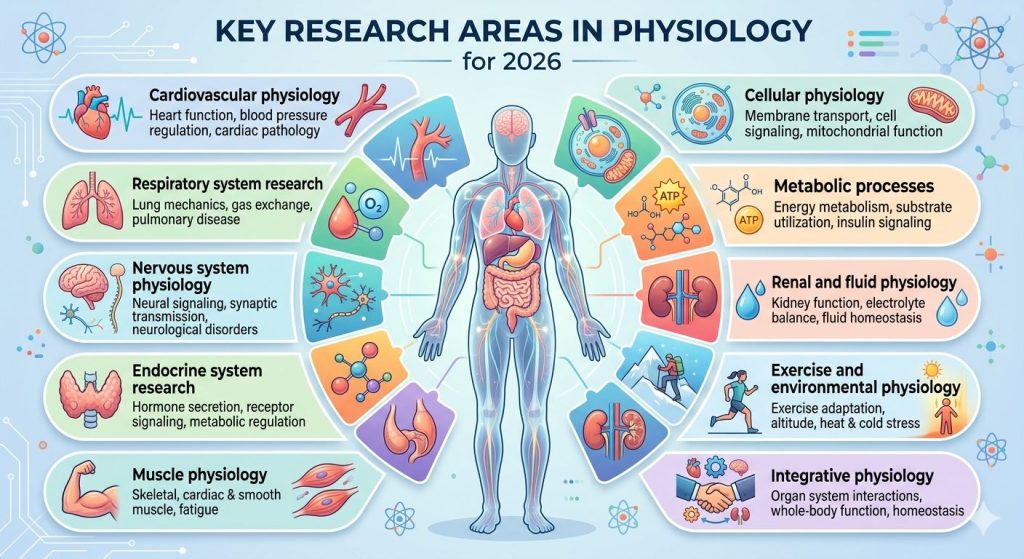
Physiology is a broad discipline, and students benefit from understanding its main research territories before selecting a topic. The following subfields represent established and emerging areas where academic research is actively growing:
- Cardiovascular physiology: Covers heart function, blood pressure regulation, circulatory adaptation, and cardiac pathology.
- Respiratory system research: Focuses on lung mechanics, gas exchange, breathing regulation, and pulmonary disease mechanisms.
- Nervous system physiology: Examines neural signalling, synaptic transmission, sensory processing, and neurological disorders.
- Endocrine system research: Explores hormone secretion, receptor signalling, feedback mechanisms, and metabolic regulation.
- Muscle physiology: Investigates skeletal, cardiac, and smooth muscle function, fatigue, and adaptation.
- Cellular physiology: Looks at membrane transport, cell signalling, mitochondrial function, and intracellular communication.
- Metabolic processes: Examines energy metabolism, substrate utilisation, insulin signalling, and metabolic disease.
- Renal and fluid physiology: Studies kidney function, electrolyte balance, acid-base regulation, and fluid homeostasis.
- Exercise and environmental physiology: Explores physiological adaptation to physical training, altitude, heat, and cold.
- Integrative physiology: Considers how multiple organ systems interact to maintain whole-body function and homeostasis.
Each of these areas contains hundreds of potential dissertation questions. The sections below will help you identify and develop a topic that suits your level and interests.
Physiology Dissertation Topics With Examples: Aims and Objectives
Understanding how a dissertation topic is structured academically will help you write your own proposal with confidence. Below are five example topics, each with a stated research aim and two or three clearly written research objectives.
Example 1: Cardiovascular Physiology
Topic: The Effect of Prolonged Aerobic Exercise on Left Ventricular Remodelling in Recreational Athletes
Aim: To investigate the structural and functional adaptations of the left ventricle in recreational athletes following a 12-week aerobic training programme.
Objectives:
- To measure changes in left ventricular volume and wall thickness using echocardiography before and after training.
- To assess the relationship between training intensity and degree of cardiac remodelling.
- To compare findings with established normative data from sedentary control participants.
Example 2: Nervous System Physiology
Topic: The Role of Glial Cells in Modulating Synaptic Plasticity in the Hippocampus
Aim: To examine how astrocytes and microglia contribute to synaptic strengthening and weakening in hippocampal circuits.
Objectives:
- To review current evidence on glial involvement in long-term potentiation and depression.
- To identify the key molecular pathways through which glial cells regulate glutamate availability at synapses.
- To evaluate the implications of glial dysfunction for memory and learning disorders.
Example 3: Endocrine System Research
Topic: Cortisol Dysregulation and Its Impact on Immune Function in Individuals with Chronic Psychological Stress
Aim: To explore the mechanisms by which sustained cortisol elevation suppresses immune responses in chronically stressed adults.
Objectives:
- To examine the relationship between hypothalamic-pituitary-adrenal axis activity and lymphocyte function.
- To assess how chronic cortisol exposure affects natural killer cell activity.
- To evaluate whether targeted stress reduction interventions can restore immune competence.
Example 4: Metabolic Processes and Obesity
Topic: Mitochondrial Dysfunction as a Driver of Insulin Resistance in Type 2 Diabetes
Aim: To investigate the cellular mechanisms linking impaired mitochondrial function with insulin signalling failure in skeletal muscle cells.
Objectives:
- To identify the key mitochondrial markers associated with reduced insulin sensitivity.
- To examine how lipid accumulation within muscle fibres disrupts insulin receptor signalling.
- To explore the potential of mitochondria-targeted therapies in reversing insulin resistance.
Example 5: Respiratory System Research
Topic: Hypoxic Ventilatory Response Variability Among High-Altitude Residents and Sea-Level Controls
Aim: To compare the chemoreceptor sensitivity and ventilatory drive in individuals chronically exposed to high altitude versus those living at sea level.
Objectives:
- To measure peripheral and central chemoreceptor responses using standardised hypoxic challenge protocols.
- To quantify differences in resting arterial oxygen saturation and ventilation rate between groups.
- To assess whether genetic factors contribute to the observed variability in hypoxic response.
80 Unique Physiology Dissertation Topics for 2026
The following topics have been carefully developed to reflect current and emerging areas of physiology research. They are suitable for undergraduate, master’s, and PhD students depending on scope and depth. Each is designed to be researchable, focused, and academically credible.
Cardiovascular Physiology Dissertation Topics
- Arterial stiffness as a predictor of cardiovascular risk in young adults with sedentary lifestyles
- The role of nitric oxide in regulating coronary vasodilation during physical exertion
- Heart rate variability as a biomarker of autonomic nervous system balance in hypertensive patients
- The physiological mechanisms of atrial fibrillation onset during acute emotional stress
- Endothelial dysfunction in early-stage atherosclerosis: cellular and molecular mechanisms
- The impact of intermittent fasting on blood pressure and vascular compliance in obese adults
- Baroreceptor sensitivity and its decline in ageing: implications for blood pressure regulation
- Cardiac output distribution during maximal aerobic exercise in trained versus untrained individuals
- The role of the renin-angiotensin-aldosterone system in exercise-induced hypertension
- Sex-based differences in myocardial oxygen consumption during graded exercise testing
Respiratory System Physiology Dissertation Topics
- The physiological consequences of mouth breathing on upper airway resistance and sleep quality
- Surfactant dysfunction and alveolar collapse in premature neonates: a mechanistic review
- Pulmonary vascular remodelling in response to chronic intermittent hypoxia
- The role of the Hering-Breuer reflex in regulating tidal volume during moderate exercise
- Diffusion capacity of the lung for carbon monoxide as a marker of early interstitial lung disease
- Respiratory muscle fatigue and its contribution to exercise intolerance in COPD patients
- The physiological basis of hypercapnic ventilatory response variability in elite endurance athletes
- Effects of nasal airflow resistance on upper airway mechanics during non-REM sleep
- Chemoreceptor adaptation to chronic hypercapnia in individuals with motor neuron disease
- Ventilation-perfusion mismatch as a driver of hypoxaemia in post-COVID pulmonary pathology
Nervous System Physiology Dissertation Topics
- The physiological basis of chronic pain sensitisation in fibromyalgia: central nervous system mechanisms
- Neuroinflammation as a mediator of cognitive decline in early Alzheimer’s disease
- The role of the default mode network in mind-wandering and attentional control
- Autonomic dysreflexia in individuals with thoracic spinal cord injuries: mechanisms and management
- Glial cell line-derived neurotrophic factor and its neuroprotective role in Parkinson’s disease models
- Circadian rhythm disruption and its effects on hippocampal neurogenesis in shift workers
- The role of myelin sheath integrity in cognitive processing speed in multiple sclerosis
- Nociceptor sensitisation and the physiological underpinning of phantom limb pain
- The impact of chronic sleep deprivation on synaptic pruning in adolescents
- GABAergic signalling deficits and their relationship to generalised anxiety disorder: a neurophysiological analysis
Endocrine System Dissertation Topics
- The role of leptin resistance in the pathophysiology of obesity-related metabolic dysfunction
- Thyroid hormone signalling and its influence on cardiac contractility and rhythm
- The physiological effects of polycystic ovary syndrome on insulin sensitivity and adrenal androgen output
- Melatonin secretion patterns in adolescents with delayed sleep phase disorder
- Glucocorticoid receptor downregulation in chronically stressed individuals and its consequences for immune function
- The role of growth hormone in regulating nitrogen balance and protein metabolism in critically ill patients
- Aldosterone excess and its contribution to renal sodium retention in resistant hypertension
- Adipokine profiles in visceral versus subcutaneous obesity and implications for systemic inflammation
- The physiological mechanisms through which insulin-like growth factor 1 promotes skeletal muscle hypertrophy
- Disruption of the hypothalamic-pituitary-gonadal axis in male endurance athletes with low energy availability
Muscle Physiology Dissertation Topics
- The molecular mechanisms of eccentric exercise-induced muscle damage and satellite cell activation
- Cross-bridge cycling kinetics in fast and slow muscle fibres during fatiguing contractions
- The role of titin in passive force generation and elastic energy storage in skeletal muscle
- Neuromuscular adaptations to blood flow restriction training in older adults
- The physiological basis of delayed onset muscle soreness: inflammatory and mechanical factors
- Fibre type transitions in response to long-term aerobic versus resistance training
- Calcium cycling dysregulation as a mechanism of skeletal muscle weakness in muscular dystrophy
- The role of heat shock proteins in protecting skeletal muscle during thermal stress
- Smooth muscle hyperresponsiveness in airway remodelling associated with severe asthma
- The impact of immobilisation on neuromuscular junction morphology and acetylcholine receptor density
Cellular and Molecular Physiology Dissertation Topics
- Mitochondrial biogenesis pathways and their response to sustained caloric restriction
- The role of aquaporins in regulating transcellular water transport in the renal collecting duct
- Reactive oxygen species signalling in skeletal muscle adaptation to oxidative stress
- The physiological role of the sodium-potassium ATPase pump in maintaining resting membrane potential
- Cellular senescence and its contribution to age-related decline in tissue regenerative capacity
- The role of heat-sensitive transient receptor potential channels in thermoregulation
- Endoplasmic reticulum stress responses in pancreatic beta cells under glucolipotoxic conditions
- The physiological regulation of autophagy in cardiomyocytes during ischaemia-reperfusion injury
- Mechanotransduction pathways in osteoblasts and their role in bone formation under mechanical loading
- Lysosomal dysfunction and its contribution to neurodegenerative protein aggregation diseases
Metabolic and Nutritional Physiology Dissertation Topics
- The role of short-chain fatty acids produced by gut microbiota in regulating systemic insulin sensitivity
- Fatty acid oxidation versus glucose oxidation during low and high-intensity exercise: substrate selection mechanisms
- The physiological consequences of prolonged ketogenic diet adherence on renal function and acid-base balance
- Protein turnover rates in ageing muscle and the anabolic resistance hypothesis
- The effect of dietary nitrate supplementation on skeletal muscle oxygen efficiency during submaximal exercise
- Brown adipose tissue thermogenesis and its potential role in obesity prevention
- Postprandial glycaemic variability and its relationship with autonomic nervous system responses
- The physiological basis of anorexia nervosa: hormonal, metabolic, and cardiovascular consequences
- Fructose versus glucose metabolism: differential hepatic effects and implications for metabolic syndrome
- The role of branched-chain amino acid catabolism in skeletal muscle during prolonged endurance exercise
Renal, Fluid, and Integrative Physiology Dissertation Topics
- The physiological basis of exercise-associated hyponatraemia in ultramarathon runners
- Renal adaptation to chronic dehydration in individuals living in hot arid climates
- The role of antidiuretic hormone in regulating water reabsorption during sleep
- Potassium homeostasis during high-intensity interval training: renal and muscular contributions
- The physiological effects of exogenous erythropoietin on oxygen-carrying capacity and renal filtration
- Acid-base disturbance patterns in patients with chronic kidney disease on haemodialysis
- The integrative physiological response to haemorrhagic shock: compensatory mechanisms and their limits
- How the kidneys regulate blood pressure over long time periods: pressure natriuresis mechanisms
- The physiological consequences of prolonged bed rest on fluid redistribution and orthostatic tolerance
- Comparative physiological responses to cold water immersion and hot water immersion in athletes with delayed recovery
How to Choose the Right Physiology Topic for Your Level
Knowing whether a topic is appropriate for your level of study is just as important as finding one that interests you. Here is a simple guide:
Undergraduate students should select topics that are clearly focused, limited in scope, and researchable through a systematic review or a small-scale empirical study. Topics numbered 1, 11, 22, 41, and 51 in the list above are good examples of undergraduate-appropriate focus.
Master’s students are expected to demonstrate greater independent thinking, methodological awareness, and engagement with primary research. Topics such as those on endocrine disruption, cellular senescence, or renal adaptation lend themselves well to this level.
PhD candidates should target topics where genuine gaps in the literature exist. Topics around novel mechanisms, emerging biomarkers, or integrative physiological responses across multiple systems are suitable starting points for doctoral research.
Students seeking science assignment help during the topic selection phase often benefit from speaking with an academic specialist before finalising their choice. A second pair of eyes can prevent common mistakes such as choosing a topic that is too broad, too dependent on unavailable data, or already heavily saturated in the literature.
How to Develop a Strong Research Question From a Dissertation Topic
A dissertation topic is not the same as a research question. The topic describes the area of investigation. The research question defines precisely what you are trying to find out. Here is how to move from one to the other.
Start with the topic and ask yourself: what specifically about this topic do I want to understand? For example, if your topic is muscle physiology and satellite cell activation, your question might be: “To what extent does eccentric exercise induce greater satellite cell proliferation than concentric exercise in healthy young males over a six-week period?”
That question is specific, measurable, and researchable. It identifies the population, the intervention, the comparator, and the timeframe.
Use the PICO framework (Population, Intervention, Comparator, Outcome) to test whether your research question is well formed. A clearly structured question makes the rest of your dissertation far easier to write, from the literature review to the methodology and discussion.
Conclusion
Choosing a physiology dissertation topic in 2026 requires more than simply picking a subject that sounds interesting. It demands that you consider the academic level you are working at, the current state of research in the field, the availability of data and literature, and the feasibility of your research approach.
This post has provided a structured pathway through that process, from understanding the key research areas in physiology, to seeing how aims and objectives are written, to browsing 80 carefully developed dissertation topics across every major subfield. Whether your interest lies in cardiovascular physiology, metabolic processes, organ function, or the nervous system, there is a researchable and relevant topic here for you.
The most important thing is to begin. Students who approach their dissertation with a clear topic and well-structured research question consistently produce stronger work than those who delay. Use this post as your starting point, seek medical dissertation writing service guidance if you need it, and take the next step with confidence.
Your dissertation is an opportunity to contribute something meaningful to the scientific understanding of human physiology. Choose your topic wisely, plan carefully, and write with academic integrity.
