


Zoology Dissertation Topics for 2026

Before diving into the main content, it is worth acknowledging that many of the questions below have been collected from student forums, academic discussion boards, and university support communities. They reflect the real concerns students face when trying to choose the right dissertation topic in zoology.
- What are the most relevant zoology dissertation topics for 2026?
- How do I choose a zoology research topic that is narrow enough to be manageable?
- What is the difference between undergraduate, master’s, and PhD-level zoology topics?
- Are there any wildlife biology dissertation topics that align with current conservation policy?
- Where can I find the latest zoology research topics in animal behaviour or marine biology?
- Can I get zoology dissertation topics with examples that show aims and objectives?
- What animal biology dissertation topics are suitable for a 2026 research proposal?
Why Choosing the Right Zoology Dissertation Topic Matters
Choosing the right dissertation topic is one of the most important decisions a zoology student will make throughout their academic journey. A well-chosen topic shapes the quality of your research, the strength of your argument, and your ability to contribute meaningfully to the scientific community. In 2026, zoology sits at the intersection of urgent global challenges, including species extinction, climate-driven habitat loss, and the emergence of new wildlife diseases. This means that the topic you choose carries real-world weight beyond your university submission.
A strong zoology dissertation topic is focused, researchable, and grounded in a specific subfield. It should connect to existing academic literature while also offering something new, whether that is a fresh angle, an underexplored population, or an emerging methodology. Students who invest time in selecting a meaningful topic find that their research flows more naturally and that supervisors engage more readily with their work.
If you are struggling to settle on a direction, seeking online dissertation help early in the process can save considerable time. Many students benefit from guidance that helps them align their interests with what is academically feasible and relevant to current research priorities.
This post is designed to walk you through the key research areas within zoology, provide structured examples of strong dissertation topics, and offer a comprehensive list of 80 original topics for your consideration.
Download Zoology Dissertation Topics PDF
Students who would prefer a curated and personalised collection of zoology dissertation topics can access a downloadable PDF version prepared by academic subject specialists. This resource presents a refined selection of topics organised by subfield and academic level, making it easier to identify options that match your research interests and institutional requirements.
The PDF is available after completing a short request form. Once submitted, the list is tailored to your field of study and delivered directly to your inbox. This is particularly useful for students who are still narrowing down their focus or who need to present a shortlist of options to their dissertation supervisor.
Key Research Areas in Zoology for 2026
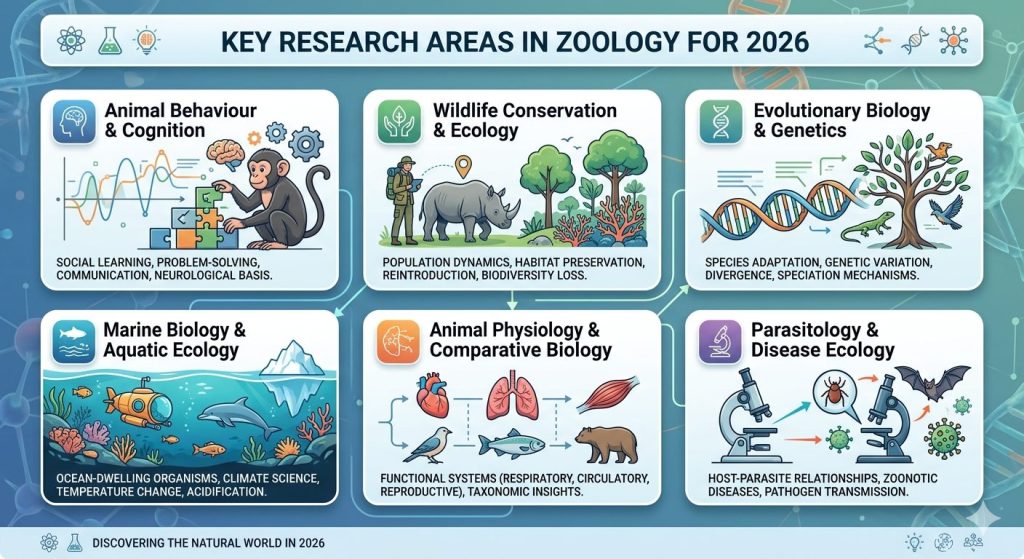
Zoology is a broad discipline that encompasses a wide range of specialisms. Understanding which research areas are currently active and academically significant can help you choose a topic that is both timely and well-supported by existing literature. The following areas represent established domains within zoology that continue to generate substantial academic interest in 2026.
Animal Behaviour and Cognition
This area examines how animals perceive, process, and respond to their environment. Research in 2026 continues to explore social learning, problem-solving, communication, and the neurological basis of behaviour across a wide range of species.
Wildlife Conservation and Ecology
Conservation biology remains one of the most urgent research priorities in zoology. Topics in this area focus on population dynamics, habitat preservation, species reintroduction, and the human factors that drive biodiversity loss.
Evolutionary Biology and Genetics
Evolutionary zoology explores the mechanisms behind species adaptation, genetic variation, and the long-term patterns of divergence and speciation. Advances in genomics have opened new opportunities for research in this area.
Marine Biology and Aquatic Ecology
Marine zoology covers the biology and behaviour of ocean-dwelling organisms, from marine mammals to invertebrates and fish. Research in this subfield often intersects with climate science, given the sensitivity of aquatic ecosystems to temperature change and ocean acidification.
Animal Physiology and Comparative Biology
This area investigates how animals function at the physiological level, including respiratory, circulatory, and reproductive systems. Comparative approaches allow researchers to draw insights across taxonomic groups.
Parasitology and Disease Ecology
Parasitology sits at the boundary of zoology and public health. Researchers in this area study host-parasite relationships, the spread of zoonotic diseases, and the ecological factors that enable pathogen transmission.
Zoology Dissertation Topics with Examples: Aims and Objectives
Understanding how to frame a dissertation topic academically is just as important as selecting one. Below are five structured examples to illustrate how a research aim and supporting objectives are developed from a topic idea. These zoology dissertation topics with examples are intended to guide your thinking rather than to be used directly as submission titles.
Example 1: Urban Foxes and Behavioural Adaptation
Topic: How do red foxes (Vulpes vulpes) modify foraging behaviour in response to urban food availability in British cities?
Research Aim: To investigate how increased access to anthropogenic food sources alters the nocturnal foraging strategies of urban red fox populations in the United Kingdom.
Research Objectives:
- To compare foraging time budgets between urban and peri-urban fox populations using GPS tracking data.
- To analyse dietary composition through scat analysis and determine the proportion of anthropogenic food in urban fox diets.
- To assess whether behavioural plasticity in foraging correlates with population density and habitat type.
Example 2: Coral Reef Fish and Climate Stress
Topic: The impact of elevated sea surface temperatures on the feeding behaviour and reproductive success of coral reef fish species in the Indo-Pacific region.
Research Aim: To evaluate how increasing ocean temperatures associated with climate change affect the ecological functioning and reproductive outputs of reef-associated fish communities.
Research Objectives:
- To document changes in feeding frequency and prey selection in thermally stressed reef fish populations.
- To compare reproductive success metrics between control and high-temperature experimental groups across three species.
- To identify which life history traits correlate most strongly with thermal tolerance in reef fish.
Example 3: Migratory Birds and Phenological Mismatch
Topic: Phenological mismatch between migratory songbird arrival dates and peak invertebrate availability in Northern Europe.
Research Aim: To determine the extent to which climate-driven shifts in invertebrate emergence timing are creating feeding deficits for long-distance migratory songbirds arriving in Northern Europe.
Research Objectives:
- To compile long-term arrival date datasets for three focal songbird species using citizen science records.
- To correlate arrival timing with temperature-linked invertebrate abundance data across a 20-year period.
- To assess whether phenological mismatch is associated with declining breeding success rates in focal species.
Example 4: Pollinator Decline and Agricultural Pesticides
Topic: The sub-lethal effects of neonicotinoid pesticides on the navigational ability and hive-return success of the European honeybee (Apis mellifera).
Research Aim: To examine whether sub-lethal exposure to commonly used neonicotinoid compounds impairs spatial memory and hive-return performance in managed honeybee colonies.
Research Objectives:
- To conduct controlled laboratory trials assessing navigational errors in exposed versus control bee groups.
- To measure foraging duration and hive-return rates under field conditions using RFID tagging.
- To compare cognitive performance metrics across different pesticide concentrations relevant to agricultural exposure.
Example 5: Megafauna Reintroduction and Trophic Cascades
Topic: Assessing the ecological outcomes of wolf (Canis lupus) reintroduction on vegetation structure and prey population dynamics in rewilded European landscapes.
Research Aim: To evaluate whether wolf reintroduction in European conservation zones generates measurable trophic cascades that improve ecosystem structure and biodiversity.
Research Objectives:
- To compare vegetation recovery indices in areas with and without wolf presence using satellite imagery analysis.
- To track behavioural changes in ungulate prey populations, focusing on grazing distribution and movement patterns.
- To assess whether observed trophic changes align with cascade models predicted for large carnivore reintroduction.
80 Zoology Dissertation Topics for 2026
The following list presents 80 original, academically sound, and researchable zoology research topics suitable for undergraduate, master’s, and PhD-level work. Topics are grouped under relevant subfield headings and numbered in fixed ranges to support easy reference.
Animal Behaviour and Cognition
- The role of social play in the development of predatory skills in juvenile domestic cats.
- Tool use and object permanence in New Caledonian crows: a comparative cognitive assessment.
- Alarm call specificity in meerkats (Suricata suricatta) in response to aerial versus terrestrial predators.
- The influence of early maternal separation on long-term anxiety-related behaviour in captive chimpanzees.
- Assessing problem-solving flexibility in corvids as a function of group size and social hierarchy.
- Territorial song complexity in the European robin (Erithacus rubecula) and its role in mate attraction.
- How does light pollution alter the nocturnal activity rhythms of hedgehogs (Erinaceus europaeus) in suburban habitats?
- Investigating lateralisation of limb preference in domestic horses during approach-avoidance tasks.
- The relationship between parasite load and exploratory behaviour in three-spined sticklebacks (Gasterosteus aculeatus).
- Evaluating the role of olfactory communication in inter-group conflict resolution in ring-tailed lemurs.
Wildlife Conservation and Endangered Species
- The effectiveness of wildlife corridors in maintaining genetic diversity in fragmented Scottish pine marten populations.
- Assessing the impact of ecotourism on the daily movement patterns of African savanna elephants.
- Camera trap monitoring as a non-invasive method for estimating Bengal tiger population density in Indian reserves.
- Evaluating community-based conservation schemes on snare removal rates and poaching incidence in Sub-Saharan Africa.
- The role of ex-situ captive breeding programmes in the recovery of the Spix’s macaw (Cyanopsitta spixii).
- Assessing genetic bottlenecks in reintroduced Eurasian lynx populations across Central Europe.
- How do shifting agricultural boundaries affect the ranging behaviour of African wild dogs (Lycaon pictus)?
- Evaluating the success of rewilding initiatives in restoring invertebrate communities in lowland English heathlands.
- Zoology research topics on wildlife conservation: examining the impact of drought frequency on lion pride structure in East Africa.
- Population viability analysis of the Amur leopard (Panthera pardus orientalis) under projected habitat loss scenarios.
Ecology, Ecosystems and Biodiversity
- The cascading effects of grey squirrel (Sciurus carolinensis) range expansion on woodland bird nesting success in Wales.
- Assessing invertebrate biodiversity as an indicator of soil health in rewilded versus conventionally farmed land.
- The role of large herbivores in shaping plant community structure in upland Scottish moorland.
- How does salinity fluctuation affect macroinvertebrate diversity in estuarine transition zones?
- Seasonal variation in bat species richness and foraging activity across an urban-rural gradient in Northern England.
- The influence of tree species diversity on insectivorous bird abundance in temperate mixed woodland.
- Assessing the ecological impact of American mink (Neovison vison) removal on water vole recovery in English river systems.
- Evaluating nitrogen deposition effects on moth species assemblages in ancient calcareous grasslands.
- How do beaver (Castor fiber) reintroductions affect freshwater macroinvertebrate communities and riparian vegetation structure?
- Investigating microhabitat use by reptile species in response to prescribed burning in lowland heath ecosystems.
Evolutionary Biology and Genetics
- Convergent evolution of venom composition in sea snakes and terrestrial elapids: a comparative genomic analysis.
- The genomic basis of melanism in urban versus rural populations of the peppered moth (Biston betularia).
- Evaluating phylogeographic structure in the European otter (Lutra lutra) using mitochondrial DNA markers.
- How does sexual selection shape colouration patterns in male great crested newts (Triturus cristatus)?
- Adaptive radiation in cichlid fish of the East African Rift Lakes: a morphological and genetic assessment.
- The role of hybridisation in the evolutionary trajectory of endangered Scottish wildcat populations.
- Investigating rapid morphological change in island bird populations following colonisation events.
- Genetic evidence for cryptic species within the common bumblebee (Bombus terrestris) complex in Western Europe.
- Comparative analysis of immunogenetic diversity in declining versus stable shorebird populations.
- The influence of inbreeding depression on reproductive fitness in small, isolated populations of the sand lizard (Lacerta agilis).
Marine Biology and Aquatic Ecology
- The effect of ocean acidification on the skeletal integrity and predator avoidance behaviour of juvenile sea urchins.
- Microplastic ingestion rates and tissue accumulation in common shore crabs (Carcinus maenas) in UK coastal waters.
- Assessing the recovery of seagrass meadows as nursery habitats following cessation of trawling in the North Sea.
- The behavioural response of bottlenose dolphins (Tursiops truncatus) to recreational boat traffic in Welsh coastal waters.
- Investigating the seasonal migration patterns of basking sharks (Cetorhinus maximus) using satellite tagging data.
- How do marine protected areas influence the biomass and size structure of commercially exploited fish species?
- The impact of freshwater discharge events on estuarine fish community composition and feeding ecology.
- Thermal tolerance thresholds and bleaching susceptibility in coral species endemic to the Maldivian reef system.
- Evaluating the foraging efficiency of grey seals (Halichoerus grypus) in relation to prey availability and tidal phase.
- How does artificial light at night affect the vertical migration behaviour of marine zooplankton?
Animal Physiology and Comparative Biology
- Thermoregulatory strategies in ectothermic reptiles under elevated ambient temperatures predicted for 2050 climate scenarios.
- The physiological cost of long-distance migration in red knots (Calidris canutus): organ remodelling and fat deposition patterns.
- Comparative analysis of immune function in wild versus captive populations of the Eurasian red squirrel (Sciurus vulgaris).
- How does altitude affect haematological parameters and oxygen-carrying capacity in Andean camelids?
- Investigating the hormonal regulation of seasonal coat change in mountain hares (Lepus timidus) under altered photoperiod conditions.
- The role of counter-current heat exchange in maintaining thermal homeostasis in Arctic seabird extremities.
- Comparative gut morphology and digestive efficiency in frugivorous versus insectivorous bat species.
- How do dehydration stresses affect renal function and urine concentration in desert-adapted small mammals?
- Investigating the reproductive endocrinology of the European badger (Meles meles) in relation to food availability.
- The effect of artificial light exposure on melatonin secretion and sleep architecture in captive nocturnal primates.
Parasitology, Disease Ecology and Zoonoses
- The prevalence and diversity of gastrointestinal parasites in free-ranging red deer (Cervus elaphus) across Scottish estates.
- Investigating the role of migratory waterfowl in the transboundary spread of avian influenza subtypes in Europe.
- How does urbanisation affect the tick burden and Borrelia burgdorferi prevalence in urban hedgehog populations?
- Evaluating the immunological response of bats to white-nose syndrome (Pseudogymnoascus destructans) infection in UK colonies.
- The ecological drivers of chytrid fungus (Batrachochytrium dendrobatidis) transmission in amphibian communities of the English uplands.
- Assessing parasite community structure in invasive versus native fish species within shared river systems.
- How does trophy hunting intensity affect the parasite burden and immune competence of lion populations in Zambia?
- The role of intermediate hosts in the life cycle of Echinococcus multilocularis in European wildlife populations.
- Investigating co-infection dynamics between helminth parasites and protozoa in African buffalo herds.
- Evaluating the effectiveness of oral rabies vaccination programmes on wildlife reservoir populations in Eastern Europe.
Field Research, Applied Zoology and Human-Wildlife Conflict
- Assessing the effectiveness of wildlife warning reflectors in reducing ungulate-vehicle collisions on rural Scottish roads.
- The influence of land use intensification on barn owl (Tyto alba) prey availability and breeding output in lowland England.
- Evaluating the use of environmental DNA (eDNA) as a monitoring tool for great crested newt (Triturus cristatus) populations.
- How do farmers’ attitudes and tolerance thresholds shape coexistence outcomes with large carnivores in Scandinavia?
- Investigating acoustic monitoring as a method for estimating freshwater mussel density in lowland chalk streams.
- The impact of road networks on the population connectivity and roadkill vulnerability of European amphibians.
- Assessing the suitability of citizen science data for tracking long-term changes in urban garden bird assemblages.
- How do invasive signal crayfish (Pacifastacus leniusculus) alter macroinvertebrate community structure in English chalk streams?
- Evaluating the ecological impact of domestic cat (Felis catus) predation on small mammal populations in rural UK villages.
- The use of remote sensing and drone technology in estimating population size and habitat use of wading birds in UK estuaries.
How to Choose the Right Zoology Dissertation Topic
With so many directions available within zoology, narrowing down to one focused topic can feel overwhelming. The following guidance is designed to help you approach this process in a structured and academically sound way.
Match Your Topic to Your Academic Level
Undergraduate dissertations typically require a clear, testable question and a manageable methodology, often involving field observation, secondary data, or a literature-based comparative study. Master’s dissertations are expected to demonstrate independent research design, a stronger theoretical framework, and engagement with the latest zoology research topics in your chosen subfield. PhD research must offer an original contribution to knowledge, which means your topic must sit at the frontier of current scientific understanding.
Consider Research Feasibility and Access
Your chosen topic must be achievable within your timeframe, budget, and access to equipment or study sites. Topics involving remote fieldwork, endangered species, or restricted habitats may require additional ethical approvals and logistical planning. Always discuss feasibility with your supervisor early in the process.
Align with Current Research Gaps
Reading recent literature in your chosen subfield is essential. Review journals such as the Journal of Animal Ecology, Animal Behaviour, Conservation Biology, and PLOS ONE to identify where active debates are taking place and where evidence remains limited. This is where your dissertation can make a genuine contribution.
Seek Guidance When Needed
Many students benefit from zoology dissertation help during the topic selection stage, particularly when they are unsure how to transform a general interest into a focused research question. Speaking to your department’s dissertation coordinator, attending academic writing workshops, and consulting with peers who have already completed their dissertations are all valuable steps.
Conclusion
Selecting a dissertation topic in zoology for 2026 is a genuinely exciting opportunity to contribute to some of the most pressing scientific questions of our time. Whether your interest lies in animal behaviour, wildlife conservation, evolutionary biology, or marine ecology, the field offers a rich landscape of researchable questions that matter both academically and in the wider world.
The 80 zoology thesis topics presented in this post are designed to spark ideas and demonstrate the variety of directions available to you. Each topic has been selected for its academic relevance, its feasibility as a research project, and its alignment with current scientific priorities. None of them are exhaustive; they are starting points for refinement and adaptation to your own context, institutional requirements, and supervisor expertise.
Informed topic selection is not a small decision. It shapes your relationship with the research process, your ability to sustain motivation across months of work, and ultimately the quality of the dissertation you submit. Approach the decision with curiosity, take the time to read widely before committing, and do not hesitate to seek dissertation writing help if you find the process challenging.
Zoology as a discipline thrives on careful observation, rigorous methodology, and a genuine respect for the natural world. Bring those values to your dissertation topic, and you will be well placed to produce research you can be proud of.
