


Business Psychology Dissertation Topics for 2026

What Students Are Asking — Questions from Forums and Academic Platforms
Before diving into the content, here are some of the most common questions gathered from student forums, Reddit threads, and academic discussion platforms. If you have asked any of these yourself, this post was written for you.
- “What are the most relevant business psychology dissertation topics for 2026?”
- “How do I choose a business psychology dissertation topic that is not too broad?”
- “What business psychology research topics are suitable for a master’s level thesis?”
- “Can I get business psychology dissertation topics with examples to understand structure?”
- “What are the latest business psychology research topics aligned with current workplace trends?”
- “Which organisational psychology dissertation topics work best for undergraduate research?”
- “Is workplace psychology dissertation research different from general organisational behaviour research?”
- “Where can I get business psychology dissertation help if I feel stuck on topic selection?”
Why Choosing the Right Business Psychology Dissertation Topic Matters
Choosing a dissertation topic is one of the most consequential decisions you will make during your academic programme. In a field as applied and dynamic as business psychology, topic selection can determine not only your grade but also the academic contribution your research makes.
Business psychology sits at the intersection of psychological science and organisational practice. It draws on theories of behaviour, motivation, and cognition to understand how people function within workplace environments. This makes it a uniquely rich field for research. However, it also means the scope can feel overwhelming, particularly for students choosing a topic for the first time.
A well-chosen topic gives your research a clear direction. It helps your supervisor understand what you are investigating and why. It also signals to your institution that you are capable of independent academic thinking. Whether you are completing an undergraduate project or pursuing a PhD, your topic must be specific, researchable, and grounded in current academic discourse.
Many students underestimate how much the topic shapes the entire dissertation process. A topic that is too vague leads to unfocused literature reviews. A topic that is too narrow may lack sufficient published sources. The right balance is precise but not restrictive, ambitious but not unmanageable.
If you are feeling uncertain about where to begin, you are not alone. Seeking online dissertation help during this stage is a sensible and increasingly common approach taken by students across disciplines worldwide.
Download Business Psychology Dissertation Topics PDF
For students who want a more personalised approach to topic selection, a downloadable PDF containing a curated list of business psychology dissertation topics is available through a short form. The list is prepared by academic specialists with experience across undergraduate, master’s, and doctoral-level dissertation supervision.
Once you complete the short form, the PDF is sent directly to you. The topics are aligned with your level of study and research interests, offering a tailored starting point rather than a generic list.
Key Research Areas in Business Psychology
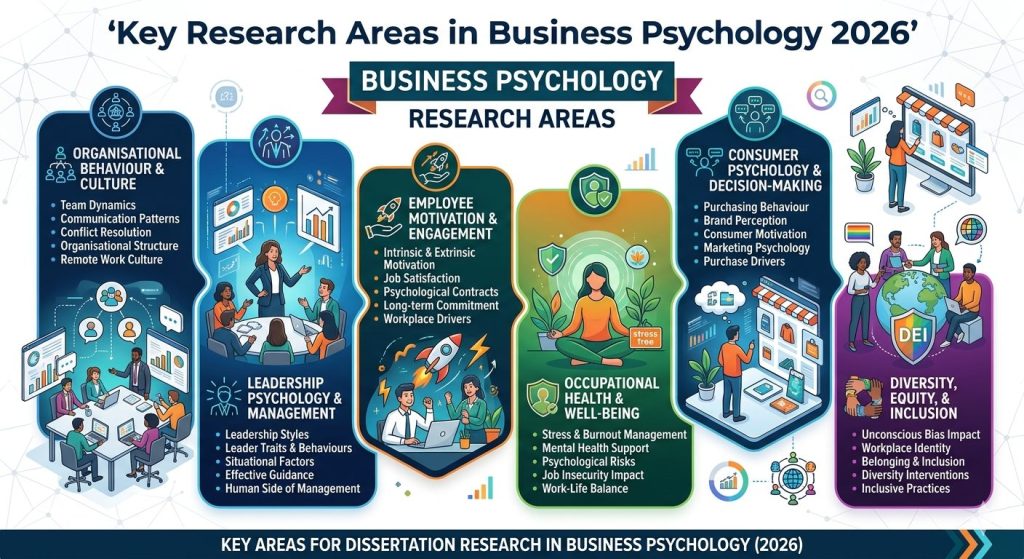
Business psychology is a broad discipline with several well-established research domains. Students often benefit from understanding the major subfields before narrowing down a specific topic. Below are the primary areas where academic research in business psychology is currently active and growing.
Organisational Behaviour and Workplace Culture
This area examines how individuals and groups behave within organisations. It covers topics such as team dynamics, communication patterns, conflict resolution, and the psychological effects of organisational structure. Workplace culture has gained particular academic attention in recent years, especially following shifts in how and where people work.
Leadership Psychology and Management
Leadership psychology explores how different leadership styles influence employee outcomes. Research in this area draws on psychological frameworks to examine traits, behaviours, and situational factors that distinguish effective leaders. This subfield is highly relevant for students interested in the human side of management.
Employee Motivation and Engagement
Understanding what drives people to perform well at work is central to business psychology. Research in this area explores intrinsic and extrinsic motivation, job satisfaction, psychological contracts, and the conditions that sustain long-term employee engagement. This is one of the most prolific research areas in the field.
Occupational Health and Well-being
This subfield looks at the psychological risks and protective factors associated with work. It includes burnout, stress, mental health support in the workplace, and the psychological impact of job insecurity. Research here is closely connected to human resource management and public health.
Consumer Psychology and Decision-Making
This area investigates how psychological principles influence purchasing behaviour, brand perception, and consumer decision-making. It connects marketing strategy with psychological science, making it highly relevant for business students with an interest in consumer-facing industries.
Diversity, Equity, and Inclusion in Organisations
Research in this area examines the psychological dimensions of diversity and inclusion, including the impact of unconscious bias, identity in the workplace, belonging, and the effectiveness of diversity interventions. This is one of the fastest-growing areas of academic interest.
Five Example Dissertation Topics with Research Aims and Objectives
Understanding how a strong dissertation topic is structured can help you build your own. The following five examples demonstrate how a focused research question translates into a clear aim and specific objectives.
Example 1: Remote Work and Psychological Wellbeing
Topic: The Psychological Effects of Permanent Remote Work on Employee Well-being in UK-Based Financial Services Firms
Research Aim: To examine how sustained remote working conditions affect the psychological well-being of employees in the UK financial sector.
Objectives:
- To identify the key psychological stressors associated with permanent remote work in financial services environments
- To assess the relationship between remote work autonomy and reported levels of job satisfaction
- To evaluate the effectiveness of current employer-led mental health interventions for remote workers
Example 2: Transformational Leadership and Motivation
Topic: Transformational Leadership and Its Influence on Intrinsic Employee Motivation in Technology Startups
Research Aim: To explore how transformational leadership behaviours affect intrinsic motivation among employees in early-stage technology companies.
Objectives:
- To analyse the specific leadership behaviours that predict higher levels of intrinsic motivation
- To compare motivation levels in organisations with and without transformational leadership structures
- To examine whether organisational size moderates the relationship between leadership style and motivation
Example 3: Unconscious Bias in Recruitment
Topic: The Role of Unconscious Bias in Graduate Recruitment Decisions Within FTSE 100 Organisations
Research Aim: To investigate how unconscious bias influences graduate recruitment outcomes in large UK corporations.
Objectives:
- To identify the stages of graduate recruitment most vulnerable to unconscious bias
- To examine the psychological mechanisms underlying bias in structured interview settings
- To assess whether unconscious bias training reduces discriminatory recruitment decisions
Example 4: Burnout and Organisational Culture
Topic: Organisational Culture as a Predictor of Employee Burnout in Healthcare Management Roles
Research Aim: To examine how specific dimensions of organisational culture contribute to burnout in healthcare management professionals.
Objectives:
- To identify cultural characteristics most strongly associated with elevated burnout rates
- To explore the role of perceived organisational support in buffering burnout risk
- To recommend evidence-based cultural interventions to reduce burnout incidence
Example 5: Psychological Safety and Team Performance
Topic: Psychological Safety and Its Impact on Innovation and Performance in Cross-Functional Business Teams
Research Aim: To evaluate the relationship between psychological safety and creative performance outcomes in cross-functional teams.
Objectives:
- To measure psychological safety levels across different team configurations
- To examine whether psychological safety mediates the relationship between leadership style and team innovation
- To identify organisational conditions that foster high psychological safety in cross-functional settings
80 Business Psychology Dissertation Topics for 2026
The following 80 topics are organised by subfield. Each one is narrow, academically grounded, and suitable for research proposals at undergraduate, master’s, or doctoral level. These reflect current directions in business psychology research and are appropriate for 2026-level academic expectations.
Organisational Behaviour and Workplace Culture
- The effect of hybrid working models on team cohesion and shared identity in multinational organisations
- How organisational silence contributes to dysfunctional workplace cultures in mid-sized enterprises
- The relationship between perceived organisational fairness and counterproductive work behaviours
- The psychological impact of open-plan office environments on employee concentration and satisfaction
- How social norms within organisational culture influence whistleblowing intentions
- The role of organisational storytelling in shaping employee values and behavioural norms
- The influence of bureaucratic organisational structures on employee autonomy and motivation
- Cultural tightness-looseness and its effect on workplace compliance and creativity
- The psychological consequences of role ambiguity in matrix organisational structures
- How workplace rituals and routines contribute to a sense of psychological belonging
Leadership Psychology and Management
- Authentic leadership and its influence on employee trust in public sector organisations
- The psychological mechanisms through which servant leadership improves employee retention
- How toxic leadership behaviours affect psychological safety in high-performance work teams
- Narcissistic leadership in SMEs and its impact on subordinate well-being
- Gender differences in perceived leadership effectiveness across STEM organisations
- The relationship between emotionally intelligent leadership and organisational commitment
- How leader humility shapes employee voice behaviour in hierarchical organisations
- Crisis leadership and the psychological outcomes for staff during organisational change
- The influence of remote leadership practices on employee motivation in distributed teams
- How leader-member exchange quality affects performance appraisal outcomes in UK organisations
Employee Motivation and Engagement
- The role of psychological contract fulfilment in sustaining long-term employee engagement
- How gamification in the workplace influences intrinsic motivation among knowledge workers
- The effect of performance-related pay on the intrinsic motivation of creative professionals
- Job crafting behaviours and their relationship to employee engagement in the service sector
- How perceived meaningfulness of work moderates the relationship between workload and burnout
- The psychological impact of micromanagement on employee autonomy and self-efficacy
- The role of peer recognition programmes in supporting sustained employee motivation
- How career growth opportunities influence the engagement of Generation Z employees
- The relationship between flexible working arrangements and employee motivation in legal firms
- Psychological ownership and its contribution to proactive work behaviour in retail organisatios
Occupational Health, Stress, and Well-being
- The relationship between emotional labour demands and burnout in frontline customer service roles
- How occupational stress manifests differently across gender in the UK financial services sector
- The psychological impact of zero-hours contracts on employee mental health and identity
- How access to employee assistance programmes influences recovery from work-related stress
- The role of social support at work in buffering the effects of job insecurity on mental health
- Compassion fatigue and its psychological correlates in business consulting roles
- The effect of organisational change on employee anxiety and resistance in restructuring periods
- How sleep quality and work-related rumination interact to affect productivity and well-being
- The psychological consequences of presenteeism in high-pressure financial trading environments
- Mindfulness-based interventions and their effectiveness in reducing workplace anxiety in SMEs
Diversity, Equity, and Inclusion
- The psychological experience of code-switching among ethnic minority professionals in UK boardrooms
- How inclusion climate perceptions affect innovation contribution in diverse project teams
- The relationship between intersectionality and workplace discrimination experiences in higher education institutions
- Allyship behaviour at work and its psychological impact on marginalised employee groups
- The effect of diversity training on unconscious racial bias in recruitment decision-making
- Psychological safety and its role in enabling authentic self-expression for LGBTQ+ employees
- How perceived tokenism affects job satisfaction and commitment among underrepresented professionals
- The psychological barriers to gender equity in senior leadership succession in UK corporations
- How microaggressions in hybrid workplaces affect the mental health of neurodiverse employees
- The relationship between inclusive leadership behaviours and belonging among disability-disclosed employee
Consumer Psychology and Decision-Making
- The role of cognitive biases in online consumer purchasing decisions in subscription-based services
- How colour psychology in digital retail environments influences impulse buying behaviour
- The psychological mechanisms underlying brand loyalty among millennial consumers in fashion retail
- Fear appeal messaging and its effectiveness in promoting sustainable consumer behaviour
- How scarcity cues on e-commerce platforms affect decision-making and purchase urgency
- The role of social proof in shaping consumer trust towards AI-driven product recommendations
- How emotional advertising strategies influence long-term brand attachment in luxury goods markets
- The psychological effects of dynamic pricing on perceived fairness and repurchase intentions
- How consumers psychologically process negative brand reviews in experience-based industries
- The influence of choice overload on consumer satisfaction in digital streaming services
Talent Management, HRM, and Recruitment Psychology
- The psychological impact of algorithmic recruitment on candidate experience and fairness perceptions
- How personality assessments used in graduate recruitment predict long-term job performance
- The role of realistic job previews in reducing early-stage turnover among new hires
- Psychological safety during onboarding and its effect on new employee integration and retention
- How talent hoarding by managers affects employee development and organisational performance
- The relationship between perceived career support and organisational commitment in knowledge-intensive firms
- The psychological impact of rejection feedback on candidate self-efficacy in competitive graduate markets
- How employer branding perceptions shape the employment expectations of Generation Z applicants
- The role of internal mobility opportunities in sustaining employee motivation during economic uncertainty
- How performance management systems influence employee psychological responses to feedback in global firms
Emerging and Digital Workplace Psychology
- The psychological effects of constant connectivity and digital presenteeism in remote-first organisations
- How artificial intelligence integration in the workplace affects employee identity and role clarity
- The relationship between technostress and employee burnout in digitally transformed manufacturing firms
- How virtual reality onboarding programmes influence new employee confidence and social integration
- The psychological consequences of surveillance technology on employee autonomy and trust in organisations
- How social media use during work hours influences cognitive attention and task performance
- Digital leadership competencies and their relationship to remote employee well-being and performance
- The psychological impact of automation anxiety on skill development motivation in administrative roles
- How digital feedback tools shape employee perceptions of performance fairness in agile organisations
- The role of online communities of practice in supporting employee learning and psychological belonging in distributed teams
How to Choose the Right Topic for Your Level
Not every topic suits every student. The right topic depends on your academic level, the resources available to you, and your access to research participants or data.
Undergraduate Students
At undergraduate level, your dissertation topic should be focused and manageable within a shorter timeframe. Topics that rely on surveys, interviews, or case studies of single organisations tend to work well. Avoid topics that require access to longitudinal data or highly sensitive organisational records. Topics numbered 1, 2, 10, 22, 51, and 55 in the list above are particularly accessible at this level.
Master’s Students
Master’s level research should demonstrate theoretical engagement and methodological competence. You are expected to critically evaluate existing literature and offer nuanced findings. Topics that involve comparing groups, testing moderating variables, or exploring under-researched organisational contexts are appropriate. Workplace psychology dissertation research at master’s level often benefits from mixed-method approaches.
PhD Candidates
PhD research must offer an original contribution to knowledge. Topics should address a genuine gap in the literature and be theoretically informed. You are expected to design a study that can withstand peer scrutiny and withstand examination. Topics involving longitudinal designs, cross-cultural comparisons, or novel frameworks are well-suited to doctoral investigation. If you are seeking psychology dissertation writing service support at this level, ensure that any assistance you receive is ethical and compliant with your institution’s policies.
Conclusion
Selecting a dissertation topic in business psychology is both an intellectual and a personal decision. The topic you choose reflects your interests, your academic maturity, and your ability to think critically about real-world problems in workplace environments.
This post has outlined 80 carefully constructed business psychology thesis topics, explained the key subfields driving current research, and provided structured examples to help you understand what a strong topic looks like in practice. Whether your interest lies in leadership psychology, consumer behaviour, occupational well-being, or the psychology of digital workplaces, there is a viable and academically rich topic available to you.
Informed topic selection is not just a starting point. It is a foundation. Students who invest time in choosing the right topic are better positioned to write focused literature reviews, design coherent methodologies, and produce dissertations that supervisors value.
Approach your dissertation with curiosity, intellectual honesty, and a willingness to engage seriously with the existing body of knowledge. If you are still uncertain, revisiting the example topics, exploring the PDF download, or speaking with your supervisor are all constructive next steps. You do not need to navigate this process alone.
