


Construction Dissertation Topics for 2026
Questions Students Are Asking About Construction Dissertations
The following questions have been gathered from student forums, academic discussion boards, and university help platforms. They reflect the real concerns students face when trying to find a suitable dissertation topic in construction.
- What are the best construction dissertation topics for 2026?
- How do I choose a topic that is relevant and academically strong?
- What are the research topics for construction at undergraduate level?
- Are there construction dissertation topics that suit master’s and PhD research?
- Can I download construction dissertation topics to compare ideas?
- What research areas are currently trending in construction studies?
- How do I structure my dissertation aim and objectives around a construction topic?
If any of these questions sound familiar, this guide is written specifically for you.
Why Choosing the Right Construction Dissertation Topic Matters
Selecting a dissertation topic is one of the most important academic decisions a construction student will make. A well-chosen topic sets the direction for your entire research journey. It shapes the methods you use, the literature you review, and the conclusions you can draw.
Construction is a broad and evolving field. It sits at the intersection of engineering, project management, environmental science, law, and digital technology. Students who pick a topic that is too vague often struggle to produce focused research. On the other hand, students who select a topic grounded in current industry challenges tend to produce work that examiners find both credible and relevant.
Choosing the right construction dissertation topic also helps you contribute meaningfully to the academic body of knowledge. Whether you are writing at undergraduate, master’s, or doctoral level, your topic should be narrow enough to investigate properly but significant enough to matter.
If you are feeling overwhelmed, you are not alone. Many students find that accessing quality online dissertation help at this early stage makes a significant difference in the direction and confidence of their work.
Download Construction Dissertation Topics PDF
Students who prefer to explore topics offline or want a curated list tailored to their academic level can request a downloadable PDF. This document is prepared by academic experts with experience in construction research and dissertation supervision.
The PDF contains a personalised selection of construction dissertation ideas, organised by subfield and academic level. Students can access it by completing a short form, after which the document is sent directly to their inbox. It is designed to help students compare topics, assess research suitability, and begin developing their proposal with greater clarity.
Key Research Areas in Construction Studies
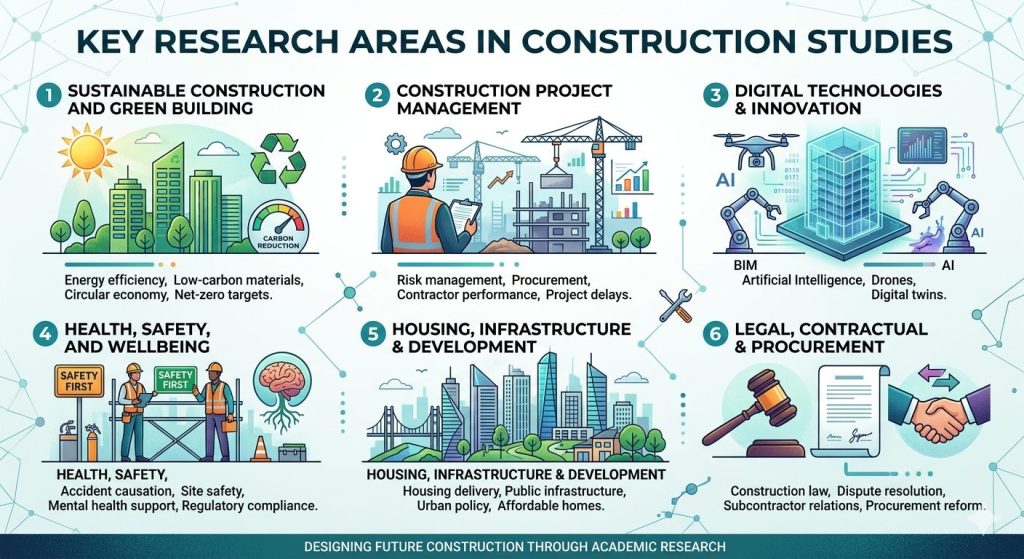
Before exploring specific construction dissertation topics, it helps to understand the main research areas within the field. These domains reflect established academic disciplines and active areas of industry concern.
Sustainable Construction and Green Building
This area focuses on reducing the environmental impact of the built environment. Research in this domain covers energy efficiency, low-carbon materials, circular economy principles, and net-zero construction targets.
Construction Project Management
This domain examines how construction projects are planned, executed, and controlled. Topics here explore risk management, procurement strategies, contractor performance, and project delays.
Digital Technologies and Construction Innovation
Building Information Modelling (BIM), artificial intelligence, drones, and digital twins are transforming how buildings are designed and built. Research in this area sits at the cutting edge of industry practice.
Health, Safety, and Wellbeing on Construction Sites
Worker safety remains a critical concern globally. Research in this area explores accident causation, mental health on site, safety culture, and regulatory compliance.
Housing, Infrastructure, and Urban Development
This domain addresses the planning, delivery, and governance of housing and public infrastructure. It is particularly relevant to students interested in policy, urban growth, and affordable housing.
Legal, Contractual, and Procurement Issues
Construction law and contract management form a specialist area within the field. Topics here examine dispute resolution, subcontractor relationships, and procurement reform.
Five Example Dissertation Topics With Aims and Objectives
The following examples show how a strong construction dissertation topic is structured at an academic level. Each includes a clear research aim and two to three objectives.
Example 1: Carbon Reduction in UK House Building
Research Aim: To examine the effectiveness of low-carbon construction methods in reducing embodied carbon in new residential buildings in the United Kingdom.
Research Objectives:
- To review current low-carbon construction techniques used in residential development
- To assess how embodied carbon is measured and reported across UK house building projects
- To identify the barriers preventing wider adoption of carbon-efficient materials
Example 2: BIM Adoption in Small and Medium-Sized Construction Firms
Research Aim: To investigate the challenges and drivers of Building Information Modelling (BIM) adoption among small and medium-sized construction enterprises (SMEs).
Research Objectives:
- To identify the key barriers SMEs face when implementing BIM workflows
- To examine how BIM adoption levels differ between SMEs and large contractors
- To propose a practical framework to support BIM uptake in smaller firms
Example 3: Mental Health Challenges Among Construction Workers
Research Aim: To explore the prevalence of mental health issues among construction site workers and evaluate the effectiveness of current workplace support programmes.
Research Objectives:
- To analyse existing literature on mental health prevalence in the construction sector
- To examine what mental health initiatives are currently offered by major UK contractors
- To assess worker perceptions of the stigma associated with seeking mental health support
Example 4: Delays in Public Infrastructure Projects
Research Aim: To investigate the primary causes of time overruns in publicly funded infrastructure projects and their impact on project outcomes.
Research Objectives:
- To identify the most commonly reported causes of delay in public sector construction
- To compare delay patterns across road, rail, and utility infrastructure types
- To evaluate the effectiveness of current delay mitigation strategies
Example 5: Women in Construction Leadership
Research Aim: To examine the structural and cultural barriers preventing women from reaching senior leadership roles within the construction industry.
Research Objectives:
- To review gender representation data across management levels in UK construction firms
- To identify the institutional and interpersonal barriers faced by women in the sector
- To explore the policy and organisational interventions that have shown the most promise
80 Construction Dissertation Topics for 2026
The following construction dissertation ideas are organised by subfield. All topics are suitable for 2026-level research and can be adapted for undergraduate, master’s, or PhD proposals.
Sustainable Construction and Net-Zero Goals
- Assessing the role of mass timber construction in achieving net-zero carbon targets in residential developments
- The effectiveness of BREEAM certification in improving environmental outcomes on commercial construction projects
- Barriers to implementing circular economy principles in demolition and construction waste management
- Comparing embodied carbon measurement methods across major UK housebuilding firms
- The impact of energy performance certificates on construction design decisions in new-build housing
- Evaluating the use of recycled aggregates in structural concrete for low-carbon construction
- Green roofs and their contribution to urban heat island mitigation in UK cities
- Whole-life carbon assessment in public buildings: practices, challenges, and policy gaps
- The feasibility of carbon capture technologies in large-scale construction supply chains
- Passive house design standards and their commercial viability in the UK housing market
Digital Technologies in Construction
- The impact of artificial intelligence on cost estimation accuracy in large construction projects
- Digital twin technology: opportunities and limitations for infrastructure lifecycle management
- Drone surveillance on construction sites: effectiveness in quality assurance and safety monitoring
- How machine learning tools are improving schedule management in complex construction programmes
- Augmented reality applications in on-site training for construction operatives
- Evaluating the return on investment of BIM Level 2 adoption in medium-sized contractors
- Cyber security risks in BIM-enabled construction projects: identifying vulnerabilities and responses
- The role of construction management software in reducing project delays
- Blockchain applications in construction procurement and contract transparency
- Assessing the reliability of automated quantity take-off tools compared with manual methods
Construction Project Management
- Risk allocation strategies in NEC4 contracts and their effect on project performance
- The relationship between procurement method selection and construction project outcomes in the public sector
- Earned value management as a performance measurement tool in infrastructure projects
- How project governance structures influence the success of large-scale construction programmes
- Exploring the impact of supply chain disruptions on project delivery timelines post-COVID-19
- Integrated project delivery models: a comparative analysis with traditional contracting approaches
- The effectiveness of collaborative planning techniques such as Last Planner System in reducing waste
- Contractor selection criteria and their relationship to project success in local authority construction
- Dispute avoidance mechanisms in JCT contracts: a practitioner perspective
- Managing scope creep in design-and-build projects: causes, consequences, and mitigation strategies
Health, Safety, and Worker Wellbeing
- The influence of safety leadership behaviour on accident rates on UK construction sites
- Evaluating the effectiveness of toolbox talks as a safety communication method in construction
- Mental health stigma among male construction workers: a qualitative investigation
- The impact of working at height regulations on fall-related incidents in UK construction
- Heat stress and outdoor construction work: occupational health risks and employer responses
- Safety culture assessment tools: a critical review of their application in the construction industry
- The relationship between subcontractor management practices and site safety performance
- Wearable technology for real-time health monitoring on construction sites: adoption and accuracy
- Night-time construction work and its effects on worker fatigue, safety, and mental wellbeing
- Pre-qualification requirements and their impact on subcontractor safety standards
Housing and Residential Construction
- Offsite manufacturing and its potential to address the UK housing shortage
- The role of modular construction in delivering affordable housing for local authorities
- Planning permission delays and their impact on housing delivery in urban areas
- Intergenerational housing design: how construction standards are adapting to an ageing population
- The viability of self-build housing as a model for expanding home ownership in rural England
- Retrofit programmes for energy efficiency in older residential stock: challenges and outcomes
- Social housing construction quality: comparing traditional and modern methods of construction
- First-time buyer affordability and the role of government-led construction incentive schemes
- The impact of the building safety act 2022 on high-rise residential construction practices
- Community land trusts and their influence on sustainable residential development in urban areas
Infrastructure and Civil Engineering
- Evaluating the cost-effectiveness of whole-life costing in highway infrastructure procurement
- The impact of climate change on transport infrastructure resilience in coastal regions of the UK
- Underground utility mapping and its role in reducing construction delays on urban sites
- Smart motorway technology: construction implications and safety performance assessments
- Bridge inspection methodologies: comparing traditional and drone-assisted approaches
- The effectiveness of earthworks monitoring technology in reducing ground movement risks on rail projects
- Net biodiversity gain requirements under the Environment Act 2021: implications for infrastructure delivery
- Carbon footprint comparison of steel versus concrete framing in major infrastructure construction
- Managing utility diversions on large linear infrastructure projects: contractor challenges and best practices
- The role of geotechnical investigation in reducing unforeseen ground conditions claims
Legal, Contractual, and Procurement Issues
- Adjudication as a dispute resolution mechanism in construction: its effectiveness and limitations
- How the Construction Act 1996 has shaped payment practices across the UK supply chain
- Contract risk allocation in PFI and PPP projects: a critical assessment of lessons learned
- Retentions reform in UK construction: the case for change and resistance from industry stakeholders
- The role of early contractor involvement in reducing procurement inefficiency on public projects
- Framework agreements in local authority construction: benefits, limitations, and supplier experiences
- Fitness-for-purpose obligations in design-and-build contracts: legal implications for contractors
- Novation of professional appointments in two-stage design-and-build procurement: risk implications
- The influence of contract type on collaborative working behaviours in construction projects
- Extension of time claims under JCT and NEC contracts: a comparative analysis
Construction Workforce and Industry Trends
- Skills shortages in the UK construction workforce: causes, consequences, and workforce planning responses
- The impact of Brexit on construction labour supply and project costs in England
- Apprenticeship completion rates in construction trades: barriers and enablers to success
- Diversity and inclusion practices in large UK construction firms: progress and persistent gaps
- The mental health of construction project managers: workload, stress, and coping strategies
- Generational differences in technology adoption among construction site operatives
- The role of professional bodies such as the CIOB in raising standards across the construction sector
- Graduate retention in construction consultancies: what motivates early career professionals to stay
- The impact of hybrid working on project team collaboration in construction consultancy firms
- Construction dissertation topics undergraduate research demand: how student research priorities are shaping industry awareness of emerging field gaps
Conclusion
Selecting a strong dissertation topic in construction is a thoughtful process that requires understanding your academic level, the current state of the industry, and where your own interests lie. This post has covered 80 well-researched construction dissertation ideas suitable for 2026, supported by example topics with structured aims and objectives, and an overview of the key research areas within the field.
The construction industry is changing rapidly. Digital transformation, net-zero commitments, safety reform, and workforce change are all reshaping how buildings and infrastructure are delivered. Students who align their research with these real-world challenges are more likely to produce work that is both academically rigorous and practically meaningful.
Wherever you are in the topic selection process, approach your dissertation with honesty, academic integrity, and a genuine curiosity about the problem you want to investigate. The topic you choose should be one you can commit to for the duration of your research journey.
If you need further support with topic refinement or research design, speaking with your academic supervisor early is always the best first step. Seeking structured construction dissertation examples from your institution’s library is another excellent way to understand what examiners expect at your level.
You have more academic potential than you may realise. A well-chosen topic is just the beginning.
