


Economics Dissertation Topics for 2026
Common Questions from Students About Economics Dissertation Topics
When students begin researching economics dissertation topics, they often find themselves asking similar questions. These questions come from real discussions on university forums, academic subreddits, and student mentoring platforms. Below are the questions you might be asking right now.
What are students actually asking?
- How do I choose an economics dissertation topic that is narrow enough to be researchable but broad enough to have academic value?
- What are the latest economics research topics that will still be relevant in 2026 and beyond?
- How do I know if my topic idea is suitable for my academic level, whether I am an undergraduate, master’s student, or doctoral candidate?
- Are there economics dissertation topics that combine emerging trends like artificial intelligence, climate change, or digital currencies with traditional economic theory?
- How can I ensure my economics dissertation topic aligns with what universities are looking for in 2026?
- Where can I find examples of well-structured macroeconomics dissertation topics and microeconomics dissertation topics to guide my thinking?
- How do I avoid choosing a topic that is either too vague or too narrow for a proper dissertation?
These questions reflect genuine concerns about making an informed choice. The answer to each one lies in understanding both your discipline and the current landscape of economics research.
Why Choosing the Right Economics Dissertation Topic Matters
Selecting your dissertation topic is arguably the most important academic decision you will make during your university years. Your topic determines not only what you will research and write about, but also how engaged you will feel during the dissertation process itself. A well-chosen topic can transform your research into an exciting intellectual journey, whilst a poorly selected one can feel like a burden from start to finish.
In economics specifically, your choice of topic signals to supervisors, examiners, and future employers what you understand about the discipline and where your academic interests lie. A strong economics dissertation topic demonstrates that you can identify gaps in existing research, understand current debates in the field, and propose a focused research question that contributes meaningfully to knowledge. When examiners assess your work, they are not just looking at your findings; they are evaluating whether you have engaged with a topic that is academically defensible, relevant, and appropriately scoped for your level of study.
The discipline of economics has changed significantly over the past decade. Traditional approaches to economic analysis now sit alongside behavioural economics, computational methods, sustainability concerns, and global inequality issues. This means that the economics dissertation topics available to you in 2026 are richer and more varied than ever before. Your task is to find a topic that excites you intellectually whilst remaining grounded in sound economic theory and methodology.
Key Research Areas in Economics You Can Explore
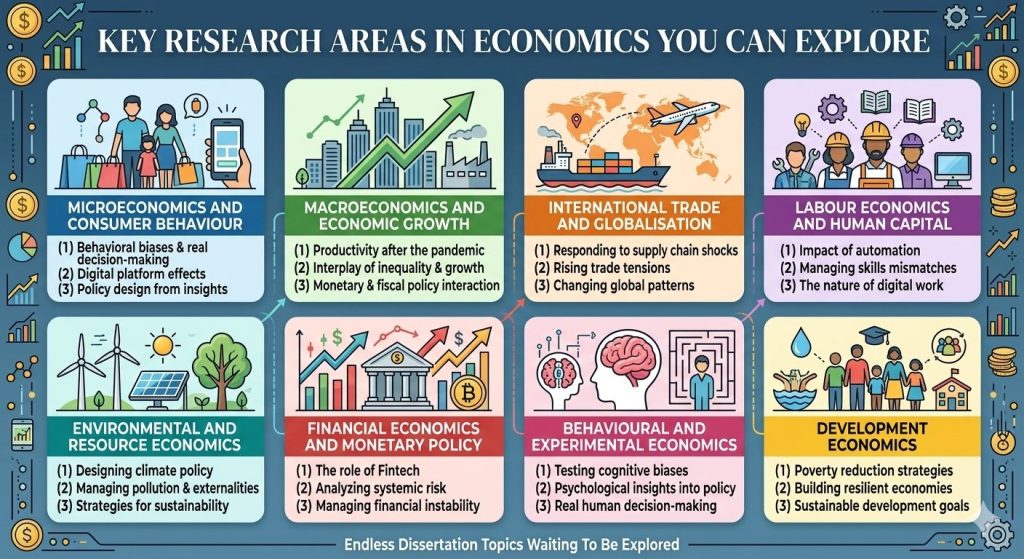
Before diving into specific dissertation topics, it helps to understand the main subfields and research directions within economics. These areas represent where most academic research and professional practice happens. Within each area, countless dissertation topics are waiting to be explored.
Microeconomics and Consumer Behaviour
Microeconomics examines how individuals, households, and firms make decisions about production and consumption. Modern microeconomics research increasingly focuses on how real people deviate from rational choice theory, how digital platforms affect consumer choices, and how behavioural insights can improve policy design. This is a rich area for dissertation research.
Macroeconomics and Economic Growth
Macroeconomics looks at entire economies, focusing on inflation, unemployment, economic growth, and the role of government policy. Current research in this area explores questions about productivity in the post-pandemic world, the relationship between inequality and growth, and how monetary and fiscal policy interact in an interconnected global economy.
International Trade and Globalisation
This field examines how countries, firms, and workers benefit from or are harmed by trade. With supply chain disruptions, trade tensions, and changing globalisation patterns, international trade remains a vibrant research area for students who want to understand real-world economic challenges.
Labour Economics and Human Capital
Labour economics studies how people earn income, develop skills, and transition between jobs. Current research addresses automation, wage inequality, skills mismatches, and the changing nature of work in the digital age.
Environmental and Resource Economics
Environmental economics applies economic thinking to problems like climate change, pollution, and sustainable resource use. This is an increasingly important area as policymakers seek evidence-based approaches to environmental challenges.
Financial Economics and Monetary Policy
This field examines how financial markets work, how central banks influence the economy, and what causes financial instability. Recent years have brought new research questions around cryptocurrencies, financial technology, and systemic risk.
Behavioural and Experimental Economics
Behavioural economics combines insights from psychology and economics to understand real human decision-making. This is a dynamic and growing field with applications across policy, business, and society.
Development Economics
Development economics focuses on poverty reduction, economic growth in low-income countries, and strategies for sustainable development. It remains one of the most socially impactful areas of economic research.
Five Worked Examples: Economics Dissertation Topics With Clear Research Aims
To help you understand how a strong dissertation topic is structured, here are five examples of well-developed economics dissertation topics. Each includes a clear research aim and specific research objectives that could guide an actual dissertation project. These examples span different economic subfields and academic levels.
Example 1: The Role of Supply Chain Transparency in Reducing Price Volatility in Agricultural Markets
Research Aim: To investigate how transparency in agricultural supply chains influences price stability and farmer income in developing economies.
Research Objectives:
- To analyse historical data on price volatility in regions with varying levels of supply chain transparency.
- To examine how digital tools and traceability systems affect information flow between producers and buyers.
- To evaluate the impact of transparency interventions on farmer welfare and market efficiency.
This topic combines international trade, development economics, and practical policy questions. It is suitable for a master’s dissertation.
Example 2: Monetary Policy Transmission Mechanisms in a Digital Currency Environment
Research Aim: To assess how the introduction of central bank digital currencies alters traditional channels through which monetary policy affects the real economy.
Research Objectives:
- To review existing literature on monetary policy transmission and identify gaps where digital currencies create new challenges.
- To build a theoretical model of how digital currency adoption changes interest rate pass-through and liquidity management.
- To conduct comparative analysis of monetary policy effectiveness in economies that have introduced digital currencies.
This is a cutting-edge macroeconomics topic suitable for PhD research or advanced master’s work.
Example 3: Gender Wage Gaps in Tech Industry Occupations: A Longitudinal Analysis
Research Aim: To examine the drivers of wage inequality between men and women in technology sector roles over a ten-year period.
Research Objectives:
- To collect and analyse wage data disaggregated by gender, role type, and years of experience in the tech industry.
- To identify which factors (education, job type, career breaks, discrimination) contribute most to observed wage gaps.
- To recommend evidence-based policy interventions that could reduce wage inequality in tech careers.
This labour economics topic is suitable for master’s level research and addresses a socially relevant question.
Example 4: Carbon Pricing and Industrial Competitiveness: Evidence From the European Union Emissions Trading System
Research Aim: To analyse how carbon pricing policies affect the competitiveness and emissions intensity of energy-intensive industries.
Research Objectives:
- To compare emissions reductions achieved in covered versus non-covered sectors.
- To examine whether carbon leakage occurred and where emissions-intensive production relocated.
- To assess the effectiveness of exemptions and allowance allocations in protecting competitive industries.
This environmental economics topic combines policy analysis with empirical methods suitable for master’s research.
Example 5: Behavioural Biases in Retail Investor Trading Behaviour: A Study of Online Brokers
Research Aim: To identify and quantify the most common behavioural biases affecting retail investors’ trading decisions in online platforms.
Research Objectives:
- To review psychological research on cognitive biases and relate these to observed patterns in retail investor behaviour.
- To analyse transaction data from online brokers to identify signatures of overconfidence, herding, and loss aversion.
- To develop practical recommendations for platforms and regulators to reduce costly biases in retail investing.
This behavioural and financial economics topic is suitable for an undergraduate honours dissertation or master’s research.
Download Economics Dissertation Topics PDF
Throughout your dissertation journey, having access to a curated list of relevant topics can be incredibly valuable. Many students find that reviewing a collection of carefully selected economics research topics helps them refine their own ideas and ensures they are not missing important areas of the field.
We have compiled a comprehensive PDF resource containing a personalised selection of dissertation topics across all major subfields of economics. This resource is designed for students at all academic levels, whether you are beginning an undergraduate honours project, pursuing a master’s degree, or undertaking doctoral research. The PDF includes topic descriptions, suitable academic levels, and guidance on how to adapt topics to suit your specific interests and circumstances.
To receive your free PDF download, you can complete a short form through which you share your academic level, area of interest within economics, and any specific preferences for your research focus. Once submitted, you will receive the PDF directly, allowing you to explore 80+ unique economics dissertation topics organised by subfield. This resource has been created by academic experts with years of experience in higher education and dissertation supervision, so the topics reflect current research directions and genuine academic value.
80 Economics Research Topics Organised by Subfield
Below is a comprehensive collection of 80 economics research topics suitable for dissertation work at undergraduate, master’s, and PhD levels. These topics are organised under meaningful subheadings based on key areas within the discipline. Each topic is researchable, academically sound, and relevant to 2026-level research expectations.
Microeconomics and Consumer Behaviour
- How do subscription-based pricing models affect consumer purchasing behaviour and long-term customer value in digital markets?
- The impact of social media influencer recommendations on purchasing decisions among Gen Z consumers in fashion retail.
- Price discrimination strategies in airline revenue management: effects on consumer welfare and market efficiency.
- Consumer preference for sustainable products versus price sensitivity: evidence from online shopping behaviour.
- The role of choice architecture and default options in influencing retirement savings decisions.
- How do personalised product recommendations from artificial intelligence algorithms affect consumer choice and welfare?
- Demand elasticity for experience goods versus material goods: implications for platform-based markets.
- The effect of plastic bag bans on consumer behaviour and firm profit margins in retail grocery markets.
- Willingness to pay for privacy: valuing personal data in digital platforms and social media services.
- How information asymmetries in second-hand markets affect pricing, quality signalling, and market participation.
Macroeconomics and Economic Growth
- The relationship between labour force participation, demographic change, and long-term economic growth in ageing societies.
- How do cryptocurrency markets affect monetary policy transmission and central bank effectiveness?
- Post-pandemic inflation dynamics: persistent supply shocks versus demand-side factors in developed economies.
- Fiscal stimulus design and effectiveness: comparing direct transfers, tax cuts, and public investment in recession recovery.
- The impact of remote work adoption on regional economic inequality and productivity growth in developed nations.
- Natural resource abundance and economic growth: evaluating the resource curse hypothesis with 2020–2026 data.
- Government debt sustainability in the context of rising interest rates and ageing populations.
- How do trade policy changes and tariffs affect inflation, employment, and growth trajectories?
- The role of public research and development investment in driving innovation and long-term productivity growth.
- Income inequality and social cohesion: examining feedback effects on economic stability and growth.
International Trade and Economic Integration
- The impact of supply chain reshoring on production costs, employment, and trade flows in post-pandemic economies.
- How do regional trade agreements and preferential tariffs affect small and medium-sized enterprise participation in global markets?
- Trade and wages: examining the heterogeneous impact of import competition on different skill groups.
- The role of digital trade barriers and data localisation rules in fragmenting global digital markets.
- Currency movements and export competitiveness: evidence from emerging market exchange rate policies.
- How environmental standards and carbon border adjustment mechanisms affect international trade patterns.
- Services trade liberalisation and its effects on labour migration and wage inequality between countries.
- The impact of Brexit on UK-EU trade, supply chains, and firm-level productivity.
- Trade in virtual services: measuring the economic impact of remote delivery and cross-border digital commerce.
- How trade agreements affect the adoption of green technology and environmental practices in manufacturing.
Labour Economics and Human Capital
- Wage returns to technical versus general education: evidence from labour market outcomes over the past decade.
- The impact of automation and artificial intelligence on employment growth and wage inequality by occupation.
- Gender discrimination in hiring: evidence from audit studies in the professional services sector.
- How do apprenticeship and vocational training programmes affect long-term career earnings and job stability?
- Wage penalties for career breaks: gender differences and implications for work-life balance policies.
- The gig economy and job security: examining income volatility and worker wellbeing in platform-based work.
- Intergenerational earnings mobility and the role of education policy in reducing socioeconomic inequality.
- How do skills mismatches affect productivity, job satisfaction, and wage growth in knowledge-intensive industries?
- Remote work, job search frictions, and labour market matching efficiency across regions.
- The impact of minimum wage policies on employment, hours worked, and firm labour productivity.
Environmental and Resource Economics
- Carbon pricing effectiveness: comparing tax and trading systems in achieving emissions reduction targets.
- The economics of plastic pollution: assessing the costs of cleanup, prevention, and substitution strategies.
- How do environmental regulations affect innovation, green technology adoption, and firm competitiveness?
- Water pricing and scarcity: economic tools for managing freshwater resources in arid regions.
- The true cost of deforestation: quantifying ecosystem service losses and economic implications.
- Green stimulus spending and job creation: comparing employment effects of renewable energy investments.
- Circular economy business models: economic viability and scalability in manufacturing and retail.
- Agricultural economics and climate adaptation: economic impacts of changing weather patterns on crop yields.
- Valuation of natural capital: methods and applications in cost-benefit analysis of environmental projects.
- Fisheries economics and sustainability: economic instruments for preventing overexploitation of marine resources.
Financial Economics and Monetary Policy
- Central bank digital currencies and financial stability: risks and opportunities for monetary policy transmission.
- The effectiveness of macroprudential policy in preventing asset price bubbles and financial crises.
- How do negative interest rates affect savings behaviour, bank profitability, and financial stability?
- Credit rationing and its effects on small business growth and entrepreneurship in developing economies.
- Cryptocurrency volatility and contagion effects: systemic risk in decentralised digital finance.
- The impact of quantitative easing on asset prices, inequality, and long-term economic growth.
- Banking sector concentration and market power: effects on lending rates and credit availability.
- Fintech and financial inclusion: how digital financial services reach underbanked populations.
- Systemic risk in derivatives markets: assessing the impact of leverage and interconnectedness.
- The effectiveness of stress testing and capital requirements in preventing banking crises.
Behavioural and Experimental Economics
- Loss aversion and reference points in household financial decision-making and portfolio construction.
- Herding behaviour in financial markets: evidence from cryptocurrency and equity trading patterns.
- The impact of framing effects on policy acceptance and public support for economic reforms.
- How do present bias and time inconsistency affect long-term savings and investment decisions?
- Overconfidence and financial risk-taking: experimental evidence on trading behaviour and portfolio decisions.
- Social preferences and altruism: examining cooperative behaviour in public goods and bargaining experiments.
- Mental accounting and household budgeting: how people categorise and manage money across domains.
- The effectiveness of nudges in changing behaviour: meta-analysis of field experiments in economic contexts.
- Anchoring effects in price negotiations and wage bargaining: mechanisms and policy implications.
- Reciprocity and fairness perceptions in labour markets: evidence from experimental and real-world data.
Development Economics
- Microfinance effectiveness in poverty reduction and women’s economic empowerment in sub-Saharan Africa.
- The role of remittances in household income, education, and consumption smoothing in developing countries.
- Infrastructure investment and economic development: evaluating returns on transport, energy, and digital projects.
- How do land tenure insecurity and property rights affect agricultural productivity and investment in developing regions?
- Education quality and economic mobility: examining the impact of school efficiency on student outcomes and earnings.
- Financial inclusion and entrepreneurship: evidence on how access to credit affects business creation and growth.
- Value chain integration and firm competitiveness: how smallholder farmers can benefit from global supply chains.
- Tax systems and development: comparing revenue mobilisation capacity and redistributive effects in low-income countries.
- Urbanisation and economic growth: examining migration, productivity, and service provision in developing cities.
- Health economics and productivity: evaluating the economic returns on public health interventions in developing nations.
How to Evaluate and Refine Your Economics Dissertation Topic
Once you have explored the topics above, you may have several ideas that appeal to you. The next step is to evaluate these ideas critically and refine them into a workable dissertation topic. This process ensures that your final choice is realistic, academically sound, and suited to your academic level and available resources.
Is your topic narrow enough?
A common mistake is choosing a topic that is too broad. For instance, “the impact of trade on employment” is too wide to be researched in a single dissertation. A better version might be: “the impact of Chinese import competition on manufacturing employment in post-industrial regions of England between 2010 and 2023.” This version specifies the countries involved, the sector, the geography, and the time period, making it genuinely researchable.
Is your topic relevant to current debates?
Your topic should connect to questions that economists and policymakers are actually asking. Check whether your topic appears in recent academic journals, policy reports, or news coverage of economics. If your topic seems entirely disconnected from current research and practice, reconsider whether it is truly significant. Economics dissertation help from your supervisor is invaluable here; they can point you towards active research areas in your chosen field.
Do you have realistic access to data?
Some brilliant dissertation topics become impossible because the necessary data are not publicly available or are too expensive to collect. Before finalising your topic, spend time investigating what data exist. Can you access government statistics databases? Are there published datasets you can use? Will you need to conduct surveys or interviews, and do you have the skills and time to do this? This practical thinking will save you months of frustration later.
Does your topic suit your academic level?
Undergraduate dissertation topics should be more modest in scope than master’s topics, and master’s topics should be narrower than PhD topics. An undergraduate might investigate a specific local policy or small-scale empirical question. A master’s student might conduct a national or international comparison. A PhD student might develop new theory or conduct large-scale original research. Be honest about your level and choose accordingly.
Does your topic excite you?
Finally, ask yourself whether you genuinely want to spend months researching this topic. Dissertation work is demanding, and if your topic does not hold your interest, motivation will become a real problem. Choose something you find intellectually compelling. Your enthusiasm will shine through in your writing and analysis, and your examiners will notice the difference
Conclusion: Moving Forward With Confidence
Selecting your economics dissertation topic is not a decision to be made lightly, but it is also not one that needs to paralyse you with indecision. Throughout this post, you have encountered a thorough exploration of what makes a strong dissertation topic, the major research areas within economics, worked examples showing how to structure your thinking, and 80 concrete topic ideas spanning the discipline.
The most important thing to remember is that your choice of topic reflects your engagement with economics as a discipline and your ability to identify questions worth answering. A well-chosen topic demonstrates intellectual maturity and academic responsibility. When you sit down with your supervisor, when you begin your literature review, and when you conduct your analysis, you will be grateful you invested time in selecting wisely.
As you move forward, remember that your topic is not absolutely fixed in stone. Within reason, topics can be refined, narrowed, or adjusted as you learn more during your preliminary research. However, the earlier you settle on a clear direction, the more efficiently you can progress. Use the resources available to you, including your supervisor, your university library, academic databases, and your own reading of recent research in your chosen area.
The economics discipline in 2026 offers rich opportunities for research that addresses real-world problems whilst contributing to theoretical understanding. Whether you are interested in how consumers behave online, how central banks manage inflation, how trade affects communities, how labour markets adapt to automation, or how societies can balance growth with environmental responsibility, there is a dissertation topic waiting for you. Approach your choice with the same rigour and thoughtfulness you will apply to your research itself, and you will begin your dissertation journey with genuine academic confidence.
