


Health Economics Dissertation Topics for 2026

These questions come from student forums, academic discussion groups, and online communities where learners share their dissertation worries. If any of them sound familiar, this guide is written for you.
- What are the best health economics dissertation topics for 2026?
- Which health economics research topics are relevant at master’s level?
- How do I choose a healthcare economics dissertation topic that is researchable?
- Are there health economics dissertation topics with examples I can use as a guide?
- What health economics research paper topics are currently trending in academia?
- How do I structure a dissertation aim and objectives for a health economics topic?
- Are there specific topics suitable for an MSc health economics dissertation?
- Where can I find health economics dissertation topics for undergraduate students?
Choosing the right dissertation topic in health economics is one of the most important decisions you will make during your academic journey. This field sits at a powerful crossroads between economics, public health, healthcare policy, and social justice. The topics you choose will shape not only your academic performance but also your contribution to real-world debates about how societies fund, organise, and improve healthcare for their populations.
Students often struggle to narrow down their focus. Health economics is broad, and without clear direction, it is easy to pick a topic that is either too vague to research effectively or too narrow to generate meaningful findings. This post is designed to remove that uncertainty by offering structured guidance, practical examples, and a curated list of 80 current and researchable dissertation topics.
Whether you are working at undergraduate, master’s, or doctoral level, the ideas here will help you align your academic interests with the expectations of your institution. If you feel stuck or overwhelmed, you are not alone. Many students benefit from online dissertation help at this stage, and that is a perfectly sensible step to take.
Download Health Economics Dissertation Topics PDF
Students who want a personalised list of health economics dissertation topics curated specifically for their academic level and area of interest can access a professionally prepared PDF through our topic request service. Academic experts select topics based on your level of study, institution type, and research interests. You can request your copy by completing a short online form, and the PDF will be sent directly to you. This is one of the most straightforward ways to start your topic selection with confidence, rather than spending hours searching through journals and reading lists on your own.
Why Choosing the Right Health Economics Dissertation Topic Matters
A well-chosen dissertation topic does several things at once. It demonstrates that you understand the current state of the field, it shows your ability to identify a genuine gap in existing research, and it proves that your work can contribute something original to academic or policy discussions.
Health economics as a discipline has a direct impact on how governments design healthcare systems, how hospitals allocate resources, and how insurance markets function. Choosing a topic grounded in these realities makes your dissertation not just academically relevant but practically meaningful. Markers and supervisors recognise this immediately, and it sets the tone for a strong dissertation from the very beginning.
Poor topic selection is one of the most common reasons students struggle with their dissertations. A topic that is too broad leads to shallow analysis. A topic that lacks data or literature support leads to a frustrating research process. A topic that does not align with your level of study leads to mismatched expectations. Taking time now to choose wisely will save you significant effort later.
Key Research Areas in Health Economics for 2026
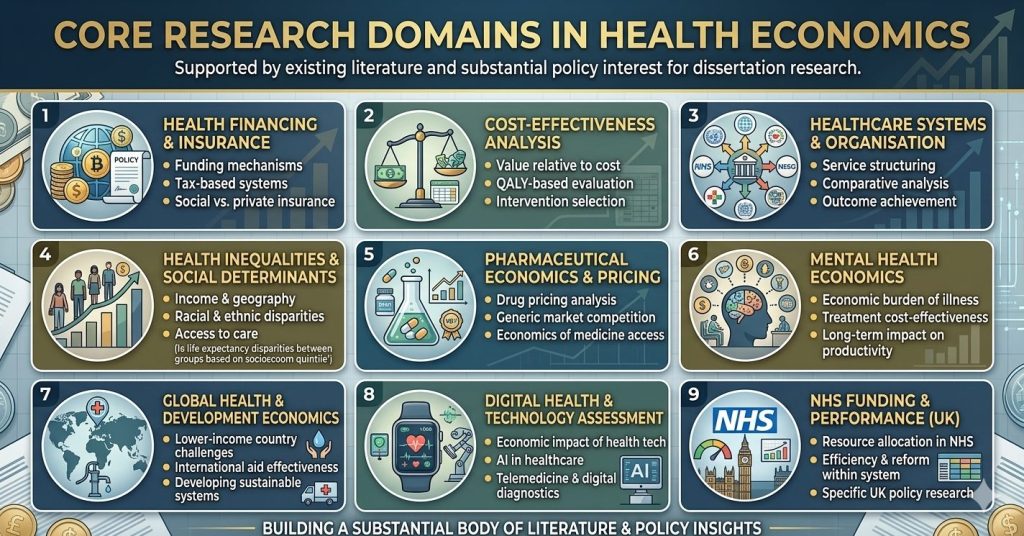
Health economics covers a wide range of interconnected research domains. Below are the core areas that students can explore, each of which is supported by a substantial body of existing literature and ongoing policy interest.
- Health financing and insurance: How countries fund healthcare, including tax-based systems, social health insurance, and private markets.
- Cost-effectiveness analysis: Evaluating whether health interventions deliver value relative to their cost, often using tools like QALYs (Quality-Adjusted Life Years).
- Healthcare systems and organisation: Comparing how different countries structure their health services and what outcomes they achieve.
- Health inequalities and social determinants: Examining how income, geography, and ethnicity affect access to care and health outcomes.
- Pharmaceutical economics and pricing: Analysing drug pricing, generic markets, and the economics of medicine access.
- Mental health economics: Studying the economic burden of mental illness and the cost-effectiveness of treatment models.
- Global health and development economics: Exploring healthcare challenges in low- and middle-income countries.
- Digital health and technology assessment: Evaluating the economic impact of health technologies, AI in diagnostics, and telemedicine.
- NHS funding and performance: Specific to the UK context, examining resource allocation, efficiency, and reform within the National Health Service.
These areas are not exhaustive, but they represent where the most active academic research, policy debate, and funding interest currently sit. Choosing a topic from within these domains increases the likelihood that you will find adequate secondary literature and data to support your research.
Health Economics Dissertation Topics with Examples: 5 Structured Samples
One of the most effective ways to understand what makes a strong dissertation topic is to see worked examples. Below are five health economics thesis topics, each presented with a research aim and two to three clearly written research objectives. Use these as models, not templates to copy directly.
1. The Cost-Effectiveness of Digital Mental Health Interventions in the NHS
Research Aim:
To evaluate whether digital mental health platforms deliver cost-effective outcomes compared to traditional in-person therapy within the NHS setting.
Research Objectives:
- To compare the cost per QALY of digital versus face-to-face cognitive behavioural therapy.
- To identify which patient groups benefit most from digital intervention from an economic perspective.
- To assess whether NHS commissioners currently use cost-effectiveness data when commissioning digital mental health services.
2. Health Insurance Coverage and Out-of-Pocket Expenditure Among Low-Income Households in Sub-Saharan Africa
Research Aim:
To examine how the absence of universal health insurance increases catastrophic health spending among lower-income populations in selected Sub-Saharan African countries.
Research Objectives:
- To measure the proportion of household income spent on healthcare in uninsured versus insured groups.
- To identify the main drivers of out-of-pocket expenditure in countries without universal coverage.
- To assess what policy mechanisms could reduce financial risk among vulnerable populations.
3. Pharmaceutical Pricing Policies and Access to Essential Medicines in the European Union
Research Aim:
To analyse how different pharmaceutical pricing strategies across EU member states affect the equitable availability of essential medicines.
Research Objectives:
- To compare price regulation models used in Germany, France, and the Netherlands.
- To evaluate the relationship between pricing policy and medicine access rates in lower-income EU states.
- To recommend evidence-based policy adjustments to support equitable access across the EU.
4. The Economic Burden of Obesity on the United Kingdom’s Healthcare System
Research Aim:
To quantify the direct and indirect economic costs of obesity-related conditions on UK public health expenditure.
Research Objectives:
- To calculate direct NHS costs attributable to obesity-linked conditions such as type 2 diabetes and cardiovascular disease.
- To estimate productivity losses and welfare costs associated with obesity in the working-age population.
- To evaluate the cost-effectiveness of existing public health interventions targeting obesity prevention.
5. Income Inequality and Preventive Healthcare Utilisation in England
Research Aim:
To determine how income inequalities influence the uptake of preventive healthcare services, including screening programmes, among adult populations in England.
Research Objectives:
- To compare screening attendance rates across income quintiles using NHS data.
- To identify the economic and non-economic barriers that reduce preventive care uptake among lower-income groups.
- To assess what targeted interventions could improve equitable access to preventive services.
80 Health Economics Dissertation Topics for 2026
The following 80 health economics research topics are original, current, and structured to meet 2026 academic standards. They are organised by subfield and suitable for undergraduate, master’s, and doctoral research. Use them as starting points and refine them further with your supervisor’s guidance.
💡 Tip: Each topic below is intentionally specific. Avoid broadening it back out. The narrower your focus, the stronger your argument and the more manageable your research process.
NHS Funding and Resource Allocation
- The impact of real-terms funding reductions on elective surgery waiting times in NHS England between 2019 and 2024.
- Resource allocation efficiency in NHS integrated care systems: a comparative analysis of the first three years.
- How NHS commissioning decisions incorporate NICE cost-effectiveness thresholds in practice.
- The financial sustainability of NHS mental health trusts under current block contract arrangements.
- Health inequalities in per-capita NHS spending across English local authority areas.
- The economic consequences of NHS staff shortages on patient outcomes and operational costs.
- Value-based healthcare frameworks and their practical implementation within NHS acute trusts.
- The role of private finance initiatives in NHS capital investment: economic evaluation from 2000 to 2025.
- Evaluating the economic case for preventive spending versus acute care within NHS budget planning.
- NHS spending efficiency across regional integrated care boards: what performance data reveal.
Cost-Effectiveness Analysis and Economic Evaluation
- Cost-utility analysis of robotic-assisted surgery compared to conventional laparoscopic procedures in colorectal cancer treatment.
- Economic evaluation of universal newborn hearing screening programmes in the United Kingdom.
- The cost-effectiveness of smoking cessation pharmacotherapy versus behavioural support in the NHS.
- QALY measurement limitations in elderly populations: implications for healthcare resource allocation decisions.
- Cost-effectiveness of proton beam therapy versus conventional radiotherapy for paediatric brain tumours.
- Economic modelling of early intervention programmes for childhood obesity in primary school settings.
- The incremental cost-effectiveness ratio of CAR-T cell therapy for relapsed B-cell lymphoma.
- Cost-effectiveness of remote patient monitoring for patients with chronic obstructive pulmonary disease.
- Economic evaluation of community pharmacist-led hypertension screening programmes in England.
- Threshold-based NICE decision-making and its equity implications for rare disease patients.
Health Insurance and Healthcare Financing
- The effect of private health insurance uptake on NHS demand and public waiting lists in England.
- Health insurance design and moral hazard: evidence from voluntary excess arrangements in European markets.
- Catastrophic health expenditure and household impoverishment in countries without universal health coverage.
- Social health insurance expansion in Ghana: lessons for other low-income countries pursuing universal coverage.
- The economics of community-based health insurance schemes in rural Sub-Saharan Africa.
- Risk selection and adverse selection in private health insurance markets: a UK and German comparison.
- How employer-sponsored health insurance in the United States distorts labour market decisions.
- Health financing transitions in South-East Asia: economic drivers and sustainability concerns.
- Premium affordability and coverage gaps in voluntary supplemental health insurance markets.
- The economic rationale for mandating mental health parity in private health insurance legislation.
Healthcare Policy and Systems Economics
- Economic consequences of delayed hospital discharge and its effect on social care spending in England.
- The impact of primary care gatekeeping on emergency department demand and associated costs.
- Healthcare system decentralisation and efficiency outcomes: a comparison of Nordic countries.
- Evaluating the economic effects of introducing a co-payment system in a universal healthcare setting.
- The economics of health system resilience: what COVID-19 revealed about fragile financing structures.
- Pay-for-performance schemes in primary care: evidence of efficiency gains or unintended consequences.
- Competition between NHS trusts and its effect on service quality and patient outcomes.
- The economic case for integrating social care and NHS services under a single funding model.
- Tariff reform in hospital payment systems: implications for provider behaviour and efficiency in England.
- Health technology assessment governance and pricing decisions across OECD countries.
Health Inequalities and Social Determinants of Health
- The economic cost of health disparities between the most and least deprived English local authorities.
- How fuel poverty intersects with health outcomes and NHS utilisation in low-income households.
- Income gradients in cancer screening participation: an analysis of NHS bowel cancer data by deprivation quintile.
- The economic burden of homelessness-related healthcare use on NHS emergency services.
- Racial health disparities in maternal mortality: economic and systemic factors in the UK context.
- The productivity cost of poor mental health in the United Kingdom’s working-age population.
- Food insecurity and chronic disease management costs: evidence from NHS primary care data.
- Economic analysis of the Marmot Review recommendations and their implementation progress in England.
- Regional health inequality in life expectancy and its relationship to NHS resource distribution.
- The economic effects of Universal Credit reform on low-income household health service use.
Pharmaceutical Economics and Drug Pricing
- Reference pricing systems for pharmaceuticals and their effect on generic medicine market entry.
- The economic impact of pharmaceutical patent extensions on healthcare payer budgets.
- Biosimilar uptake in NHS England: barriers, incentives, and potential cost savings.
- Managed access agreements for high-cost cancer drugs: economic governance and patient equity.
- Antimicrobial resistance as an economic externality: policy frameworks for internalising the cost.
- The orphan drug market and the economics of rare disease pharmaceutical development.
- Prescription opioid markets and the economic cost of dependency treatment in the United Kingdom.
- How differential pricing agreements can improve medicine access in low- and middle-income countries.
- The economic case for investing in antibiotic pipeline development through public-private partnerships.
- Vaccine pricing negotiations between pharmaceutical manufacturers and national governments: a comparative analysis.
Mental Health Economics
- The economic return on investment of Improving Access to Psychological Therapies (IAPT) in England.
- Presenteeism and absenteeism costs of untreated anxiety disorders in UK workplaces.
- Economic evaluation of early intervention in psychosis programmes compared to standard care pathways.
- Mental health parity legislation and its actual impact on insurance coverage decisions in practice.
- The cost-effectiveness of school-based mental health programmes targeting adolescent depression.
- Economic burden of eating disorders on NHS inpatient services and long-term care pathways.
- Peer support models in community mental health: a cost-effectiveness analysis.
- Long COVID and its emerging economic burden on mental health services in the United Kingdom.
Digital Health and Health Technology Economics
- Economic evaluation of artificial intelligence-assisted diagnostic imaging in NHS radiology departments.
- Telemedicine adoption and its effect on outpatient appointment costs following the COVID-19 pandemic.
- The economics of electronic health record implementation: efficiency gains versus transition costs.
- Wearable health technology and preventive care: a cost modelling analysis for NHS commissioners.
- Health app regulation and economic governance: managing quality and value in digital therapeutics markets.
- The economic case for digital diabetes management tools in reducing long-term complication costs.
Global Health and Development Economics
- The economic effectiveness of community health worker programmes in improving maternal health outcomes in East Africa.
- Health financing reforms in post-conflict states: economic barriers to rebuilding healthcare systems.
- The economic impact of malaria on labour productivity and educational attainment in endemic regions.
- Donor aid dependency and its effect on domestic health financing decisions in low-income countries.
- Universal health coverage as an economic growth strategy: evidence from rapidly developing economies.
- The economic costs and benefits of mass drug administration programmes for neglected tropical diseases.
Matching Topics to Your Academic Level
Health economics dissertation topics for undergraduate students tend to focus on clearly defined single-country or single-policy questions with accessible data sources, such as NHS statistics, OECD databases, or publicly available government reports. Topics in the NHS, public health, and health inequality categories work particularly well at this level.
For students completing an MSc health economics dissertation, the expectation shifts towards methodological sophistication. You are expected to demonstrate familiarity with economic evaluation frameworks, health econometrics, or comparative policy analysis. Topics in cost-effectiveness analysis, pharmaceutical economics, and health insurance are well-suited to master’s-level research.
PhD-level research demands original conceptual or methodological contributions. This might involve developing new economic modelling approaches, conducting primary data collection in underrepresented populations, or challenging prevailing assumptions in health system design. Topics across all eight subfields can be elevated to doctoral level with appropriate theoretical framing and methodological depth.
If you are unsure which level of complexity is appropriate for your institution’s requirements, speaking with your supervisor early is the best course of action. Students who access economics dissertation writing service support at the planning stage often arrive at their supervisors better prepared and with a clearer sense of direction.
How to Develop a Strong Health Economics Research Topic
Identifying a topic from a list is only the first step. Turning that topic into a viable research proposal requires additional work. Here is a simple framework to help you move from idea to research question.
Step 1: Test Whether the Topic Is Researchable
Ask yourself whether there is enough existing literature to contextualise your study, and whether there is data available to support your analysis. A topic with no prior academic engagement and no accessible data will not produce a credible dissertation.
Step 2: Identify a Gap or Tension
The strongest dissertations do not simply summarise existing research. They identify a specific gap, unresolved debate, or underexplored dimension within the literature. For example, you might notice that cost-effectiveness studies on a particular intervention exist in the United States but not in a UK context, creating a gap your research can address.
Step 3: Write a Clear Research Aim
Your aim should capture what your dissertation is designed to achieve in a single, focused sentence. It should be ambitious enough to be academically interesting but narrow enough to be manageable within your word count and timeline.
Step 4: Derive Two to Four Research Objectives
Objectives break your aim down into distinct, measurable tasks. Each objective should be independently answerable and together they should fully address your research aim. Avoid having more than four objectives at undergraduate or master’s level, as this tends to spread the research too thin.
Conclusion
Health economics is a field that genuinely matters. The decisions studied within it, from how NHS funding is distributed to how pharmaceutical markets operate, affect millions of people’s lives every day. Choosing a dissertation topic in this field is not just an academic exercise. It is an opportunity to engage seriously with questions that shape healthcare policy, resource allocation, and health equity.
The 80 healthcare economics dissertation topics presented in this post are designed to give you a solid, research-ready starting point. Each one is grounded in real academic debates and is suitable for adaptation to your specific level, institution, and interests. The example topics with aims and objectives show you what well-structured research looks like before you even begin writing.
Approach your dissertation with curiosity, patience, and a commitment to academic integrity. Narrow your focus, build your argument from evidence, and use every available resource, including your university’s library, your supervisor’s expertise, and credible guidance from academic support services. The process is demanding, but it is also one of the most intellectually rewarding experiences of your academic career.
Your dissertation has the potential to make a genuine contribution to health economics scholarship. Start with a topic that genuinely interests you, and the rest will follow.
