


Natural Resource Management
Dissertation Topics 2026

Questions Students Are Asking in 2026
The questions below reflect common concerns gathered from student forums, university discussion boards, and academic support communities. If any of these sound familiar, this post was written for you.
- What are the best natural resource management dissertation topics for 2026?
- How do I find a dissertation topic in natural resource management that is narrow enough to research?
- Which natural resource management research topics are suitable for a master’s level dissertation?
- Can I get natural resource management dissertation topics with examples of aims and objectives?
- What are the latest natural resource management research topics that supervisors will approve?
- How do I know if my natural resource dissertation topic is academically strong enough?
- Where can I find a free downloadable PDF of natural resource management dissertation topics?
Choosing the right dissertation topic is one of the most important decisions you will make during your academic journey. In natural resource management, this decision carries extra weight. The field sits at the intersection of environmental science, policy, ecology, and human development. A poorly defined topic can derail months of work, while a well-structured research question opens doors to meaningful contribution and academic recognition.
This post brings together 80 original natural resource management dissertation topics for 2026, along with worked examples, research aims, and a clear guide to subfield areas you can explore. Whether you are at undergraduate, master’s, or PhD level, you will find ideas here that are focused, researchable, and academically credible.
If you are already feeling overwhelmed by the process, you are not alone. Many students benefit from structured online dissertation help to narrow their ideas and build a strong research proposal from scratch.
Why Choosing the Right Natural Resource Management Dissertation Topic Matters
Natural resource management sits at a critical point globally. Climate change, biodiversity loss, freshwater scarcity, and land degradation are accelerating. Research in this field is no longer theoretical; it feeds directly into policy, governance, and conservation practice. Your dissertation, even at undergraduate level, has the potential to add genuine value to this conversation.
A focused and well-chosen topic in resource management dissertation work signals to your supervisor and examiners that you understand the field. It also tells them that you can scope a research problem appropriately. Broad topics like “climate change and the environment” fail because they offer no clear boundary for investigation. Narrow, specific topics succeed because they allow for deep, credible analysis within the time and word count you have available.
Your topic also shapes everything that follows: your research methodology, your literature review, your data collection approach, and ultimately your conclusions. Getting this right at the start saves significant time and stress later in the process.
Download Natral Resource Management Dissertation Topics PDF
A downloadable PDF containing a personalised list of natural resource management dissertation topics is available for students who need expert-curated guidance. The PDF is compiled by academic specialists and tailored to your level of study. Students receive this resource after completing a short form that helps match topics to their specific research interests and academic requirements. No promotional sign-up is involved; the form simply ensures the topics you receive are relevant to your programme and university expectations.
Key Research Areas in Natural Resource Management You Can Explore
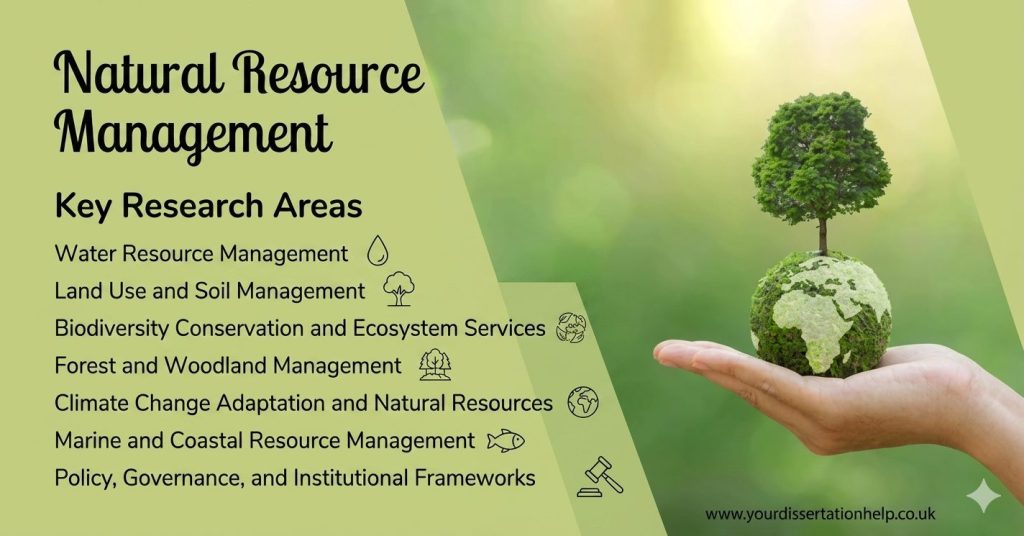
Before selecting a dissertation topic, it helps to understand the main subfields that make up natural resource management as an academic discipline. These areas are well established in peer-reviewed literature and recognised by universities worldwide.
Water Resource Management
This area covers freshwater governance, groundwater depletion, transboundary river systems, irrigation efficiency, and the links between water access and food security. Water resource management research is particularly active given the pressures of population growth and climate variability.
Land Use and Soil Management
Land use research explores how land is allocated, transformed, and governed across urban, agricultural, and forest landscapes. Topics often examine land degradation, tenure rights, sustainable agriculture, and the environmental consequences of urban expansion.
Biodiversity Conservation and Ecosystem Services
This subfield investigates how ecosystems function, how species are protected, and how human activity affects ecological balance. Research in biodiversity conservation increasingly intersects with economics, ethics, and community participation.
Forest and Woodland Management
Forest management dissertation research covers deforestation, afforestation, community forestry, carbon sequestration, and sustainable timber practices. This area has gained renewed academic interest given global net-zero commitments.
Climate Change Adaptation and Natural Resources
This growing area links climate science with resource governance. Topics explore how communities, governments, and ecosystems adapt to changing climate patterns, with particular focus on vulnerable regions and indigenous land systems.
Marine and Coastal Resource Management
Covering fisheries, blue carbon ecosystems, marine protected areas, and coastal erosion, this subfield is highly relevant in 2026 given the increasing pace of ocean degradation and the growing body of international marine policy.
Policy, Governance, and Institutional Frameworks
Resource management is shaped as much by institutions as by ecology. Research in this area examines international agreements, national policy implementation, community governance models, and the political economy of natural resource decisions.
Natural Resource Management Dissertation Topics with Examples: Aims and Objectives
The following five examples show you how to structure a dissertation topic at a professional academic level. Each includes a research aim and two to three focused research objectives. These are illustrative models you can adapt for your own proposal.
1. The effectiveness of community-based water governance in reducing groundwater depletion in semi-arid regions of Sub-Saharan Africa
Research Aim: To assess how community-led governance models influence groundwater sustainability outcomes in drought-prone areas.
- To examine existing community water governance structures across three selected case study regions.
- To evaluate the extent to which participatory approaches reduce over-extraction of groundwater.
- To identify policy barriers that limit the effectiveness of community-based water management programmes.
2. Examining the role of payment for ecosystem services in incentivising forest conservation among smallholder farmers in tropical regions
Research Aim: To investigate whether financial incentives through ecosystem service payments successfully motivate sustainable forest management among small-scale landholders.
- To review the design and delivery of payment for ecosystem services schemes in selected tropical countries.
- To analyse the behavioural and economic responses of smallholder farmers participating in these schemes.
- To evaluate the long-term conservation outcomes achieved through monetised ecosystem service frameworks.
3. Land tenure insecurity and its effects on sustainable soil management practices among agricultural communities in East Africa
Research Aim: To explore the relationship between land tenure security and the adoption of sustainable soil conservation methods in smallholder farming systems.
- To map existing land tenure arrangements and their legal recognition in selected East African communities.
- To assess how tenure insecurity affects investment in long-term soil health improvement practices.
- To recommend policy reforms that support tenure rights while promoting sustainable land use management.
4. Assessing the impact of marine protected areas on fish stock recovery in the North Atlantic: A policy analysis
Research Aim: To critically evaluate the effectiveness of marine protected areas as a fisheries management tool in the North Atlantic region.
- To document changes in fish population data within selected marine protected areas over a ten-year period.
- To compare governance frameworks across different national approaches to marine area protection.
- To identify implementation gaps that reduce the effectiveness of marine protection policy in practice.
5. Indigenous ecological knowledge and its integration into formal natural resource conservation planning in Canada
Research Aim: To examine how indigenous ecological knowledge is incorporated, or excluded, from national and provincial conservation planning processes in Canada.
- To document how indigenous resource governance systems function across selected First Nations communities.
- To analyse the degree to which indigenous knowledge frameworks appear in formal conservation policy documents.
- To evaluate collaborative models that successfully integrate traditional ecological knowledge with scientific conservation methods.
80 Natural Resource Management Dissertation Topics for 2026
The following 80 topics are organised by subfield. Each topic is intentionally narrow so that it is workable within a standard dissertation word count. These natural resources thesis topics are designed for students at undergraduate, master’s, and PhD level, and all reflect research directions that are active and publishable in 2026.
Water Resource Management
- 1The effectiveness of integrated water resource management frameworks in reducing seasonal water scarcity in southern African river basins.
- 2Assessing groundwater governance failures and their contribution to aquifer depletion in northern India.
- 3Transboundary water conflict and diplomatic resolution mechanisms: A case study of the Nile Basin Initiative.
- 4The role of gender in household water decision-making in rural communities in sub-Saharan Africa.
- 5Urban stormwater harvesting as a supplementary freshwater source: Policy barriers and implementation opportunities in Australian cities.
- 6Examining the relationship between agricultural irrigation efficiency and river ecosystem health in Spain’s Guadalquivir basin.
- 7Water pricing as a demand management tool: A comparative analysis of municipal water policies in the United Kingdom and South Africa.
- 8Community perceptions of water quality and their influence on drinking water governance in rural Pakistan.
- 9The impact of glacier retreat on downstream water availability: Institutional responses in the Andean region.
- 10Evaluating the effectiveness of constructed wetlands in treating agricultural runoff in the East Midlands, UK.
Land Use and Soil Management
- 11The relationship between customary land rights and soil degradation outcomes in West African smallholder farming systems.
- 12Urban green infrastructure and its contribution to soil carbon sequestration in European city parks.
- 13Agroforestry adoption barriers among smallholder farmers in Rwanda: A behavioural economics perspective.
- 14Land grabbing, displacement, and food security: Examining the long-term outcomes for rural communities in Mozambique.
- 15The effectiveness of soil erosion control policies in the loess plateau region of China.
- 16How changes in land use affect downstream flooding frequency: A catchment-level analysis in the Welsh uplands.
- 17Nitrogen pollution from intensive agriculture and its governance under EU nitrates directive frameworks.
- 18Rewilding as a land restoration strategy: Evaluating ecological and socioeconomic outcomes in the Scottish Highlands.
- 19The role of land use planning regulation in preventing peri-urban sprawl and habitat loss in Southeast England.
- 20Assessing the carbon storage potential of restored peatlands as a nature-based climate solution in Northern Ireland.
Biodiversity Conservation and Ecosystem Services
- 21Evaluating the effectiveness of national biodiversity strategies in meeting the Kunming-Montreal Global Biodiversity Framework targets.
- 22Insect pollinator decline in arable landscapes: How agricultural policy failures contribute to biodiversity loss in the UK.
- 23Community attitudes towards large carnivore reintroduction programmes: A case study from the Iberian lynx recovery project.
- 24The economic valuation of mangrove ecosystem services and its use in conservation policy decisions in Bangladesh.
- 25Assessing biodiversity offsetting mechanisms: Do net gain policies deliver genuine conservation outcomes in England?
- 26The role of seed banks in safeguarding crop biodiversity under climate-driven agricultural disruption.
- 27Protected area management effectiveness: A comparative study of buffer zone governance in East African national parks.
- 28Invasive species management and its costs to local ecosystem service delivery in the British Isles.
- 29Citizen science as a tool for long-term biodiversity monitoring in temperate woodland ecosystems.
- 30Linking ecosystem service valuation to local government land use decisions in rural Wales.
Forest and Woodland Management
- 31The role of REDD+ in reducing deforestation in the Congo Basin: Governance challenges and community outcomes.
- 32Assessing the sustainability of community forest enterprises in Nepal under devolved governance arrangements.
- 33Fire management in Mediterranean forest ecosystems: Policy responses to increasing wildfire risk in Portugal.
- 34Forest certification schemes and their influence on sustainable timber trade between tropical and European markets.
- 35Carbon accounting accuracy in afforestation programmes: A critical review of UK woodland creation schemes.
- 36The social dimensions of participatory forest management in hill districts of Bangladesh.
- 37Deforestation driven by palm oil expansion in Borneo: Policy instruments and enforcement gaps.
- 38How ancient woodland loss affects bird species richness in fragmented British landscapes.
- 39Evaluating the economic viability of small-scale coppice woodland management in rural England.
- 40Urban forest governance structures and their role in achieving municipal sustainability targets in German cities.
Climate Change Adaptation and Natural Resources
- 41Smallholder farmer adaptation strategies to rainfall variability in rain-fed agriculture systems in Ethiopia.
- 42How national adaptation plans address natural resource vulnerability in Pacific Island nations.
- 43The effectiveness of green infrastructure in reducing urban heat island effects and conserving biodiversity in UK cities.
- 44Integrating climate risk into river basin management plans: Lessons from the Rhine and Danube basins.
- 45Nature-based solutions for coastal flood risk management: Policy and governance challenges in England.
- 46The vulnerability of indigenous pastoral communities to climate-driven land degradation in the Sahel region.
- 47Climate-smart agriculture in sub-Saharan Africa: Adoption rates, barriers, and enabling institutional conditions.
- 48Permafrost thaw and its consequences for northern resource governance in Canada and Siberia.
- 49The role of locally-led adaptation funding in building community resource resilience in low-income countries.
- 50Assessing the limits of ecosystem-based adaptation for securing freshwater resources in the Hindu Kush Himalaya.
Marine and Coastal Resource Management
- 51Evaluating the governance structures of no-take marine reserves and their impact on fish population recovery in the Indian Ocean.
- 52Small-scale fisheries and the challenge of integrating artisanal fishing rights into national marine resource policy in West Africa.
- 53Blue carbon accounting in seagrass meadows: Policy readiness and measurement challenges in the United Kingdom.
- 54Marine plastic pollution governance: Examining the effectiveness of single-use plastic bans in coastal Southeast Asia.
- 55The social and economic costs of coral reef degradation for reef-dependent communities in the Caribbean.
- 56Offshore wind energy development and its governance implications for marine biodiversity conservation.
- 57Mangrove restoration as a coastal protection strategy: Community participation and long-term success rates in Vietnam.
- 58Ocean acidification and shellfish aquaculture: Adaptation strategies among fishing communities in Scotland.
- 59The role of international fisheries agreements in preventing illegal, unreported, and unregulated fishing in the North Sea.
- 60Examining the equity dimensions of marine conservation in displacing small-scale fishing communities from protected zones in Kenya.
Policy, Governance, and Institutional Frameworks
- 61Decentralisation of natural resource governance and its outcomes for forest management in Latin America.
- 62The influence of multinational mining corporations on national environmental governance in sub-Saharan Africa.
- 63Assessing the implementation gap between international biodiversity commitments and domestic policy action in the UK.
- 64The political economy of water privatisation in Latin America: Winners, losers, and resource access outcomes.
- 65Common pool resource governance and the relevance of Ostrom’s principles in 21st-century fisheries management.
- 66Environmental impact assessment quality and its relationship to large infrastructure approval decisions in England and Wales.
- 67The effectiveness of multi-stakeholder platforms in resolving resource conflicts between pastoralists and farmers in East Africa.
- 68Post-Brexit changes to agricultural and natural resource regulation in England: Environmental gains or governance gaps?
- 69How corruption affects the implementation of protected area management plans in Southeast Asian forest governance.
- 70Corporate sustainability commitments and the credibility of voluntary environmental disclosure in the extractive industries.
Emerging and Interdisciplinary Research Areas
- 71The application of remote sensing and GIS in monitoring land degradation hotspots in the Sahel region of Africa.
- 72Digital technologies and participatory natural resource governance: Opportunities and risks in low-bandwidth contexts.
- 73The role of environmental education in shaping pro-conservation behaviour among secondary school students in rural India.
- 74Green bonds and sustainable resource finance: Assessing the additionality of green bond-funded conservation projects.
- 75The intersection of mental health and access to urban green space: Implications for equitable resource planning in cities.
- 76Sustainable resource management and supply chain transparency: How technology is changing mineral extraction accountability.
- 77Biochar as a soil remediation tool: Evaluating its potential and limitations in degraded agricultural land in West Africa.
- 78The human rights dimensions of large-scale land acquisitions and their governance under international law frameworks.
- 79Circular economy principles in water resource management: Case studies from municipal systems in the Netherlands and Singapore.
- 80Evaluating the contribution of urban allotment gardens to local food security, resource conservation, and community resilience in UK cities.
Need help selecting the right topic for your level? Many students find that working with specialist environmental dissertation help services significantly reduces the time spent narrowing down ideas and strengthens the quality of their research proposal from the outset
How to Select the Right Natural Resource Management Research Topic for Your Level
Not all dissertation topics are equally suited to every academic level. A topic that works well for a PhD student, for example, may be far too broad or too technically demanding for an undergraduate project. Here is a brief guide to help you match your ambition to your level of study.
Undergraduate Dissertation Topics
At this level, your dissertation is likely between 8,000 and 12,000 words. You will benefit from topics with clear geographical boundaries, accessible data sources, and straightforward methodology. Topics focusing on local case studies, policy analysis, or literature-based reviews work particularly well for natural resource management dissertation topics for undergraduate research.
Masters Natural Resource Management Dissertation Topics
At master’s level, you are expected to demonstrate methodological awareness and a stronger critical voice. Your topic should have a clear theoretical framework and draw on both primary and secondary research where appropriate. The worked examples earlier in this post reflect this standard. Masters natural resource management dissertation topics are often positioned within governance, interdisciplinary frameworks, or comparative analysis.
PhD-Level Research
At doctoral level, originality is non-negotiable. Your topic must contribute new knowledge to the field, engage with gaps in the existing literature, and typically involve sustained fieldwork or advanced quantitative or qualitative analysis. PhD research in natural resource management often connects to funded research programmes or interdisciplinary centres.
Final Thoughts: Approaching Your Dissertation with Confidence
Choosing the right dissertation topic in natural resource management does not need to feel overwhelming. The field offers a remarkable range of research directions, from water resource management and biodiversity conservation to governance frameworks and emerging digital methodologies. The key is to start with an area that genuinely interests you, then narrow your focus until you have a question that is specific, researchable, and academically justified.
The 80 topics in this post are starting points, not finished products. Each one can be refined, localised, or adapted to suit your university’s expectations, your available data, and the particular angle you wish to take. Use the worked examples to understand how aims and objectives connect, and use the level guide to calibrate your ambitions appropriately.
A strong dissertation in this field is one that is rooted in academic rigour, engages honestly with its limitations, and makes a clear and credible contribution to ongoing conversations about how we manage the planet’s finite natural resources. You are more capable of producing that work than you may currently believe. The process starts with a single, well-chosen research question.
Publication-ready academic content for university students. All topics are original and designed for 2026 research standards. Written in British English.
