


Neurology Dissertation Topics for 2026
Questions Students Are Asking About Neurology Dissertations
The questions below are drawn from student forums, academic discussion platforms, and university Q&A boards. They reflect the real concerns that medical and neuroscience students share when they are trying to move forward with their dissertation research.
- What are the most relevant neurology dissertation topics for 2026?
- How do I find a neurology topic that is narrow enough to research in depth?
- What are the latest neurology research topics that universities are likely to approve?
- Can I get neurology dissertation topics with examples and research objectives?
- Are there specific masters neurology dissertation topics suitable for my academic level?
- Where can I find neurology dissertation topics for medical students that are clinically relevant?
- Which subfields of neurology are receiving the most research funding right now?
- How do brain disorders research topics differ at undergraduate versus PhD level?
Introduction: Why Your Neurology Dissertation Topic Matters
Choosing the right topic is one of the most important decisions you will make during your academic journey. In a field as vast and evolving as neurology, a poorly chosen topic can leave you with too little data, too broad a scope, or a question that has already been answered thoroughly by others.
Neurology sits at the intersection of medicine, biology, and technology. Every year, new discoveries about how the brain functions, how diseases develop, and how treatments can be improved create fresh opportunities for meaningful research. Students who align their dissertation with these active areas of inquiry give themselves a genuine academic advantage.
This post presents 80 well-structured neurology dissertation topics organised across key subfields, along with topic examples, research aims, and objectives. Whether you are at undergraduate, master’s, or PhD level, this guide will help you move from confusion to clarity. If you need further support, online dissertation help is available to assist you in refining your chosen topic and building a strong research proposal.
Download Neurology Dissertation Topics PDF
Students who prefer a curated offline resource can access a downloadable PDF version of neurology dissertation topics prepared by academic subject specialists. This PDF is tailored to match your academic level and research interests and is made available after you complete a short information form. The list is updated annually to reflect current clinical and neurological research trends, ensuring that the topics remain relevant for 2026 submissions.
Why Choosing the Right Neurological Research Topic Matters
Your dissertation topic shapes every stage of your research. It determines which databases you will search, which methodologies you will apply, and which academic conversations you will contribute to. A topic that is too broad becomes unmanageable. A topic that is too narrow may lack sufficient existing literature to support a critical review.
In neurology, topic selection also carries clinical significance. Research on conditions such as Alzheimer’s disease, Parkinson’s disease, epilepsy, multiple sclerosis, and stroke can directly influence patient outcomes, treatment protocols, and public health policy. Choosing a topic that connects to real clinical challenges shows examiners that you understand the practical value of academic research.
For medical students especially, selecting neurology dissertation topics for medical students that reflect genuine clinical observation can strengthen both the academic and professional dimensions of your work. It demonstrates that your research is grounded in patient care, not just theory.
Key Research Areas in Neurology Students Can Explore
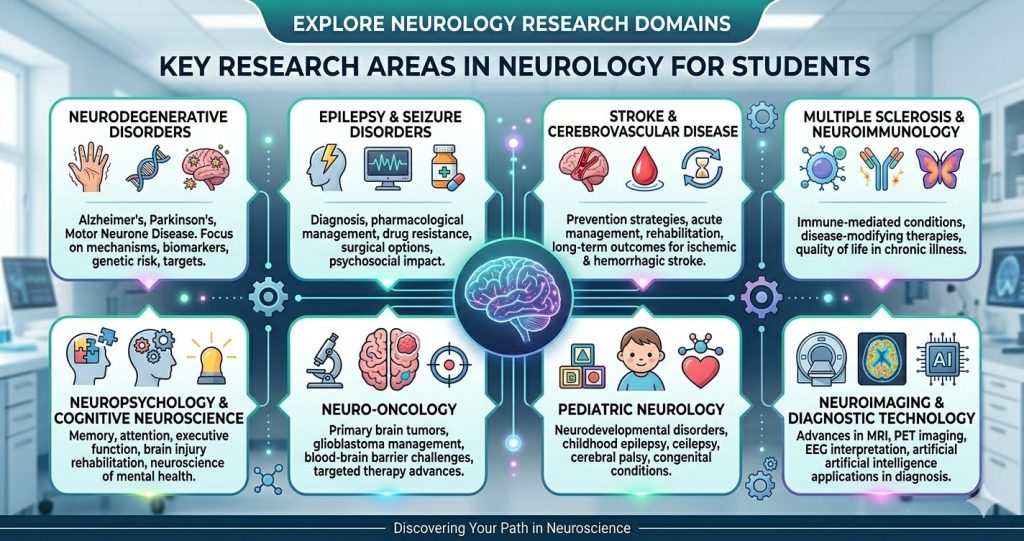
Neurology is a broad discipline. Before selecting a topic, it helps to understand the main research domains available to you. Each area has its own academic community, literature base, and methodological conventions.
- Neurodegenerative Disorders: This includes conditions such as Alzheimer’s disease, Parkinson’s disease, and motor neurone disease. Research focuses on disease mechanisms, biomarkers, genetic risk, and therapeutic targets.
- Epilepsy and Seizure Disorders: Topics here cover diagnosis, pharmacological management, drug-resistant epilepsy, surgical interventions, and the psychosocial impact on patients.
- Stroke and Cerebrovascular Disease: Research examines prevention strategies, acute management, rehabilitation, and the long-term outcomes of ischaemic and haemorrhagic stroke.
- Multiple Sclerosis and Neuroimmunology: This domain explores immune-mediated neurological conditions, disease-modifying therapies, and quality of life in chronic neurological illness.
- Neuropsychology and Cognitive Neuroscience: Topics include memory, attention, executive function, brain injury rehabilitation, and the neuroscience of mental health.
- Neuro-oncology: Research covers primary brain tumours, glioblastoma management, blood-brain barrier challenges, and advances in targeted therapy.
- Paediatric Neurology: This area examines neurodevelopmental disorders, childhood epilepsy, cerebral palsy, and congenital neurological conditions.
- Neuroimaging and Diagnostic Technology: Topics here focus on advances in MRI, PET imaging, EEG interpretation, and artificial intelligence applications in neurological diagnosis.
Neurology Dissertation Topics with Examples: Aims and Objectives
Understanding how a strong dissertation topic is structured makes it easier to develop your own. Below are five neuroscience dissertation topics with clearly written research aims and objectives. These examples illustrate how to balance specificity with scope.
Example 1: Biomarkers for Early Alzheimer’s Disease Detection
Research Aim: To evaluate the reliability of blood-based biomarkers in identifying early-stage Alzheimer’s disease in adults aged 55 and over.
- To conduct a systematic review of existing studies on blood-based biomarker testing in pre-clinical Alzheimer’s populations.
- To compare the diagnostic accuracy of amyloid beta and tau protein markers against established imaging-based methods.
- To assess the feasibility of blood-based biomarker screening in routine clinical practice within the NHS.
Example 2: Drug-Resistant Epilepsy in Adolescents
Research Aim: To investigate the psychosocial and clinical outcomes of adolescents living with drug-resistant epilepsy in the United Kingdom.
- To identify the prevalence of drug-resistant epilepsy among adolescent patients in tertiary neurology centres.
- To examine the impact of epilepsy on educational attainment, mental health, and social participation in this age group.
- To evaluate the effectiveness of ketogenic dietary therapy as an adjunct treatment in drug-resistant adolescent cases.
Example 3: AI in Stroke Diagnosis
Research Aim: To assess the diagnostic accuracy of artificial intelligence tools in detecting ischaemic stroke from CT imaging in emergency settings.
- To review published literature on AI-assisted neuroimaging tools used in acute stroke diagnosis between 2018 and 2025.
- To compare the diagnostic performance of AI models against experienced radiologists in stroke detection tasks.
- To identify barriers to implementing AI diagnostic tools in emergency departments of district general hospitals.
Example 4: Parkinson’s Disease and Physical Rehabilitation
Research Aim: To evaluate the effectiveness of physiotherapy-based rehabilitation programmes in improving motor function in patients with Parkinson’s disease.
- To review randomised controlled trials examining the effect of exercise on motor symptoms in Parkinson’s patients.
- To assess whether structured physiotherapy programmes reduce fall risk in community-dwelling Parkinson’s patients.
- To compare the outcomes of group-based versus home-based rehabilitation across different stages of the disease.
Example 5: Multiple Sclerosis and Mental Health
Research Aim: To examine the relationship between multiple sclerosis disease progression and the prevalence of depression and anxiety in adult patients.
- To analyse data from longitudinal cohort studies on psychiatric comorbidities in multiple sclerosis populations.
- To identify factors that predict a higher risk of depression in patients with progressive forms of multiple sclerosis.
- To evaluate the effectiveness of psychological interventions integrated into multiple sclerosis management pathways.
80 Neurology Dissertation Topics for 2026
The topics below represent the latest neurology research topics across established subfields. They are suitable for undergraduate, master’s, and PhD-level research. Each topic is original, academically sound, and designed to support a focused and researchable dissertation proposal. Students seeking neurology dissertation help can use these as starting points for refining their research direction with a specialist supervisor or academic consultant.
Alzheimer’s Disease and Dementia Research
- The role of tau phosphorylation in the progression of early-onset Alzheimer’s disease in patients under 65.
- Lifestyle interventions and their effect on reducing the risk of Alzheimer’s disease in adults with mild cognitive impairment.
- Ethnic disparities in Alzheimer’s disease diagnosis rates within the United Kingdom’s primary care system.
- The accuracy of digital cognitive screening tools in detecting dementia in rural and underserved communities.
- The effectiveness of cholinesterase inhibitors in slowing cognitive decline in moderate Alzheimer’s disease.
- Caregiver burden and psychological distress among family members of patients with advanced dementia.
- Gut microbiome changes as a potential biomarker for early Alzheimer’s disease detection.
- The role of sleep disruption in accelerating amyloid plaque accumulation in elderly populations.
- Post-COVID cognitive impairment and its overlap with early dementia symptoms in adults over 60.
- The impact of social isolation during the COVID-19 pandemic on dementia progression in care home residents.
Parkinson’s Disease and Movement Disorders
- The effectiveness of deep brain stimulation in managing motor fluctuations in advanced Parkinson’s disease.
- Alpha-synuclein aggregation and its role in the non-motor symptoms of Parkinson’s disease.
- Dance therapy as a complementary intervention for improving balance and gait in Parkinson’s patients.
- Genetic predisposition to Parkinson’s disease: A review of LRRK2 and GBA mutations in South Asian populations.
- The quality of life impact of wearing-off episodes in Parkinson’s patients managed with levodopa therapy.
- Digital biomarkers from wearable devices as tools for monitoring Parkinson’s disease progression in real time.
- Anxiety and depression as early indicators of Parkinson’s disease in adults aged 50 to 70.
- Comparing the efficacy of MAO-B inhibitors and dopamine agonists in early-stage Parkinson’s management.
- The relationship between pesticide exposure and risk of developing Parkinson’s disease in agricultural workers.
- Subcortical dementia in Parkinson’s disease: Patterns of cognitive decline and intervention strategies.
Epilepsy and Seizure Disorders
- The impact of drug-resistant epilepsy on the employment and social functioning of adults in the UK.
- The role of neuroinflammation in the pathogenesis of temporal lobe epilepsy.
- Vagus nerve stimulation versus responsive neurostimulation in the management of focal onset epilepsy.
- Mental health outcomes in adults with newly diagnosed epilepsy during the first year of treatment.
- Ketogenic diet adherence and seizure reduction rates in children with Dravet syndrome.
- Sudden unexpected death in epilepsy: Risk factors and prevention strategies in community settings.
- Stigma and disclosure behaviour among young adults living with epilepsy in higher education settings.
- EEG-based machine learning models for predicting seizure onset in patients with focal epilepsy.
- The effect of antiseizure medication on bone density and metabolic health in women with epilepsy.
- Cannabidiol as an adjunctive treatment for Lennox-Gastaut syndrome: A review of clinical trial outcomes.
Multiple Sclerosis and Neuroimmunology
- The relationship between vitamin D deficiency and the risk of relapse in relapsing-remitting multiple sclerosis.
- Fatigue management strategies in multiple sclerosis: A comparison of pharmacological and non-pharmacological approaches.
- The diagnostic delay in multiple sclerosis and its consequences for long-term neurological disability.
- Ocrelizumab versus natalizumab: A comparative effectiveness review in active relapsing multiple sclerosis.
- Cognitive impairment in early multiple sclerosis and its impact on occupational functioning.
- The role of Epstein-Barr virus in triggering autoimmune demyelination in genetically susceptible individuals.
- Progressive multiple sclerosis and the unmet need for effective disease-modifying therapies.
- Physical activity as a neuroprotective strategy in patients with early-stage multiple sclerosis.
- Patient experiences of switching disease-modifying therapies in multiple sclerosis: A qualitative analysis.
- Gut microbiota composition differences between multiple sclerosis patients and healthy matched controls.
Stroke and Cerebrovascular Disease
- The effectiveness of mechanical thrombectomy beyond the standard 6-hour treatment window in ischaemic stroke.
- Socioeconomic factors influencing access to stroke rehabilitation services in deprived urban areas of England.
- Recurrent stroke risk in patients with atrial fibrillation: Anticoagulant prescribing patterns and outcomes.
- Post-stroke depression: Prevalence, predictive factors, and its impact on functional recovery.
- Cryptogenic stroke in young adults: Investigating the role of patent foramen ovale in recurrence.
- The effectiveness of remote rehabilitation interventions for post-stroke patients in rural areas.
- Time-to-treatment delays in stroke care and their relationship to long-term disability outcomes.
- Aphasia recovery following ischaemic stroke: Predictors of speech and language therapy response.
- Blood pressure variability as a predictor of haemorrhagic transformation after thrombolytic therapy.
- Cognitive outcomes one year after stroke in patients under 55: A prospective cohort study design.
Neuro-oncology and Brain Tumours
- Temozolomide resistance mechanisms in recurrent glioblastoma multiforme: A systematic literature review.
- The role of IDH mutation status in predicting survival outcomes in patients with lower-grade gliomas.
- Quality of life in patients with high-grade brain tumours receiving concurrent chemoradiotherapy.
- Blood-brain barrier disruption techniques and their implications for improving drug delivery in brain metastases.
- Immunotherapy outcomes in glioblastoma: A critical analysis of checkpoint inhibitor clinical trials.
- Cognitive rehabilitation needs of brain tumour survivors following surgical resection and radiotherapy.
- Tumour treating fields therapy adherence and its relationship to progression-free survival in glioblastoma.
- Paediatric medulloblastoma: Long-term neurocognitive outcomes following treatment in childhood.
- The diagnostic value of liquid biopsy in detecting recurrent glioblastoma compared with MRI surveillance.
- Palliative care integration in brain tumour management: Timing, barriers, and patient preferences.
Paediatric Neurology and Neurodevelopmental Disorders
- Early diagnosis of autism spectrum disorder through neuroimaging biomarkers in children under three years.
- The impact of preterm birth on long-term neurodevelopmental outcomes in school-age children.
- Childhood absence epilepsy: Academic performance and cognitive functioning in primary school children.
- Congenital cytomegalovirus infection and its association with hearing loss and neurodevelopmental delay.
- Attention deficit hyperactivity disorder and its neurological basis: A review of structural brain differences.
- Febrile seizures in infancy: Risk of developing epilepsy and long-term neurological sequelae.
- Cerebral palsy rehabilitation: The effectiveness of constraint-induced movement therapy in upper limb function.
- Tuberous sclerosis complex and epilepsy: Correlating genetic variants with seizure severity in children.
- Neonatal encephalopathy outcomes following therapeutic hypothermia: A five-year follow-up study design.
- The experience of parents raising a child with a rare neurological condition: A thematic analysis.
Neuroimaging, Technology, and AI in Neurology
- Machine learning algorithms for predicting cognitive decline from MRI data in older adults.
- Functional MRI resting-state networks as diagnostic tools for differentiating neurological from psychiatric disorders.
- The diagnostic accuracy of diffusion tensor imaging in detecting white matter abnormalities in traumatic brain injury.
- Portable EEG devices and their potential for community-based neurological monitoring in low-resource settings.
- AI-assisted interpretation of brain CT scans in acute neurology: Accuracy, safety, and implementation challenges.
- The use of transcranial magnetic stimulation in mapping eloquent cortex prior to epilepsy surgery.
- Optogenetics and its emerging applications in understanding the neurobiology of seizure generation.
- Brain-computer interface technology for communication in patients with locked-in syndrome: Current evidence and barriers.
- Retinal imaging as a non-invasive biomarker for detecting neurodegenerative disorders in pre-symptomatic patients.
- Ethical implications of predictive neuroimaging data in pre-symptomatic diagnosis of hereditary neurodegenerative conditions.
Conclusion: Moving Forward with Confidence
Selecting a dissertation topic in neurology is a significant academic milestone. The 80 topics presented in this post are designed to give you a strong foundation across a range of subfields, from neurodegenerative disorders research topics to neuroimaging and artificial intelligence applications.
The most effective dissertations come from a genuine curiosity about a specific clinical or research question. When you choose a topic that genuinely interests you and aligns with the academic literature in your field, your motivation and focus will be far greater throughout the research process.
At every academic level, the goal is the same: to contribute something meaningful to the existing knowledge base, even in a modest way. Whether you are exploring clinical neurology topics for the first time or developing a PhD-level proposal on neuroimaging biomarkers, approach your work with intellectual honesty and methodological rigour.
Use the examples and topic lists in this post as a starting point. Discuss your ideas with your supervisor early, search the current literature carefully, and do not hesitate to narrow your scope if you find your initial idea is too broad. A focused, well-structured dissertation will always be stronger than a broad one.
You are capable of producing work that matters. Choose your topic wisely, plan methodically, and approach every stage with academic integrity.
