


Cultural and Heritage Tourism Dissertation Topics for 2026

What Students Are Asking About This Topic
The questions below have been gathered from student forums, academic discussion boards, and university support platforms. They reflect what real students search for when they feel stuck choosing a dissertation topic.
- What are the best cultural and heritage tourism dissertation topics for 2026?
- How do I narrow down my cultural tourism research topics so they are original enough?
- Which dissertation topic in cultural and heritage tourism suits a master’s-level student?
- Are there cultural and heritage tourism topics for a PhD dissertation that are still under-researched?
- What current trends in heritage tourism are worth investigating for my thesis?
- Can I find a list of cultural and heritage tourism dissertation topics organised by subfield?
- Are there cultural and heritage tourism thesis topics for UK students that reflect British heritage sites and policy?
If any of these questions sound familiar, you are in the right place. This post answers all of them.
Why Choosing the Right Dissertation Topic in Cultural and Heritage Tourism Matters
Selecting a strong dissertation topic is one of the most consequential academic decisions a student makes. In a field as broad and socially significant as cultural and heritage tourism, the stakes are particularly high.
Cultural and heritage tourism sits at the intersection of history, identity, economics, and sustainability. Research in this field informs how governments preserve sites, how communities benefit from tourism revenue, and how visitors engage with the past. A well-chosen topic positions your work within real, ongoing academic conversations.
A weak topic, by contrast, produces vague research questions, thin literature reviews, and inconclusive findings. It also makes it much harder to demonstrate the kind of independent thinking that examiners at undergraduate, master’s, and PhD level are looking for.
If you are unsure where to begin, seeking online dissertation help from an academic expert can save time and reduce the anxiety of starting from scratch.
This post gives you a structured, research-informed starting point. Whether you are working on a bachelor’s dissertation, a postgraduate thesis, or a doctoral proposal, the topic lists and worked examples below will help you move forward with clarity.
Download Cultural and Heritage Tourism Dissertation Topics PDF
Many students find it easier to review dissertation topics in a single, portable document rather than scrolling through a webpage. A downloadable PDF of cultural and heritage tourism dissertation topics, curated and reviewed by academic specialists, is available for students who want a personalised list matched to their level and research interests.
After completing a short form with your study level and field preferences, you will receive a PDF compiled specifically for your needs. The list is prepared by subject experts who understand current academic standards and university expectations.
Key Research Areas in Cultural and Heritage Tourism
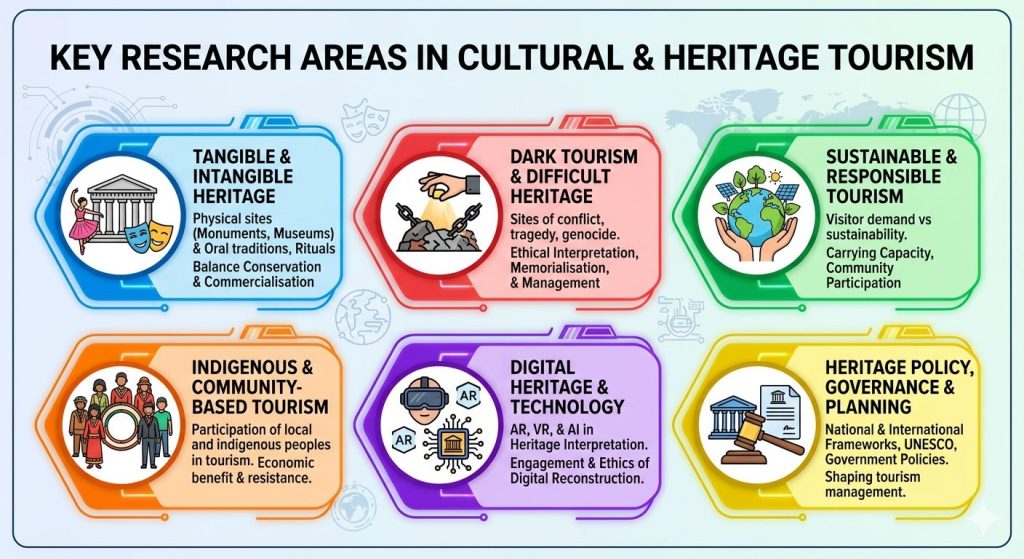
Before selecting a topic, it helps to understand the main academic domains within the field. Cultural and heritage tourism research topics are typically grouped around several well-established areas.
Tangible and Intangible Heritage
This area covers the preservation of physical sites such as monuments, museums, and historic buildings, as well as intangible forms of heritage including oral traditions, performing arts, and community rituals. Research here often explores the tension between conservation and commercialisation.
Dark Tourism and Difficult Heritage
Sites associated with conflict, tragedy, genocide, and colonial histories attract significant visitor interest. Scholars in this area examine how such sites are interpreted, memorialised, and managed ethically.
Sustainable and Responsible Tourism
This domain focuses on balancing visitor demand with environmental and cultural sustainability. Research questions often address carrying capacity, community participation, and long-term heritage protection.
Indigenous and Community-Based Tourism
This growing area investigates how indigenous peoples and local communities participate in, benefit from, and sometimes resist tourism development connected to their cultural identities.
Digital Heritage and Technology
The use of augmented reality, virtual reality, and artificial intelligence in heritage interpretation is producing a rich body of emerging research. Questions here range from visitor engagement to the ethics of digital reconstruction.
Heritage Policy, Governance, and Planning
This area looks at national and international frameworks such as UNESCO designations, national heritage strategies, and local government planning policies that shape how cultural tourism is managed.
Five Example Dissertation Topics with Research Aims and Objectives
The following examples show how a strong cultural tourism research topic is structured with a clear aim and focused objectives. Use these as models when developing your own proposal.
Example 1: Overtourism at UNESCO World Heritage Sites
Research Aim: To examine how overtourism affects the physical integrity and visitor experience of UNESCO World Heritage Sites in Southern Europe.
Objectives:
- To identify the key indicators of overtourism at selected sites in Spain, Italy, and Greece
- To evaluate current management strategies deployed by site authorities
- To assess visitor perceptions of crowding and its impact on cultural authenticity
Example 2: Digital Interpretation in Local Museums
Research Aim: To investigate the effectiveness of digital interpretation tools in increasing visitor engagement at regional museums in England.
Objectives:
- To review existing literature on digital heritage interpretation and visitor learning outcomes
- To collect and analyse visitor feedback data from three regional museums
- To identify best practice principles for digital interpretation at under-resourced heritage venues
Example 3: Indigenous Community Ownership of Cultural Tourism
Research Aim: To explore how indigenous-led tourism enterprises in New Zealand and Australia manage the relationship between cultural sharing and cultural protection.
Objectives:
- To document the governance structures of selected indigenous tourism enterprises
- To analyse community members’ perspectives on the benefits and risks of cultural tourism
- To compare policy frameworks that support indigenous tourism sovereignty in both countries
Example 4: Dark Tourism and Ethical Narration at Colonial Sites
Research Aim: To critically examine the ethical dimensions of heritage narration at sites linked to British colonial history.
Objectives:
- To identify how colonial narratives are currently presented at selected heritage sites in the UK
- To assess visitor responses to counter-narratives and decolonised interpretations
- To propose a framework for ethically responsible heritage narration at contested sites
Example 5: Cultural Heritage Tourism as a Rural Economic Driver
Research Aim: To assess the economic contribution of cultural heritage tourism to rural regeneration in post-industrial regions of Wales.
Objectives:
- To measure the economic impact of heritage tourism on selected Welsh rural economies
- To identify the barriers rural communities face in developing heritage tourism products
- To evaluate the role of national and regional policy in supporting rural heritage tourism
80 Cultural and Heritage Tourism Dissertation Topics for 2026
The following list contains 80 dissertation topic ideas suitable for undergraduate, master’s, and PhD research proposals. Topics are organised under thematic subheadings and numbered in fixed ranges for easy navigation. These cultural and heritage research topics for college students are designed to be narrow, researchable, and aligned with 2026 academic standards.
Heritage Site Management and Visitor Experience
- Visitor management strategies at overcrowded UNESCO sites: A case study of Stonehenge
- How interpretation panels influence visitor satisfaction at archaeological heritage sites
- The role of signage design in shaping visitor behaviour at outdoor heritage parks
- Assessing the relationship between heritage authenticity and revisit intention
- The impact of entrance fees on visitor access and cultural equity at national heritage sites
- Managing heritage tourism carrying capacity at rural sites in the Scottish Highlands
- Staff training and its effect on visitor engagement at independent heritage museums
- Measuring heritage tourism quality using the SERVQUAL model at cathedral sites
- Visitor motivations for attending living history events at English Heritage properties
- How accessibility improvements at historic buildings affect visitor diversity
Dark Tourism and Difficult Heritage
- Ethical representation of slavery at plantation heritage sites in the American South
- How UK battlefield sites narrate military loss and national identity
- Visitor emotional responses to Holocaust memorial museums: A qualitative study
- The commercialisation of tragedy: Balancing remembrance and revenue at Auschwitz
- Dark tourism and its role in post-conflict reconciliation in Rwanda
- How colonial prisons are interpreted as heritage sites in Australia
- Visitor expectations versus experience at Jack the Ripper walking tours in London
- The ethics of photographing at sites of mass atrocity
- Memorialisation of the Troubles: Heritage tourism at conflict sites in Northern Ireland
- How digital storytelling is changing visitor engagement at sites of difficult history
Sustainable Heritage Tourism
- Sustainable tourism planning at fragile archaeological sites: Lessons from Pompeii
- Community attitudes to sustainable heritage tourism development in rural Ireland
- How carbon offsetting schemes apply to cultural heritage tourism operators
- The impact of seasonal tourism on the physical deterioration of historic town centres
- Green certification in heritage accommodation: Does it change visitor booking behaviour?
- Circular economy principles and their application to heritage tourism businesses
- Resident perceptions of sustainable heritage tourism in historic city centres
- How national parks balance conservation and cultural tourism access in Wales
- The role of local food culture in sustainable heritage tourism experiences
- Measuring sustainability performance in intangible cultural heritage festivals
Digital Heritage and Technology-Enhanced Interpretation
- Augmented reality at heritage sites: Does it enhance or distract from the authentic experience?
- Virtual reality reconstructions of lost heritage: Visitor perceptions and ethical considerations
- The use of artificial intelligence in personalising museum visitor journeys
- How social media engagement shapes destination image for heritage sites
- QR codes and digital audio guides: Comparing user satisfaction at historic houses
- The role of gamification in increasing youth engagement with heritage tourism
- Digital storytelling platforms and their influence on cultural identity preservation
- How 3D scanning and printing technologies support heritage conservation in museums
- Live streaming cultural events as a form of digital heritage tourism
- Evaluating the accessibility of digital heritage interpretation tools for disabled visitors
Indigenous and Community-Based Cultural Tourism
- How Māori communities in New Zealand manage the boundaries of cultural tourism sharing
- Indigenous storytelling as a heritage tourism product in Northern Canada
- Community benefit agreements in indigenous cultural tourism: A comparative study
- The role of women in managing community-based heritage tourism in sub-Saharan Africa
- How Aboriginal Australian cultural centres navigate the tension between education and entertainment
- Diaspora communities and their role in heritage tourism development in West Africa
- Cultural commodification and resistance among First Nations tourism entrepreneurs
- The use of traditional ecological knowledge in indigenous nature-culture tourism products
- Governance models for community-owned heritage tourism in the Pacific Islands
- How cultural tourism shapes ethnic identity assertion among minority groups in Southeast Asia
Heritage Policy, Planning, and Governance
- The effectiveness of UNESCO World Heritage designation in driving tourism growth: A critical review
- How Brexit has changed the governance of cross-border heritage tourism in Ireland
- National heritage strategy and its alignment with sustainable tourism policy in England
- The role of local councils in funding and preserving intangible cultural heritage in the UK
- Historic England’s listing criteria and its impact on heritage tourism development
- How planning policy affects adaptive reuse of historic buildings for tourism purposes
- Comparing heritage conservation legislation across EU member states
- The role of philanthropy in funding heritage tourism infrastructure
- Public-private partnerships in heritage tourism: Lessons from the National Trust
- How heritage impact assessments are used in major infrastructure planning decisions
Cultural Identity, Memory, and Tourism
- How diaspora tourism shapes national identity narratives in Ireland and Scotland
- Roots tourism and emotional connection among African American visitors to West Africa
- The politics of memory at contested heritage sites in post-apartheid South Africa
- How national museums construct and communicate cultural identity to domestic visitors
- Cultural tourism and its role in language preservation among minority communities in Wales
- Gentrification and the displacement of authentic cultural heritage in urban tourism zones
- How literary heritage tourism shapes place identity in the English Lake District
- Pilgrimage and sacred heritage tourism: Balancing faith and visitor management
- The role of gastronomy in constructing regional cultural identity through tourism
- How war memorials function as sites of national identity performance for tourists
Festivals, Events, and Living Heritage
- The economic and cultural impact of the Edinburgh Festival Fringe on local heritage identity
- How folk festivals preserve and commodify rural cultural heritage
- Visitor motivations and cultural learning outcomes at traditional craft fairs
- The role of re-enactment events in communicating Tudor history to general audiences
- How cultural festivals contribute to place branding in post-industrial cities
- Managing safety and cultural integrity at large-scale heritage events
- The impact of international music festivals on host community cultural values
- Carnivals as intangible heritage: A study of management and preservation in Trinidad
- How local food festivals function as agents of cultural heritage tourism development
- Evaluating the legacy of cultural Olympiad programmes for host city heritage tourism
Conclusion
Choosing a dissertation topic in cultural and heritage tourism is not just an administrative requirement. It is an opportunity to contribute meaningfully to a field that shapes how societies remember their past and share it with the world.
The 80 topics presented in this post span a wide range of subfields, from digital interpretation and dark tourism to indigenous governance and heritage policy. Each one is grounded in current academic concerns and designed to support focused, original research at any level of study.
The worked examples show that a strong topic is built on a precise aim and clearly defined objectives. It addresses a real gap in knowledge, uses appropriate methodology, and draws on credible academic sources. Students who approach topic selection with this level of thought give themselves a significant advantage before the research even begins.
If you are still finding the process difficult, structured dissertation help from an experienced academic can make the topic selection stage far less daunting. The right support at the right time can transform a vague idea into a confident, well-framed research proposal.
Take the time to choose well, and your dissertation will reflect both your intellectual investment and your commitment to academic integrity.
