


Disaster Management Dissertation Topics for 2026
Common Questions Students Ask Before Choosing a Topic
Based on discussions across student forums and academic platforms, many learners struggle with similar concerns when selecting their dissertation topic. These questions reflect real uncertainty and confusion:
- How do I choose a focused and researchable topic in disaster management?
- What makes a topic suitable for undergraduate, master’s, or PhD level?
- Are my ideas aligned with current global disaster risks and policies in 2026?
- How can I make my research relevant to real-world disaster challenges?
- What are the latest research topics in disaster management that universities expect?
- How do I structure my topic with clear aims and objectives?
- Can I combine climate change, technology, and disaster management in one study?
These are not minor doubts. If you ignore them, you risk choosing a weak topic that limits your entire dissertation.
Introduction
Choosing the right Disaster Management Dissertation Topics is not just an academic requirement. It directly shapes the quality, relevance, and impact of your research. Disaster management is a multidisciplinary field that connects environmental science, public policy, urban planning, and humanitarian response.
A poorly chosen topic leads to vague arguments, weak data, and low academic scores. A well-defined topic, on the other hand, allows you to produce structured, evidence-based research that reflects current global challenges such as climate change, urban vulnerability, and crisis response systems.
This guide is designed to help you move from confusion to clarity by identifying focused, researchable, and academically appropriate topics for 2026.
Download Disaster Management Dissertation Topics PDF
Many students prefer having a structured list of curated topics to review offline. You can receive a downloadable PDF containing a personalised selection of disaster management dissertation ideas prepared by academic experts. This resource is typically shared after completing a short academic request process and is designed to match your level of study and research interests.
Why Choosing the Right Disaster Management Dissertation Topic Matters
Your topic determines everything that follows. It defines your research question, methodology, data sources, and academic contribution.
Here is what most students overlook:
- A broad topic leads to shallow analysis
- A vague topic creates unclear research objectives
- An outdated topic reduces academic relevance
Strong disaster management thesis topics are:
- Specific and clearly defined
- Aligned with current global risks
- Supported by available data and literature
- Suitable for your academic level
If your topic fails in any of these areas, your dissertation will struggle, no matter how much effort you put in later.
Key Research Areas in Disaster Management for 2026
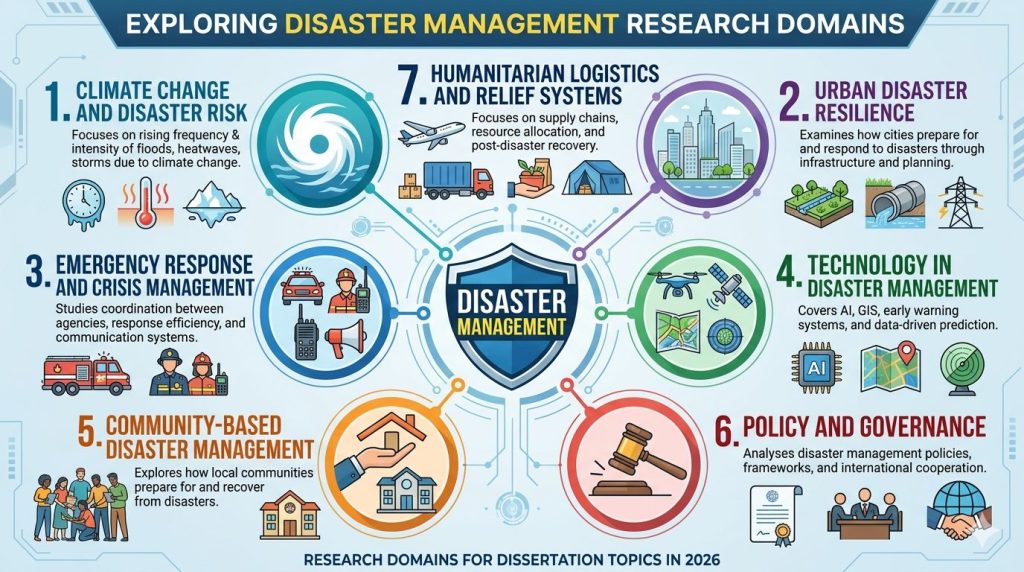
Disaster management is not one subject. It is a collection of specialised research domains. You need to choose your topic within one of these areas.
1. Climate Change and Disaster Risk
Focuses on how climate change increases the frequency and intensity of disasters such as floods, heatwaves, and storms.
2. Urban Disaster Resilience
Examines how cities prepare for and respond to disasters, including infrastructure and planning systems.
3. Emergency Response and Crisis Management
Studies coordination between agencies, response efficiency, and communication systems.
4. Technology in Disaster Management
Covers AI, GIS, early warning systems, and data-driven disaster prediction.
5. Community-Based Disaster Management
Explores how local communities prepare for and recover from disasters.
6. Policy and Governance
Analyses disaster management policies, frameworks, and international cooperation.
7. Humanitarian Logistics and Relief Systems
Focuses on supply chains, resource allocation, and post-disaster recovery.
If you are randomly picking ideas without aligning them to these domains, you are already making a mistake.
Sample Disaster Management Dissertation Titles with Aims and Objectives
These examples show how to structure academically sound Disaster Management Dissertation Titles.
1. Topic: The Role of Early Warning Systems in Reducing Flood Impact
Aim: To evaluate the effectiveness of early warning systems in flood-prone regions.
Objectives:
- To analyse response times before and after warning alerts
- To assess community awareness and preparedness levels
- To identify gaps in current warning mechanisms
2. Topic: Urban Flood Risk Management in Developing Cities
Aim: To examine flood risk management strategies in rapidly urbanising areas.
Objectives:
- To evaluate drainage infrastructure efficiency
- To assess policy implementation challenges
- To recommend sustainable urban planning solutions
3. Topic: The Impact of Climate Change on Disaster Frequency
Aim: To analyse the relationship between climate change and disaster occurrence.
Objectives:
- To examine historical disaster data trends
- To assess climate variables influencing disasters
- To evaluate predictive modelling approaches
4. Topic: Community Resilience in Earthquake-Prone Regions
Aim: To assess how communities adapt to earthquake risks.
Objectives:
- To evaluate local preparedness strategies
- To analyse recovery processes
- To identify resilience-building factors
5. Topic: The Role of Artificial Intelligence in Disaster Prediction
Aim: To explore the application of AI in forecasting disasters.
Objectives:
- To examine current AI tools in disaster prediction
- To assess accuracy and reliability
- To identify limitations and ethical concerns
80 Disaster Management Dissertation Topics for 2026
Climate Change and Disaster Risk
- Climate change impact on coastal flooding patterns
- Heatwave risk management in urban environments
- Rising sea levels and disaster preparedness strategies
- Climate-induced migration and disaster risk
- Flood frequency changes due to global warming
- Drought risk assessment in developing countries
- Climate adaptation policies in disaster-prone regions
- Wildfire risk management under changing climates
- Climate vulnerability mapping using GIS
- Role of climate models in disaster prediction
Urban Disaster Management
- Urban flooding and drainage system failures
- Smart cities and disaster preparedness
- Informal settlements and disaster vulnerability
- Infrastructure resilience in megacities
- Disaster risk in high-density urban areas
- Urban planning policies and disaster mitigation
- Earthquake preparedness in urban regions
- Role of green infrastructure in disaster reduction
- Urban heat island effects and disaster risks
- Transport systems resilience during disasters
Emergency Response and Crisis Management
- Emergency response coordination challenges
- Role of communication systems in crisis response
- Disaster response time analysis
- Effectiveness of emergency evacuation plans
- Multi-agency coordination in disaster management
- Crisis leadership in disaster situations
- Emergency medical response during disasters
- Public communication strategies in disasters
- Disaster simulation and training effectiveness
- Role of volunteers in emergency response
Technology in Disaster Management
- AI-based disaster prediction models
- Use of drones in disaster response
- GIS applications in disaster mapping
- Big data analytics in disaster management
- Early warning systems using IoT
- Satellite monitoring for disaster detection
- Blockchain in humanitarian logistics
- Digital platforms for disaster communication
- Predictive analytics in risk assessment
- Technology adoption challenges in disaster management
Community-Based Disaster Management
- Community resilience strategies in disaster-prone areas
- Role of local knowledge in disaster preparedness
- Public awareness programmes effectiveness
- Community participation in disaster planning
- Gender roles in disaster response
- Education and disaster preparedness
- Indigenous practices in disaster management
- Social vulnerability in disaster contexts
- Community recovery after disasters
- Role of NGOs in community disaster management
Policy and Governance
- National disaster management policies analysis
- International disaster response frameworks
- Governance challenges in disaster management
- Policy implementation gaps in disaster planning
- Role of government agencies in disaster mitigation
- Legal frameworks for disaster response
- Disaster risk reduction policies evaluation
- Public policy and climate-related disasters
- Institutional coordination in disaster management
- Policy effectiveness in reducing disaster impact
Humanitarian Logistics and Recovery
- Supply chain management in disaster relief
- Resource allocation during emergencies
- Post-disaster recovery strategies
- Logistics challenges in disaster zones
- Role of international aid in disaster recovery
- Food distribution systems during disasters
- Shelter management in humanitarian crises
- Financial aid effectiveness in recovery
- Infrastructure rebuilding after disasters
- Long-term recovery planning strategies
Emerging and Advanced Topics
- AI ethics in disaster management systems
- Climate justice and disaster vulnerability
- Psychological impacts of disasters on communities
- Disaster risk financing models
- Role of insurance in disaster recovery
- Cross-border disaster management cooperation
- Digital transformation in disaster management
- Pandemic preparedness and disaster frameworks
- Resilience metrics in disaster assessment
- Integration of sustainability in disaster planning
Conclusion
Selecting the right Disaster Management Research topics is the most critical decision in your dissertation journey. It determines your research direction, academic quality, and final outcome.
Avoid broad, vague, or outdated ideas. Focus on specificity, relevance, and academic feasibility. Align your topic with current global challenges and ensure it fits your level of study.
Approach your dissertation with clarity and discipline. A strong topic does not guarantee success, but a weak one almost guarantees failure.
