


Environmental Economics Dissertation Topics for 2026

Student Questions About Environmental Economics Dissertation Topics
Before we dive into the specifics, it helps to know what students are actually asking when they search for guidance on this subject. The following questions have been gathered from university forums, student discussion platforms, and academic support communities. They represent the real concerns and confusion that affect students at all levels.
Common questions students ask:
- What makes a good environmental economics dissertation topic, and how do I know if my idea is narrow enough?
- How do current environmental issues like climate change and pollution connect to economics dissertation research?
- Are there dissertation topics in environmental economics that work for undergraduate, master’s, and PhD research?
- What are the latest environmental economics research topics for 2026, and how do I find emerging trends in this field?
- How do I structure a strong research aim and research objectives for an environmental economics dissertation?
- What topics in sustainability economics, carbon pricing, or green economy research are still under-explored?
- How can I make sure my environmental policy dissertation topic aligns with real-world academic expectations?
- Where can I find reliable examples of environmental economics topics that have already been successfully researched?
These questions show that students are not just looking for topic ideas; they are looking for reassurance, structure, and confidence that their chosen area of research is both academically sound and achievable.
Why Choosing the Right Environmental Economics Dissertation Topic Matters
Selecting your dissertation topic is one of the most significant decisions you will make during your academic journey. It determines the direction of your research, the scope of your literature review, the methods you will use, and ultimately, how your work will be evaluated by supervisors and examiners.
In the field of environmental economics, this choice becomes even more important. Environmental economics bridges two complex worlds: the natural environment and economic systems. Your topic must demonstrate that you understand how markets, policy, and human behaviour interact with ecological limits and sustainability challenges. This is why poorly chosen topics often lead to unfocused research, scope creep, or work that fails to meet academic expectations.
A well-chosen environmental economics dissertation topic does several things. First, it shows that you have read widely enough to identify a genuine gap in knowledge. Second, it proves that your research question is answerable within your timeframe and with available resources. Third, it demonstrates that you understand the current state of the field and where new thinking is needed. When examiners read your dissertation, they want to see that you have thought carefully about why your topic matters and how it contributes to the broader conversation about environmental and economic sustainability.
The reality is that environmental economics is a rapidly evolving field. Research conducted in 2023 may already feel dated by 2026. This means that choosing a topic requires you to think not just about what interests you, but about what will be relevant and important when you submit your dissertation. Your topic should connect to real-world environmental challenges, current policy debates, or emerging economic frameworks that are shaping how we think about sustainability.
Key Research Areas in Environmental Economics You Can Explore
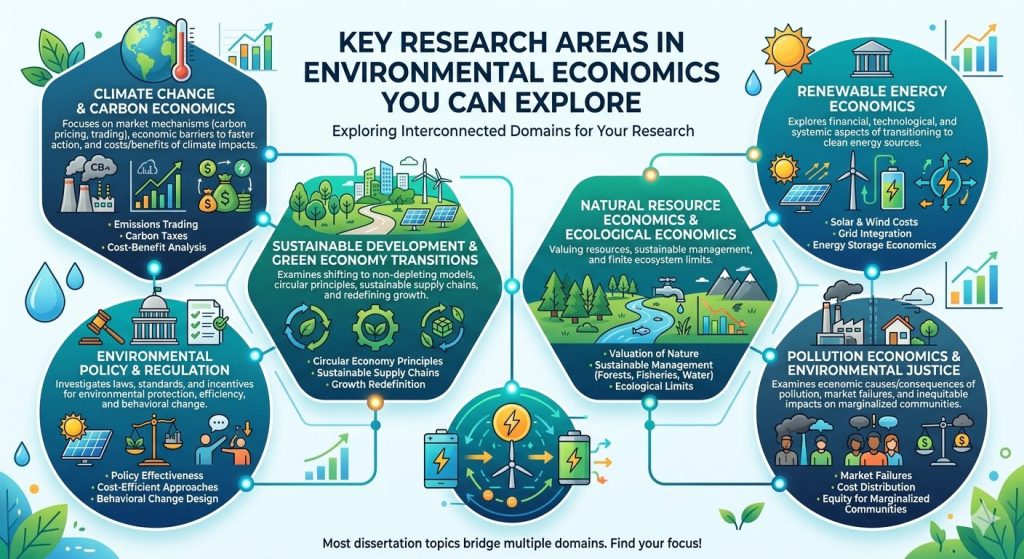
Environmental economics is not one narrow discipline. It encompasses several interconnected research areas, each with its own questions, methods, and real-world applications. Understanding these domains will help you position your own research and recognise where your interests lie.
Climate change and carbon economics focuses on how markets can be used to reduce greenhouse gas emissions, how carbon pricing works, and what economic barriers prevent faster climate action. This includes research on emissions trading systems, carbon taxes, and the economic costs and benefits of climate change itself.
Sustainable development and green economy transitions examines how economies can shift towards models that do not deplete natural resources or degrade ecosystems. This area includes research on circular economy principles, sustainable supply chains, and how governments and businesses are redefining growth and prosperity.
Environmental policy and regulation investigates how governments use laws, standards, and incentives to protect the environment. This includes research on how effective different policies are, which approaches are most cost-efficient, and how policy design influences behaviour change.
Renewable energy economics explores the financial, technological, and systemic aspects of transitioning from fossil fuels to renewable energy sources. This includes research on solar and wind energy costs, grid integration challenges, and the economics of energy storage.
Natural resource economics and ecological economics focuses on how to value natural resources, manage them sustainably, and recognise the economic limits imposed by finite ecosystems. This includes research on fisheries, forests, water resources, and biodiversity.
Pollution economics and environmental justice examines the economic causes and consequences of pollution, who bears the costs of environmental degradation, and how markets fail to account for these costs. This area increasingly addresses how environmental harm affects lower-income and marginalised communities.
Understanding these areas helps you see the breadth of environmental economics research available to you. Most dissertation topics will sit within or bridge two or more of these domains.
Download Environmental Economics Dissertation Topics PDF
As you work through this post, you will discover that choosing a dissertation topic is not something you need to do alone. Many students benefit from having a personalised list of dissertation topics curated specifically for their level of study and research interests. A downloadable resource containing a comprehensive collection of environmental economics dissertation topics, organised by research area and academic level, can serve as a valuable reference guide as you refine your ideas.
After completing a short form that asks about your research interests and academic level, students typically receive access to a PDF document that brings together carefully researched dissertation topic ideas. This kind of structured guidance can remove much of the initial overwhelm and help you move more quickly from “I need to find a topic” to “I have a clear research direction.” Many students find that having this kind of curated list, especially one that reflects current thinking in the field, provides the reassurance and starting point they need to begin their dissertation journey with confidence. Whether you are seeking undergraduate environmental economics dissertation topics or more advanced research directions, having access to expert-curated suggestions can streamline your planning process significantly.
Five Example Dissertation Topics with Research Aims and Objectives
Before you explore the full list of eighty dissertation topics, it helps to understand how a strong topic is structured. Below are five complete examples, each showing a clear research aim and between two and three research objectives. These examples cover different academic levels and research approaches, so you can see how the same general subject area can be tackled in different ways.
Example 1: Carbon Pricing Effectiveness (Master’s Level)
Research Aim: To evaluate the effectiveness of carbon pricing mechanisms in reducing industrial emissions across European manufacturing sectors between 2020 and 2025.
Research Objectives:
- To analyse the relationship between carbon price levels and measurable emissions reductions in three key manufacturing industries.
- To compare the cost-efficiency of carbon tax versus emissions trading system approaches in achieving environmental targets.
- To identify barriers to carbon pricing effectiveness and propose policy refinements based on empirical evidence.
Example 2: Green Finance and SME Investment (Undergraduate Level)
Research Aim: To investigate how environmental policy incentives influence small and medium-sized enterprise investment decisions in renewable energy projects.
Research Objectives:
- To examine the role of government subsidies and tax incentives in shaping SME capital allocation towards clean technology.
- To identify the most common barriers SMEs face when investing in renewable energy infrastructure.
Example 3: Biodiversity Loss and Economic Valuation (PhD Level)
Research Aim: To develop and test a novel economic valuation framework for quantifying ecosystem service losses resulting from biodiversity decline in tropical agricultural regions.
Research Objectives:
- To synthesise existing biodiversity valuation methods and identify their limitations in capturing ecosystem service complexity.
- To develop an integrated economic model that incorporates ecological data, market values, and non-market service estimates.
- To apply and validate this framework using case study data from three tropical agricultural zones.
- To assess the policy implications of this valuation approach for environmental regulation and land-use planning.
Example 4: Circular Economy and Waste Economics (Master’s Level)
Research Aim: To explore how circular economy principles affect the economic viability and environmental impact of waste management systems in urban centres.
Research Objectives:
- To compare traditional linear waste management models with circular economy approaches using cost-benefit analysis.
- To assess the scalability and profitability of circular economy business models in waste sectors.
Example 5: Climate Change Adaptation and Rural Livelihoods (Undergraduate Level)
Research Aim: To examine how farming communities in climate-vulnerable regions are adapting their economic practices and what support mechanisms are most effective.
Research Objectives:
- To document the economic and agricultural changes farmers have implemented in response to climate change.
- To evaluate the effectiveness and accessibility of government and non-governmental adaptation support programmes.
These examples show that a strong dissertation topic has a clear, focused research aim that can be broken down into manageable research objectives. Each objective should be answerable and should contribute directly to addressing your main research aim. As you review the list of eighty topics that follows, use this structure as your template for evaluating and refining potential topics.
80 Environmental Economics Dissertation Topics for 2026
Carbon Pricing, Emissions Trading, and Climate Economics
- The impact of dynamic carbon pricing mechanisms on industrial decarbonisation rates in developing economies.
- Comparing the economic efficiency of carbon tax systems versus cap-and-trade schemes in achieving net-zero targets.
- How carbon border adjustment mechanisms affect global supply chains and competitive disadvantage in manufacturing sectors.
- The role of voluntary carbon offset markets in corporate climate commitments and their economic validity.
- Analysing the relationship between carbon price volatility and long-term investment decisions in clean energy infrastructure.
- The economic feasibility of implementing negative carbon pricing systems to incentivise carbon removal technologies.
- How sectoral emissions trading schemes influence technological innovation in energy-intensive industries.
- The distributional effects of carbon pricing on household energy costs across income groups.
- Evaluating the cost-effectiveness of carbon pricing versus regulatory standards in reducing transport sector emissions.
- The economic barriers to international carbon pricing harmonisation and proposals for overcoming them.
Sustainable Development and Green Economy Transitions
- The economic pathways to achieving sustainable development goals through green economy transitions in middle-income countries.
- How circular economy principles affect the financial viability and scalability of manufacturing businesses.
- The role of ecosystem services valuation in mainstream economic decision-making and environmental policy.
- Analysing the employment and income effects of transitioning from extractive to sustainable industries in resource-dependent regions.
- The economic trade-offs between biodiversity conservation and agricultural productivity in developing nations.
- How green infrastructure investment generates economic returns while reducing environmental degradation.
- The financial mechanisms and incentives required to accelerate sustainable consumption patterns in developed economies.
- Evaluating the economic impact of circular economy adoption on supply chain resilience and business competitiveness.
- The relationship between sustainable development investment and long-term macroeconomic growth in least developed countries.
- How corporate sustainability commitments affect shareholder value and financial performance across sectors.
Environmental Policy, Regulation, and Market Mechanisms
- The cost-benefit analysis of stringent environmental regulations on small business competitiveness and innovation.
- Comparing regulatory versus market-based approaches to controlling agricultural pollution and nutrient runoff.
- How environmental impact assessment frameworks influence project investment decisions and economic feasibility.
- The effectiveness of extended producer responsibility schemes in reducing waste generation and improving resource recovery economics.
- Analysing the economic efficiency of pollution control standards in achieving air quality improvements in urban areas.
- The role of environmental subsidies in market distortion and their impact on resource allocation efficiency.
- How tradeable permit systems for water usage affect agricultural productivity and regional water security.
- The economic consequences of implementing strict chemical and pesticide regulations on agricultural output and farmer incomes.
- Evaluating the financial impact of mandatory environmental disclosure requirements on corporate investment behaviour.
- The relationship between environmental policy stringency and sectoral competitiveness in global markets.
Renewable Energy Economics and Clean Technology
- The economic factors influencing renewable energy adoption rates in electricity grids with high coal dependency.
- How battery storage technology costs affect the economic viability of 100 percent renewable energy systems.
- Comparing the total cost of ownership for solar, wind, and hydroelectric power across geographic and climatic regions.
- The economic barriers to scaling green hydrogen production and its potential role in decarbonising heavy industry.
- Analysing the financial feasibility of grid modernisation required to integrate variable renewable energy sources.
- The role of risk and uncertainty in investor decision-making for renewable energy projects in emerging markets.
- How subsidies and feed-in tariff policies affect the long-term economic sustainability of renewable energy sectors.
- The economic impact of renewable energy transition on employment patterns and labour market dynamics.
- Evaluating the cost-effectiveness of electric vehicle infrastructure development and charging network expansion.
- The financial viability of offshore wind energy development compared to onshore alternatives in European markets.
Natural Resource Management and Ecological Economics
- The economic implications of ocean acidification on commercial fisheries and coastal livelihoods.
- How property rights regimes affect sustainable forest management and economic incentives for conservation.
- Evaluating the economic value of pollination services and designing market mechanisms to protect pollinator populations.
- The relationship between water scarcity, agricultural productivity, and rural economic vulnerability in arid regions.
- Analysing the economic trade-offs between mining operations and ecosystem service preservation in biodiverse regions.
- The economic feasibility of implementing payment for ecosystem services schemes in developing economies.
- How overfishing affects economic stability in fishing-dependent communities and coastal economies.
- The role of natural capital accounting in corporate financial reporting and investment decision-making.
- Evaluating the economic sustainability of wildlife conservation programmes dependent on tourism revenue.
- The economic consequences of land degradation and desertification on agricultural productivity and rural incomes.
Pollution Economics and Environmental Justice
- Analysing the disproportionate economic burden of air pollution exposure on lower-income urban communities.
- The relationship between industrial pollution and property values in residential neighbourhoods.
- How corporate environmental liability policies affect the internalisation of pollution costs and corporate behaviour.
- The economic feasibility of pollution prevention versus remediation in industrial sectors.
- Evaluating the distributional effects of water pollution on farming communities and food security.
- The role of environmental taxation in incentivising pollution reduction and its regressive impacts on households.
- Analysing the economic consequences of soil contamination for agricultural land value and productivity.
- How toxic waste management costs affect business profitability and environmental compliance in different sectors.
- The economic valuation of health impacts resulting from exposure to industrial and ambient pollution.
- The relationship between environmental justice outcomes and the effectiveness of pollution control policies.
Climate Change Adaptation and Economic Resilience
- The economic costs and benefits of climate adaptation measures in vulnerable coastal communities.
- How climate change affects agricultural productivity, farm incomes, and food system economics in different regions.
- Analysing the financial mechanisms required to support climate adaptation in least developed countries.
- The role of climate insurance and risk management tools in protecting economic livelihoods in climate-vulnerable sectors.
- Evaluating the macroeconomic consequences of climate-related natural disasters on national economic growth and stability.
- The economic implications of climate-induced migration for labour markets and fiscal systems in receiving regions.
- How infrastructure adaptation to climate change affects infrastructure investment needs and public finance requirements.
- The relationship between climate adaptation investment and long-term economic resilience in developing nations.
- Analysing the economic trade-offs between proactive climate adaptation and reactive disaster response spending.
- The role of green bonds and climate finance in funding adaptation projects in emerging economies.
Emerging Topics: Circular Economy and Biodiversity Economics
- The economic potential of industrial symbiosis and waste-to-resource systems in decentralised manufacturing networks.
- How artificial intelligence and digital technologies affect the economics of resource tracking and circular supply chains.
- Evaluating the financial viability of biodiversity offsetting as a mechanism for balancing conservation and economic development.
- The economic implications of implementing plastic reduction and single-use plastic bans on manufacturing and retail sectors.
- Analysing the relationship between circular economy adoption and innovation-driven competitiveness in developed economies.
- The role of corporate biodiversity accounting in environmental risk assessment and financial performance.
- How regenerative agriculture practices affect farm profitability and environmental outcomes in different agricultural systems.
- The economic value of urban green spaces and their contribution to health outcomes and property values.
- Evaluating the financil mechanisms required to support smallholder farmer transitions to sustainable and regenerative practices.
- The economic feasibility of nature-based solutions for climate change mitigation and their scalability across regions.
Conclusion: Approaching Your Environmental Economics Dissertation with Confidence
Choosing a dissertation topic in environmental economics is an act of positioning yourself within a field that is genuinely important and rapidly evolving. You are not selecting a topic simply for academic exercise; you are choosing to contribute, even in a small way, to the conversation about how we can balance human economic activity with the limits and resilience of the natural world.
The eighty topics presented in this post represent genuine research opportunities. They are grounded in established economic theory, they address real environmental challenges, and they reflect the direction that environmental economics research is taking as we move towards 2026. Some of these topics are narrow enough for undergraduate research; others require the depth and originality expected at master’s and PhD levels.
As you review these options, remember that your topic should excite you intellectually. Environmental economics research requires sustained focus and critical thinking. If your topic does not genuinely interest you, the research process will feel like a burden rather than an opportunity. At the same time, do not assume that your initial idea is final. Many students start with one topic and, after reading more widely, discover a more specific angle or a different approach that feels more authentic to their research interests.
Work closely with your dissertation supervisor or academic advisor as you narrow down your options. Your supervisor can help you evaluate whether your chosen topic is appropriately scoped, whether sufficient literature exists to support your research, and whether your research aims and objectives are clearly articulated. They can also help you understand whether your topic aligns with the expectations of your particular institution and academic level.
Finally, approach your dissertation with integrity. Environmental economics matters because real decisions affect real people and real ecosystems. Your research, however focused it may be, contributes to our collective understanding of how to create more sustainable and equitable economic systems. Choose a topic that you are proud to spend months researching, frame your research questions honestly, and commit to following your evidence wherever it leads. This approach will not only produce better research; it will make your dissertation journey more meaningful and rewarding.
