


Evolutionary Psychology Dissertation Topics for 2026

Common Questions Students Ask Before Choosing a Topic
Before selecting a dissertation topic, many students turn to forums and academic discussion platforms to seek clarity. These are some of the most common questions students ask when they feel uncertain or overwhelmed:
- How do I choose a dissertation topic in Evolutionary Psychology for my Master’s in 2026?
- What are the best dissertation topics in evolutionary psychology right now?
- Are there suitable undergraduate dissertation topics in evolutionary psychology that are not too complex?
- How can I ensure my topic is relevant to current research trends?
- What makes a dissertation topic strong at Master’s or PhD level?
- Can I combine evolutionary psychology with modern fields like technology or mental health?
- How narrow should my topic be to meet university expectations?
These questions reflect real concerns about academic relevance, feasibility, and originality. This guide answers them in a clear and structured way.
Introduction
Choosing the right Evolutionary Psychology Dissertation Topics is one of the most important academic decisions you will make. Your topic shapes your research direction, determines your methodology, and influences your final grade.
Evolutionary psychology focuses on how human behaviour, cognition, and emotions have been shaped by natural selection. This makes it a rich and interdisciplinary field, combining biology, psychology, anthropology, and even sociology.
A well-chosen topic should be:
- Clear and focused
- Researchable within your timeframe
- Relevant to current academic debates
- Appropriate for your study level
This guide will help you understand the field, explore key research areas, and select a topic that aligns with your academic goals.
Download Evolutionary Psychology Dissertation Topics PDF
Many students prefer working from a structured list they can review offline. If you are looking for a curated list of evolutionary psychology dissertation topics pdf, you can access a personalised version prepared by academic experts.
This downloadable resource is typically shared after completing a short request form and is designed to match your academic level and research interests. It can be especially helpful if you feel stuck or need guided direction.
Key Research Areas in Evolutionary Psychology
Understanding major research domains helps you identify where your interests fit best.
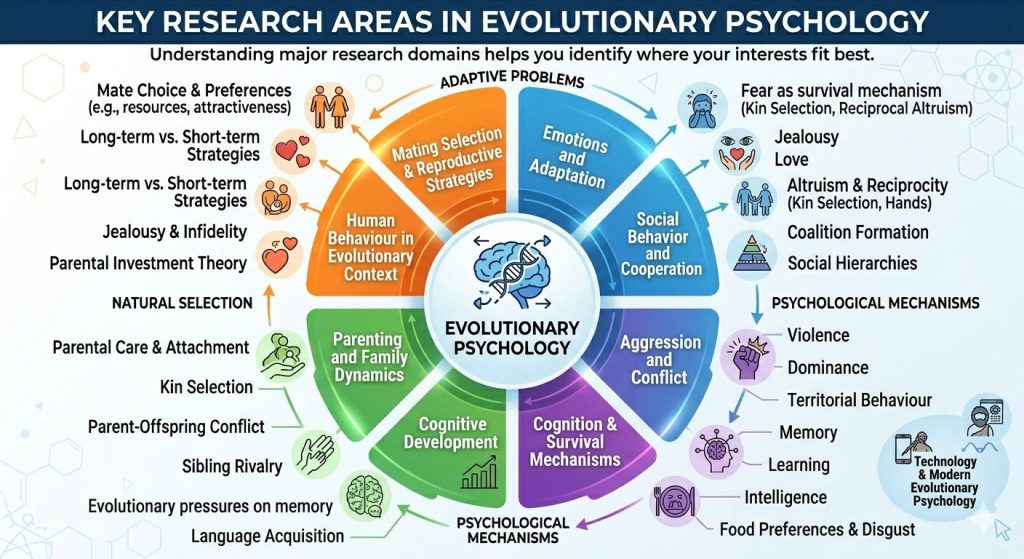
Human Behaviour in Evolutionary Context
This area explores how survival and adaptation shaped behaviours like cooperation, competition, and decision-making.
Mate Selection and Reproductive Strategies
Focuses on attraction, partner choice, and reproductive success from an evolutionary perspective.
Parenting and Family Dynamics
Examines parental investment, kin selection, and family roles in human evolution.
Cognitive Development
Studies how evolutionary pressures shaped memory, learning, and intelligence.
Emotions and Adaptation
Explores emotions like fear, jealousy, and love as survival mechanisms.
Social Behaviour and Cooperation
Looks at group dynamics, altruism, and social hierarchies.
Aggression and Conflict
Examines violence, dominance, and territorial behaviour.
Technology and Modern Evolutionary Psychology
Investigates how modern environments interact with evolved traits.
5 Example Evolutionary Psychology Dissertation Topics (With Aim and Objectives)
These examples show how to structure a strong dissertation topic.
1. The Evolutionary Basis of Human Jealousy
Aim: To analyse jealousy as an adaptive emotional response
Objectives:
- Examine gender differences in jealousy
- Analyse its role in mate retention
- Evaluate modern implications
2. Evolutionary Explanations of Altruism
Aim: To explore why humans help others without direct benefit
Objectives:
- Study kin selection theory
- Analyse reciprocal altruism
- Evaluate real-world applications
3. Mate Preferences in Digital Dating Environments
Aim: To investigate how online platforms influence evolved mate preferences
Objectives:
- Compare online vs offline selection
- Analyse gender-based preferences
- Assess evolutionary consistency
4. Parental Investment Theory in Modern Families
Aim: To examine how parental roles reflect evolutionary strategies
Objectives:
- Study investment differences
- Analyse cultural variation
- Evaluate child outcomes
5. Evolutionary Roots of Anxiety Disorders
Aim: To explore anxiety as an adaptive survival mechanism
Objectives:
- Identify evolutionary triggers
- Analyse mismatch theory
- Evaluate clinical implications
Evolutionary Psychology Dissertation Topics for 2026
Human Behaviour in Evolutionary Context
- Evolutionary explanations of risk-taking behaviour in young adults
- Adaptive functions of curiosity in human survival
- Evolutionary basis of procrastination
- Survival instincts and decision-making under stress
- Evolutionary roots of leadership behaviour
- The role of dominance in social hierarchies
- Adaptive value of conformity in group settings
- Evolutionary explanation of moral judgement
- Behavioural adaptation in resource scarcity
- Evolutionary origins of human cooperation
Mate Selection and Reproductive Strategies
- Evolutionary basis of physical attractiveness
- Female mate choice and reproductive success
- Male competition and status signalling
- The role of symmetry in attraction
- Evolutionary psychology of long-term relationships
- Mate preferences across cultures
- Age preferences in romantic partners
- Evolutionary explanations of infidelity
- Sexual jealousy and reproductive strategies
- Online dating through an evolutionary lens
Parenting and Family Dynamics
- Parental investment theory in modern societies
- Evolutionary explanation of sibling rivalry
- Kin selection and family bonding
- Parenting styles and evolutionary adaptation
- The role of grandparents in child survival
- Adoption and evolutionary psychology
- Step-parenting and investment differences
- Birth order and behavioural outcomes
- Evolutionary roots of parental favouritism
- Child development and survival strategies
Cognitive Development from an Evolutionary Perspective
- Evolutionary origins of intelligence
- Memory as an adaptive function
- Language development and survival
- Problem-solving in ancestral environments
- Evolutionary explanations of learning styles
- Cognitive biases as survival tools
- Attention mechanisms in threat detection
- Evolutionary roots of creativity
- Social learning and imitation
- Brain evolution and decision-making
Emotions and Evolutionary Psychology
- Fear as a survival mechanism
- Evolutionary explanation of happiness
- Anger and dominance behaviour
- Love as an adaptive bonding tool
- Disgust and disease avoidance
- Emotional regulation in evolutionary context
- Shame and social survival
- Guilt and cooperation
- Anxiety as a protective mechanism
- Emotional responses to social rejection
Social Behaviour and Evolution
- Evolutionary roots of altruism
- Group selection theory and cooperation
- Social norms as adaptive strategies
- Evolution of trust in human societies
- In-group vs out-group behaviour
- Reputation management in evolution
- Evolutionary basis of prejudice
- Social bonding and survival
- Cooperation in large groups
- Cultural evolution and behaviour
Human Aggression and Evolution
- Evolutionary origins of violence
- Aggression in male competition
- Territorial behaviour in humans
- War and evolutionary psychology
- Hormonal influences on aggression
- Evolutionary explanation of bullying
- Revenge as an adaptive response
- Conflict resolution strategies
- Aggression and resource control
- Evolution of dominance hierarchies
Technological Advancements in Evolutionary Psychology
- Evolutionary mismatch in digital environments
- Social media and evolved social behaviour
- Technology and attention span
- Online identity and evolutionary signalling
- AI and human cognitive adaptation
- Digital communication and social bonding
- Gaming behaviour and reward systems
- Technology addiction and evolutionary mismatch
- Virtual relationships and mate selection
- Evolutionary impact of modern lifestyles
Sexual Selection and Evolutionary Psychology
- Sexual dimorphism and attraction
- Evolution of mating signals
- Ornamentation and attractiveness
- Competition vs choice in mating
- Evolutionary explanation of flirting
- Sexual selection in modern societies
- Reproductive strategies and behaviour
- Mate guarding behaviour
- Evolutionary basis of attraction cues
- Sexual competition and status
Advanced and Emerging Topics
- Evolutionary psychology of climate behaviour
- Environmental adaptation and human behaviour
- Evolutionary roots of consumer behaviour
- Decision-making in uncertain environments
- Evolutionary basis of addiction
- Mental health from an evolutionary perspective
- Evolutionary explanation of social anxiety
- Cross-cultural evolutionary psychology
- Evolutionary psychology in organisational behaviour
- Future directions in evolutionary psychology research
Conclusion
Selecting a dissertation topic in evolutionary psychology requires careful thought, academic awareness, and clarity of purpose. A strong topic is not just interesting. It must be researchable, relevant, and aligned with your academic level.
This guide has shown you:
- How to approach topic selection with confidence
- Key research areas within the field
- Structured examples of strong dissertation topics
- A wide range of over 80 research-ready ideas
If you take time to refine your topic and align it with current research, you will set a strong foundation for your dissertation. Approach the process with curiosity, discipline, and academic integrity, and you will be well prepared for success in 2026 and beyond.
