


99 Top Forestry Dissertation Topics for 2026
Introduction
Before choosing a dissertation direction, many students feel unsure about what is expected at university level. Below are common questions collected from student forums and academic discussion spaces, reflecting real confusion when selecting research topics in forestry:
- What are the most relevant forestry research areas for 2026?
- How do I choose a dissertation topic that is not too broad or too complex?
- What level of originality is expected in a forestry dissertation?
- Can I connect forestry with climate change or technology?
- Which topics are suitable for undergraduate, master’s, or PhD research?
These questions highlight a key issue. Students are not just looking for ideas, they are looking for direction, clarity, and academic confidence.
Choosing a dissertation topic in forestry is important because it defines the entire research journey. A well-selected topic helps you stay focused, meet academic standards, and produce meaningful research that contributes to environmental science and sustainable development. Forestry is now deeply connected with climate policy, biodiversity protection, and global sustainability goals, making topic selection more critical than ever.
Why Choosing the Right Forestry Dissertation Topics Matters
A dissertation is not just a university requirement. It is a demonstration of your ability to think critically and contribute to real-world environmental issues.
In forestry, topic selection matters because:
- It determines the scope of your research and data collection
- It affects your ability to access fieldwork or secondary datasets
- It influences your final grade and academic progression
- It shapes your future career direction in environmental science or policy
Students often struggle because they select topics that are either too wide or too technical. A strong dissertation topic is specific, researchable, and aligned with current environmental challenges.
At this stage, many students also explore structured guidance platforms like online dissertation help to better understand methodology, structuring, and research design expectations in modern universities.
Key Research Areas in Forestry for 2026
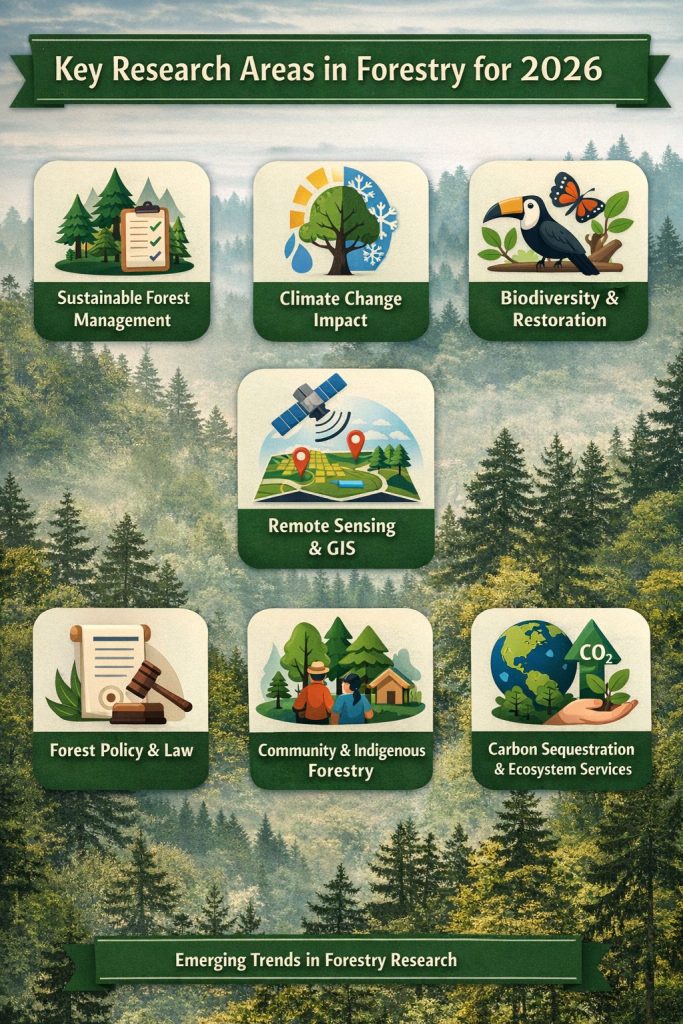
Forestry research in 2026 is shaped by sustainability, digital transformation, and ecological resilience. Below are the major academic domains:
- Sustainable forest management and conservation
- Climate change impact on forest ecosystems
- Biodiversity protection and habitat restoration
- Remote sensing and GIS applications in forestry
- Forest policy, governance, and environmental law
- Community forestry and indigenous land management
- Carbon sequestration and ecosystem services
Students exploring broader interdisciplinary work may also connect forestry with International Finance Research Topics, especially when studying carbon credits, green finance, and sustainability-linked investments.
These areas reflect global academic expectations and are widely accepted in undergraduate, MSc, and PhD-level research.
Five Potential Forestry Dissertation Topics (With Research Structure)
1. Climate-Resilient Forest Management Strategies
Aim:
To analyse how forest ecosystems can be managed to withstand increasing climate variability.
Objectives:
- To assess current forest management practices
- To evaluate climate risks affecting forest health
- To propose adaptive management strategies
2. Impact of Deforestation on Biodiversity Loss
Aim:
To examine the relationship between deforestation rates and biodiversity decline.
Objectives:
- To measure biodiversity changes in deforested regions
- To identify key drivers of deforestation
- To recommend conservation policies
3. Role of Remote Sensing in Forest Monitoring
Aim:
To evaluate the effectiveness of satellite-based monitoring in forest conservation.
Objectives:
- To assess accuracy of remote sensing tools
- To compare traditional and digital monitoring methods
- To analyse real-world case studies
4. Community-Based Forest Management Systems
Aim:
To explore how local communities contribute to sustainable forest management.
Objectives:
- To study community governance models
- To assess environmental outcomes
- To identify policy support mechanisms
5. Forest Carbon Sequestration and Climate Mitigation
Aim:
To analyse the role of forests in reducing atmospheric carbon levels.
Objectives:
- To quantify carbon storage in forest ecosystems
- To evaluate afforestation impacts
- To assess policy frameworks supporting carbon markets
Download Forestry Dissertation Example Pdf
Students often benefit from reviewing structured examples before starting their own dissertation. A curated collection of forestry dissertation examples can help you understand formatting, methodology, and academic expectations more clearly.
A downloadable PDF resource is typically provided after completing a short academic request process. This includes topic ideas, sample structures, and research frameworks designed to support undergraduate, master’s, and PhD-level forestry studies.
Such resources are especially helpful when students are finalising their proposal and need clarity on research direction, scope, and feasibility.
A List of Forestry Dissertation Topics
Forest Management And Policy
- Sustainable forest certification systems and environmental outcomes
- Forest governance models in developing countries
- Policy effectiveness in reducing illegal logging
- Economic impact of forest conservation laws
- Role of government subsidies in reforestation projects
- Comparative analysis of public and private forest management
- Forest land tenure systems and sustainability outcomes
- Evaluation of national forestry policies in climate adaptation
- Forest fire management strategies and policy frameworks
- Impact of international agreements on forest conservation
- Forest resource allocation and economic efficiency
- Legal frameworks for indigenous forest rights
- Urban forestry policy development and implementation
- Governance challenges in tropical forest regions
- Sustainable timber trade regulations and compliance
- Role of NGOs in forest policy implementation
Forest Ecosystems And Biodiversity
- Effects of habitat fragmentation on forest biodiversity
- Species diversity in managed versus natural forests
- Invasive species impact on native forest ecosystems
- Forest soil health and ecosystem productivity
- Pollination networks in forest environments
- Role of fungi in forest ecosystem stability
- Biodiversity restoration in degraded forest lands
- Ecological succession in reforested areas
- Wildlife population trends in protected forests
- Forest canopy structure and microclimate regulation
- Relationship between soil microbes and tree growth
- Conservation strategies for endangered forest species
- Forest edge effects on ecosystem balance
- Role of wetlands within forest ecosystems
- Genetic diversity in forest tree populations
- Ecosystem services provided by temperate forests
Climate Change And Forestry
- Climate change impact on forest growth rates
- Role of forests in global carbon cycles
- Effects of drought on forest ecosystems
- Forest resilience to extreme weather events
- Afforestation as a climate mitigation strategy
- Deforestation contribution to global warming
- Carbon trading systems linked to forestry
- Forest adaptation strategies to rising temperatures
- Fire frequency changes due to climate change
- Climate-smart forestry practices
- Forest hydrology changes under climate stress
- Impact of glacier retreat on mountain forests
- Carbon offset programmes in forestry projects
- Climate policy integration in forest management
- Role of mangrove forests in climate adaptation
- Climate vulnerability assessment of forest regions
Forestry And Technology
- Use of drones in forest surveillance and mapping
- GIS applications in forest resource management
- Artificial intelligence in forest fire prediction
- Remote sensing for deforestation tracking
- Big data analytics in forest conservation
- Smart sensors for forest health monitoring
- Digital modelling of forest growth patterns
- Blockchain in timber supply chain transparency
- Automation in sustainable logging operations
- Satellite imagery in biodiversity assessment
- Precision forestry and data-driven management
- Mobile applications for community forestry reporting
- Machine learning in forest disease detection
- Digital twins for forest ecosystem simulation
- Climate modelling using forestry datasets
- Technology-driven forest inventory systems
Forestry And Society
- Community participation in forest conservation
- Indigenous knowledge in forest sustainability
- Socio-economic impact of deforestation on rural communities
- Forest-based livelihoods and poverty reduction
- Gender roles in community forestry management
- Education and awareness in forest conservation
- Ecotourism and forest ecosystem preservation
- Cultural significance of forests in indigenous societies
- Urban expansion impact on nearby forest areas
- Forest dependency among rural populations
- Public perception of forest conservation policies
- Human-wildlife conflict in forest regions
- Role of schools in promoting forest awareness
- Forest restoration and community engagement
- Migration patterns linked to forest degradation
- Social equity in forest resource distribution
Conclusion
Selecting the right dissertation topic in forestry is a critical academic step that shapes your entire research journey. A strong topic helps you stay focused, meet university expectations, and contribute meaningful insights to environmental science.
Forestry is no longer just about trees and land management. It now connects with climate policy, technology, biodiversity, and global sustainability challenges. Students who choose carefully structured and research-driven topics are more likely to produce impactful and high-quality dissertations.
Approach your topic selection with clarity, patience, and academic discipline. A well-defined research idea will always lead to stronger methodology, better analysis, and higher academic confidence.
