


Genetics Dissertation Topics for 2026
Questions Students Are Asking (From Forums and Academic Discussion Platforms)
Students across academic forums and research communities frequently ask questions like these when choosing their dissertation topics. If you have been wondering the same things, this post is written for you.
- What are the best genetics dissertation topics for 2026?
- How do I find a genetics research topic that is narrow enough to be manageable?
- Which genetics topics are suitable for undergraduate versus master’s level?
- What are the latest trends in genetics research that I can base my dissertation on?
- Can you give me examples of genetics dissertation topics with aims and objectives?
- Are there any strong human genetics dissertation topics for a PhD proposal?
- How do I connect my genetics thesis topic to real-world medical or agricultural relevance?
- Where can I find help if I am struggling to structure my genetics research proposal?
Why Choosing the Right Genetics Dissertation Topic Matters
Choosing the right dissertation topic is one of the most important academic decisions you will make. In a field as vast and fast-moving as genetics, a poorly chosen topic can leave you overwhelmed, stuck in literature reviews with no clear direction, or writing on something that lacks academic originality.
Genetics is a discipline that sits at the intersection of biology, medicine, computing, and ethics. From DNA sequencing to gene expression studies, from hereditary diseases to CRISPR technology, the research possibilities are wide. But that breadth is also the challenge. Without a clearly defined focus, students often spend months going in circles.
A well-chosen topic aligns with your academic level, connects to current research directions, and gives you a realistic scope to complete within your time frame. This post will help you do exactly that.
If you are currently struggling to narrow down your ideas, seeking online dissertation help from academic specialists early in your process can save considerable time and stress.
Download Genetics Dissertation Topics PDF
Many students find it helpful to have a curated, downloadable list of dissertation topics they can review alongside their supervisors or personal tutors. A personalised PDF containing genetics dissertation topics, selected by academic experts based on your level and research interests, is available for students who complete a short request form.
The list is tailored to your degree level and subfield of interest, so the topics you receive will be directly relevant to your academic context, rather than a generic list.
Key Research Areas in Genetics for 2026
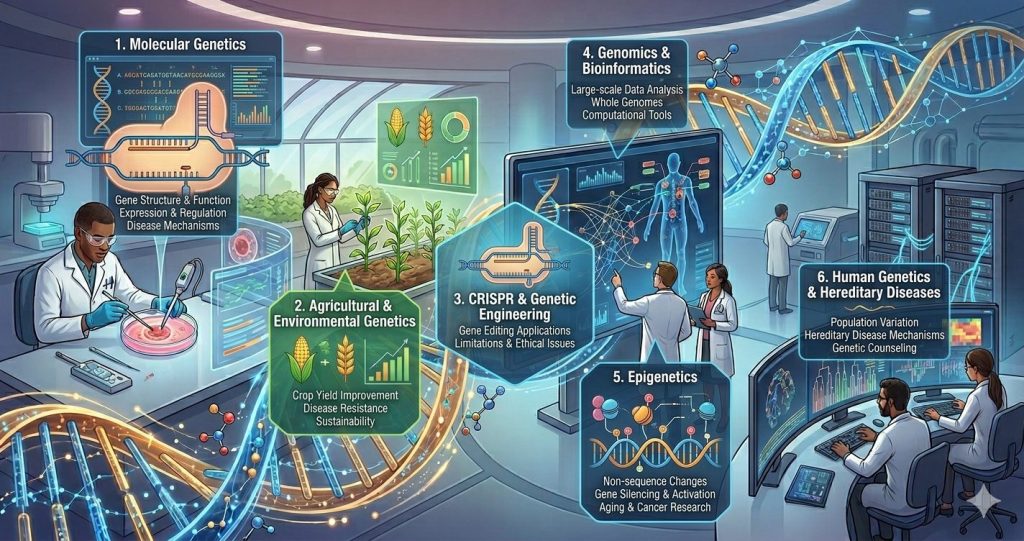
Before diving into topic lists, it helps to understand the main subfields within genetics. Each area contains rich possibilities for original dissertation research.
Molecular Genetics This area focuses on the structure and function of genes at a molecular level, including how genes are expressed and regulated. It is central to understanding disease mechanisms.
Genomics and Bioinformatics Genomics looks at entire genomes rather than individual genes. When combined with bioinformatics, it involves the computational analysis of large-scale genetic data, which is increasingly important in precision medicine.
Epigenetics Epigenetics studies heritable changes in gene expression that do not involve changes to the DNA sequence itself. This is a rapidly growing area with implications for cancer research, ageing, and developmental biology.
Human Genetics and Hereditary Diseases This subfield examines how genetic variation contributes to health and disease in human populations. It includes the study of hereditary diseases, genetic counselling, and population genetics.
CRISPR and Genetic Engineering Gene editing technologies, particularly CRISPR-Cas9, have transformed what is possible in genetics research. Dissertation topics in this area often explore applications, limitations, and ethical considerations.
Agricultural and Environmental Genetics Genetics plays a significant role in improving crop yields, disease resistance, and sustainability in agricultural science. This is a growing area for applied research.
Five Example Genetics Dissertation Topics with Aims and Objectives
The following five examples show how a dissertation topic should be framed academically. Each includes a research aim and two to three focused objectives.
Example 1: CRISPR Gene Editing in Hereditary Disease Treatment
Research Aim: To evaluate the therapeutic potential and ethical implications of CRISPR-Cas9 gene editing in treating hereditary diseases in human patients.
Research Objectives:
- To review current clinical trials using CRISPR technology for genetic disease treatment
- To assess the off-target mutation risks associated with CRISPR-Cas9 in human genome editing
- To explore the ethical and regulatory frameworks governing gene editing in medicine
Example 2: Epigenetic Modifications and Cancer Progression
Research Aim: To investigate how epigenetic changes, specifically DNA methylation patterns, contribute to the progression of colorectal cancer.
Research Objectives:
- To identify key methylation sites associated with colorectal cancer gene silencing
- To compare methylation profiles across different stages of tumour development
- To assess the potential of epigenetic biomarkers as diagnostic tools
Example 3: Population Genetics of Antibiotic Resistance
Research Aim: To examine the population genetics of antibiotic resistance genes in pathogenic bacteria within hospital environments.
Research Objectives:
- To map the distribution of resistance alleles across bacterial populations
- To analyse the horizontal gene transfer mechanisms contributing to resistance spread
- To evaluate the implications for public health intervention strategies
Example 4: Bioinformatics Approaches in Rare Disease Genomics
Research Aim: To assess the effectiveness of bioinformatics pipelines in identifying causative variants in patients with undiagnosed rare genetic diseases.
Research Objectives:
- To compare whole-exome sequencing and whole-genome sequencing diagnostic yields
- To evaluate variant prioritisation tools used in clinical genomics settings
- To identify gaps in current computational tools for rare disease diagnosis
Example 5: Genetic Factors in Type 2 Diabetes Across Ethnic Populations
Research Aim: To investigate how genetic susceptibility loci for Type 2 diabetes differ across diverse ethnic populations using genome-wide association data.
Research Objectives:
- To compare published GWAS data across South Asian, African, and European populations
- To assess the transferability of polygenic risk scores across population groups
- To identify underrepresented populations in current genomics research
80 Genetics Dissertation Topics for 2026
The following topics are organised by subfield. Each is designed to be narrow, researchable, and academically relevant for 2026.
Molecular Genetics and Gene Expression
- The role of RNA splicing errors in the development of neurodegenerative diseases
- Investigating the regulation of gene expression through non-coding RNA in mammalian cells
- The effect of transcription factor mutations on embryonic development in model organisms
- How post-translational modifications of histone proteins regulate gene silencing
- The relationship between mitochondrial DNA mutations and age-related disease
- Analysing alternative splicing patterns in cancer cells compared to healthy tissue
- The function of long non-coding RNAs in regulating tumour suppressor gene expression
- Molecular mechanisms of X-chromosome inactivation and their implications for female health
- Investigating the role of promoter methylation in silencing DNA repair genes in lung cancer
- How stress-induced gene expression changes in the immune system affect autoimmune risk
CRISPR Technology and Gene Editing
- Evaluating the off-target effects of CRISPR-Cas9 in human embryonic stem cells
- The application of base editing tools in correcting sickle cell disease mutations
- Comparing CRISPR-Cas9 and CRISPR-Cas12 efficiency in mammalian gene knockout studies
- Ethical and legal challenges of germline gene editing in reproductive medicine
- The use of CRISPR interference (CRISPRi) in studying essential gene functions
- CRISPR-based diagnostics for rapid detection of infectious disease pathogens
- Gene drive applications in controlling mosquito-borne diseases: risks and benefits
- The role of Cas9 delivery mechanisms in determining editing precision and safety
- CRISPR technology in agricultural science: modifying drought resistance in wheat
- Public perception of CRISPR-based therapies and the role of science communication
Epigenetics and Gene Regulation
- The influence of early childhood nutrition on epigenetic programming and metabolic disease
- Transgenerational epigenetic inheritance in humans: evidence and limitations
- Investigating DNA methylation changes associated with post-traumatic stress disorder
- The role of histone deacetylase inhibitors as therapeutic agents in haematological cancers
- How environmental toxins alter epigenetic patterns in occupationally exposed populations
- Epigenetic clocks as biomarkers of biological ageing in long-lived populations
- The epigenetic basis of phenotypic plasticity in response to climate stress in plants
- Investigating chromatin remodelling complexes in stem cell differentiation
- The relationship between gut microbiome composition and host epigenetic regulation
- Differential DNA methylation in identical twins as a model for studying environmental epigenetics
Human Genetics and Hereditary Diseases
- Genetic modifiers that influence disease severity in cystic fibrosis patients
- The contribution of copy number variations to intellectual disability in paediatric populations
- Carrier frequency of autosomal recessive disorders in consanguineous communities
- Investigating the genetic architecture of familial hypercholesterolaemia in a UK cohort
- The role of BRCA1 and BRCA2 variants beyond breast cancer risk: a systematic review
- Polygenic risk scores for predicting cardiovascular disease in South Asian populations
- Genetic counselling outcomes following whole-genome sequencing in neonatal care
- Mitochondrial inheritance patterns in maternally inherited diabetes and deafness
- The genetics of rare ovarian insufficiency disorders in young women
- Penetrance variability in hereditary cancer syndromes and implications for genetic testing
Genomics, Bioinformatics, and Genome Analysis
- Comparative genome analysis of antibiotic-resistant Staphylococcus aureus strains
- Machine learning models for predicting pathogenicity of missense variants in clinical genomics
- Benchmarking whole-genome sequencing pipelines for rare disease variant discovery
- Pan-genome analysis of plant pathogens and its implications for crop protection
- The utility of long-read sequencing technologies in resolving complex genomic regions
- Identifying novel therapeutic targets through multi-omics integration in pancreatic cancer
- Structural variant detection using third-generation sequencing in neurodevelopmental disorders
- Genome-wide association studies in admixed populations: methodological challenges
- The role of transposable elements in shaping mammalian genome evolution
- Applying single-cell genomics to understand tumour heterogeneity in glioblastoma
Population Genetics and Evolutionary Biology
- Detecting signatures of natural selection in the human HLA region using modern genomic tools
- Founder effects and genetic disease burden in geographically isolated island populations
- Genetic admixture patterns in South Asian populations and implications for disease mapping
- The effect of recent demographic changes on allele frequency distributions in European populations
- Population genetic evidence for selective sweeps in malaria-endemic African populations
- Reconstructing migration patterns of ancient human populations using ancient DNA
- The genetic differentiation of wolf and domestic dog populations across Eurasia
- Investigating genetic bottlenecks in critically endangered mammal species
- Linkage disequilibrium patterns and haplotype blocks across global human populations
- Genetic diversity and conservation implications for captive breeding programmes
Cancer Genetics and Oncogenomics
- Somatic mutation landscapes across early-onset colorectal cancer in young adults
- The role of tumour suppressor gene methylation in treatment resistance in ovarian cancer
- Circulating tumour DNA as a non-invasive biomarker for early cancer detection
- Driver mutation analysis in metastatic melanoma using whole-exome sequencing
- The genetic basis of exceptional responders to immunotherapy in non-small cell lung cancer
- Investigating germline predisposition variants in paediatric solid tumours
- Clonal haematopoiesis of indeterminate potential and its relationship to leukaemia risk
- Tumour microenvironment genomics and its influence on immune evasion mechanisms
- Copy number alterations as prognostic markers in triple-negative breast cancer
- The role of splicing factor mutations in myelodysplastic syndromes
Agricultural Genetics and Plant Genomics
- Genetic mapping of drought tolerance quantitative trait loci in maize under heat stress
- Genome editing approaches to improving nitrogen use efficiency in cereal crops
- The genetic basis of resistance to Fusarium head blight in UK wheat varieties
- Population genomics of wild relatives of cultivated potato and implications for breeding
- Investigating epigenetic regulation of seed dormancy in wheat under climate variability
- CRISPR-mediated modification of fatty acid biosynthesis pathways in oilseed crops
- The role of transposable elements in adaptive evolution of crop plants
- Genomic selection accuracy in dairy cattle breeding programmes across diverse environments
- Comparative genomics of nitrogen-fixing bacteria and implications for sustainable agriculture
- Genetic diversity in heritage grain varieties and its relevance to food security research
Choosing the Right Topic for Your Academic Level
Not every topic on this list will suit every student. Your academic level matters when choosing how complex and original your dissertation needs to be.
Undergraduate students should look for topics with a clear existing literature base, limited fieldwork requirements, and a focused research question. Topics 1, 12, 21, 34, and 72 are good starting points.
Master’s students are expected to demonstrate critical analysis and some original insight. Topics involving bioinformatics tools, clinical genomics, or comparative population data work well at this level. Consider topics 41, 48, 63, and 74.
PhD researchers need topics that make a genuine contribution to knowledge. The most demanding topics in this list include topics 46, 60, 70, and 79, which involve multi-omics integration, conservation genomics, and translational applications.
If you are unsure which direction suits your programme, a genetics dissertation help service staffed by subject-specific academics can help you assess your options before you commit to a proposal.
Conclusion
Selecting a strong genetics dissertation topic is not just about picking something that sounds interesting. It is about choosing a question that is researchable, academically justified, and aligned with what is happening in the field right now.
Genetics research in 2026 is shaped by rapid advances in genome analysis, growing applications of CRISPR technology, and an increasing emphasis on data-driven approaches through bioinformatics. The best dissertation topics sit within these current directions while remaining narrow enough for a student to manage within the constraints of a research programme.
The 80 topics and five structured examples in this post are designed to give you a strong starting point. Whether you are writing at undergraduate, master’s, or doctoral level, use this list as inspiration to develop a question that reflects your genuine academic interests.
Take your time. Discuss your ideas with your supervisor. Be honest about the resources and time available to you. A dissertation written on a focused, well-supported topic will always outperform one that is too broad or too ambitious.
With the right topic and a clear plan, your dissertation can be a genuinely valuable contribution to the field of genetics.
