


How to Plan a Dissertation Timeline So You Avoid Last-Minute Deadlines

To plan a dissertation timeline, start from your submission deadline and work backwards. Place your final checks first, then the full draft, then analysis, data collection, ethical approval and the literature review, and leave spare weeks between them for the delays that almost every project meets.
If you are asking yourself “how do I stop my dissertation turning into an emergency?”, the answer is rarely more hours at the end. It is a plan that puts the easily forgotten work, such as supervisor feedback, ethical approval and referencing, on the calendar before it can ambush you. Below we show how to build that plan from your own module handbook dates, how many hours your credits really give you, and what to do if you have already fallen behind.
Which dates go into a dissertation timeline first?
The dates you cannot move. Before you draw any chart, collect them from your module handbook, your virtual learning environment (VLE) and your supervisor, and write each one down exactly:
- The final submission deadline, including the time of day and how you upload.
- The deadline for your proposal or dissertation plan, and when it is approved.
- Any ethical approval deadline or committee meeting date.
- Progress reports, draft deadlines or presentations, if your department sets them.
- Your own commitments, such as placements, other modules, paid work and the Christmas and Easter breaks.
The University of Kent’s guidance on managing a research project notes that most schools set a formal deadline for proposals or dissertation plans with an approval process, and that longer projects also carry intermediate deadlines. Your department may be different, so the handbook always overrides any sample plan, including ours.
How many hours does a dissertation really need?
More than most students budget. The Quality Assurance Agency’s guide to academic credit says one credit is typically equal to 10 hours of notional learning, and notional hours cover everything you do to reach the learning outcomes, not only typing. Check your module descriptor for the credit value, then see what it means for your weekly workload. The totals and hourly figures below are our own arithmetic from the QAA’s 10-hour figure.
| Dissertation credits | Notional hours | Hours a week over 20 weeks | Hours a week over 12 weeks |
|---|---|---|---|
| 30 credits | 300 | 15 | 25 |
| 40 credits | 400 | 20 | about 33 |
| 60 credits | 600 | 30 | 50 |
A 60-credit master’s project squeezed into 12 weeks would mean about 50 hours a week, which is why compressed summer dissertations leave no room for a late start. Your word limit gives a second check. Our guide to how many words a dissertation should have covers typical limits, and the dissertation breakdown tool shows how those words split across chapters, so you can budget writing time chapter by chapter.
How do I work backwards from my submission deadline?
Fill the calendar from the deadline towards today, in this order:
- Submission and upload. Treat uploading as a task with its own slot, not something you do in the last hour.
- Editing and proofreading. The University of Bath’s academic skills blog suggests leaving two or more weeks at the end for this, and the University of Reading’s study advice warns that jobs such as sorting the bibliography and proofreading take longer than you expect.
- Full draft and supervisor feedback. Set the date your complete draft is finished, then leave time for your supervisor to read it and for you to act on what they say.
- Writing. Bath’s guide counts back from two weeks before submission and calculates that a 15,000-word dissertation needs at least 30 days of writing alone, at about 500 words to a page. Work out your own figure the same way.
- Analysis, data collection and ethical approval. These sit before writing, but you can start writing the introduction and methodology while data comes in.
- Methodology, literature review and proposal. Our guides to writing a literature review and writing the methodology show what each stage has to produce.
- Spare weeks. Scatter them through the plan rather than saving them all for the end, because a slow ethics decision in November cannot be fixed with a spare week in April.
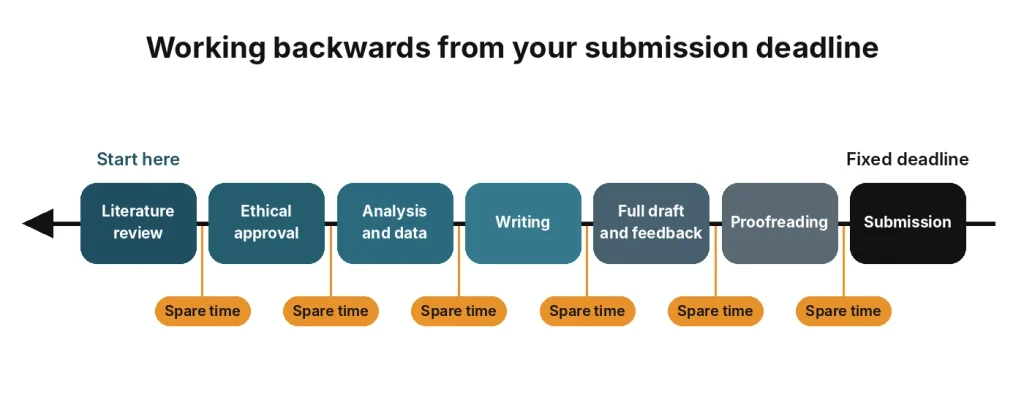
Because several of these stages overlap, the University of Westminster’s library guide recommends a Gantt chart for dissertation planning, a bar chart that shows when each task runs. The University of Sheffield adds that a Gantt chart helps you spot “blocker” tasks, such as ethical review that must finish before data collection can begin, and advises building in contingency time for unforeseen problems in its dissertation planning guide, which also links a free Google Sheets template. A weekly checklist works just as well if a chart feels heavy. What matters is that every task has a date.
What do students forget to schedule in a dissertation timeline?
The tasks that do not feel like “writing”. These are the ones that quietly eat the last month:
- Supervisor turnaround. Ask early how long they need to read a draft. The University of Warwick’s History department, for example, tells students not to expect lengthy meetings outside term time and to check availability over vacations.
- Ethical approval and participant recruitment. Both depend on other people, so neither runs to your calendar.
- Transcription, data cleaning and learning your software. Analysis is rarely a single afternoon after the last response arrives.
- Referencing. Build your reference list as you read, following your department’s Harvard or other required style. Our guide on how to cite a dissertation helps with the format.
- Formatting and word-count checks. Contents page, figure numbers, appendices and whether they count towards your limit.
- The upload itself. File type, size limits, declarations and keeping the receipt.
How long should I allow for ethical approval?
Allow for the slower route, and ask your supervisor which one applies to you. Practice varies by university and even by department. At Leeds University Business School, undergraduates must submit their application at least two weeks before they intend to start collecting primary data and must wait for the approval email, as the LUBS ethics guidance explains. That is the minimum for the standard block-approval route. University of Leeds guidance for module leaders and supervisors says the full University review of taught student projects is normally completed within six working weeks.
The cost of getting this wrong is high. The University of Essex states that ethical approval cannot be granted retrospectively, and that data collected before approval cannot be used. So put your ethics submission early, put a realistic wait after it, and fill that wait with literature review and methodology writing rather than data collection.
What does a dissertation timeline look like in practice?
Below are two plans we have put together as illustrations. They are not university rules, and your handbook dates come first. Use them to see how the stages fit around each other, then change the weeks to match your own deadline.
12-week plan for a literature-based or secondary-data project
| Weeks | Main work | Output to show your supervisor |
|---|---|---|
| 1 | Confirm the research question and scope | Agreed question and plan |
| 2 to 3 | Literature search, reading and choice of method | Source list and method outline |
| 4 | Literature review draft, dataset access confirmed | Draft literature review |
| 5 to 6 | Data preparation and analysis | First tables and figures |
| 7 to 8 | Results, discussion, introduction and conclusion | Chapter drafts |
| 9 | Full draft to supervisor, and your spare week if analysis ran over | Complete draft |
| 10 | Act on feedback | Revised draft |
| 11 to 12 | Edit, proofread, check references and formatting, upload | Submitted dissertation |
24-week plan for an interview or survey project
| Weeks | Main work | Output to show your supervisor |
|---|---|---|
| 1 to 2 | Research question, proposal, first supervisor meeting | Approved proposal |
| 3 to 5 | Literature search, draft interview or survey questions, prepare ethics documents | Draft instruments |
| 6 | Submit ethics application after supervisor review | Submission receipt |
| 7 to 8 | Wait for approval, write the literature review and methodology | Two draft chapters |
| 9 to 12 | Recruitment and data collection, with slack for no-shows | Data collected |
| 13 to 14 | Transcription and data cleaning | Clean, organised data |
| 15 to 17 | Analysis | Findings with notes |
| 18 to 19 | Results and discussion chapters | Chapter drafts |
| 20 | Full draft to supervisor | Complete draft |
| 21 to 22 | Feedback, revision and spare time | Revised draft |
| 23 to 24 | Final checks and upload | Submitted dissertation |
Notice that weeks 7 to 8 and 21 to 22 do double duty. If ethical approval or recruitment runs late, those weeks absorb the delay without touching your writing or final checks. If nothing goes wrong, you simply finish early.
What if I am already behind on my dissertation timeline?
Protect the end of the plan first, then cut from the middle. A late start on analysis is recoverable. An unproofread, unformatted submission usually is not.
- List what is left and attach a realistic number of days to each task, using how long similar tasks actually took you so far.
- Talk to your supervisor now, with a revised plan in hand. A smaller sample or an existing dataset may be acceptable, but only your supervisor can agree that, and any change to your design may need fresh ethical approval.
- Keep the final block. Do not borrow from proofreading, referencing and upload time to buy more analysis time.
- Write the strongest chapters first. Check your marking criteria and give the most time to the sections that carry the most credit.
- Check your university’s rules on extensions and extenuating circumstances if illness or other serious disruption caused the delay. These procedures and their deadlines differ between universities, so read yours before the submission date.
Update your plan once a week. Compare what you meant to finish with what you did, move the dates honestly, and decide which later stage absorbs the slip. Hidden slippage is what turns a manageable delay into a last-minute crisis.
Common questions about dissertation timelines
How long before the deadline should I finish writing?
At least two weeks before, according to the University of Bath’s skills guidance, so that editing, proofreading and referencing do not collide with the submission date. Your supervisor’s feedback window needs to fit inside that time too.
Do I need a Gantt chart for my dissertation?
No, but it helps. Westminster and Sheffield both recommend one because dissertation tasks overlap and some tasks block others. A simple table of tasks, start dates and end dates does the same job if you update it weekly.
How many hours a week should I spend on my dissertation?
Divide your notional hours by the weeks you have. A 30-credit dissertation is about 300 hours on the QAA’s 10-hours-a-credit figure, so 20 weeks means about 15 hours a week. Other modules and paid work come out of the same week, so plan around them.
When should I send a chapter or draft to my supervisor?
Agree this at your first meeting, because supervisors differ and some departments set draft deadlines. Whatever you agree, send work early enough that your supervisor can read it and you can act on the comments before the next milestone.
When your deadline is already close
Sometimes the plan is made and the deadline is still too near. If you would like a second pair of eyes on your timeline, or help with a stuck chapter, our team at OnlineDissertationHelp works with UK students at undergraduate, master’s and PhD level, from a literature review to a full dissertation. Every project includes a free Turnitin report and AI report, with unlimited revisions until you are satisfied with the work, according to your requirements.
The sooner you ask, the more options you have. Tighter deadlines move a project into a higher rate band, which our guide to the cost of academic writing help explains, and you can see current rates on our pricing page. To talk it through, message us on WhatsApp, email info@onlinedissertationhelp.co.uk or visit our Leeds office at 54 Great George St, Leeds LS1 3BB.
