


How to Read an Assignment Brief and Marking Criteria: A UK Student Guide

Understanding how to read an assignment brief and marking criteria is one of the most important skills for university students in the UK. Before starting an essay, report, presentation or coursework task, you need to know exactly what your lecturer expects, which topics you must cover and how your work will be assessed.
An assignment can contain relevant research, well-written paragraphs and appropriate references but still lose marks if it does not answer the question properly. This often happens because students begin writing before fully understanding the instructions or checking the assessment criteria.
The good news is that an assignment brief becomes much easier to manage when you break it into smaller parts. This guide explains how to understand university assignment instructions, interpret marking criteria, recognise academic command words and use grade descriptors to plan stronger coursework.
What Is an Assignment Brief?
An assignment brief is a document or set of instructions explaining what you need to complete for a particular university assessment. It tells you what the task involves, what subject or issue you should address and any requirements you must follow when preparing your work.
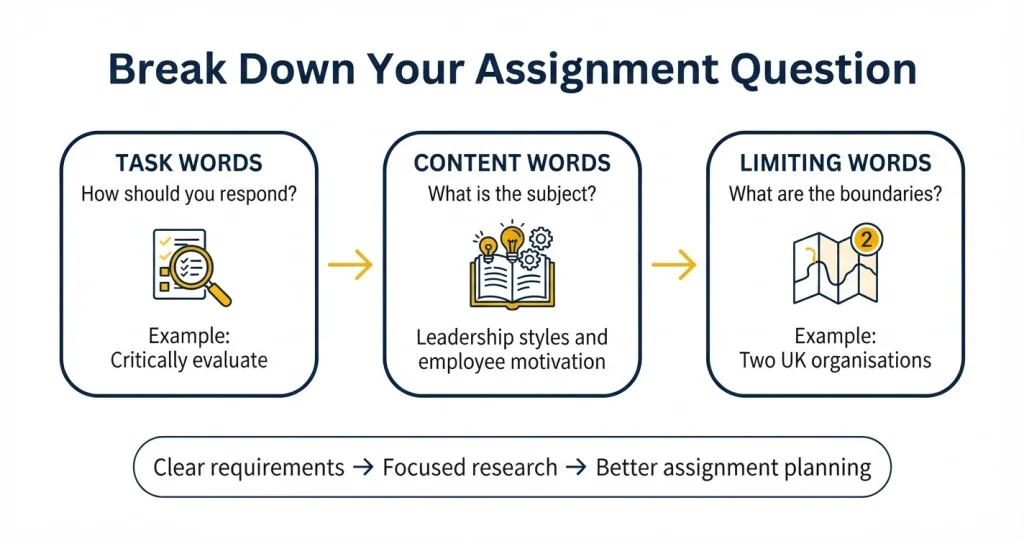
According to the University of Portsmouth’s guidance on understanding an assignment brief, students should identify the task words, content words and limiting words before beginning their work.
An assignment brief may include:
- Assignment question or title: The main task you are expected to answer.
- Assessment type: Whether you need to produce an essay, report, case study, presentation or another format.
- Word count: The expected length of your submission.
- Submission deadline: The date and time by which your work must be submitted.
- Learning outcomes: The knowledge and skills being assessed.
- Referencing requirements: The referencing style or source requirements you must follow.
- Assessment criteria: The standards against which your work will be evaluated.
- Submission instructions: Information about file format, online submission and any additional requirements.
Not every university uses the same assignment brief template. Some provide a detailed document, while others include instructions in a module handbook, online learning platform or assessment page. Check all the relevant documents before you begin.
Why Is It Important to Read an Assignment Brief Carefully?
Reading the brief carefully helps you avoid writing about the wrong topic, missing part of a question or using an unsuitable assignment structure.
For example, a question asking you to critically evaluate a theory requires more than a general explanation. You need to examine the theory, consider supporting and opposing evidence, discuss its limitations and reach a reasoned judgement.
Similarly, if the question specifies two organisations, your discussion should remain focused on those two organisations rather than expanding into unrelated examples.
The University of Oxford Brookes assignment brief guidance also recommends checking the full requirements, understanding the question and ensuring that your response addresses the task you have actually been given.
What Are Assignment Marking Criteria?
Assignment marking criteria are the standards lecturers use to assess the quality of your work. They explain which academic skills, knowledge and qualities are expected and may include descriptions of what different levels of performance look like.
The University of Sheffield’s guide to marking criteria and assessment briefs explains that marking criteria help students understand the standards against which their work will be judged.
Depending on your subject and assessment type, marking criteria may assess:
- Knowledge and understanding of the subject.
- Critical analysis and evaluation.
- Quality and relevance of research.
- Use of academic evidence.
- Development of a clear argument.
- Organisation and structure.
- Academic writing and presentation.
- Referencing and acknowledgement of sources.
Some universities present these criteria in a marking table or rubric. The table may show different grade bands and describe the characteristics associated with each level.
Understanding Grade Descriptors and Marking Bands
Grade descriptors explain what work at different academic levels may look like. They help students understand the difference between a basic response and a more developed piece of academic work.
The following table is a general illustration of common UK undergraduate classifications. It is not a universal marking scale: always check your university’s regulations and the specific criteria for your assessment.
| Classification | Typical undergraduate mark | General characteristics |
|---|---|---|
| First Class | 70% and above | Strong subject knowledge, developed critical analysis, convincing argument and effective use of evidence. |
| Upper Second Class (2:1) | 60–69% | Good understanding, relevant research, clear argument and some critical evaluation. |
| Lower Second Class (2:2) | 50–59% | Satisfactory knowledge, reasonable structure and some relevant analysis, although discussion may lack depth. |
| Third Class | 40–49% | Basic understanding of the subject, with limited analysis or weaknesses in the development of arguments. |
| Fail | Below 40% | Significant gaps in understanding or failure to meet important assessment requirements. |
These bands are commonly used for undergraduate degree classifications in the UK, but individual assessment criteria and institutional regulations may differ. Postgraduate marking systems can also use different thresholds and descriptors.
Do not assume that achieving a particular percentage requires the same qualities at every university. Read the actual grade descriptors provided for your module.
Difference Between an Assignment Brief and Marking Criteria
An assignment brief and marking criteria are closely connected, but they serve different purposes. The brief explains what you need to do, while the criteria explain how the quality of your work will be assessed.
| Assignment brief | Marking criteria |
|---|---|
| Explains the task or question. | Explains the standards used to assess your work. |
| Identifies the topic and scope. | Identifies the qualities expected in your response. |
| Provides the assessment format. | Evaluates how effectively you follow the required format. |
| Includes the word count and deadline. | May assess structure, clarity and academic presentation. |
| Identifies learning outcomes and requirements. | Shows how achievement of those outcomes is judged. |
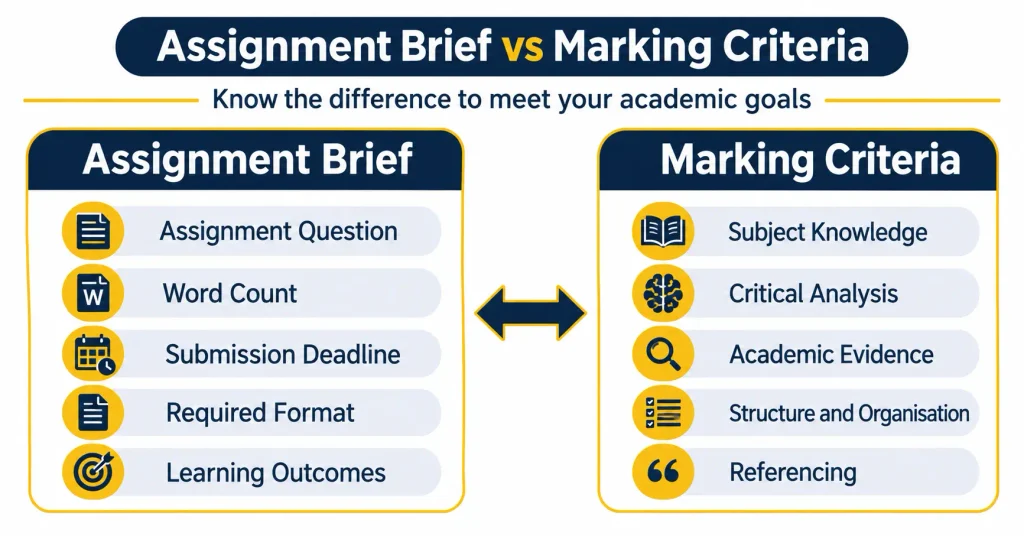
For example, an assignment brief might ask you to critically evaluate leadership styles in two UK organisations. The marking criteria may then assess how effectively you compare the organisations, use academic research, evaluate evidence and develop a justified conclusion.
It is important not to treat every marking criterion as a separate paragraph heading. As Oxford Brookes University explains, criteria usually describe qualities you should demonstrate throughout your work rather than providing a ready-made assignment structure.
How to Read an Assignment Brief Step by Step
Reading an assignment brief systematically can help you identify the main requirements before you begin researching or writing. Follow these steps to turn the instructions into a practical assignment plan.
Step 1: Identify the Main Assignment Question
Start by reading the complete assignment question rather than focusing on individual words immediately. Identify the main subject, the task you need to complete and any specific requirements.
For example:
Critically evaluate the impact of leadership styles on employee motivation and organisational performance in two UK organisations.
This question contains several important requirements:
- Main task: Critically evaluate.
- Topic: Leadership styles.
- Key concepts: Employee motivation and organisational performance.
- Scope: Two UK organisations.
- Expected approach: Evidence-based analysis, comparison and a justified conclusion.
Writing these points down gives you a clearer understanding of what your lecturer expects.
Step 2: Understand Command Words and Instruction Verbs
Command words explain how you should approach the subject. They are among the most important parts of an assignment question because they determine the depth and direction of your response.
| Command word | What it means | What your assignment should demonstrate |
|---|---|---|
| Analyse | Examine the different parts of an issue and their relationships. | Detailed discussion supported by evidence. |
| Evaluate | Judge the value, effectiveness or importance of something. | Evidence-based judgement and a clear conclusion. |
| Discuss | Explore different views, arguments or perspectives. | Balanced consideration and reasoned discussion. |
| Critically evaluate | Examine strengths, weaknesses and alternative perspectives before reaching a judgement. | Critical thinking, supporting evidence and justified conclusions. |
| Compare | Identify similarities between two or more subjects. | Relevant similarities supported by examples. |
| Contrast | Identify differences between subjects. | Clear discussion of important differences. |
| Assess | Judge the significance, value or effectiveness of something. | Evidence and a reasoned assessment. |
| Explain | Make an idea, process or concept clear. | Relevant information and logical explanation. |
| Justify | Give reasons supporting a particular decision or position. | Evidence-based reasoning. |
| Describe | Present the main features or characteristics of something. | Accurate and relevant information. |
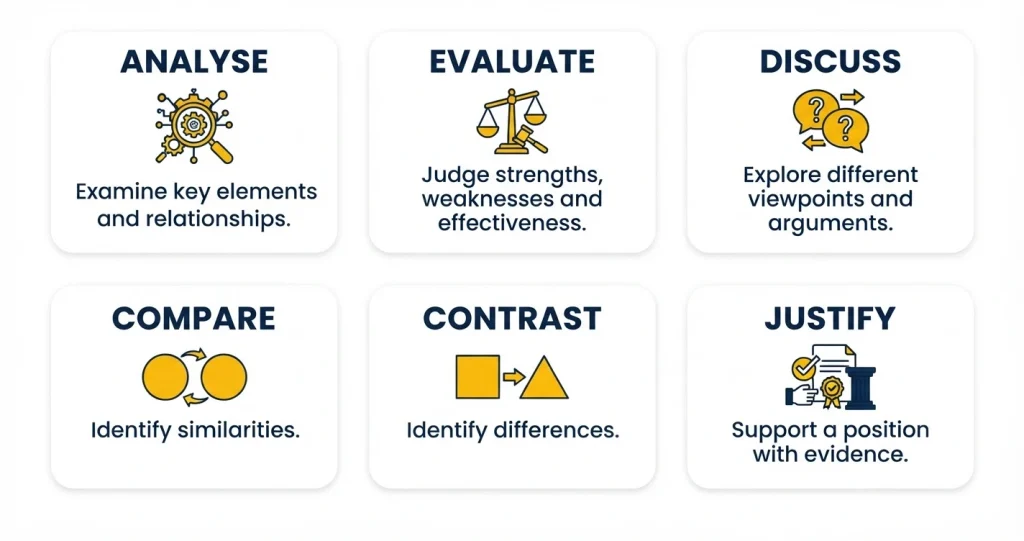
The exact meaning of a command word can vary between subjects and assessments. If you are unsure, consult your module guidance or ask your lecturer.
For additional explanations, see Abertay University’s guide to understanding an assessment brief.
Step 3: Identify the Topic and Scope of the Task
An assignment question may contain several concepts, but you should not automatically discuss everything related to the general topic. Look for words that limit the scope of your response.
Consider the example:
Evaluate the impact of social media on the political participation of young people in the UK since 2015.
The question contains:
- Task word: Evaluate.
- Main topic: Social media.
- Specific issue: Political participation.
- Target group: Young people.
- Geographical boundary: The UK.
- Time boundary: Since 2015.
These details help you select appropriate research and avoid including unrelated information.
A useful technique is to turn each part of the question into a planning question. For example:
- What does the question require me to evaluate?
- Which aspects of political participation should I consider?
- How will I define young people in this assignment?
- Which UK examples or studies are relevant?
- What evidence is available from 2015 onwards?
Step 4: Check the Required Assignment Format
Your assignment brief should explain whether you need to produce an essay, report, case study, reflective piece or presentation.
Different assessment formats have different expectations.
An essay generally develops a central argument through an introduction, main discussion and conclusion. A report may use numbered headings, subheadings, findings and recommendations. A reflective assignment may require you to examine personal learning and connect experience with academic concepts.
Do not choose a format simply because you find it easier. Follow the instructions in your brief.
If you need guidance on structuring academic coursework, you can explore the assignment writing guidance available from Online Dissertation Help.
Step 5: Review the Word Count and Submission Deadline
Check the required word count and deadline before planning your work. These details affect how much research, analysis and discussion you can include.
For example, a 1,500-word essay requires a different level of detail from a 4,000-word report. You should allocate space according to the importance of each part of the task.
Also check:
- Whether the reference list is included in the word count.
- Whether appendices are included or excluded.
- Whether headings count towards the total.
- Whether a permitted word-count variation applies.
- The exact submission date and time.
- The required file format and submission platform.
Always follow your institution’s specific rules rather than assuming that every module uses the same requirements.
Step 6: Identify the Module Learning Outcomes
Learning outcomes describe what you should know or be able to demonstrate after completing a module. Your assignment may assess one or more of these outcomes.
For example, a business management module might expect students to demonstrate an understanding of leadership theories, evaluate management practices and apply relevant concepts to organisational situations.
Look for connections between the assignment question and the learning outcomes. This can help you identify the knowledge and academic skills that should appear in your response.
Step 7: Check Referencing and Source Requirements
Your assignment brief may specify a referencing style such as Harvard, APA or OSCOLA. It may also provide instructions about academic sources, recommended reading or the use of particular materials.
Before writing, check:
- Which referencing style is required.
- Whether academic journal articles are expected.
- Whether books and textbooks are appropriate.
- Whether websites and reports can be used.
- Whether there is a minimum or recommended number of sources.
- How quotations, paraphrasing and citations should be presented.
Keep a record of your sources while researching. This makes it easier to prepare your reference list and reduces the risk of missing citations.
How to Understand University Marking Criteria
Once you understand the assignment brief, read the marking criteria carefully. Do not leave this until the final stages of writing. Reviewing the criteria early helps you understand which qualities deserve attention during research, planning and drafting.
Understand the Different Assessment Categories
Start by identifying the main categories in the marking table. These may include subject knowledge, critical analysis, research, argument, structure and referencing.
For each category, ask yourself:
- What does this criterion mean?
- What would a strong response demonstrate?
- Which parts of my assignment will provide evidence of this skill?
- How can I check whether I have met the requirement?
For example, if critical analysis is a major assessment category, simply describing theories will not be enough. You may need to compare different perspectives, evaluate evidence and explain why one interpretation is more convincing.
Check the Weighting of Each Criterion
Some assignments give more marks to particular assessment categories than others. If your marking criteria include percentages, use them to understand where you should focus your time.
Consider this hypothetical example:
| Assessment category | Weighting |
|---|---|
| Knowledge and understanding | 20% |
| Critical analysis and evaluation | 30% |
| Research and use of evidence | 25% |
| Structure and organisation | 15% |
| Referencing and presentation | 10% |
| Total | 100% |
In this example, critical analysis and evaluation carry the highest weighting. This suggests that you should give particular attention to developing arguments and examining evidence rather than spending most of your word count describing background information.
The percentages above are illustrative only. Use the weightings in your own assignment documentation.
Identify What Higher Grade Descriptors Require
Read the descriptions for the grade bands and compare their language. You may notice that higher bands place greater emphasis on critical engagement, independent thinking, strong evidence and well-supported conclusions.
For example:
- A basic response may identify relevant theories.
- A stronger response may explain and apply those theories.
- A more developed response may compare theories and examine their limitations.
- A highly developed response may evaluate different perspectives and reach a convincing conclusion supported by evidence.
Use these descriptions as guidance for improving your work, not as a guarantee of a particular grade.
Worked Example: Breaking Down an Assignment Brief and Marking Criteria
A worked example can show how the assignment question and assessment criteria work together.
Example assignment question:
Critically evaluate the impact of leadership styles on employee motivation and organisational performance in two UK organisations.
Imagine the marking criteria place particular emphasis on subject knowledge, critical analysis, research evidence and organisation.
| Assignment requirement | What you need to do | Relevant assessment quality |
|---|---|---|
| Critically evaluate | Examine different leadership perspectives and reach a reasoned judgement. | Critical analysis and evaluation. |
| Leadership styles | Explain relevant theories and concepts. | Knowledge and understanding. |
| Employee motivation | Explore how leadership may influence employee motivation. | Application of theory and evidence. |
| Organisational performance | Examine relevant organisational outcomes. | Analysis and use of research. |
| Two UK organisations | Compare suitable examples within the stated scope. | Relevance, comparison and argument. |
How Could You Turn This Into an Assignment Plan?
A possible structure might include:
Introduction
Introduce the topic, explain the purpose of the assignment and identify the two organisations selected for comparison.
Section 1: Leadership Theories
Explain the leadership theories relevant to the question. Use academic sources to establish the key concepts.
Section 2: Leadership and Employee Motivation
Examine how different leadership approaches may influence employee motivation. Support your discussion with research and relevant examples.
Section 3: Organisational Performance
Evaluate the relationship between leadership styles and organisational performance in the selected organisations.
Section 4: Comparative Discussion
Compare the two organisations, considering similarities, differences and limitations in the available evidence.
Conclusion
Summarise the main findings and provide a reasoned judgement that directly answers the question.
This is an illustrative structure, not a universal template. Your final headings and word allocation should reflect the actual assessment instructions and marking criteria.
Common Mistakes Students Make When Reading Assignment Briefs
Even students who understand their subject can lose marks by overlooking important assessment requirements. The following mistakes are worth checking before you begin.
1. Ignoring Command Words
A question asking you to evaluate requires judgement, not just description. Make sure your writing reflects the instruction word throughout the assignment.
2. Answering Only Part of the Question
Some questions contain several connected requirements. Highlight each one and check that your plan addresses all of them.
3. Overlooking Assessment Weightings
If critical analysis carries more marks than presentation, your planning should reflect that difference. Do not spend disproportionate time on low-weighting details.
4. Ignoring Learning Outcomes
Learning outcomes help explain the academic knowledge and skills being assessed. Check that your work demonstrates the relevant outcomes.
5. Misunderstanding the Word Count
A response that is considerably too short may not provide enough discussion, while unnecessary material can make an assignment unfocused. Follow the word-count guidance provided by your university.
6. Writing Descriptively When Critical Analysis Is Required
Explaining what a theory says is not always enough. Where evaluation is expected, examine its strengths, weaknesses, limitations and relevance to the question.
7. Leaving Referencing Until the End
Record source details during your research and cite them as you write. This helps maintain accurate referencing and academic integrity.
If you need another review of clarity, grammar or referencing presentation, you can explore the academic proofreading and editing service.
Assignment Brief and Marking Criteria Checklist Before Submission
Before submitting your assignment, use the following checklist to review your work against the original instructions.
- I have read the complete assignment brief.
- I understand the main assignment question.
- I have identified all command words.
- I have checked the topic and scope of the task.
- I have followed the required assignment format.
- I have checked the word count and submission deadline.
- I have reviewed the relevant module learning outcomes.
- I have read the marking criteria and grade descriptors.
- I have considered the weighting of each assessment category.
- My discussion addresses every part of the question.
- I have included relevant academic research and evidence.
- My work demonstrates analysis and evaluation where required.
- I have followed the correct referencing style.
- I have checked grammar, spelling and presentation.
- I have followed the submission instructions.
The most useful final check is to place your assignment beside the original brief and marking criteria. Read each requirement and identify where your work demonstrates that you have met it.
Frequently Asked Questions
What is the difference between an assignment brief and marking criteria?
An assignment brief explains what you need to do for an assessment, including the question, format and submission requirements. Marking criteria explain how your work will be evaluated and which academic qualities are expected.
How do I know what my lecturer expects in an assignment?
Read the assignment brief, module learning outcomes and marking criteria together. Identify the command words, topic, scope, required format and assessment standards. If any instruction remains unclear, ask your lecturer or module leader.
What do marking criteria mean at a UK university?
Marking criteria are the standards used to judge the quality of university work. They may assess subject knowledge, critical analysis, research, argument, structure and referencing. The exact criteria depend on the university, module and assessment.
What are the most common command words in university assignments?
Common command words include analyse, evaluate, discuss, compare, contrast, assess, explain, describe and justify. Each asks you to approach the subject in a particular way, so check the guidance provided by your university.
How do I use grade descriptors to improve my assignment?
Compare the descriptions for different grade bands and identify the qualities associated with stronger work. Use these descriptions to review your argument, evidence, critical analysis and structure. Remember that the actual standards are institution-specific.
What should I do if my assignment brief is unclear?
Read the instructions again and identify the exact words or requirements you do not understand. Check your module handbook and any supporting guidance. If the uncertainty remains, contact your tutor or module leader before making assumptions.
Do all UK universities use the same marking criteria?
No. Universities may use different assessment frameworks, grade descriptors and marking policies. Even within one university, criteria can vary between modules and assessment types. Always use the criteria supplied for your particular assignment.
Final Thoughts
Knowing how to read an assignment brief and marking criteria can make university assessments more manageable. The brief tells you what the task requires, while the marking criteria help you understand the academic standards you need to demonstrate.
Start by identifying the main question, command words, topic boundaries and submission requirements. Then examine the assessment criteria, pay attention to the weighting of different categories and use the grade descriptors to review your work.
Most importantly, keep returning to the original assignment question while researching and writing. This helps ensure that your discussion remains relevant and that you are meeting the requirements set by your university.
Students who need further guidance with planning and preparing coursework can explore coursework help or the assignment writing service at Online Dissertation Help. For students preparing a research-based project, the research proposal help service may also be relevant.
Further University Reading
The following university resources provide additional guidance on assignment briefs, assessment criteria and academic feedback:
- University of Portsmouth – Understanding Your Assignment Brief
- University of Sheffield – How to Use Marking Criteria and Assessment Briefs
- Oxford Brookes University – Assignment Briefs
- Abertay University – Understanding Your Assessment Brief
- University of Portsmouth – Using Feedback Effectively
- Abertay University – Planning Your Assignment
