


How to Write a Research Question for Your Proposal

If you are staring at a blank proposal template, here is the short answer. A good research question is one clear, focused question that names who or what you are studying, in what context, and what you want to find out. It must be small enough to answer within your module’s time, word count and access to data.
The route to it is much the same on most UK courses. You start with a broad topic, read until you spot a gap, narrow by population, place and time, phrase it as a question, then test it against your method and your supervisor’s view. Below we walk through each step with a worked example, weak and improved questions from six subjects, fill-in templates and a checklist to run before you submit.
What is a research question in a proposal?
It is the question your whole study exists to answer. The University of Portsmouth’s library guide describes it as defining precisely what your research will investigate, while the aim is the broader purpose behind it. Everything else in the proposal, from the literature review to the methodology chapter, is there to show that you can answer it.
Where it sits depends on the template. Queen Mary University of London’s guidance for PhD applicants runs from title and background through the research questions to theory and methods, and asks for questions that are clear, concise and answerable in the time available. The Open University’s faculty guidance for a 2,000-word PhD proposal gives the question its own 50-word section straight after the literature review. Your module handbook will say which order your department expects.
One thing trips up a lot of students at this point. A topic is not a question. “Hybrid working” is a topic. A question tells the reader exactly what you will find out about it, and for whom.
| Topic (too wide) | Research question (workable) |
|---|---|
| Hybrid working | How do office-based employees in UK small and medium-sized enterprises experience hybrid working in relation to work-life balance? |
Not sure you have even reached the topic stage? Our guide on how to choose a dissertation topic helps you settle on one first. If you are unsure whether your course wants a dissertation proposal or a research proposal, we explain how a dissertation proposal differs from a research proposal.
What makes a good research question?
UK university guides describe good questions in slightly different words, but the same tests keep coming back. Use them as a quick scorecard on your draft.
| Test | Ask yourself |
|---|---|
| Clear | Could a classmate from another course read it once and say what you are studying? |
| Focused | Does it name who, what, where and when, or is it covering a whole field? |
| Answerable | Can you find or collect the data, sources or participants you need? |
| Open | Does it need more than a yes or no, and can it be answered within your word count? |
| Relevant and significant | Who would care about the answer, and what gap in the literature does it address? |
| Manageable | Will it fit your time, your skills and your access to people and resources? |
| Original enough | Is there some fresh angle, such as a new group, setting or way of using existing data? |
| Neutral | Does the wording avoid assuming the answer? |
Several of these tests come straight from published guidance. The University of Hull library guide says a question should be clear, focused, answerable, relevant and significant. The University of Portsmouth uses SMART criteria (specific, measurable, achievable, relevant and timely) and adds that the question should need more than a yes or no answer and use key terms you can define. The University of Leeds library guide adds that a project only needs to be original to some extent, because it is not a PhD.
Health and science courses often use the FINER checklist instead: feasible, interesting, novel, ethical and relevant. The University of Westminster’s dissertation guide recommends it for testing a draft question, and the criteria were set out by Hulley and colleagues in Designing Clinical Research. You can see them summarised in a journal article on developing a clinical research question.
How do you write a research question step by step?
Treat these steps as a loop, not a straight line. Portsmouth’s guide says the stages are a starting point rather than a strict sequence, and Sheffield Hallam notes that questions take time and refinement. Expect to go back to step 2 after you have read more.
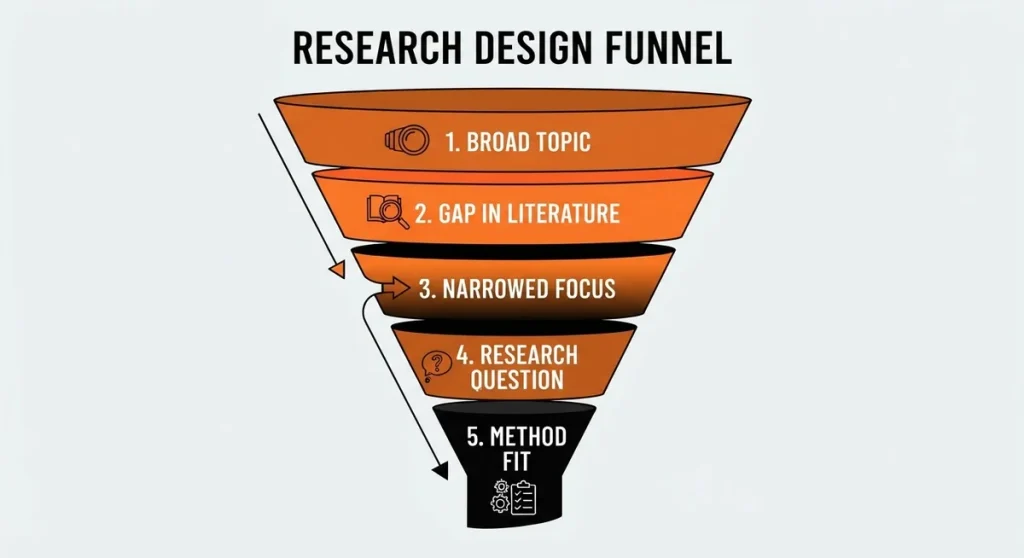
1. Choose a broad topic you can live with
Pick something that will hold your interest for months, not just something that looks easy. Hull’s guide makes this point directly. Looking back over your taught modules and your department’s research interests is a good way to start, as the Leeds guide suggests, and Westminster recommends mind mapping to group and connect your ideas.
2. Read around it and find a problem or gap
Hull’s guide says that, unless you are doing a systematic review, your question should emerge from your reading, because the literature shows why the question needs asking. Look for something that is disputed, outdated, untested with your group, or studied only in one setting. Our guide on how to write a literature review shows how to read with that gap in mind.
3. Narrow it by population, place and time
The University of Southampton’s library guide moves from subject to theme to context, such as a time period, place or population, and then to the specific angle you want to find out about. Narrowing is also how you make a question answerable. Portsmouth’s advice for a question that is not specific enough is to reduce the variables, groups or locations.
4. Phrase it as a question that does some thinking
Portsmouth suggests stems such as “To what extent…”, “How…”, “What…” or “Why…”. Sheffield Hallam’s library guide adds that analytical words like “how”, “examine” and “evaluate” push you further than “what” or “describe”, which tend to produce a descriptive project. If your question is too big to answer in one go, split it into sub-questions. Hull shows a main question broken into four smaller ones that together answer the whole.
5. Check your data and method fit the question
Portsmouth says your plans for collecting data decide whether the question is measurable and achievable. If you cannot reach the participants or the dataset, you change the question, not the other way round. The same applies to analysis. A case study, a comparison or a historical approach each shapes how you can frame the question.
6. Test it and think about ethics
Run the draft through the scorecard above. Then ask whether your idea involves people, personal data or sensitive material. If it does, you will need ethical approval before you collect anything, which we cover below.
7. Agree it with your supervisor, then write it in
Hull’s guide says the final question is agreed between you and your supervisor, and that you should still bring your own ideas to that conversation. The University of Reading’s PhD guidance also tells applicants they are not tied to their proposal’s working title once they start, so a proposal question is a strong starting point, not a contract. Even so, make it as sharp as you can before you submit, because your marker reads it first.
What does the journey from topic to question look like?
Here is one illustrative example, built to show the pattern. It is not a real study, and the gap is imagined, so do not copy it into your own proposal.
| Stage | What you write |
|---|---|
| Broad topic | Hybrid working |
| Problem or gap (imagined) | Your reading suggests most studies look at large corporations, with far fewer on smaller firms |
| Narrowed focus | Hybrid working and work-life balance among office-based staff in UK small and medium-sized enterprises |
| Research question | How do office-based employees in UK small and medium-sized enterprises experience hybrid working in relation to work-life balance? |
| Aim | To explore how hybrid working shapes work-life balance for employees in UK small and medium-sized enterprises |
| Objectives | To review existing research on hybrid working and work-life balance. To collect employees’ accounts through semi-structured interviews. To identify the main themes across those accounts. |
| Method that fits | Qualitative, using interviews and thematic analysis, with ethical approval before recruiting participants |
Notice how each row follows from the one before. If you change the question to “Is the number of days worked from home related to job satisfaction?”, the method row changes too, and so does everything under it.
Research question examples for a proposal
The six examples below show a weak question, a stronger version and why the change works. We wrote them to show the pattern across subjects. They are not real studies or approved titles, and your supervisor will want your own wording.
Business and management
- Weak: How does hybrid working affect employees?
- Stronger: How do office-based employees in UK small and medium-sized enterprises experience hybrid working in relation to work-life balance?
- Why it works: It names the group, the setting and the outcome, and “how do … experience” points straight to a qualitative design.
Nursing and healthcare
- Weak: Why do nurses leave the NHS?
- Stronger: What reasons do newly registered adult nurses in one NHS acute trust give for considering leaving within their first two years of practice?
- Why it works: One group, one setting and a time window make it researchable through interviews or a short survey. Studies involving NHS staff can need approval beyond your university, so raise that with your supervisor early.
Education
- Weak: Is digital learning good for pupils?
- Stronger: To what extent is the frequency of tablet use in lessons associated with reading attainment among Year 5 pupils in two primary schools?
- Why it works: “Good” has been replaced by something you can measure, and the pupils and settings are defined. It suits a quantitative design.
Psychology
- Weak: Does social media cause anxiety?
- Stronger: Is there a relationship between daily time on social media and self-reported anxiety among first-year UK undergraduates?
- Why it works: “Cause” is a claim a survey cannot prove. Asking about a relationship matches what a correlational design can actually show, and the population is clear.
Law
- Weak: Is company law good at protecting the environment?
- Stronger: To what extent does section 172 of the Companies Act 2006 require directors of UK companies to weigh environmental impact in their decisions?
- Why it works: It names a provision, a jurisdiction and a concept, and you can answer it from statute, case law and commentary. A purely doctrinal study like this often involves no participants, though your department decides whether it needs approval.
Computing and AI
- Weak: How good is AI at predicting student dropout?
- Stronger: How does the choice of input features affect the accuracy of machine-learning models that predict first-year dropout, using anonymised higher education data?
- Why it works: It compares something you control (the features) against something you can measure (accuracy). Check early that you can get an ethically usable dataset, because that decides whether the question is achievable.
If your subject is not here, our topic lists for human resource management, social psychology, educational psychology, law and data science are a quick way to find an area worth narrowing.
Research question templates you can adapt
Templates give you a shape to fill, not wording to copy. Swap in your own group, setting and outcome, then read the result aloud. If it sounds vague, tighten it.
| Type | Template |
|---|---|
| Qualitative | How do [participants] experience [phenomenon] in [context]? |
| Quantitative, relationship | Is there a relationship between [variable A] and [variable B] among [population] in [setting]? |
| Quantitative, comparison | Do [group 1] and [group 2] differ in [measurable outcome]? |
| Mixed methods | To what extent does [measurable pattern] occur among [population], and how do [participants] explain it? |
| Exploratory | What factors shape [phenomenon] for [group] in [context]? |
| Evaluative or doctrinal | To what extent does [law, policy or intervention] achieve [stated purpose] in [jurisdiction or setting]? |
Frameworks that help you structure the question
Health and social care courses often use a named framework to break a question into parts. Edinburgh Napier University’s library guide says PICO (population, intervention, comparison, outcome) is most widely used for quantitative questions, and notes you do not have to use every element. The University of Exeter’s scoping review guide describes PEO (population, exposure, outcome) as useful for questions with a qualitative focus. SPIDER (sample, phenomenon of interest, design, evaluation, research type) was developed from PICO to cover qualitative and mixed-methods work, as the University of Bath library guide explains, and London South Bank University’s SPIDER page sets out each element. Ask your module leader which, if any, your course expects.
How do you match your research question to your methodology?
The question and the method should fit like a lock and key. The University of Westminster’s library guide says questions suit exploratory, usually qualitative work, while hypotheses suit explanatory work that tests cause and effect, usually quantitative. A library guide from Toronto Metropolitan University adds that qualitative questions often use words such as experience, understanding and meaning, while quantitative ones tend to look at relationships, differences or descriptions of measurable variables.
- Qualitative: aim to understand experiences, meanings or processes, usually through interviews, focus groups or document analysis.
- Quantitative: aim to measure, compare or test relationships between variables, usually through surveys or existing datasets.
- Mixed methods: use when one part of your question needs numbers and another needs explanation, and be ready to justify why a single approach would not do.
If you are torn between approaches, read our guide on how to choose the right methodology for your dissertation before you lock the question in. Changing the question later is far easier than rebuilding a method.
Research question vs aim vs objectives vs hypothesis
These four terms get mixed up constantly, and markers notice. The table below uses a quantitative version of our running example so you can see how they line up.
| Term | What it does | Example |
|---|---|---|
| Aim | States the overall purpose in one broad sentence | To examine how hybrid working relates to job satisfaction in UK small and medium-sized enterprises. |
| Research question | Says exactly what you will find out | To what extent is the number of days worked from home associated with job satisfaction among office-based employees in UK small and medium-sized enterprises? |
| Objectives | Break the aim into achievable steps | To review existing evidence. To survey employees. To analyse the association between days at home and satisfaction. |
| Hypothesis | Predicts a testable outcome, mainly in quantitative work | Employees who work more days from home report higher job satisfaction. |
Here is what trips people up. Sheffield Hallam’s library guide says research objectives and research questions are the same thing, written differently, and that meeting each objective or answering each question should meet your aim. So you may not need both. Check which your handbook wants.
On numbers, UK guides give no single answer for questions, but they do for objectives. Portsmouth says most proposals have two to four objectives, and Sheffield Hallam says you will usually have three to five. Our post on how many research questions a dissertation should have goes into the detail, and your module handbook has the final say.
Common mistakes when writing a research question
| Mistake | What it looks like | How to fix it |
|---|---|---|
| Too broad | “How does social media affect young people?” | Name the group, platform, outcome and place. The Open University’s guidance warns that proposals are usually over-ambitious. |
| Too narrow | A question so specific that there is almost no literature | Widen the context a little. Hull warns that a narrow topic limits your conclusions and your literature. |
| Vague terms | “Effective”, “good” or “success” with no definition | Define it or replace it with something measurable, such as attainment or turnover. |
| Yes or no question | “Is remote working better?” | Rephrase with “how”, “to what extent” or “why”. |
| Leading wording | “Why is hybrid working harmful?” | Remove the assumption and let your data show the answer. |
| Several questions in one | A sentence joined by “and” that asks two things | Split it into a main question and sub-questions. |
| No access to data | A question that depends on confidential records or hard-to-reach groups | Check access now. Change the question if you cannot get what you need. |
| Method mismatch | A “how do people experience” question answered with a tick-box survey | Match the method to the verb in your question. |
Does your research question need ethical approval?
If your question involves interviews, surveys, observation, social media data or anyone’s personal information, almost certainly yes. The University of St Andrews’ business school page says approval is needed for research with human participants, including surveys, questionnaires, interviews and research involving social media, and that students must get a favourable opinion letter before they begin. The University of Manchester’s health sciences handbook says approval cannot be given retrospectively. The University of Southampton’s library guide adds that spotting an ethical issue does not mean abandoning the idea, only discussing it with your supervisor and applying before you proceed.
Some studies need more than your department’s sign-off. The University of Warwick’s history department guidance for taught students says projects involving the NHS, the military or higher risk may need further formal approval. Ask your supervisor what applies to you while you are still shaping the question, because it can change what you can realistically ask.
Research question checklist before you submit your proposal
Run through this before you send your draft to your supervisor. If you cannot tick a line, that is where to work next.
- ☐ It is one clear sentence, and a classmate can say what it asks.
- ☐ It names the group, the setting and the outcome.
- ☐ It needs more than a yes or no answer.
- ☐ Every key term can be defined or measured.
- ☐ It follows from a gap you found in the literature.
- ☐ You can get the data, sources or participants in the time you have.
- ☐ Your methodology matches the way the question is phrased.
- ☐ You have thought about ethical approval and data protection.
- ☐ Your aim, objectives and any hypothesis point at the same question.
- ☐ It fits the word limit and format in your module handbook.
FAQs about writing a research question for a proposal
How many research questions should a proposal have?
There is no fixed number, so follow your module handbook. Most proposals centre on one main question, sometimes with a few sub-questions. UK library guides give figures for objectives rather than questions, such as two to four at Portsmouth and three to five at Sheffield Hallam.
How long should a research question be?
Usually one clear sentence. Queen Mary’s guidance asks for questions that are brief and reasonable in scope, and the Open University’s PhD template gives the whole research question section only 50 words. If yours needs a paragraph, it is probably several questions.
Does a research proposal need a hypothesis?
Not always. Westminster’s guide links hypotheses mainly to quantitative studies that test cause and effect, and research questions to exploratory work. Your department’s template and your method decide, so check before you add one.
Can a research question be too broad or too narrow?
Yes, both. Too broad and you cannot answer it in a small project. Too narrow and you struggle to find literature or draw useful conclusions. Hull’s guide describes this balance, and a quick test is whether you can name the group, setting and outcome.
Can I change my research question after my proposal is approved?
Often yes, within limits. Leeds says your question may evolve as the project develops, and Hull says the final question is agreed with your supervisor. Agree any significant change with your supervisor before you act on it, and check whether your course needs it recorded.
What is the difference between a research question and a research objective?
Mostly wording. Sheffield Hallam says objectives and questions are the same thing written differently, with objectives phrased as tasks (“to analyse…”) and questions as enquiries (“how…?”). Your handbook says which form your marker expects.
How do I write a research question for a Master’s or PhD proposal?
Use the same steps, but raise the bar on originality and show how the question connects to existing debates. A PhD application also needs a project that fits your supervisor’s expertise. Our PhD and thesis support covers the later stages once you are accepted.
Once your question is settled, the rest of the proposal gets easier. Our step-by-step guide to writing a dissertation proposal shows how it fits with your rationale, methodology and timeline. If you would like a specialist to sharpen yours around your own brief, handbook and marking criteria, our research and dissertation proposal help starts from what your department asks for. Prefer a quick chat first? At OnlineDissertationHelp you can message us on WhatsApp and we will help you read your brief.
