


International Business Dissertation Topics for 2026

Questions Students Are Asking (From Academic Forums and Student Discussion Platforms)
Before diving in, here are some of the most common questions collected from student forums, Reddit threads, and academic discussion boards. These reflect exactly how students think when they are stuck choosing a dissertation topic:
- What are the best international business dissertation topics for 2026?
- How do I choose a dissertation topic in international business that is narrow enough to research?
- What international business research topics are currently relevant at master’s level?
- Can I find global business dissertation topics that connect theory with real-world practice?
- Are there international trade dissertation topics suitable for undergraduate research?
- How should I structure a dissertation aim and objectives for an international business topic?
- What are the latest trends shaping international business research right now?
If any of these questions sound familiar, this post is written specifically for you.
Why Choosing the Right International Business Dissertation Topic Matters
Choosing the right dissertation topic is one of the most important decisions you will make throughout your degree. In international business, this decision carries extra weight because the field moves quickly. Trade policies shift, global supply chains break and rebuild, and new markets emerge almost every year.
A well-chosen topic gives your dissertation direction and purpose. It also shows your supervisor and assessment panel that you understand the field. Students who select a topic that is too broad often struggle to complete their research within the word limit. Those who pick a topic that is too narrow risk finding insufficient literature. The right balance is a topic that is focused, researchable, and academically meaningful.
This post is designed to help you find that balance. Whether you are searching for international business dissertation topics at undergraduate, master’s, or PhD level, the guidance below will help you move forward with confidence.
Download International Business Dissertation Topics PDF
Many students find it helpful to have a curated, ready-to-use list of dissertation topics they can review at their own pace. An expert-compiled PDF of international business dissertation topics is available for students who complete a short academic preference form. Once submitted, the PDF is sent directly and includes topics personalised to your academic level and research interests. This resource has been put together by experienced academic professionals who understand what universities expect from a strong dissertation proposal.
Key Research Areas in International Business
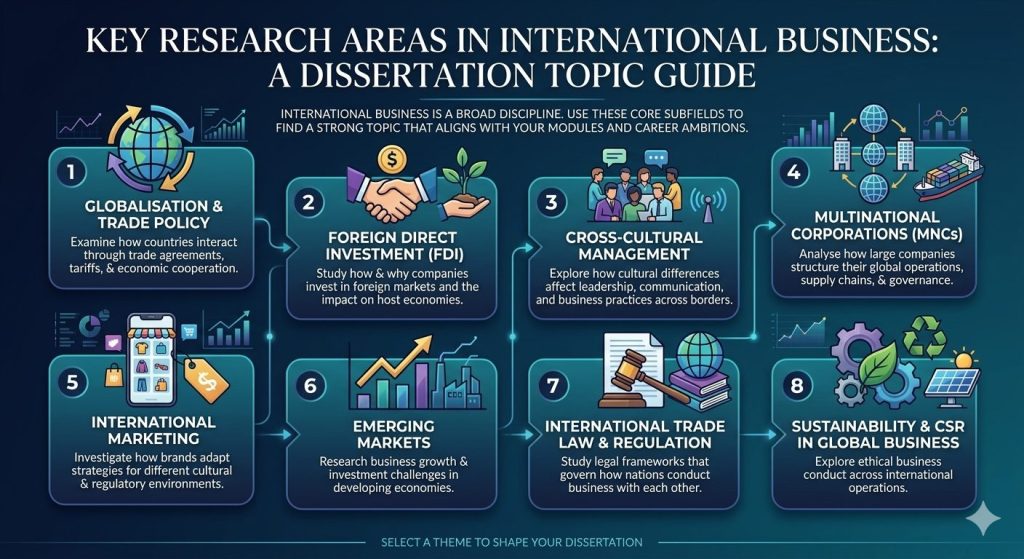
International business is a broad academic discipline. To choose a strong dissertation topic, it helps to understand the major subfields you can explore. Below are the core areas that currently shape international business research:
- Globalisation and trade policy — examining how countries interact through trade agreements, tariffs, and economic cooperation
- Foreign direct investment (FDI) — studying how and why companies invest in foreign markets, and what impact this has on host economies
- Cross-cultural management — exploring how cultural differences affect leadership, communication, and business practices across borders
- Multinational corporations (MNCs) — analysing how large companies structure their global operations, supply chains, and governance
- International marketing — investigating how brands adapt their strategies for different cultural and regulatory environments
- Emerging markets — researching business growth and investment challenges in developing economies
- International trade law and regulation — studying legal frameworks that govern how nations conduct business with each other
- Sustainability and corporate social responsibility (CSR) in global business — exploring ethical business conduct across international operations
Each of these areas offers rich potential for original research. Students who are unsure which direction to take can often find clarity by asking which of these themes connects most naturally with their module experience or career ambitions.
Five Example Dissertation Topics With Aims and Objectives
Understanding how to structure a dissertation topic academically is just as important as choosing the right subject. Below are five example topics, each with a clearly written aim and a set of research objectives. These examples are intended to guide you in framing your own research idea.
Example 1: Foreign Direct Investment in Sub-Saharan Africa
Research Aim: To examine the key determinants of foreign direct investment in Sub-Saharan Africa and assess their impact on economic development outcomes between 2015 and 2025.
Research Objectives:
- To identify the political, economic, and infrastructural factors that attract FDI to Sub-Saharan African economies.
- To evaluate how FDI inflows have influenced employment levels and GDP growth in selected Sub-Saharan African countries.
- To assess how policy reforms in the region have shaped investor confidence over the last decade.
Example 2: Cross-Cultural Communication in Multinational Corporations
Research Aim: To investigate how cross-cultural communication barriers affect team performance in multinational corporations operating across Western and Asian markets.
Research Objectives:
- To identify the primary communication challenges experienced by multinational teams in cross-cultural environments.
- To analyse how organisational culture and management strategies mitigate intercultural misunderstandings.
- To recommend practical frameworks for improving cross-cultural communication within MNC teams.
Example 3: Brexit and UK International Trade Policy
Research Aim: To evaluate the long-term consequences of Brexit on the United Kingdom’s international trade relationships and export performance between 2020 and 2025.
Research Objectives:
- To assess the changes in UK trade volumes with EU and non-EU partners since 2020.
- To examine how British businesses have adapted their international trade strategies in the post-Brexit environment.
- To compare UK trade policy outcomes with those of similar non-EU economies over the same period.
Example 4: Sustainability Reporting Practices in MNCs
Research Aim: To critically evaluate how multinational corporations in the consumer goods sector report on environmental sustainability across different national regulatory environments.
Research Objectives:
- To compare sustainability reporting standards applied by MNCs in Europe, North America, and Asia.
- To assess whether voluntary or mandatory reporting requirements produce more transparent sustainability disclosures.
- To examine stakeholder perceptions of MNC sustainability reports and their influence on consumer behaviour.
Example 5: Digital Transformation and International Marketing Strategy
Research Aim: To explore how digital transformation has reshaped international marketing strategies for small and medium-sized enterprises (SMEs) entering global markets.
Research Objectives:
- To identify the digital tools and platforms SMEs use most frequently to support international market entry.
- To evaluate how digital marketing strategies differ across culturally diverse international markets.
- To assess the barriers SMEs face when scaling digital marketing efforts across multiple countries.
80 International Business Dissertation Topics for 2026
The following topics are organised by research subfield. Each topic is narrow enough to support focused academic research and current enough to meet 2026 academic expectations. These topics are suitable for undergraduate, master’s, and PhD-level students depending on scope and depth.
Students looking for additional guidance on framing their research proposal may benefit from professional online dissertation help to ensure their topic aligns with institutional requirements.
Foreign Direct Investment and Emerging Markets
- The role of political stability in attracting greenfield FDI to Southeast Asian economies between 2018 and 2024.
- How tax incentive policies in sub-Saharan Africa influence the location decisions of multinational investors.
- A comparative analysis of FDI inflows into India and Brazil following post-pandemic economic recovery policies.
- The relationship between institutional quality and foreign direct investment performance in frontier markets.
- How bilateral investment treaties shape FDI flows between the European Union and African Union nations.
- The impact of China’s Belt and Road Initiative on FDI patterns in Central Asian economies from 2015 to 2025.
- Examining the crowding-in and crowding-out effects of state-owned enterprise investment on private FDI in Vietnam.
- How digital infrastructure development in emerging economies attracts technology-oriented foreign direct investment.
- The influence of cultural distance on the entry mode choices of European MNCs investing in South Asian markets.
- Assessing investor perception of risk in fragile states: a study of FDI decisions in conflict-affected economies.
Globalisation, Trade Policy, and International Trade
- How the United States-China trade war has reshaped global supply chain configurations in the electronics sector.
- The effect of regional trade agreements on export competitiveness among small island developing states.
- Evaluating the role of the World Trade Organisation in resolving bilateral trade disputes between developing nations.
- How post-Brexit trade policy has affected agricultural exports from the United Kingdom to the European Union.
- The influence of non-tariff barriers on market access for pharmaceutical exports from South Asia to Europe.
- Trade diversification strategies adopted by ASEAN member states in response to shifting global demand.
- How currency volatility in Latin American economies affects the volume and direction of international trade flows.
- Examining the relationship between trade openness and income inequality in middle-income economies from 2010 to 2024.
- The role of export processing zones in facilitating international trade growth in East African economies.
- How digital trade regulations are reshaping cross-border e-commerce flows between the EU and non-EU markets.
Cross-Cultural Management and International HRM
- How national culture dimensions influence performance management systems in multinational corporations operating in Japan.
- The effect of cultural intelligence on expatriate adjustment and job performance in Middle Eastern host countries.
- Cross-cultural leadership styles and their impact on employee engagement in German-Chinese joint ventures.
- How language barriers affect knowledge transfer within multinational corporate teams in multilingual environments.
- The influence of Hofstede’s cultural dimensions on negotiation strategies in international business partnerships.
- Examining gender diversity practices in MNC subsidiaries across culturally conservative host-country environments.
- How work-life balance expectations vary across cultures and what this means for international HR policy design.
- The role of cross-cultural training programmes in reducing expatriate failure rates for British MNCs in Asia.
- How national identity and cultural pride influence consumer loyalty towards domestic versus international brands.
- Managing cultural conflict in internationally dispersed project teams: a qualitative study of remote work practices.
Multinational Corporations and Global Strategy
- How multinational corporations restructure their global value chains in response to geopolitical fragmentation.
- The strategic role of regional headquarters in coordinating MNC operations across diverse emerging market subsidiaries.
- Examining the knowledge transfer mechanisms used by Japanese MNCs to integrate acquired foreign subsidiaries.
- How global standardisation versus localisation strategies affect the market performance of consumer goods MNCs.
- The influence of home country political environment on the international expansion decisions of state-linked enterprises.
- Corporate governance challenges facing MNCs operating across high-corruption environments in developing economies.
- How dynamic capabilities shape the international competitive advantage of South Korean technology conglomerates.
- The role of digital platforms in enabling micro-multinational firms to compete with large established MNCs globally.
- How environmental regulations in host countries influence the operational strategies of energy-sector MNCs.
- Examining how MNCs balance global integration with local responsiveness in fast-moving consumer goods markets.
International Marketing and Consumer Behaviour
- How cultural adaptation of brand messaging influences consumer trust in international markets across the Middle East.
- The role of country-of-origin effects in shaping consumer purchasing decisions for luxury goods in China.
- How social media influencer marketing strategies differ across culturally distinct international markets.
- Examining how price sensitivity and brand perception affect international market entry for affordable fashion brands.
- The impact of digital localisation strategies on consumer engagement for SaaS companies entering Japanese markets.
- How international marketing campaigns for fast food brands address cultural food norms in Muslim-majority countries.
- The effectiveness of cause-related marketing as an international strategy for improving brand equity in developing markets.
- How global sportswear brands adapt endorsement strategies to align with regional cultural values and sporting traditions.
- Examining how language and symbolism in advertising translate across multilingual international markets.
- The role of customer experience localisation in driving loyalty for international retail brands entering African markets.
Sustainability, Ethics, and CSR in Global Business
- How mandatory ESG reporting requirements in the European Union are reshaping supply chain practices for non-EU suppliers.
- The effectiveness of voluntary corporate social responsibility commitments by MNCs operating in resource-rich developing nations.
- Examining greenwashing practices in the international fast fashion industry and their regulatory implications.
- How stakeholder pressure influences the adoption of sustainable sourcing practices among global food and beverage MNCs.
- The role of international CSR standards in shaping business conduct within MNC operations in conflict-affected regions.
- How corporate governance reforms affect the environmental performance of listed multinational firms in the Asia-Pacific region.
- Evaluating the business case for circular economy adoption among European manufacturing MNCs with global supply chains.
- How international labour standards compliance affects the reputational outcomes of apparel brands sourcing from Bangladesh.
- The relationship between board diversity and CSR performance in multinational corporations listed on major stock exchanges.
- How climate risk disclosure frameworks are influencing strategic decision-making in globally operating financial institutions.
International Finance and Trade Economics
- The impact of exchange rate fluctuations on the export earnings of commodity-dependent economies in West Africa.
- How international capital flows affect financial stability in small open economies within the Caribbean region.
- The role of microfinance institutions in facilitating cross-border trade for small businesses in South Asia.
- How trade credit availability shapes the internationalisation speed of manufacturing SMEs in emerging markets.
- Examining the influence of sovereign credit ratings on the cost of international borrowing for developing nations.
- How digital payment infrastructure developments are enabling informal cross-border trade in sub-Saharan Africa.
- The effect of remittance flows on current account balances and economic resilience in Pacific island nations.
- How hedging strategies adopted by MNCs manage transaction risk in highly volatile currency markets.
- Examining the role of export credit agencies in supporting the international market entry of domestic firms.
- The relationship between financial integration and economic growth convergence among ASEAN member states.
Technology, Innovation, and Digital Globalisation
- How artificial intelligence adoption in global supply chain management is reshaping competitive dynamics among MNCs.
- The role of digital trade platforms in reducing barriers to internationalisation for SMEs in Southeast Asia.
- How blockchain technology is improving traceability and transparency in international agricultural supply chains.
- Examining the regulatory challenges facing fintech companies pursuing cross-border expansion into multiple jurisdictions.
- How cybersecurity risks in global digital infrastructure are influencing international business continuity strategies.
- The impact of digital protectionism policies on the global expansion strategies of American and Chinese technology firms.
- How platform economy models are disrupting traditional internationalisation pathways for service-sector businesses.
- Examining data sovereignty regulations and their implications for the international operations of cloud computing firms.
- How automation and Industry 4.0 technologies are altering comparative advantages in global manufacturing locations.
- The role of digital innovation hubs in supporting the internationalisation of technology startups from African markets.
How to Choose the Right Topic From This List
Selecting a topic from a list of 80 options can feel overwhelming. Here is a simple approach to help you narrow things down:
- Start with your interest. Sustained motivation is essential for a long piece of research. Pick a topic that genuinely engages you.
- Consider your academic level. Undergraduate dissertations typically focus on descriptive or comparative research. Master’s dissertations are expected to include critical analysis. PhD research must make an original contribution to knowledge.
- Check the available literature. A quick search using Google Scholar or your university library database will tell you whether enough academic sources exist for your chosen topic.
- Talk to your supervisor. Once you have two or three candidate topics, discuss them with your dissertation supervisor before making a final decision.
Students who need more structured guidance on narrowing down their topic and developing a strong proposal can explore professional business dissertation writing service options for academic support that adheres to institutional integrity standards.
Conclusion
Choosing a dissertation topic in international business is not just an administrative step. It is the foundation of your entire research project. The right topic gives your work academic coherence, keeps you motivated through difficult writing periods, and demonstrates to your assessors that you understand the field.
The 80 international business dissertation topics presented in this post are designed to give you a strong starting point. They reflect current and emerging areas of academic interest, from foreign direct investment and cross-cultural management to digital globalisation and sustainability in MNC operations. Each topic has been framed to be narrow, researchable, and relevant to 2026 academic standards.
Whatever level you are studying at, the most important thing is to approach your dissertation with intellectual curiosity and academic integrity. Take time to review the literature, refine your research question, and build a clear rationale for why your chosen topic matters.
The more thoughtfully you choose your topic, the more confidently you will complete your research.
