


Mass Communications Dissertation Topics for 2026

Questions Students Are Asking About Mass Communications Dissertations
The following questions have been gathered from student forums, Reddit academic threads, and university discussion boards. They reflect how real students search for guidance when choosing a dissertation topic.
- What are the most relevant mass communications dissertation topics for 2026?
- How do I pick a dissertation topic in media and mass communication that is both original and achievable?
- What are the current trends in mass communication research I should be aware of?
- Are there easy mass communications dissertation topics for undergraduates, or is everything too complex?
- How do I narrow down a broad topic into something I can actually research?
- What is the difference between a dissertation topic for a master’s and a PhD in mass communications?
- Can I get examples of dissertation topics with research aims and objectives?
If any of these questions sound familiar, this post was written specifically for you. Read on for a complete, structured guide to help you choose a strong topic and start your dissertation with confidence.
Why Choosing the Right Dissertation Topic in Mass Communications Matters
Choosing the right dissertation topic is one of the most important academic decisions you will make as a communications student. The field of mass communications is vast. It spans journalism, broadcasting, digital media, public relations, advertising, film, social media, and more. Without a clear direction, it is easy to feel overwhelmed or to pick a topic that is either too broad to research properly or too narrow to find sufficient literature on.
A well-chosen topic does more than satisfy your academic requirements. It demonstrates your ability to identify a genuine gap in knowledge, engage with current debates, and contribute meaningfully to the field. Whether you are at undergraduate, master’s, or PhD level, your topic signals your academic maturity and your understanding of the discipline.
This post provides 80 original, research-ready mass communications dissertation topics for 2026, along with examples, research aims, and guidance to help you make an informed choice. If you are still unsure where to begin after reading this post, you may also benefit from professional online dissertation help to support your planning and structure.
Download Mass Communications Dissertation Topics PDF
If you would like a personalised list of dissertation topics curated by academic experts in media and communication studies, a downloadable PDF is available for you. The PDF contains topics tailored to your academic level, research interests, and field focus.
Students receive this PDF after completing a short information form, which allows the academic team to match the topics to your specific programme and university expectations. The process is straightforward, and the topics provided are aligned with 2026 research standards in mass communications.
This is particularly useful for students who need mass communications research support during the early stages of their dissertation journey, especially when juggling coursework or unsure where to start.
Key Research Areas in Mass Communications for 2026
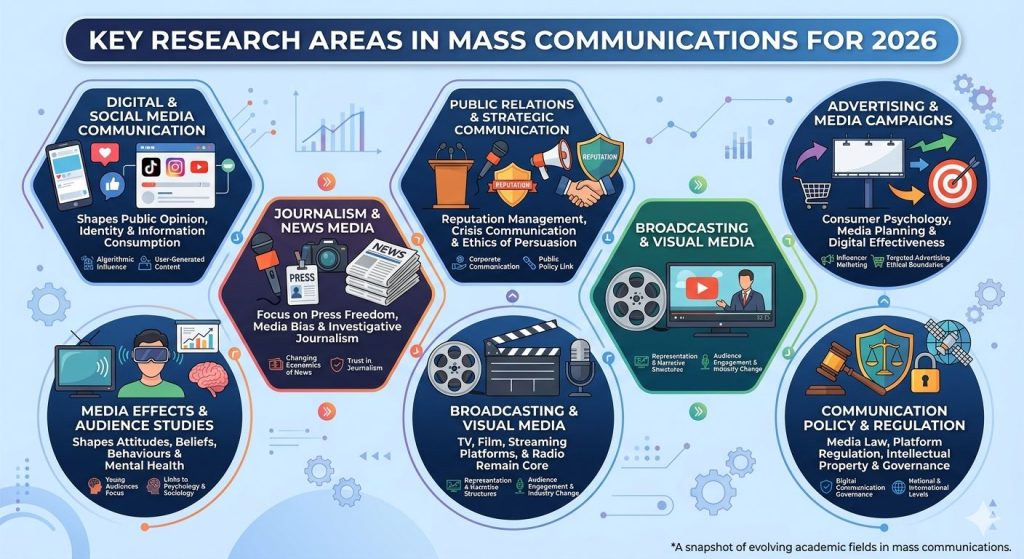
Before selecting a topic, it helps to understand the primary domains within mass communications that are currently active in academic research. These areas are grounded in established literature and are evolving rapidly due to changes in technology, politics, media ownership, and audience behaviour.
Digital and Social Media Communication This area examines how platforms such as Instagram, TikTok, X (formerly Twitter), and YouTube shape public opinion, identity, and information consumption. Research in this space is growing quickly, particularly around algorithmic influence and user-generated content.
Journalism and News Media Research here focuses on press freedom, media bias, investigative journalism, and the changing economics of news. There is particular academic interest in how trust in journalism has shifted over the last decade.
Public Relations and Strategic Communication This subfield covers reputation management, crisis communication, corporate communication strategies, and the ethics of persuasion. It links strongly to business, politics, and public policy research.
Advertising and Media Campaigns Advertising research looks at consumer psychology, media planning, digital advertising effectiveness, influencer marketing, and the ethical boundaries of targeted advertising.
Media Effects and Audience Studies This area focuses on how media content shapes attitudes, beliefs, behaviours, and mental health, especially among young audiences. It connects media studies with psychology and sociology.
Broadcasting and Visual Media Television, film, streaming platforms, and radio remain core to mass communications. Research in this area often explores representation, narrative structures, audience engagement, and industry change.
Communication Policy and Regulation This domain covers media law, platform regulation, intellectual property, and the governance of digital communication at national and international levels.
Five Example Dissertation Topics with Research Aims and Objectives
H2 — Five Example Dissertation Topics with Research Aims and Objectives
The following examples demonstrate how a dissertation topic should be structured at an academic level. Each includes a clear research aim and two to three focused objectives.
Example 1: Social Media and Political Polarisation
Topic: The Role of Algorithmic Content Curation in Reinforcing Political Polarisation Among Young Adults in the United Kingdom
Research Aim: To examine how social media algorithms on platforms such as Instagram and X contribute to political echo chambers among adults aged 18 to 30 in the UK.
Research Objectives:
- To identify the key mechanisms through which social media algorithms filter and prioritise political content for users
- To assess the relationship between algorithm-driven content exposure and political attitude change in young adults
- To evaluate the effectiveness of proposed regulatory frameworks in reducing algorithm-induced polarisation
Example 2: Representation in Streaming Media
Topic: Gender Representation in Leading Roles on UK Netflix Originals Between 2020 and 2025
Research Aim: To critically analyse trends in gender representation among lead characters in Netflix UK original productions over a five-year period.
Research Objectives:
- To catalogue lead character gender across a sample of Netflix UK original titles released between 2020 and 2025
- To compare these findings against industry benchmarks and prior studies on broadcast television
- To assess whether streaming platforms are advancing or merely replicating traditional gender representation patterns
Example 3: Crisis Communication in the Digital Age
Topic: Corporate Crisis Communication on Social Media: A Case Study of UK Retail Brands During Supply Chain Disruptions (2021 to 2023)
Research Aim: To investigate how UK retail companies used social media platforms to manage public perception during supply chain crises between 2021 and 2023.
Research Objectives:
- To document the communication strategies employed by three major UK retail brands during publicly reported supply chain disruptions
- To assess public sentiment responses using qualitative content analysis of audience comments
- To identify best practices for social media crisis communication in retail environments
Example 4: Misinformation and Public Health Communication
Topic: The Spread of Health Misinformation on WhatsApp Among Older Adults in South Asia: A Study of Community Group Dynamics
Research Aim: To understand how health misinformation spreads through WhatsApp community groups among adults aged 55 and above in South Asia, and what communication strategies may help reduce it.
Research Objectives:
- To identify common types of health misinformation circulating in WhatsApp groups among the target demographic
- To examine the social and cultural factors that make older adults more susceptible to sharing unverified health content
- To evaluate the effectiveness of digital literacy interventions in reducing misinformation sharing behaviour
Example 5: Influencer Marketing and Consumer Trust
Topic: Disclosure Practices in Influencer Marketing and Their Impact on Consumer Trust Among Gen Z Audiences in the UK
Research Aim: To analyse whether and how disclosure of paid partnerships by social media influencers affects trust and purchasing intent among UK consumers aged 18 to 26.
Research Objectives:
- To review current Advertising Standards Authority guidelines around influencer disclosure in the UK
- To survey a sample of Gen Z consumers about their awareness and interpretation of sponsorship disclosures
- To determine whether transparent disclosure positively, negatively, or neutrally affects brand trust in influencer marketing campaigns
80 Mass Communications Dissertation Topics for 2026
The following topics are organised by subfield. Each topic is narrow, researchable, and suitable for undergraduate, master’s, or PhD-level research proposals. These are contemporary mass communications research topics aligned with current debates, technological shifts, and global media trends.
Social Media and Digital Communication
- How TikTok’s recommendation algorithm shapes news consumption habits among teenagers in the UK
- The impact of Instagram’s removal of public like counts on user self-esteem and engagement behaviour
- Twitter/X and the professionalisation of citizen journalism in sub-Saharan Africa
- The role of LinkedIn in shaping professional identity and self-branding among recent graduates
- Dark patterns in social media design and their effect on user attention and data consent
- How YouTube creators negotiate creative freedom and platform monetisation rules
- Anonymity and accountability: how anonymous posting cultures shape online civic discourse
- The use of Discord communities in political mobilisation among young adults in Europe
- Digital detox campaigns and their long-term effect on social media engagement behaviour
- How Snapchat’s ephemeral content model affects advertising recall among university students
Journalism, News Media, and Press Freedom
- The decline of local print journalism in the UK and its impact on community accountability reporting
- Artificial intelligence and automated news generation: ethical considerations in British newsrooms
- How podcast journalism is reshaping long-form investigative reporting for digital-native audiences
- Source protection practices among investigative journalists in politically restrictive environments
- The influence of media ownership concentration on editorial independence in South Asian newspapers
- Fact-checking organisations and their measurable impact on public belief in misinformation
- Paywalls and news accessibility: examining the socio-economic divide in quality journalism consumption
- Reporting trauma: ethical frameworks for covering natural disasters and conflict in broadcast journalism
- The role of foreign correspondents in shaping Western media narratives about the Global South
- Photojournalism in the age of deepfakes: trust, verification, and visual authenticity in news imagery
Public Relations and Strategic Communication
- How UK government departments used social media during public health emergencies between 2020 and 2023
- Ethical boundaries in lobbying communication: a comparative analysis of UK and US public affairs strategies
- Reputation recovery strategies used by global FMCG brands following product recall crises
- The growing role of internal communication in employee engagement during post-pandemic hybrid work models
- Purpose-driven public relations: how corporate social responsibility campaigns affect brand reputation
- Crisis communication failures: a case study analysis of institutional responses to student safety incidents at UK universities
- The strategic use of transparency in non-governmental organisation communication with donors
- How LGBTQ+ advocacy groups in South Asia use digital public relations to manage societal opposition
- Greenwashing and strategic communication: how environmental claims are framed in corporate press releases
- The effectiveness of apology statements in political communication following public trust violations
Advertising, Media Campaigns, and Consumer Behaviour
- The effectiveness of cause-related marketing in fast fashion advertising among environmentally aware consumers
- Nostalgia advertising and its emotional impact on millennial consumer decision-making
- Targeted digital advertising and GDPR compliance: a study of UK digital marketing practices post-2018
- How influencer authenticity perceptions differ across age groups in the UK beauty and wellness industry
- Subliminal cues in streaming platform interface design and their effect on continued viewing behaviour
- The role of user-generated content in building brand communities on Instagram for small businesses
- Comparative analysis of fear appeals in anti-smoking public health campaigns across three European countries
- Mobile-first advertising strategies and their effectiveness in reaching rural audiences in developing nations
- Children and advertising literacy: how primary school-aged children in the UK recognise and respond to branded content
- The ethics of neuromarketing and its application in media campaign planning
Media Effects and Audience Studies
- The relationship between true crime media consumption and public attitudes towards criminal justice in the UK
- Media portrayals of mental health and their influence on help-seeking behaviour among young adults
- How exposure to climate change news affects environmental activism among university students
- Cultivation theory revisited: heavy streaming usage and distorted perceptions of crime rates in urban Britain
- The effect of sports media consumption on national identity among diaspora communities in Europe
- Body image and fashion magazines: a longitudinal analysis of reader perceptions among teenage girls
- How news framing of immigration affects public sympathy and policy preference in UK audiences
- Binge-watching behaviour and its correlation with sleep disruption and academic performance among students
- Children’s media literacy in the age of AI-generated content: parental awareness and educational gaps
- The role of humour in political satire and its impact on civic engagement among first-time voters
Broadcasting, Streaming, and Visual Media
- How Netflix’s global expansion has altered local television production investment in Southeast Asia
- Representation of South Asian women in British broadcast television between 2015 and 2025
- The rise of docuseries and their role in shaping public understanding of real-world events
- How sports broadcasting rights negotiations have transformed public access to live events in the UK
- The impact of second-screen behaviour on primary television engagement during live broadcasts
- Streaming fatigue and subscription cancellation patterns among UK households between 2022 and 2025
- Podcast growth in Africa: examining audience development and monetisation challenges
- How public service broadcasters like the BBC navigate political pressure while maintaining editorial impartiality
- Visual storytelling and accessibility: how UK streaming platforms are addressing deaf and hearing-impaired audiences
- Fan communities and participatory culture: how viewer feedback shapes narrative decisions in serialised television
Communication Policy, Ethics, and Regulation
- The Online Safety Act 2023 and its practical implications for platform content moderation in the UK
- Balancing free expression and hate speech regulation in digital media: a comparative EU and UK analysis
- Data localisation policies and their impact on global digital media distribution
- Ethical frameworks for artificial intelligence in content moderation: accountability and transparency
- How media self-regulation bodies in the UK have responded to public complaints about press conduct since 2019
- The right to be forgotten and its application in media archives: a study of UK case law
- Regulating political advertising on social media platforms: lessons from the 2024 UK general election
- Media piracy in developing countries: legal, ethical, and economic dimensions for content creators
- How international broadcasting agreements shape editorial content in state-funded news organisations
- Child protection in digital media environments: an evaluation of UK safeguarding policies for online content
Media, Identity, and Culture
- How diasporic Pakistani communities in the UK use WhatsApp to maintain cultural identity and homeland ties
- The role of K-pop fan media culture in constructing transnational youth identities
- Representation of disability in UK advertising: progress, tokenism, and the gap between visibility and authenticity
- How social media has transformed mourning and memorial communication practices in digital societies
- Indigenous media and cultural sovereignty: examining First Nations broadcasting in Canada and Australia
- Gender and sport media: how women’s football coverage has changed in British media between 2018 and 2025
- Afrofuturism in digital media and its influence on Black cultural identity narratives in the UK
- How LGBTQ+ representation in soap operas has evolved in British television since 2010
- The role of memes in political communication and cultural resistance among youth in authoritarian contexts
- How Bollywood’s digital distribution shift has changed narrative content and audience expectations globally
How to Choose the Right Dissertation Topic for Your Academic Level
Not every topic on this list will suit every student. The right topic depends on your academic level, the resources available to you, and your research skills. Here is a brief guide to help you decide.
Undergraduate Level At undergraduate level, you are expected to demonstrate an understanding of existing literature and apply an established methodology to a focused research question. Choose topics that are clearly defined, have plenty of accessible secondary sources, and do not require primary data from hard-to-reach populations. Topics in the areas of social media, advertising, and audience studies tend to work well at this level.
Master’s Level At master’s level, you are expected to make a modest original contribution to knowledge. This often means identifying a gap in the literature and designing research that fills it in a specific context. You may use mixed methods or original primary data. Topics involving strategic communication dissertation ideas, media policy, or digital journalism are particularly suited to this level.
PhD Level At PhD level, you are expected to produce a genuinely original and sustained contribution to the academic field. Topics should be theoretically sophisticated, methodologically rigorous, and address a significant gap in the existing body of knowledge. This often means narrower, more specialised research questions with multi-layered analysis.
If you are unsure how to frame your topic at the right academic level, seeking mass communications dissertation help from a qualified academic can save you significant time and stress.
Conclusion
Choosing a dissertation topic in mass communications is not just an administrative task. It is the foundation of your entire research project, and it deserves careful, informed thought. The field offers extraordinary breadth. From digital communication and journalism to media policy and cultural identity, there are dozens of directions your research could take.
The 80 topics in this post reflect the current academic landscape and the questions researchers are genuinely engaging with in 2026. Whether you are looking for easy mass communications dissertation topics for undergraduates or a theoretically demanding PhD-level inquiry, there is something on this list to inspire you.
The most important thing is to choose a topic you care about, one that connects to real-world issues and is grounded in honest scholarly inquiry. Start with a broad area you find interesting, narrow it down using the questions outlined in the example topics, and make sure your research aim is achievable within your time frame and resources.
Academic integrity, original thinking, and a willingness to engage critically with the literature will take you far. Approach your dissertation not as a hurdle to get past, but as your first real contribution to the field you have spent years studying. You are more prepared than you think.
