


Real Estate Management Dissertation Topics for 2026

What questions do students usually ask before choosing a topic?
These are common questions gathered from student forums and academic discussion platforms where learners openly share their confusion about dissertation planning:
- How do I choose the right Real Estate Management Dissertation Topics for my degree level?
- What makes a topic suitable for undergraduate, master’s, or PhD research?
- How do I know if my topic is relevant to 2026 industry trends?
- Should I focus on quantitative or qualitative research methods?
- Are there specific research topics in real estate management that universities prefer?
- How narrow or broad should my dissertation topic be?
- What are some strong real estate dissertation topics UK universities accept?
- How can I turn a general idea into a structured research proposal?
Introduction
Choosing the right dissertation topic in real estate management shapes your entire academic journey. A strong topic helps you stay focused, meet university expectations, and produce meaningful research. A weak topic leads to confusion, lack of direction, and poor outcomes.
Real estate management is a multidisciplinary field. It combines finance, urban planning, sustainability, and policy. This makes topic selection both an opportunity and a challenge. You need to align your interests with current industry developments while staying within academic boundaries.
This guide helps you understand the field, identify research directions, and choose topics that are relevant for 2026.
Download Real Estate Management Dissertation Topics PDF
Many students struggle to shortlist topics that truly match their academic level and research goals. To simplify this process, curated topic lists are often prepared by academic experts.
You can receive a personalised PDF containing carefully selected real estate topics for dissertation after completing a short form. These lists are designed to match your level, whether undergraduate, master’s, or PhD, and reflect current academic expectations.
Why Choosing the Right Dissertation Topic Matters
A dissertation is not just an assignment. It is a demonstration of your research ability, critical thinking, and subject knowledge.
A well-chosen topic:
- Aligns with your academic level
- Matches available data and research methods
- Reflects current industry issues
- Keeps you motivated throughout the research process
Many students rush this step and end up changing topics midway. That usually leads to weak research outcomes. If you feel stuck, seeking online dissertation help early can prevent major mistakes.
Key Research Areas in Real Estate Management
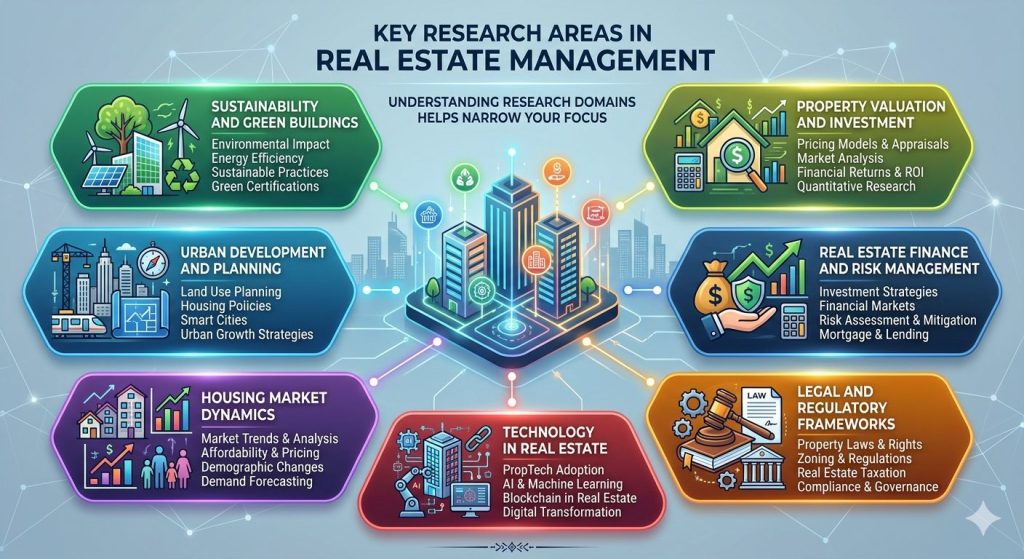
Understanding research domains helps you narrow your focus. Real estate management is broad, but most topics fall into structured areas.
Property Valuation and Investment
This area focuses on pricing, risk analysis, and financial returns. It often involves quantitative research topics in real estate management.
Urban Development and Planning
Covers land use, housing policies, and smart cities. These topics often combine policy analysis and social impact.
Sustainability and Green Buildings
Examines environmental impact, energy efficiency, and sustainable construction practices.
Real Estate Finance and Risk Management
Focuses on investment strategies, financial markets, and economic influences on property values.
Housing Market Dynamics
Explores demand, affordability, and demographic changes affecting real estate markets.
Technology in Real Estate
Includes PropTech, AI, blockchain, and digital transformation in property management.
Legal and Regulatory Frameworks
Analyses property laws, taxation, and governance structures affecting real estate.
5 Example Dissertation Topics with Aims and Objectives
1. Impact of Green Building Certifications on Property Value
Aim:
To evaluate how sustainability certifications influence property prices.
Objectives:
- To analyse price differences between certified and non-certified buildings
- To assess buyer preferences regarding sustainable housing
- To examine long-term investment benefits
2. The Role of AI in Property Valuation
Aim:
To examine how artificial intelligence improves valuation accuracy.
Objectives:
- To compare traditional and AI-based valuation methods
- To identify challenges in AI adoption
- To evaluate efficiency improvements
3. Housing Affordability in Urban Areas
Aim:
To investigate factors affecting housing affordability in major cities.
Objectives:
- To analyse income-to-price ratios
- To evaluate government housing policies
- To assess demand and supply imbalance
4. Real Estate Investment Risk During Economic Uncertainty
Aim:
To analyse investment risks during economic downturns.
Objectives:
- To identify key risk factors
- To evaluate mitigation strategies
- To compare market performance during crises
5. Tenant Satisfaction in Rental Properties
Aim:
To explore factors influencing tenant satisfaction.
Objectives:
- To identify key service quality indicators
- To assess landlord-tenant relationships
- To evaluate retention strategies
80 Real Estate Management Dissertation Topics for 2026
Property Valuation and Investment
- Comparative analysis of automated valuation models and traditional methods
- Impact of location intelligence on property valuation accuracy
- Risk-return analysis of residential versus commercial real estate investments
- Role of big data in property price prediction
- Influence of inflation on real estate investment returns
- Valuation challenges in emerging property markets
- Behavioural biases in real estate investment decisions
- Impact of interest rates on property valuation trends
- Real estate portfolio diversification strategies
- Cross-border property investment risk analysis
Urban Development and Planning
- Smart city development and its impact on property demand
- Urban regeneration and property value appreciation
- Role of infrastructure development in real estate growth
- Housing policies and urban expansion patterns
- Impact of population growth on housing demand
- Mixed-use developments and urban sustainability
- Urban sprawl and its economic implications
- Role of public transport in property valuation
- Affordable housing strategies in metropolitan areas
- Land use regulations and property development
Sustainability and Green Real Estate
- Financial performance of green-certified buildings
- Energy efficiency and property value correlation
- Sustainable construction practices in real estate
- Environmental regulations and property development
- Green leasing and tenant behaviour
- Carbon footprint reduction in real estate projects
- Lifecycle cost analysis of sustainable buildings
- Renewable energy integration in property management
- ESG criteria in real estate investment decisions
- Sustainable urban housing models
Real Estate Finance and Economics
- Impact of economic cycles on property markets
- Real estate investment trusts and market performance
- Mortgage financing trends in developing economies
- Interest rate volatility and housing affordability
- Financial risk management in property investment
- Role of banking institutions in real estate growth
- Economic downturn effects on commercial real estate
- Inflation hedging through property investment
- Capital flow trends in global real estate markets
- Real estate as a long-term investment strategy
Housing Market Analysis
- Housing demand forecasting using data analytics
- Impact of demographic shifts on housing markets
- Rental market trends in urban areas
- Housing affordability crisis and policy solutions
- Role of foreign investment in housing markets
- Short-term rentals and housing availability
- Socioeconomic factors affecting home ownership
- Housing supply constraints and pricing trends
- Migration patterns and property demand
- Comparative study of urban and rural housing markets
Technology in Real Estate
- Blockchain applications in property transactions
- Artificial intelligence in real estate management
- PropTech innovations and market transformation
- Digital platforms and property marketing effectiveness
- Big data analytics in real estate forecasting
- Virtual reality in property sales
- Smart home technology and property value
- Automation in property management systems
- Cybersecurity challenges in real estate platforms
- Role of digital twins in property development
Legal and Regulatory Issues
- Impact of property taxation on investment decisions
- Legal challenges in real estate transactions
- Land ownership laws and market development
- Regulatory frameworks in housing markets
- Compliance issues in property management
- Impact of zoning laws on property development
- Real estate fraud prevention strategies
- Legal implications of digital property transactions
- Tenant protection laws and rental markets
- Cross-border property regulation challenges
Emerging Trends and Global Perspectives
- Impact of globalisation on real estate markets
- Climate change risks in property investment
- Post-pandemic real estate market trends
- Remote work and commercial property demand
- Urbanisation trends in developing countries
- Role of sustainability in future property markets
- Global investment trends in real estate
- Real estate resilience during economic crises
- Impact of tourism on property markets
- Future of real estate in digital economies
These topics reflect both qualitative research topics in real estate management and data-driven approaches, helping students choose based on their preferred methodology.
Conclusion
Selecting the right dissertation topic is a strategic decision, not a random choice. It determines the quality of your research and your academic success.
You need to balance interest, feasibility, and relevance. A focused and researchable topic leads to stronger arguments, clearer analysis, and better results.
Take time to evaluate your options, understand your academic level, and align your topic with current trends. If you approach this step carefully, your dissertation becomes far more manageable and meaningful.
