


Information Technology Dissertation Topics for 2026

Questions Students Are Asking About IT Dissertation Topics
The following questions have been gathered from student forums, academic discussion platforms, and university support communities. They reflect the real concerns students face when choosing a dissertation topic in information technology.
- What are the most relevant information technology dissertation topics for 2026?
- Which IT dissertation topics are suitable for undergraduate students?
- How do I find masters IT dissertation topics that are both original and researchable?
- Are there easy information technology dissertation topics I can complete within my time frame?
- What are the latest IT research topics connected to artificial intelligence and cybersecurity?
- How do I narrow down a broad topic into a focused dissertation?
- Can I get IT dissertation help if I am unsure where to start?
If any of these questions match your thoughts right now, this post is written for you. Read on to find structured guidance, examples, and a complete list of 80 original dissertation topics.
Why Choosing the Right IT Dissertation Topic Matters in 2026
Choosing the right dissertation topic is one of the most important decisions you will make during your academic journey. In a field as fast-moving as information technology, your topic needs to be relevant, researchable, and aligned with the latest developments.
A well-chosen topic signals academic maturity. It shows your supervisor that you understand the field, can identify a genuine research gap, and are ready to contribute something meaningful. A poorly chosen topic, on the other hand, can lead to confusion, limited resources, and weak results.
The good news is that information technology is one of the richest fields for dissertation research right now. With developments across artificial intelligence, cybersecurity, cloud computing, data science, and software development, there is no shortage of areas to explore. The challenge is knowing where to focus.
This post will help you understand the landscape, select a suitable topic, and approach your dissertation with clarity and confidence.
Download Information Technology Dissertation Topics PDF
Many students benefit from having a personalised and curated list of dissertation topics they can refer to offline. Academic experts have prepared a downloadable PDF containing a refined selection of IT dissertation topics, matched to different academic levels and research interests.
Students can access this PDF after completing a short form. The list is curated specifically to reflect 2026 research standards and is particularly useful for students who need guidance tailored to their area of interest within information technology.
Key Research Areas in Information Technology for 2026
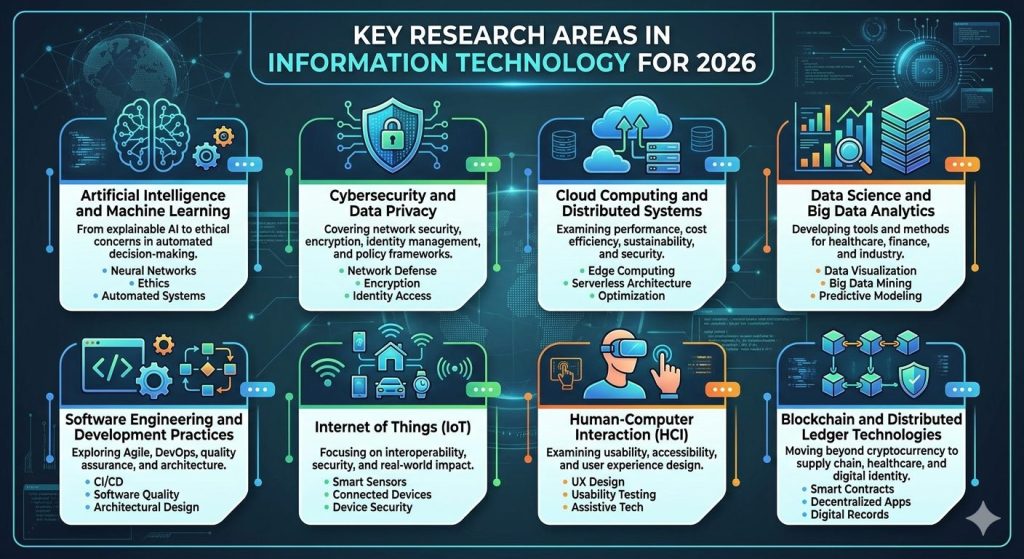
Before selecting a dissertation topic, it helps to understand the main research areas within information technology. These are established domains where active academic and industry research is taking place.
Artificial Intelligence and Machine Learning This remains one of the most dynamic areas in IT research. Topics range from explainable AI to ethical concerns in automated decision-making.
Cybersecurity and Data Privacy With increasing digital threats, research in this area covers network security, encryption, identity management, and policy frameworks.
Cloud Computing and Distributed Systems Researchers are examining performance, cost efficiency, sustainability, and security in cloud environments.
Data Science and Big Data Analytics From healthcare to finance, data-driven decision-making is transforming industries. Dissertations can focus on tools, methods, or specific applications.
Software Engineering and Development Practices Agile methodologies, DevOps, quality assurance, and software architecture offer rich grounds for both technical and non-technical dissertations.
Internet of Things (IoT) IoT research connects physical devices to digital networks, raising questions around interoperability, security, and real-world impact.
Human-Computer Interaction (HCI) This area examines how people interact with technology, covering usability, accessibility, and user experience design.
Blockchain and Distributed Ledger Technologies Beyond cryptocurrency, blockchain is being studied in supply chain management, healthcare records, and digital identity.
Five Example Dissertation Topics With Research Aims and Objectives
Understanding how a dissertation topic is structured can help you write your own proposal more confidently. Below are five examples from across the IT field, each with a clearly stated aim and supporting objectives.
Example 1: Cybersecurity
Topic: Evaluating the Effectiveness of Multi-Factor Authentication in Reducing Phishing Attacks in UK Financial Institutions
Research Aim: To assess how multi-factor authentication (MFA) reduces the risk of phishing attacks within UK-based banking environments.
Research Objectives:
- To review existing literature on phishing attack patterns and MFA implementation strategies.
- To analyse case studies from UK financial institutions that have adopted MFA systems.
- To identify gaps in current MFA approaches and propose recommendations for improvement.
Example 2: Artificial Intelligence
Topic: Examining Bias in AI-Powered Recruitment Systems Used by Large Corporations
Research Aim: To investigate how algorithmic bias manifests in AI recruitment tools and what it means for workplace equality.
Research Objectives:
- To identify the sources of bias in training data used by recruitment AI systems.
- To evaluate how bias affects candidate selection across gender and ethnic groups.
- To propose ethical guidelines for deploying AI recruitment tools responsibly.
Example 3: Cloud Computing
Topic: Analysing the Carbon Footprint of Cloud Data Centres and Strategies for Sustainable Operations
Research Aim: To measure the environmental impact of cloud data centres and assess current sustainability practices.
Research Objectives:
- To review academic and industry literature on data centre energy consumption.
- To compare sustainability strategies adopted by leading cloud providers.
- To recommend scalable green computing approaches suitable for mid-size enterprises.
Example 4: Data Science
Topic: Predictive Analytics in Early Detection of Type 2 Diabetes Using Electronic Health Records
Research Aim: To explore how predictive data models can improve early diagnosis of Type 2 diabetes using NHS patient records.
Research Objectives:
- To evaluate machine learning algorithms applicable to healthcare datasets.
- To assess the accuracy and reliability of prediction models using real-world health data.
- To examine the ethical and data privacy considerations in using patient records for predictive modelling.
Example 5: Human-Computer Interaction
Topic: The Impact of Dark UI Patterns on User Trust and Online Consumer Behaviour
Research Aim: To investigate how deceptive interface design practices influence user trust and purchasing decisions in e-commerce.
Research Objectives:
- To categorise and document prevalent dark patterns in UK e-commerce platforms.
- To assess user awareness and responses to dark UI patterns through survey methods.
- To propose regulatory and design recommendations for ethical interface development.
80 Information Technology Dissertation Topics for 2026
The following list presents 80 original and academically sound dissertation topics organised by subfield. These topics are suitable for undergraduate, master’s, and PhD research proposals. If you are looking for online dissertation help to develop any of these into a full proposal, expert support is available.
Artificial Intelligence and Machine Learning
- Explainability in Deep Learning Models Used for Medical Image Diagnosis
- Evaluating the Reliability of Natural Language Processing in Legal Document Review
- The Role of Reinforcement Learning in Optimising Urban Traffic Flow
- Bias Detection and Mitigation Strategies in Facial Recognition Technologies
- AI-Driven Personalisation in E-Learning Platforms: Benefits and Ethical Concerns
- Comparing the Performance of Transfer Learning Techniques Across Healthcare Datasets
- Autonomous Decision-Making in Financial Trading: Accountability and Risk
- Federated Learning as a Privacy-Preserving Approach in Healthcare AI
- Assessing AI Chatbot Accuracy in Mental Health Support Applications
- The Accuracy of Sentiment Analysis Models in Detecting Sarcasm Across Social Media Platforms
Cybersecurity and Network Security
- Zero Trust Architecture as a Security Model for Remote Workforce Environments
- Evaluating Ransomware Defence Strategies in UK National Health Service Networks
- The Effectiveness of Security Awareness Training in Reducing Insider Threats
- Privacy Risks in Smart Home Devices: A User-Centred Study
- Blockchain-Based Solutions for Identity Verification in Digital Banking
- Assessing the Adequacy of GDPR Compliance Measures in UK EdTech Companies
- Penetration Testing Methodologies: Comparing Manual and Automated Approaches
- Cybersecurity Challenges in Critical National Infrastructure: A UK Perspective
- Deep Fake Detection Technologies: Current Capabilities and Limitations
- The Impact of Quantum Computing on Current Cryptographic Standards
Cloud Computing and Infrastructure
- Serverless Computing Adoption in Small and Medium Enterprises: Barriers and Benefits
- A Comparative Analysis of Multi-Cloud Strategies for Business Continuity Planning
- Measuring Latency and Reliability in Edge Computing for Real-Time IoT Applications
- Cost Optimisation Models for Cloud Resource Allocation in Academic Institutions
- Containerisation Technologies: Comparing Docker and Kubernetes in Enterprise Environments
- Cloud Sovereignty and Data Localisation: Legal Implications for UK Businesses
- The Role of Hybrid Cloud in Enabling Digital Transformation in the Public Sector
- Analysing Vendor Lock-In Risks in Cloud Adoption for Financial Services
- Sustainable Cloud Architecture: Reducing Energy Consumption in Data Centres
- Fault Tolerance Mechanisms in Distributed Cloud Systems: A Comparative Study
Data Science and Big Data
- Predictive Modelling for Student Dropout Rates Using University Learning Management Data
- Real-Time Sentiment Tracking on Social Media During Political Elections
- Data Governance Frameworks for Big Data in the UK Public Health Sector
- Evaluating Open-Source Tools for Large-Scale Data Processing: A Performance Study
- Applying Graph Analytics to Detect Financial Fraud in Banking Transactions
- Data Quality Challenges in Machine Learning Pipelines for Clinical Research
- The Use of Geospatial Data Analytics in Urban Planning and Smart Cities
- Predictive Maintenance Using Sensor Data in UK Manufacturing Firms
- Ethical Dimensions of Data Monetisation in the Digital Advertising Industry
- Comparing Supervised and Unsupervised Learning Approaches for Customer Churn Prediction
Software Engineering and Development
- Agile vs Waterfall Methodologies in Managing Large-Scale Government IT Projects
- The Effectiveness of Test-Driven Development in Reducing Post-Release Defects
- Microservices Architecture: Scalability Benefits and Operational Challenges
- The Role of DevOps Practices in Improving Software Deployment Frequency
- Software Technical Debt: Measurement, Impact, and Reduction Strategies
- Evaluating Low-Code Development Platforms for Rapid Application Prototyping
- Code Review Practices and Their Influence on Software Quality in Open-Source Projects
- Mobile Application Accessibility: Measuring Compliance with WCAG 2.2 Standards
- Continuous Integration and Delivery Pipelines: A Security Assessment
- The Influence of Pair Programming on Developer Productivity and Code Quality
Internet of Things and Embedded Systems
- Security Vulnerabilities in Consumer IoT Devices: A Systematic Review
- IoT-Based Smart Agriculture: Evaluating Soil Monitoring and Crop Yield Systems
- Interoperability Challenges in Industrial IoT Deployments Across Legacy Systems
- Real-Time Health Monitoring Through Wearable IoT Devices in Elderly Care
- Energy Harvesting Techniques for Extending the Lifespan of IoT Sensor Networks
- IoT Data Management Challenges in Smart City Infrastructure
- Evaluating Communication Protocols for Low-Power Wide Area Networks in IoT
- Autonomous Vehicle IoT Systems: Safety, Reliability, and Ethical Considerations
- The Role of Digital Twins in Predictive Maintenance Within Smart Factories
- Privacy Concerns in IoT-Enabled Workplace Monitoring Systems
Blockchain and Emerging Technologies
- Blockchain Applications in NHS Medical Records: Feasibility and Privacy Implications
- Smart Contracts in Supply Chain Management: Opportunities and Legal Challenges
- Evaluating Decentralised Finance Platforms Against Traditional Banking Risk Models
- Non-Fungible Tokens and Intellectual Property Rights: A Legal-Technology Analysis
- Blockchain for Transparent Voting Systems: Technical Feasibility and Public Trust
- Cross-Border Data Sharing Using Permissioned Blockchain in Healthcare
- Energy Consumption in Proof-of-Work vs Proof-of-Stake Blockchain Consensus Mechanisms
- The Role of Blockchain in Ensuring Authenticity of Academic Credentials
- Decentralised Identity Management: Comparing Blockchain Solutions for Digital ID
- Adoption Barriers to Blockchain Technology in UK Small and Medium Enterprises
Human-Computer Interaction and UX
- Evaluating Usability of Government Digital Services Among Elderly UK Citizens
- The Psychological Effects of Infinite Scroll Design on User Behaviour and Attention
- Voice User Interface Design: Accessibility for Users With Visual Impairments
- Augmented Reality in Retail: User Experience and Purchase Behaviour
- Gamification in Workplace Training Applications: Engagement and Knowledge Retention
- The Impact of Colour Psychology in Mobile App Design on User Trust
- Cross-Cultural Differences in UX Expectations for Global Software Products
- Measuring Cognitive Load in Complex Enterprise Software Interfaces
- Accessibility in AI-Powered Assistants for Users With Cognitive Disabilities
- User Perceptions of Transparency in Algorithm-Driven Content Recommendation Systems
How to Choose the Right Topic From This List
With 80 options available, it is normal to feel unsure about where to begin. Here is a simple approach to help you narrow things down.
Start with your interest. A dissertation takes months to complete. Choosing a topic you find genuinely interesting makes the process more manageable and often produces better work.
Consider your level. Undergraduate dissertations typically focus on reviewing existing literature or conducting small-scale empirical studies. Masters dissertations require original data collection or a more focused theoretical contribution. PhD research must demonstrate a clear gap in the literature and a substantial original contribution.
Check for available resources. Some topics require access to specific datasets, software tools, or industry partners. Before committing to a topic, make sure you can realistically access what you need.
Talk to your supervisor early. Before finalising your topic, discuss your ideas with your academic supervisor. Their feedback is invaluable and can save you from choosing a direction that is too broad, too narrow, or already heavily saturated.
If you still feel uncertain, IT dissertation help from academic professionals can provide personalised guidance tailored to your level and subject area.
Conclusion
Choosing a dissertation topic in information technology is a significant decision, and approaching it thoughtfully gives you a real advantage. The topics and examples in this post reflect the current state of IT research and are designed to support students at every academic level.
Whether you are drawn to cybersecurity, data science, artificial intelligence, or human-computer interaction, there is a topic here that can align with your interests and academic goals. The key is to select something specific, researchable, and connected to current developments in the field.
Your dissertation is an opportunity to contribute to your field in a meaningful way. Approach it with curiosity, structure your research carefully, and do not hesitate to seek guidance when needed. With the right topic and a clear research plan, you are well on your way to producing work that reflects your best academic effort.
