


Travel and Tourism Dissertation Topics for 2026
What Students Are Asking About Travel and Tourism Dissertations
The following questions have been gathered from student forums, academic discussion boards, and higher education communities. They reflect the real concerns students face when selecting dissertation topics in travel and tourism.
- What are the best travel and tourism dissertation topics for 2026?
- How do I choose a dissertation topic in travel and tourism that is narrow enough to research?
- Are there travel and tourism research topics suitable for undergraduate students with limited time?
- What dissertation topics in travel and tourism work well for MSc students focusing on sustainability?
- What are the most current research paper ideas in travel and tourism for PhD students?
- How do I structure a dissertation topic with a clear aim and objectives?
- Can I find a travel and tourism dissertation topics PDF to help me get started?
If any of these sound familiar, you are in the right place. This post is designed to answer all of them clearly and thoroughly.
Introduction: Why Your Dissertation Topic in Travel and Tourism Matters
Choosing the right dissertation topic is one of the most important academic decisions you will make. In a field as broad and fast-changing as travel and tourism, the wrong topic can leave you without enough research material or pull you towards ideas that lack academic depth. The right topic, on the other hand, gives your dissertation a clear direction and helps you contribute something meaningful to the field.
Travel and tourism is one of the most complex interdisciplinary subjects in modern academia. It connects economics, sociology, environmental science, cultural studies, hospitality management, and public policy. This richness makes it exciting, but it also means students can easily feel overwhelmed when narrowing down a research area.
This post gives you 80 original, research-ready dissertation topics in travel and tourism, explained guidance on what makes a strong topic, and examples of how to structure a research aim and objectives. Whether you are looking for project topics in travel and tourism for undergraduate students or exploring research paper ideas in travel and tourism for PhD students, this guide covers everything you need.
If you need additional support while developing your research proposal, many students also seek online dissertation help from qualified academic professionals who can assist them in refining their chosen topic.
Download Travel and Tourism Dissertation Topics PDF
Many students prefer to review their topic options offline or share them with their supervisors before making a final decision. A downloadable PDF containing a personalised list of dissertation topics curated by academic experts is available to students on request.
This resource is compiled by specialists with experience in travel and tourism research at undergraduate, master’s, and doctoral levels. Students receive the PDF after completing a short form that helps match them with topics relevant to their academic level and research interests.
Why Choosing the Right Dissertation Topic in Travel and Tourism Matters
Travel and tourism research sits at the intersection of multiple disciplines, which is both its greatest strength and its biggest challenge for students. A poorly chosen topic can be either too broad to manage within your word count, too narrow to find sufficient literature, or simply outdated in relation to current industry and academic priorities.
Universities expect dissertation topics to show originality, academic rigour, and an awareness of real-world issues. Examiners want to see that you understand the field and have made a deliberate, informed choice about what to investigate. A strong topic signals intellectual maturity before you have even begun writing.
Relevance also matters. Travel and tourism is shaped by global events such as pandemics, climate policy shifts, technological disruption, and changing consumer values. A topic that reflects current realities is more likely to receive strong academic support and be of genuine use to the broader research community.
Key Research Areas in Travel and Tourism You Can Explore
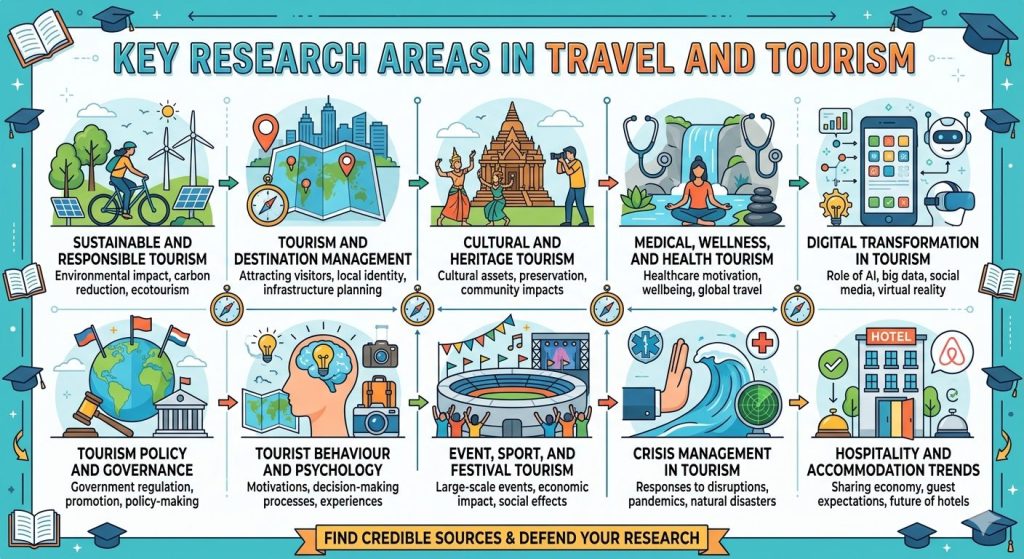
Travel and tourism covers a wide range of subfields, each with its own body of literature and methodological traditions. Understanding these areas helps you identify where your interests and skills are best matched.
- Sustainable and responsible tourism: Focuses on environmental impact, carbon reduction, ecotourism policy, and the balance between tourism growth and conservation.
- Tourism and destination management: Looks at how places attract, manage, and retain visitors while maintaining local identity and infrastructure.
- Cultural and heritage tourism: Examines how communities use cultural assets to attract tourists and how tourism affects cultural preservation.
- Medical, wellness, and health tourism: Explores how healthcare and wellbeing have become major travel motivators globally.
- Digital transformation in tourism: Covers the role of AI, big data, social media, and virtual reality in changing how people plan and experience travel.
- Tourism policy and governance: Investigates how governments and international bodies regulate, promote, and manage tourism activity.
- Tourist behaviour and psychology: Analyses what motivates travellers, how they make decisions, and how their experiences shape future travel.
- Event, sport, and festival tourism: Studies how large-scale events generate tourism and their economic and social impacts.
- Crisis management in tourism: Examines how the industry responds to disruptions including pandemics, natural disasters, and geopolitical conflict.
- Hospitality and accommodation trends: Looks at shifts in guest expectations, the sharing economy, and the future of hotel management.
Each of these areas has produced a rich body of academic literature, which means you will find credible sources to support your research. A solid foundation in one of these areas also makes your dissertation more assessable and easier to defend.
Five Example Dissertation Topics with Aims and Objectives
Before presenting the full list, here are five structured examples showing how a strong travel and tourism dissertation topic should be framed. Each includes a research aim and two to three objectives.
Example 1: Sustainable Tourism and Overtourism in European Cities
Research Aim: To examine how overtourism affects the sustainability of destination management strategies in major European cities.
Objectives:
- To identify the key indicators of overtourism used by destination management organisations in Europe.
- To assess how cities like Amsterdam and Barcelona have responded to unsustainable visitor volumes through policy intervention.
- To evaluate the long-term effectiveness of visitor cap strategies on local resident quality of life.
Example 2: The Role of Social Media in Shaping Tourism Decision-Making
Research Aim: To investigate how social media platforms influence the destination selection behaviour of millennial travellers.
Objectives:
- To analyse the types of social media content most associated with tourism booking decisions among millennials aged 25 to 35.
- To explore the relationship between influencer marketing and perceived destination authenticity.
- To assess whether social media-driven travel expectations align with actual visitor experiences.
Example 3: Medical Tourism and Healthcare Quality Perceptions in Developing Nations
Research Aim: To explore how perceptions of healthcare quality influence medical tourism flows to developing countries.
Objectives:
- To map the primary destinations for medical tourists from the United Kingdom and their chosen procedures.
- To examine how accreditation and hospital branding shape tourist confidence in overseas healthcare.
- To identify the risks associated with post-operative care when patients return to their home country.
Example 4: Climate Change Communication in Ecotourism Marketing
Research Aim: To assess how ecotourism operators in Sub-Saharan Africa communicate climate change risks to prospective visitors.
Objectives:
- To review current marketing practices among certified ecotourism operators in Kenya and Tanzania.
- To evaluate how transparent climate risk communication affects booking intentions among eco-conscious tourists.
- To propose a framework for responsible climate messaging in ecotourism promotional content.
Example 5: Artificial Intelligence Adoption in Hotel Revenue Management
Research Aim: To investigate the extent to which AI-driven tools are transforming revenue management practices in mid-range hotel chains.
Objectives:
- To identify the AI tools most commonly adopted by hotel revenue managers in the United Kingdom.
- To evaluate the impact of dynamic pricing algorithms on occupancy rates and customer satisfaction scores.
- To explore staff attitudes towards AI adoption and its implications for human roles in revenue management.
80 Travel and Tourism Dissertation Topics for 2026
The following topics are organised by subfield. Each topic is designed to be specific, researchable, and appropriate for 2026-level academic research. These are suitable as travel and tourism research topics ideas for college students, MSc candidates, and PhD researchers alike.
Sustainable Tourism and Environmental Impact
- Examining the effectiveness of carbon offset schemes offered by UK-based travel companies to eco-conscious consumers.
- Assessing the environmental footprint of cruise tourism on coral reef ecosystems in the Caribbean.
- Investigating how national park visitor management plans respond to increased post-pandemic foot traffic in the UK.
- Exploring the adoption of zero-waste practices in boutique eco-lodges across Costa Rica.
- Analysing the relationship between green certifications and tourist booking preferences in Scandinavian countries.
- Evaluating the role of government subsidies in supporting sustainable rural tourism development in Wales.
- Examining how local communities in Southeast Asia perceive the environmental consequences of mass tourism.
- Investigating the tension between tourism promotion and marine conservation in UNESCO World Heritage coastal sites.
- Assessing how climate change projections are reshaping ski resort strategies in the European Alps.
- Exploring the barriers to sustainable behaviour adoption among backpacker tourists in South and Southeast Asia.
Overtourism and Destination Management
- Investigating the social and economic consequences of overtourism on permanent residents in Dubrovnik, Croatia.
- Evaluating the effectiveness of tourist quotas as a destination management tool in Venice, Italy.
- Examining how destination management organisations in Iceland balance growth targets with environmental preservation.
- Analysing the role of price-based deterrents in managing tourist volumes at overcrowded natural attractions.
- Exploring how rural tourism redistribution policies reduce the pressure on urban hotspot destinations in Spain.
- Investigating the political challenges facing local governments attempting to regulate short-term tourist rentals.
- Assessing the psychological effects of overtourism on heritage tourism sites in Southeast Asia.
- Examining how visitor experience quality declines as tourist density increases in World Heritage Sites.
- Evaluating the use of timed entry systems as a crowd management strategy in cultural tourism settings.
- Exploring the role of community-based tourism in redirecting tourist flows away from over-visited destinations.
Digital Technology and Innovation in Tourism
- Investigating how artificial intelligence is reshaping personalised travel recommendation systems.
- Evaluating the adoption rate and customer satisfaction outcomes of chatbot-assisted hotel booking systems.
- Examining the use of virtual reality in pre-trip destination marketing for adventure tourism products.
- Analysing big data applications in predicting seasonal demand fluctuations at UK heritage attractions.
- Exploring how blockchain technology is being used to improve transparency in sustainable tourism supply chains.
- Investigating the role of user-generated content on TikTok in shaping international travel decisions among Gen Z.
- Assessing the impact of augmented reality museum tours on visitor engagement and educational outcomes.
- Examining consumer trust issues surrounding AI-generated travel content and automated trip planning tools.
- Evaluating the influence of algorithm-driven search rankings on destination visibility for small tourism operators.
- Investigating how smart city infrastructure enhances visitor experience management in large urban destinations.
Tourist Behaviour and Psychology
- Examining the psychological drivers of dark tourism visits to war memorials and genocide sites.
- Investigating how post-pandemic travel anxiety affects destination choice behaviour among solo travellers.
- Analysing the role of nostalgia in motivating heritage tourism participation among older adult travellers.
- Exploring the relationship between travel risk perception and destination avoidance behaviour in times of geopolitical instability.
- Assessing how tourist identity formation influences repeat visitation behaviour at nature-based destinations.
- Examining gender differences in safety perception among solo female travellers in South and Central America.
- Investigating the emotional impacts of voluntourism on participants and the communities they visit.
- Analysing the decision-making process of last-minute package holiday buyers in the UK market.
- Exploring how ethical concerns about animal welfare influence safari tourism choices among British tourists.
- Examining the gap between tourists’ stated sustainability values and their actual behaviour at destinations.
Cultural, Heritage, and Religious Tourism
- Investigating how religious pilgrimage tourism is managed sustainably at the Camino de Santiago in Spain.
- Examining the role of intangible cultural heritage in attracting cultural tourists to rural communities in Morocco.
- Analysing the commercialisation of indigenous cultural practices through tourism and its impact on cultural authenticity.
- Evaluating museum decolonisation efforts and their effects on cultural tourism narratives in the United Kingdom.
- Investigating how living heritage sites manage the conflict between tourist access and community privacy.
- Assessing the contribution of gastronomy tourism to regional identity preservation in Southern Italy.
- Examining the role of film-induced tourism in revitalising post-industrial towns in Northern England.
- Exploring how World Heritage Site designation affects local resident attitudes in developing countries.
- Analysing the representation of minority cultural groups in national tourism marketing campaigns.
- Investigating the extent to which dark heritage sites responsibly contextualise historical trauma for tourists.
Health, Wellness, and Medical Tourism
- Examining the factors driving UK patients to seek dental treatment abroad in Hungary and Poland.
- Assessing the growth of wellness retreat tourism in Bali and its economic impact on local service providers.
- Investigating the safety governance frameworks that regulate cosmetic surgery tourism in Thailand.
- Analysing the motivations of retirees from Northern Europe who combine long-term stays with healthcare access in warmer climates.
- Exploring the relationship between health tourism and post-COVID recovery strategies in Mediterranean countries.
- Examining how fertility tourism challenges existing legal and ethical frameworks in destination countries.
- Assessing the role of spa and thermal bath tourism in supporting rural economic regeneration in Central Europe.
- Investigating patient expectations versus actual care experiences among medical tourists in India.
- Exploring the influence of online communities and patient forums on medical tourism decision-making.
- Analysing how destination branding strategies attract high-value health tourists to private hospital networks.
Event, Sport, and Festival Tourism
- Evaluating the long-term tourism legacy of the 2022 FIFA World Cup for Qatar as an emerging destination.
- Investigating how music festivals in the UK contribute to rural destination branding and off-peak visitor numbers.
- Examining the environmental sustainability practices of large-scale outdoor festivals in Scandinavia.
- Assessing community attitudes towards the social and cultural disruption caused by major international sporting events.
- Exploring how cultural events and carnivals function as tourism anchor products in Caribbean island economies.
- Investigating the role of esports events in generating tourism demand among younger international visitors.
- Examining how cities use marathon and endurance events to attract health-conscious and high-spending tourists.
- Analysing the economic spillover effects of arts festivals on hospitality and retail sectors in mid-sized UK cities.
- Assessing how event tourism planning fails to account for the needs of disabled and neurodiverse visitors.
- Investigating the relationship between sports hall of fame attractions and heritage tourism development in the United States.
Tourism Policy, Governance, and Crisis Management
- Examining how small island developing states adapted their tourism policies following the COVID-19 pandemic.
- Investigating the effectiveness of government-led travel bubble agreements as a crisis recovery mechanism.
- Analysing how national tourism boards in sub-Saharan Africa use diaspora marketing to attract leisure visitors.
- Evaluating the role of international tourism organisations in setting global sustainability standards.
- Exploring how geopolitical tensions between nations affect bilateral tourism flows and visa policy decisions.
- Investigating the resilience strategies adopted by independent travel agencies in the UK during economic downturns.
- Assessing how climate litigation is beginning to affect government tourism planning and coastal infrastructure decisions.
- Examining the governance challenges of managing cross-border tourism regions in post-Brexit Europe.
- Investigating the ethical responsibilities of tourism boards when marketing destinations experiencing civil unrest.
- Analysing how national emergency communication frameworks affect tourist evacuation procedures during natural disasters.
How to Choose the Right Dissertation Topic from This List
Reading through 80 topics can feel like standing at a crossroads with too many paths. The good news is that narrowing down your choices does not need to be complicated. Start by identifying which subfield genuinely interests you, since your engagement with the subject will directly affect the quality of your writing and research.
Once you have a shortfield, assess whether sufficient academic literature exists. If you are studying at undergraduate level, choose a topic where foundational literature is well established. If you are writing a master’s or PhD dissertation, look for gaps in the existing research where your work can make an original contribution.
You should also consider your research methodology. Qualitative topics benefit students who enjoy in-depth interviews and thematic analysis. Quantitative topics suit those who prefer surveys and statistical testing. Mixed methods research is common in travel and tourism but requires more planning.
Many students who are uncertain about methodology or literature review structure seek dissertation topics in travel and tourism guidance from professionals who specialise in academic research support. This is a practical and academically responsible step when done correctly.
Finally, discuss your shortlisted topic with your supervisor before committing. Their feedback can save you significant time and prevent you from choosing a topic that does not align with departmental resources or available data.
Conclusion
Choosing a dissertation topic in travel and tourism is an academic milestone, not just an administrative task. The topic you choose will shape every stage of your research journey, from your literature review and methodology chapter to your findings and conclusions.
This post has walked you through the key research areas in the field, shown you how to structure a topic with a clear aim and objectives, and provided 80 original, research-ready topics suitable for undergraduate, master’s, and doctoral study in 2026. These topics reflect current academic conversations about sustainability, digital transformation, tourist behaviour, governance, and cultural heritage.
Academic honesty, intellectual curiosity, and methodological rigour are the foundations of a strong dissertation. Choose a topic that genuinely interests you, engage critically with the existing literature, and approach your research with integrity. The process is challenging, but it is also one of the most rewarding things you will do as a student. Start with a strong topic, and you are already ahead.
