


Sustainable Tourism Dissertation Topics for 2026

Common Questions Students Are Asking About Sustainable Tourism Dissertations
The questions below have been gathered from student forums, academic discussion boards, and higher education communities where students share their dissertation challenges. If you have been wondering about any of these, you are not alone.
- What are the best sustainable tourism dissertation topics for 2026?
- How do I choose a dissertation topic in sustainable tourism that is researchable and original?
- What sustainable tourism research topics are suitable for a master’s or PhD level?
- Are there project topics on sustainable tourism for an undergraduate thesis that are not too broad?
- What research paper ideas on sustainable tourism for PhD dissertations are gaining academic attention right now?
- How do I write a strong research aim and objectives for a sustainable tourism topic?
- Where can I find sustainable tourism dissertation topics PDF to get started quickly?
This post answers all of these questions and more. Whether you are at undergraduate, master’s, or doctoral level, the guidance here will help you move forward with confidence.
Why Choosing the Right Dissertation Topic in Sustainable Tourism Matters
Sustainable tourism sits at the intersection of environmental responsibility, economic development, community wellbeing, and policy planning. It is one of the most rapidly evolving fields in both academic research and real-world practice. Choosing the right dissertation topic is not just a formality. It shapes your research focus, determines the methods you will use, and influences the contribution your work makes to the academic community.
A poorly defined topic leads to unfocused research and weak arguments. A well-chosen topic, grounded in genuine academic interest and current relevance, gives your dissertation direction and credibility. If you are struggling to narrow down your ideas, this post has been designed specifically to support you.
Students who seek online dissertation help at the early stages of their journey tend to produce more structured, better-argued dissertations. Getting clarity on your topic from the beginning saves considerable time and prevents the frustration of starting over mid-way through the process.
Download Sustainable Tourism Dissertation Topics PDF
If you would prefer a curated list tailored to your specific academic level and area of interest, a downloadable PDF is available. This PDF has been put together by academic subject specialists who work across tourism, geography, environmental studies, and business management. Students can request their copy by completing a short form, after which the personalised topic list is sent directly to them. The PDF includes topic ideas, research directions, and guidance on framing research aims and objectives at the appropriate level.
Key Research Areas in Sustainable Tourism
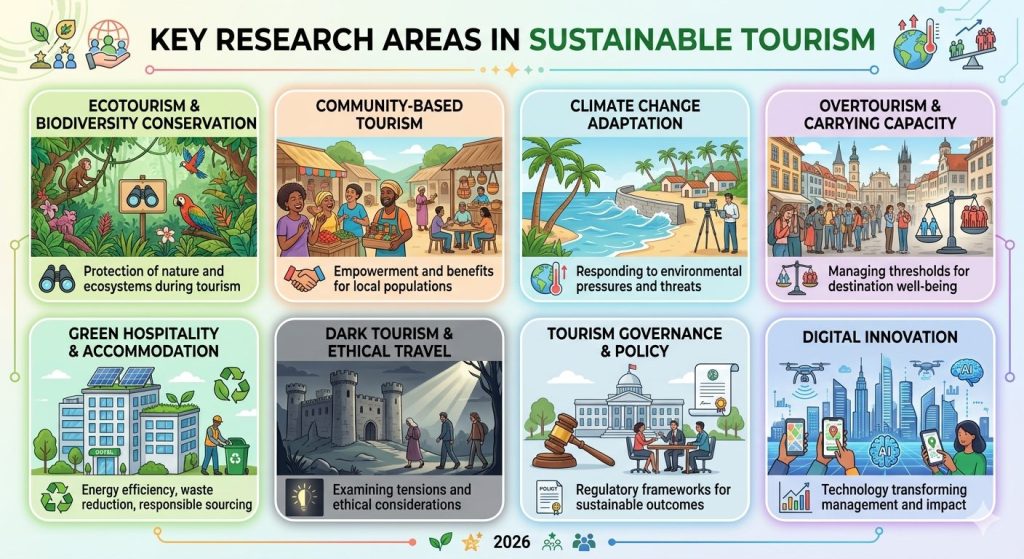
Before selecting a specific topic, it helps to understand the major subfields that sit within sustainable tourism. These are the areas where the most significant academic work is currently being produced, and where original contributions are most welcomed.
- Ecotourism and biodiversity conservation explores how tourism activities affect ecosystems and how destinations can protect natural habitats while still welcoming visitors.
- Community-based tourism examines how local populations participate in and benefit from tourism, with a focus on equity and empowerment.
- Climate change adaptation in tourism looks at how destinations, businesses, and policymakers are responding to the environmental pressures that threaten the sustainability of tourism economies.
- Overtourism and carrying capacity investigates the threshold beyond which tourism causes more harm than benefit to a destination.
- Green hospitality and sustainable accommodation covers energy efficiency, waste reduction, and responsible sourcing in hotels and lodging businesses.
- Dark tourism and ethical travel examines the academic tensions surrounding visits to sites of tragedy, war, or cultural trauma.
- Tourism governance and policy focuses on how regulatory frameworks shape sustainability outcomes at local, national, and international levels.
- Digital innovation in sustainable tourism looks at how technology, including AI and data analytics, is transforming how destinations manage visitor flows and environmental impact.
Five Example Dissertation Topics With Research Aims and Objectives
The examples below show you how to structure a dissertation topic academically. Each includes a clear research aim and two to three research objectives.
Example 1: Ecotourism and Local Economic Development in Sub-Saharan Africa
Research Aim: To examine the extent to which ecotourism contributes to sustainable local economic development in rural sub-Saharan African communities.
Research Objectives:
- To analyse the economic benefits generated by ecotourism initiatives in selected rural communities.
- To evaluate the degree of local community participation in ecotourism planning and revenue distribution.
- To identify policy barriers that limit long-term economic sustainability in community-led ecotourism ventures.
Example 2: Overtourism Management Strategies in European Heritage Cities
Research Aim: To critically assess the effectiveness of overtourism management strategies implemented in European heritage cities between 2018 and 2025.
Research Objectives:
- To compare visitor management policies across three UNESCO World Heritage cities in Europe.
- To evaluate resident perceptions of overtourism and the effectiveness of local authority responses.
- To propose a framework for balancing cultural preservation with sustained visitor access.
Example 3: Carbon Footprint Reduction in the Hospitality Sector
Research Aim: To investigate how independent hotels in the United Kingdom are reducing their carbon footprint through sustainable operational practices.
Research Objectives:
- To assess current sustainability certifications and their uptake among independent UK hotels.
- To identify the most impactful operational changes that reduce carbon emissions in small-scale hospitality businesses.
- To explore the financial and reputational incentives that drive sustainability adoption in this sector.
Example 4: Sustainable Tourism Policy and Indigenous Land Rights
Research Aim: To examine the relationship between national sustainable tourism policies and the protection of indigenous land rights in protected natural areas.
Research Objectives:
- To review existing legislative frameworks governing indigenous land use within tourism zones.
- To assess case studies where sustainable tourism development has either strengthened or undermined indigenous territorial rights.
- To recommend policy adjustments that better integrate indigenous community consent into tourism planning processes.
Example 5: Digital Technologies and Visitor Flow Management in National Parks
Research Aim: To evaluate the role of digital technologies in managing visitor flows and reducing environmental degradation in national parks.
Research Objectives:
- To identify the range of digital tools currently being deployed in national park visitor management.
- To assess the environmental outcomes associated with technology-driven visitor management systems.
- To explore visitor attitudes towards surveillance and data collection in natural conservation areas.
80 Sustainable Tourism Dissertation Topics for 2026
The following topics are organised into thematic subfields. Each is written to be academically specific, researchable, and suitable for 2026-level research expectations.
Ecotourism and Biodiversity
- The role of community ranger programmes in supporting ecotourism and biodiversity conservation in East Africa.
- Assessing the ecological impact of birdwatching tourism on avian populations in protected wetland areas.
- Certification standards in ecotourism: do they effectively protect biodiversity in tropical rainforest destinations?
- The contribution of marine ecotourism to coral reef conservation in Southeast Asian coastal communities.
- Examining the tension between ecotourism growth and wilderness preservation in Antarctic expedition tourism.
- Local guide training as a mechanism for biodiversity education in community-based ecotourism programmes.
- How do visitor numbers affect wildlife behaviour in game reserves: evidence from Southern Africa?
- The effectiveness of payment for ecosystem services models in funding ecotourism in Central America.
- Rewilding and tourism: exploring the compatibility of habitat restoration with sustainable visitor access.
- Responsible wildlife tourism and the ethical treatment of captive animals in elephant sanctuary programmes.
Climate Change and Tourism Resilience
- How are coastal tourism destinations in South Asia adapting to rising sea levels and increased storm frequency?
- The impact of glacier retreat on alpine tourism economies in the Swiss Alps between 2010 and 2024.
- Assessing climate vulnerability among small island developing states that depend heavily on tourism revenue.
- Carbon offsetting in the aviation sector: an evaluation of its credibility as a sustainable tourism tool.
- Tourism destination resilience planning: a comparative study of post-flood recovery in European river towns.
- The role of local climate knowledge in informing sustainable tourism planning in Pacific Island nations.
- Examining how drought conditions are reshaping heritage tourism management in sub-Saharan desert regions.
- Slow travel as a low-carbon tourism practice: motivations, behaviours, and barriers among UK travellers.
- Climate-adaptive visitor infrastructure in mountainous national parks: case studies from Norway and Nepal.
- The relationship between climate change communication and tourist behaviour modification in coastal resorts.
Overtourism, Carrying Capacity, and Destination Management
- Resident attitudes towards overtourism in Venice: examining quality of life indicators between 2019 and 2025.
- Timed entry systems in popular heritage sites: do they effectively manage visitor pressure?
- The use of dynamic pricing as a demand management tool in UNESCO World Heritage Sites.
- Measuring tourism carrying capacity in fragile desert ecosystems: methodological challenges and solutions.
- The psychology of tourist overcrowding: how perceived crowding affects destination satisfaction and loyalty.
- De-marketing strategies in tourism: can discouraging visitors help destinations achieve long-term sustainability?
- Developing a resident wellbeing index for measuring the social impact of tourism in historic city centres.
- Overtourism in rural areas: examining the consequences of influencer-driven destination promotion.
- Examining the relationship between Airbnb density and housing affordability in tourism-dependent cities.
- Virtual tourism as a tool for managing physical visitor pressure in vulnerable natural and cultural sites.
Community-Based Tourism and Social Sustainability
- Women’s empowerment through community-based tourism enterprises in rural Kenya: achievements and limitations.
- Examining power dynamics in community tourism cooperatives in indigenous Mexican communities.
- The role of social enterprise models in delivering equitable tourism in post-conflict regions.
- Fair trade tourism certification and its effectiveness in improving income distribution in rural South Africa.
- Youth engagement in community tourism: building local capacity and reducing rural-to-urban migration.
- Evaluating the social sustainability of volunteer tourism programmes in developing country contexts.
- Diaspora tourism and its contribution to community development in West African heritage villages.
- Cultural commodification in community tourism: where is the ethical boundary?
- The effectiveness of tourism revenue sharing schemes in reducing local poverty in protected area buffer zones.
- Community consent processes in tourism development: lessons from indigenous land management in Canada.
Sustainable Hospitality and Green Business Practices
- The adoption of ISO 14001 environmental management systems in independent hotels in the United Kingdom.
- Food waste reduction strategies in luxury hotel restaurants: operational practices and guest perceptions.
- Single-use plastic elimination in beach resort operations: case studies from Thailand and the Maldives.
- Examining the role of sustainable procurement in reducing the supply chain carbon footprint of large hotel chains.
- Green building design and energy efficiency in boutique hotels: a comparative analysis across European cities.
- The relationship between sustainability labelling and booking decisions among environmentally conscious travellers.
- Examining staff sustainability training programmes and their effect on hotel operational carbon output.
- The viability of zero-waste kitchen operations in mid-range hospitality businesses in the UK.
- Water conservation practices in resort hotels operating in water-stressed destinations.
- Assessing the gap between sustainability marketing claims and actual environmental performance in hotel chains.
Tourism Policy, Governance, and Regulation
- National sustainable tourism strategies in the post-pandemic era: an evaluation of implementation gaps.
- The effectiveness of green taxation schemes in redirecting tourism revenue towards conservation in Costa Rica.
- Governance structures and sustainability outcomes in transboundary tourism management areas in Southern Africa.
- The role of destination management organisations in coordinating sustainable tourism policy at the local level.
- Examining the impact of EU sustainability regulations on inbound tourism businesses in member states.
- How does corruption in local government affect sustainable tourism development in emerging markets?
- Tourism zoning as a spatial planning tool: evidence from marine protected areas in the Caribbean.
- The politics of sustainable tourism branding: how national governments use sustainability narratives for competitive advantage.
- Assessing the role of international NGOs in shaping sustainable tourism governance in least developed countries.
- Legal frameworks for protecting intangible cultural heritage in mass tourism destinations: a comparative analysis.
Digital Innovation and Smart Tourism
- Artificial intelligence and personalised sustainable travel recommendations: opportunities and ethical concerns.
- Blockchain technology in tourism supply chains: can it enhance transparency and sustainability accountability?
- The use of big data analytics in managing visitor pressure at natural heritage sites.
- Smart destination platforms and their contribution to sustainable urban tourism management in European cities.
- Examining the environmental impact of data centres powering digital tourism platforms and booking systems.
- Augmented reality in heritage tourism: can it reduce physical site degradation while enhancing visitor experience?
- The role of social media algorithms in shaping unsustainable tourist behaviour in fragile destinations.
- Electric vehicle infrastructure and its influence on sustainable road tourism in rural Britain.
- Mobile application design for sustainable travel guidance: assessing usability and behavioural impact among young travellers.
- The digital divide and its effect on community participation in online sustainable tourism platforms in the Global South.
Dark Tourism, Ethics, and Responsible Travel
- Ethical frameworks for managing dark tourism at genocide memorial sites in Rwanda and Cambodia.
- Voluntourism and the ethics of short-term development work: a critical examination of its sustainability claims.
- Poverty tourism in urban townships: does it empower residents or commodify deprivation?
- The ethics of wildlife selfies: examining tourist behaviour and its contribution to animal exploitation in Southeast Asia.
- Responsible travel discourse in mainstream media: how sustainable tourism narratives are constructed and consumed.
- Examining the moral economy of dark tourism at sites of natural disaster in Japan and Indonesia.
- Child protection policies in tourism: assessing compliance among tour operators in developing country destinations.
- Examining the role of travel influencers in promoting or undermining responsible tourism values.
- The ethics of all-inclusive tourism resorts in low-income countries: an assessment of economic leakage and community benefit.
- Examining how sustainable tourism research topics are evolving in response to post-pandemic shifts in global travel behaviour.
Conclusion
Selecting the right dissertation topic is one of the most important decisions you will make throughout your academic journey. Sustainable tourism offers a genuinely rich and evolving landscape for original research, and the topics in this post reflect the real challenges, debates, and opportunities shaping the field in 2026.
Whether you are exploring best research proposal topics for sustainable tourism in 2025 or looking for a more focused niche for your doctoral study, the key is to choose a topic that is specific, researchable, and aligned with academic literature in your field. A narrow, well-defined topic will always produce stronger, more coherent research than a broad, unfocused one.
If you are still unsure about where to begin, consider seeking dissertation guidance early. Students who access structured academic support tend to approach their research with greater clarity and confidence. Your dissertation is an opportunity to make a genuine contribution to a field that matters enormously for the planet and for communities around the world. Approach it with curiosity, rigour, and integrity.
