


Artificial Intelligence Dissertation Topics for 2026

Questions Students Are Asking About AI Dissertation Topics
The following questions have been gathered from student forums, academic discussion platforms, and university help communities. They reflect the real concerns students face when trying to choose a dissertation topic in artificial intelligence.
- What are the best artificial intelligence dissertation topics for 2026?
- Are there easy artificial intelligence dissertation topics suitable for beginners?
- What masters artificial intelligence dissertation topics are most relevant right now?
- Which AI research areas are expected to grow significantly this year?
- How do I choose a topic that is narrow enough but still academically substantial?
- Can I find artificial intelligence dissertation topics for undergraduate level research?
- What is the difference between machine learning dissertation topics and broader AI research topics?
- Where can I get professional AI dissertation help if I feel stuck?
Why Choosing the Right Dissertation Topic in Artificial Intelligence Matters
Choosing an artificial intelligence dissertation topic is one of the most consequential decisions a student makes during their academic journey. AI is not a single discipline. It is a rapidly evolving field that spans machine learning, natural language processing, computer vision, robotics, ethics, and much more. A poorly chosen topic can leave a student without adequate literature, viable data, or a clear research direction.
The right topic, however, positions a student to make a genuine academic contribution. It creates a foundation that examiners can assess clearly and that future researchers can build upon. In 2026, the field of AI is maturing rapidly. Topics that felt speculative only a few years ago are now well supported by published research, datasets, and real-world applications.
Students who struggle with selection often benefit from online dissertation help, particularly during the early stages when scope, feasibility, and academic level must all be balanced carefully.
Download Artificial Intelligence Dissertation Topics PDF
Students who want a curated, ready-to-use list of dissertation topics can access a downloadable PDF prepared by academic subject specialists. The PDF is personalised to a student’s academic level and area of interest within artificial intelligence. Students receive the document after completing a brief form, which helps the team match topics to individual research needs.
This resource is particularly useful for students who are at an early stage of their proposal and want to compare multiple options before committing to a direction.
Key Research Areas in Artificial Intelligence for 2026
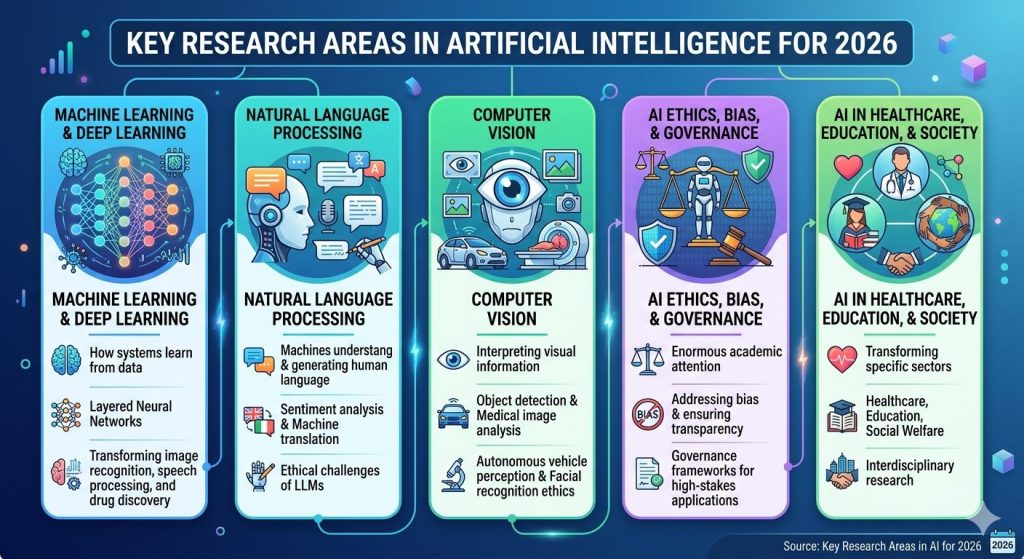
Before selecting a specific topic, it helps to understand the broader landscape of AI research. The following areas represent established academic domains and active research directions that are well supported by scholarly literature in 2026.
Machine Learning and Deep Learning
Machine learning remains one of the most studied subfields of AI. Research in this area examines how systems learn from data, improve performance over time, and generalise to new situations. Deep learning, which uses layered neural networks, has transformed areas such as image recognition, speech processing, and drug discovery.
Natural Language Processing
Natural language processing (NLP) focuses on how machines understand and generate human language. Research topics in this area include sentiment analysis, machine translation, question answering, and the ethical challenges of large language models.
Computer Vision
Computer vision explores how machines interpret visual information from the world. Dissertation research in this area often focuses on object detection, medical image analysis, autonomous vehicle perception, and facial recognition ethics.
AI Ethics, Bias, and Governance
This subfield has gained enormous academic attention. Research examines how AI systems can perpetuate bias, how transparency and accountability should be regulated, and what governance frameworks are appropriate for high-stakes applications.
AI in Healthcare, Education, and Society
Applied AI research examines how intelligent systems are transforming specific sectors. Healthcare, education, and social welfare are particularly active areas where interdisciplinary research is both welcome and necessary.
Five Example Dissertation Topics with Research Aims and Objectives
The following examples demonstrate how a well-structured dissertation topic is framed with a clear aim and focused objectives. These examples can guide students in developing their own proposals.
Example 1: Bias in Facial Recognition Systems
Research Aim: To investigate the presence and impact of demographic bias in commercial facial recognition systems used in UK law enforcement contexts.
Research Objectives:
- To review existing literature on algorithmic bias in facial recognition technology.
- To evaluate the accuracy of selected facial recognition systems across different demographic groups.
- To propose a framework for bias auditing in public sector AI applications.
Example 2: Explainability in Clinical AI Decision Support
Research Aim: To assess how explainability techniques improve clinician trust in AI-based diagnostic support tools.
Research Objectives:
- To critically evaluate existing explainable AI (XAI) methods in clinical environments.
- To analyse clinician perceptions of AI transparency through survey data.
- To recommend design principles for trustworthy clinical AI systems.
Example 3: Federated Learning for Privacy-Preserving Healthcare Data
Research Aim: To explore the application of federated learning techniques in training AI models without centralising sensitive patient data.
Research Objectives:
- To examine the technical architecture of federated learning in healthcare settings.
- To compare model performance under federated and centralised training conditions.
- To identify regulatory considerations for federated AI deployment in the NHS.
Example 4: Large Language Models in Educational Assessment
Research Aim: To investigate the potential and limitations of large language models in automating formative assessment in higher education.
Research Objectives:
- To review current applications of NLP in automated essay scoring.
- To assess the reliability and validity of LLM-generated feedback on student writing.
- To evaluate the ethical implications of AI-driven assessment in UK universities.
Example 5: Reinforcement Learning in Sustainable Energy Management
Research Aim: To determine the effectiveness of reinforcement learning algorithms in optimising energy consumption in smart building systems.
Research Objectives:
- To evaluate reinforcement learning frameworks applicable to energy management.
- To model and test algorithm performance using simulated smart grid data.
- To assess scalability and limitations of the proposed approach for real-world deployment.
80 Artificial Intelligence Dissertation Topics for 2026
The topics below are organised by subfield and numbered for easy reference. They are suitable for undergraduate, master’s, and PhD-level research proposals. Each topic is narrow in focus, academically grounded, and reflects research directions that are active and well-supported in 2026.
Machine Learning Dissertation Topics
- Evaluating the generalisation performance of transformer-based models on low-resource classification tasks.
- Comparative analysis of gradient boosting algorithms for fraud detection in UK financial services.
- Investigating the impact of data augmentation strategies on model robustness in imbalanced datasets.
- Transfer learning for crop disease detection using limited labelled agricultural image data.
- Federated machine learning for collaborative intrusion detection across distributed networks.
- Examining catastrophic forgetting in continual learning systems for real-time industrial applications.
- Multi-task learning approaches for simultaneous intent detection and slot filling in dialogue systems.
- The role of curriculum learning in improving convergence speed for deep neural network training.
- Few-shot learning for rare disease classification using electronic health records.
- Assessing the reliability of ensemble methods in predicting energy demand in smart grids.
Deep Learning and Neural Networks Topics
- Attention mechanisms in deep learning models for long-document summarisation tasks.
- Graph neural networks for predicting drug-target interactions in pharmaceutical research.
- Convolutional neural network architectures for real-time defect detection in manufacturing pipelines.
- Investigating the trade-off between depth and width in neural networks for image classification.
- Self-supervised learning for speech emotion recognition using unlabelled audio datasets.
- Neural architecture search for resource-constrained edge AI deployment.
- Recurrent neural networks versus transformers for time-series anomaly detection in IoT devices.
- The effectiveness of dropout regularisation strategies in preventing overfitting in medical imaging.
- Capsule networks for 3D object recognition in autonomous warehouse robotics.
- Investigating training instability in generative adversarial networks for synthetic data generation.
Natural Language Processing Topics
- Detecting misinformation in social media posts using fine-tuned large language models.
- Cross-lingual transfer learning for low-resource sentiment analysis in South Asian languages.
- Evaluating hallucination rates in GPT-style models across domain-specific question answering tasks.
- Automated clinical note summarisation using NLP for reducing documentation burden in NHS settings.
- Stance detection in parliamentary debates using transformer-based classification models.
- Investigating gender bias in pre-trained language models used for recruitment screening.
- Named entity recognition for legal contract analysis in UK corporate law contexts.
- Multilingual hate speech detection: challenges of cultural context and linguistic nuance.
- The role of prompt engineering in improving zero-shot performance of large language models.
- Automated plagiarism detection using semantic similarity beyond surface-level string matching.
Computer Vision Topics
- Weakly supervised object detection for aerial imagery analysis in disaster response.
- Medical image segmentation using vision transformers for early-stage tumour identification.
- Evaluating adversarial robustness in computer vision models deployed in autonomous vehicles.
- Real-time sign language recognition using RGB-depth cameras and pose estimation networks.
- Privacy-preserving face de-identification in surveillance systems using generative models.
- Domain adaptation in computer vision for cross-hospital deployment of diagnostic AI.
- Explainable visual attention maps for AI-assisted radiology reporting.
- Crowd density estimation in public spaces using unmanned aerial vehicle imagery.
- Satellite image analysis for deforestation monitoring using semantic segmentation models.
- Video-based fall detection for elderly patients in smart care environments.
AI Ethics, Bias, and Governance Topics
- Algorithmic accountability frameworks for high-stakes AI decision-making in criminal justice.
- Assessing transparency requirements under the EU AI Act for healthcare AI systems.
- Measuring fairness trade-offs in predictive policing models across demographic groups.
- The role of model cards in improving interpretability of commercial AI products.
- Ethical implications of emotion AI in the UK workplace monitoring context.
- Governance structures for generative AI in public sector communications.
- Examining consent frameworks for AI systems trained on publicly scraped data.
- Disparate impact analysis of credit scoring algorithms on minority ethnic applicants.
- Responsibility gaps in autonomous AI systems: liability in the absence of human oversight.
- Regulatory approaches to AI-generated synthetic media in democratic election campaigns.
AI in Healthcare Topics
- Predicting hospital readmission rates using machine learning on structured clinical data.
- AI-driven triage support for emergency departments: accuracy versus clinician acceptance.
- Deep learning for early detection of diabetic retinopathy using smartphone fundus images.
- Explainability requirements for AI-assisted prescription recommendations in primary care.
- Evaluating AI tools for mental health chatbot interventions: effectiveness and risk.
- Federated learning for multi-site cancer detection without sharing patient records.
- AI-powered wearable data analysis for predicting cardiovascular events in at-risk patients.
- Bias in clinical AI datasets: a systematic examination of demographic representation gaps.
- Natural language processing for automated adverse drug event detection in patient records.
- Assessing the clinical validity of AI-generated differential diagnoses in GP consultations.
AI in Education and Society Topics
- Personalised learning systems using reinforcement learning in secondary school mathematics.
- Detecting student disengagement in online learning environments using facial expression analysis.
- AI-assisted essay feedback tools: student perceptions of accuracy and fairness in UK universities.
- Algorithmic recommender systems in higher education: impact on subject diversity and choice.
- Using NLP to identify early warning signs of student dropout from discussion forum posts.
- Evaluating AI tutoring systems against human tutors for STEM subjects at A-level.
- Misinformation amplification through social media recommendation algorithms: a case analysis.
- AI-based adaptive testing for students with learning disabilities: accessibility and validity.
- Examining digital divide implications of AI integration in state versus independent schools.
- Ethical considerations of AI surveillance technologies used in university examinations.
Emerging and Interdisciplinary AI Topics
- Quantum machine learning algorithms for optimisation problems in logistics networks.
- AI applications in climate modelling: improving accuracy of regional precipitation forecasts.
- Multi-agent reinforcement learning for traffic signal control in urban congestion management.
- Artificial intelligence in legal research: evaluating case outcome prediction models.
- AI-generated music composition: originality, authorship, and intellectual property challenges.
- Neuro-symbolic AI for knowledge-based reasoning in automated scientific discovery.
- Investigating the environmental cost of large-scale AI model training: a carbon footprint analysis.
- AI-driven personalisation in news delivery and its impact on political polarisation.
- Human-robot collaboration in construction: safety, trust, and task allocation challenges.
- Benchmarking AI systems for low-resource African language translation tasks.
How to Choose the Right AI Dissertation Topic for Your Academic Level
Undergraduate Level
At undergraduate level, the expectation is to demonstrate understanding and apply existing methods to a defined problem. Topics 1–10 in the machine learning section and applied topics such as 61–70 are well suited. The research should be scoped narrowly, with a clear methodology and achievable objectives.
Master’s Level
Master’s artificial intelligence dissertation topics should show critical thinking, methodological rigour, and an ability to contribute something original, even if small. Topics in ethics, healthcare AI, and NLP are particularly strong choices because they allow for mixed-methods research and interdisciplinary analysis.
PhD Level
PhD research demands original theoretical or empirical contributions. Topics in emerging areas such as quantum machine learning, neuro-symbolic AI, or AI governance are appropriate. Students at this level often benefit from early conversations with a supervisor before committing to a topic.
Students working independently can also access AI dissertation help through academic support services, which can assist with proposal development, methodology design, and literature review structuring.
Conclusion
Selecting the right artificial intelligence dissertation topic in 2026 is both a strategic and intellectual decision. The field is broad, evolving quickly, and rich with opportunities for meaningful research at every academic level.
The 80 topics presented in this post span the full depth of AI as a discipline, from deep learning and computer vision through to governance, healthcare applications, and interdisciplinary frontiers. Whether you are an undergraduate writing your first extended research project or a doctoral student defining a multi-year programme of study, there is a topic here that can align with your interests, skills, and resources.
Good topic selection does not mean choosing the most fashionable subject. It means identifying a research gap, framing a clear question, and designing a study that your institution can assess with confidence. The examples and structured topics in this post are designed to help you do exactly that.
Approach your dissertation with intellectual curiosity, academic honesty, and confidence in the process. Students who invest time in topic selection early almost always find the rest of the journey more manageable.
