


Political Science Dissertation Topics for 2026

Questions Students Are Asking Right Now
The following questions have been gathered from student forums, academic discussion boards, and online communities where students regularly share their concerns about dissertation writing. If you have been asking yourself any of these, you are in the right place.
- What are the best political science dissertation topics for 2026?
- How do I choose a dissertation topic in political science that my supervisor will approve?
- Are there any trending political science dissertation topics 2026 that are original and researchable?
- What are some easy political science dissertation topics for undergraduates who are just starting out?
- How is a political science dissertation topic different from a general political science research topic?
- Can I find political science dissertation topics with examples to understand the structure better?
- What contemporary political science research topics are being explored at master’s and PhD level?
- Where can I get political science dissertation help if I am stuck during the proposal stage?
Why Choosing the Right Dissertation Topic in Political Science Matters
Your dissertation topic is the foundation of your entire academic project. In political science, a poor topic choice can result in a vague research design, limited available literature, or a proposal that your institution considers too broad or insufficiently original. Choosing well means your research stays focused, your methodology fits your question, and your final submission contributes meaningfully to existing academic debates.
Political science sits at the intersection of theory, institutions, behaviour, and power. This breadth is both exciting and overwhelming for students. Whether you are working on your undergraduate dissertation or developing a PhD research proposal, the topic you choose will shape your methodology, your reading list, and ultimately the quality of your contribution. Students who invest time in selecting the right topic are better positioned to produce research that is coherent, credible, and publishable.
This post is designed to walk you through key research areas within political science, provide worked examples of well-structured topics, and offer 80 original dissertation ideas to help you move forward with confidence.
Download Political Science Dissertation Topics PDF
For students who want a ready-to-use list, a downloadable PDF version of curated political science dissertation topics is available. This resource has been put together by academic specialists who understand what institutions expect at undergraduate, master’s, and doctoral level. The PDF contains a personalised selection of topics matched to your academic level and research interests. Students can access this resource after completing a short online form, making it a quick and practical tool for anyone in the early stages of dissertation planning.
Key Research Areas in Political Science Worth Exploring
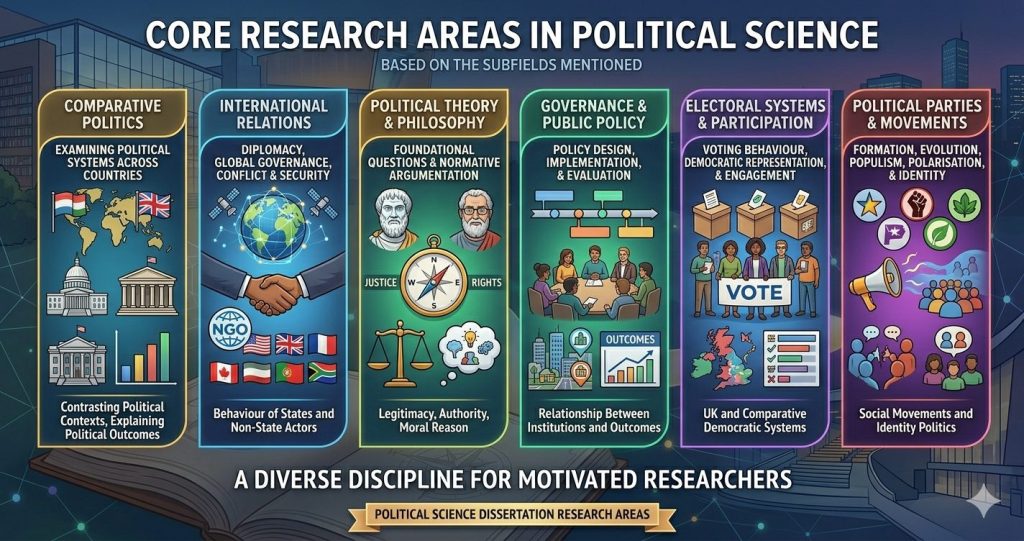
Political science is a diverse discipline with well-established subfields. Understanding where your interest lies is the first step towards selecting a topic that you will remain motivated by throughout the research process. The following areas represent core academic domains within the discipline.
Comparative Politics
This subfield examines political systems, institutions, and behaviour across different countries. It allows researchers to draw lessons from contrasting political contexts and identify patterns that explain political outcomes.
International Relations
International relations covers diplomacy, global governance, conflict, security, and the behaviour of states and non-state actors in the international system. It remains one of the most active areas of contemporary political science research topics.
Political Theory and Philosophy
This area focuses on foundational questions of justice, rights, legitimacy, and the nature of political authority. Political theory dissertation ideas are well suited to students who enjoy conceptual and normative argumentation.
Governance and Public Policy
Research in this area examines how governments design, implement, and evaluate public policies. It is particularly relevant for students interested in the relationship between political institutions and real-world outcomes.
Electoral Systems and Political Participation
This domain explores voting behaviour, party systems, democratic representation, and political engagement. It is especially relevant for students interested in UK politics and policy or comparative democratic systems.
Political Parties and Movements
Understanding how parties form, compete, and evolve, alongside the rise of social movements, forms an important part of modern political science. Research in this area often engages with populism, polarisation, and identity politics.
Political Science Dissertation Topics with Examples
Before presenting the full list of 80 topics, it is helpful to see what a well-structured dissertation topic looks like in practice. The following five examples demonstrate how a research aim and supporting objectives can be clearly structured.
Example 1: Electoral Integrity in Emerging Democracies
Research Aim: To examine the factors that undermine electoral integrity in emerging democracies in Sub-Saharan Africa.
Research Objectives:
- To identify the institutional and contextual variables associated with electoral fraud in selected case studies
- To assess how international observer missions have influenced electoral conduct in the region
- To evaluate the relationship between civil society strength and electoral accountability
Example 2: Populism and Democratic Backsliding in Central Europe
Research Aim: To analyse the role of populist parties in accelerating democratic backsliding in Hungary and Poland between 2010 and 2024.
Research Objectives:
- To assess how ruling populist parties have restructured judicial and media independence
- To compare the responses of the European Union to democratic erosion in both countries
- To evaluate the long-term implications for liberal democratic norms within the EU
Example 3: Climate Change as a Security Threat
Research Aim: To investigate how climate change has been incorporated into national security frameworks in G7 member states.
Research Objectives:
- To map the securitisation of climate change discourse in official policy documents
- To compare how military and intelligence agencies have responded to climate-related risks
- To assess the effectiveness of cross-border cooperation mechanisms addressing climate security threats
Example 4: Gender Representation in Westminster
Research Aim: To evaluate the structural and cultural barriers to gender representation in the UK House of Commons.
Research Objectives:
- To assess the impact of all-women shortlists on female parliamentary representation since 1997
- To examine how institutional culture within political parties affects women’s political careers
- To compare the UK’s progress against Nordic parliamentary models
Example 5: Digital Disinformation and Electoral Outcomes
Research Aim: To examine the influence of digital disinformation campaigns on voter behaviour in the 2024 US Presidential Election.
Research Objectives:
- To identify the primary platforms and actors responsible for distributing political disinformation
- To assess how exposure to disinformation correlates with changes in voter intention
- To evaluate the adequacy of platform regulation in limiting disinformation’s electoral impact
80 Political Science Dissertation Topics for 2026
The following topics are original, researchable, and academically appropriate for 2026-level dissertations. They are organised by subfield and numbered in fixed ranges for easy navigation.
Comparative Politics and Political Institutions
- The role of constitutional courts in limiting executive overreach in post-communist states
- How electoral threshold requirements shape party system fragmentation in Western Europe
- A comparative analysis of federalism and regional autonomy in Spain and Canada
- The impact of institutional trust on democratic resilience in Southern European states
- Presidential versus parliamentary systems: explaining policy stability in Latin America
- How coalition governments manage ideological conflict in multiparty democracies
- The effect of anti-corruption commissions on public trust in government in Southeast Asia
- Bicameralism and legislative gridlock: lessons from the United States and Germany
- How devolution has reshaped political identity in Scotland since 1999
- The influence of constitutional design on minority representation in post-conflict societies
International Relations and Global Security
- The erosion of multilateralism in the post-2016 international order
- How China’s Belt and Road Initiative reshapes political dependencies in African states
- The effectiveness of United Nations peacekeeping operations in contemporary conflict zones
- NATO’s strategic adaptation in response to Russian assertiveness since 2014
- The rise of cyber warfare as a tool of statecraft in interstate competition
- How hybrid warfare challenges traditional definitions of armed conflict under international law
- The politics of humanitarian intervention: sovereignty versus responsibility to protect
- How nuclear deterrence theory applies to the North Korean security dilemma
- The role of middle powers in mediating great power rivalry in the Indo-Pacific
- Climate diplomacy and the politics of international emissions burden-sharing
Political Theory and Philosophy
- Rethinking Rawlsian justice in the context of global inequality and migration
- How Hannah Arendt’s theory of totalitarianism applies to authoritarian digital surveillance states
- The philosophical tension between national sovereignty and cosmopolitan political obligation
- Deliberative democracy and its practical limitations in deeply polarised societies
- A critical examination of liberalism’s capacity to address structural racism in Western democracies
- Republicanism and freedom: revisiting Pettit’s non-domination thesis in the age of algorithmic governance
- The legitimacy of civil disobedience in liberal democratic states: theory and contemporary cases
- How Gramsci’s concept of hegemony applies to contemporary media and ideological power
- Post-colonialism and the limits of Western political theory in understanding African governance
- The philosophical foundations of democratic backsliding: when do citizens justify executive overreach?
Governance, Public Policy, and Political Institutions
- How evidence-based policymaking is undermined by political short-termism in Westminster
- The politics of NHS reform: analysing health policy under Conservative governments 2010–2024
- Regulatory capture and its impact on financial governance in the post-2008 landscape
- How decentralisation affects public service delivery in developing country contexts
- The political economy of austerity and its long-term effects on social welfare provision in the UK
- How independent central banks navigate political pressure during economic crises
- The role of think tanks in shaping UK welfare and immigration policy
- Administrative justice and the accountability of public agencies in England
- How e-government reforms have altered citizen-state relationships in Scandinavia
- The governance of artificial intelligence: comparing regulatory frameworks in the EU and UK
Electoral Systems and Political Participation
- How proportional representation affects voter turnout in established European democracies
- The decline of partisan identity and the rise of issue-based voting in the UK
- How social media platforms have transformed local election campaigning in Britain
- Electoral volatility and party dealignment in post-Brexit British politics
- The political consequences of compulsory voting: lessons from Australia and Belgium
- Youth political disengagement and its structural causes in post-industrial democracies
- How ranked-choice voting affects campaign strategy and electoral competition in the United States
- The relationship between economic inequality and differential voter turnout
- How redistricting practices shape electoral competition in the American Congress
- Postal voting expansion and its effects on electoral participation and fraud risk in the UK
Political Parties, Populism, and Polarisation
- The ideological repositioning of the Labour Party under Keir Starmer: causes and implications
- How the Conservative Party’s internal divisions shaped Brexit policy between 2016 and 2020
- The rise of right-wing populism in France: a study of the Rassemblement National’s electoral strategy
- How political parties in Central and Eastern Europe have adapted to authoritarian pressures
- Gender and leadership within UK political parties: barriers and institutional responses
- Affective polarisation and its effect on political behaviour in the United States
- The role of social media echo chambers in reinforcing partisan identity in Western democracies
- How new parties break into established party systems: the case of Green parties in Europe
- The collapse of traditional centre-left parties in Southern Europe post-2010
- Political entrepreneurship and the outsider candidacy: explaining electoral breakthroughs
International Politics, Diplomacy, and Foreign Policy
- UK foreign policy adaptation after Brexit: continuity, change, and strategic uncertainty
- How domestic political pressures shape foreign policy decision-making in presidential systems
- The role of diaspora communities in influencing UK foreign policy towards their countries of origin
- Soft power and cultural diplomacy: comparing UK and Chinese approaches in Sub-Saharan Africa
- How the Trump presidency reshaped transatlantic relations within NATO and the EU
- The politics of economic sanctions: assessing their effectiveness as a foreign policy tool
- How small states navigate great power competition in the Caribbean and Pacific regions
- Diplomatic recognition and the politics of statehood: the case of Palestinian sovereignty claims
- Trade policy as a strategic instrument: the EU’s use of preferential trade agreements
- How regional organisations such as ASEAN manage interstate disputes without formal enforcement mechanisms
Identity Politics, Rights, and Social Movements
- The politics of memory and historical reckoning in post-apartheid South Africa
- How the Black Lives Matter movement influenced policy debates on policing in the UK
- The political mobilisation of religious identity in contemporary Indian democracy
- How LGBTQ+ rights have become contested terrain in Central and Eastern European politics
- Intersectionality and representation: analysing diversity in UK Cabinet appointments since 2010
- The political consequences of rising anti-immigrant sentiment in Nordic welfare states
- How indigenous rights movements have reshaped constitutional frameworks in Latin America
- The securitisation of migration discourse in UK political debate post-Brexit
- Social movements and policy change: the effectiveness of climate activism in Western democracies
- How the politics of austerity have disproportionately affected racialised communities in England
How to Choose the Right Topic for Your Academic Level
Not every topic on this list will suit every student. Your choice depends on your academic level, the resources available to you, the time you have, and the expertise of potential supervisors at your institution.
For undergraduate students, topics that draw on accessible secondary literature and allow for document analysis or survey-based research are often the most manageable. Easy political science dissertation topics for undergraduates tend to be those with a clear scope and a well-documented evidence base.
For master’s and PhD students, the expectations shift significantly. You are expected to identify a gap in existing research, develop a sophisticated theoretical framework, and engage critically with primary sources. If you are at this stage and feel uncertain about your proposal, seeking out political science research support early in the process can help you avoid common structural mistakes.
If you are unsure whether your chosen topic is appropriately scoped or academically original, getting professional feedback through online dissertation help services can make a meaningful difference before you submit your proposal
Structuring Your Dissertation Proposal in Political Science
A strong dissertation proposal is what gets your topic approved. Most institutions in the UK expect a proposal that includes a clearly stated research question or aim, a brief review of relevant literature, a methodology section, and an explanation of the topic’s academic significance.
When writing your dissertation proposal, be specific about the boundaries of your research. A topic like “democracy in Africa” is too broad. A topic like “the role of civil society organisations in challenging electoral fraud in Kenya’s 2022 general election” is focused, researchable, and original.
Your methodology should match your research question. Qualitative methods such as discourse analysis, case studies, and semi-structured interviews are common in political science. Quantitative approaches are used where comparative data sets allow statistical analysis. Mixed-methods designs are increasingly accepted at master’s and doctoral level, particularly in public policy research.
If the proposal stage feels particularly challenging, it is worth looking into political science assignment help from academic support services that understand the requirements of UK-based institutions.
Conclusion
Choosing the right dissertation topic in political science is one of the most academically significant decisions you will make during your studies. A well-chosen topic gives your research clarity, keeps your methodology consistent, and positions your work within meaningful academic conversations.
The 80 topics presented in this post are designed to reflect the breadth and depth of contemporary political science research topics across the discipline’s core subfields. Whether your interest lies in political theory, international politics dissertation topics, UK governance, or social movements, there is a starting point here that can be shaped into a rigorous research proposal.
Approach your dissertation with patience and intellectual curiosity. The best research does not just answer a question. It opens up new ones. Take your time with topic selection, use the examples provided to understand academic structure, and do not hesitate to seek expert guidance when you need it.
