


Sociology Dissertation Topics for 2026

What Students Are Asking About Sociology Dissertation Topics
The questions below have been gathered from student forums, academic discussion boards, and peer communities where students regularly seek guidance on dissertation topic selection.
- “How do I pick a sociology dissertation topic that is focused enough but still academically relevant?”
- “What are the most trending social science dissertation topics for 2026?”
- “Can you give me sociology thesis topics that work for both undergraduate and master’s level?”
- “Which social issues dissertation topics are still under-researched and worth exploring?”
- “How do I know if my sociology project idea is suitable for a PhD proposal?”
- “Are there any easy social science dissertation topics for undergraduates that still meet academic standards?”
- “What are some sociology dissertation topics with examples of research aims and objectives?”
- “How do interdisciplinary social science dissertation topics differ from traditional sociology topics?”
If you have asked any of these questions, this post was written with you in mind. It walks you through everything from understanding the landscape of sociology research to choosing a topic that genuinely fits your academic level and interests.
Why Your Sociology Dissertation Topic Choice Matters
Choosing a dissertation topic in sociology is one of the most consequential academic decisions you will make. Sociology sits at the intersection of human behaviour research, cultural studies, social policy, and economics, which means the scope of possible topics is vast. However, vastness can lead to confusion, and confusion leads to weak research.
A well-chosen topic gives your dissertation a clear purpose. It connects your research to real-world social issues and shows your academic examiners that you understand both the field and the gap you intend to fill. A poorly chosen topic, even one that sounds interesting, can collapse under the pressure of research design or ethical considerations in social science.
The difference between a topic that earns distinction-level marks and one that struggles often comes down to three things: specificity, relevance, and researchability. This guide will help you achieve all three.
If you feel overwhelmed at this stage, you are not alone. Many students turn to social science dissertation help to clarify their ideas before committing to a topic. Getting structured academic support early can save months of misdirection.
Download Sociology Dissertation Topics PDF
Students who want a personalised list of sociology dissertation topics curated by academic subject specialists can access a downloadable PDF version of this content. The PDF is compiled by experienced researchers who understand current trends in sociology, anthropology, and related social science fields.
To receive the PDF, students complete a short academic enquiry form. Once submitted, the document is shared directly. This option is particularly useful for students who prefer an organised, offline reference during their proposal and planning stages.
Key Research Areas in Sociology You Can Explore
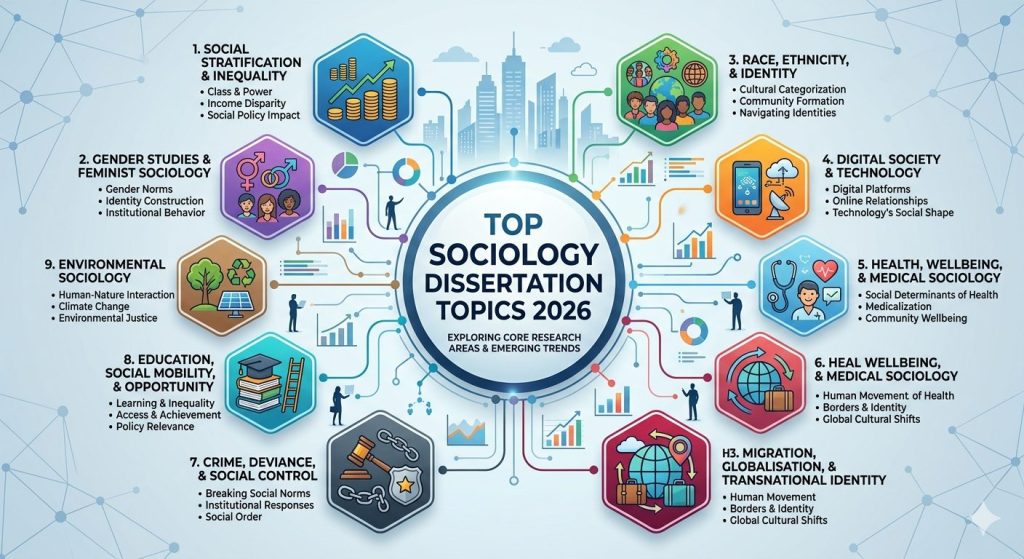
Before choosing a topic, it helps to understand the broad research areas within sociology. The field spans many disciplines, and your dissertation can draw from one or more of these established domains.
Social Stratification and Inequality
This area examines how societies divide people by class, race, gender, and other markers. Research in this space often intersects with political science research topics and economics dissertation topics.
Gender Studies and Feminist Sociology
Gender studies explores how gender shapes individual experience, institutional behaviour, and cultural norms. This is one of the most active and evolving areas within contemporary social science research topics.
Race, Ethnicity, and Identity
How societies construct, maintain, and challenge racial and ethnic categories remains a central concern in sociology. Topics here often require careful ethical considerations in social science.
Digital Society and Technology
The sociology of technology examines how digital platforms reshape social relationships, community formation, and political behaviour. This is one of the most in-demand areas for trending social science dissertation topics 2026.
Health, Wellbeing, and Medical Sociology
This area sits close to psychology research topics and looks at how social conditions shape physical and mental health outcomes.
Migration, Globalisation, and Transnational Identity
These topics explore how people move, adapt, and maintain identity across borders, often drawing on anthropology and cultural studies.
Crime, Deviance, and Social Control
This subfield examines why individuals and groups behave outside social norms and how institutions respond.
Education, Social Mobility, and Opportunity
The relationship between education and inequality is a well-established but constantly evolving area, particularly relevant to social policy research.
Environmental Sociology
An emerging interdisciplinary area that looks at human relationships with the natural environment and the social dimensions of climate change.
Five Example Sociology Dissertation Topics with Research Aims and Objectives
These examples demonstrate what a well-structured sociology dissertation topic looks like at proposal level. Each includes a research aim and supporting objectives.
Example 1: Social Media and Political Polarisation
Topic: How does algorithm-driven content on social media platforms contribute to political polarisation among young adults in the United Kingdom?
Research Aim: To examine the relationship between algorithmic content curation and the intensification of political polarisation among adults aged 18 to 30 in the UK.
Research Objectives:
- To analyse how social media algorithms filter and present political content to young users.
- To explore the lived experiences of young adults who identify as politically polarised online.
- To assess the implications of digital echo chambers for democratic participation.
Example 2: Gender Pay Gap in Higher Education
Topic: An intersectional analysis of the gender pay gap among academic staff in UK universities between 2015 and 2025.
Research Aim: To investigate how gender intersects with ethnicity and academic rank to produce differential pay outcomes within British higher education institutions.
Research Objectives:
- To map pay distribution across gender and ethnic categories using publicly available institutional data.
- To gather qualitative accounts from academic staff regarding their experiences of pay inequality.
- To identify structural and institutional factors that perpetuate the gap.
Example 3: Mental Health Stigma in Black British Communities
Topic: Exploring barriers to mental health help-seeking among Black British men aged 25 to 45.
Research Aim: To understand the social and cultural factors that prevent Black British men from accessing mental health services.
Research Objectives:
- To identify cultural narratives around masculinity and mental health within Black British communities.
- To explore how institutional mistrust shapes attitudes towards formal support services.
- To recommend community-centred approaches that address identified barriers.
Example 4: Climate Anxiety and Environmental Identity
Topic: How does climate anxiety influence pro-environmental behaviour and identity formation among university students?
Research Aim: To examine the relationship between climate-related anxiety and the development of environmental identities among students in higher education.
Research Objectives:
- To measure levels of climate anxiety across a sample of undergraduate students.
- To explore how anxiety shapes daily choices and long-term behavioural intentions.
- To assess the role of university culture in either amplifying or moderating climate distress.
Example 5: Gig Economy Workers and Social Isolation
Topic: The social consequences of platform-based labour: loneliness, identity, and community among gig economy workers in urban areas.
Research Aim: To investigate how gig work affects social connectedness and occupational identity for workers in major UK cities.
Research Objectives:
- To document the social patterns and support networks of gig economy workers.
- To explore how the absence of workplace community affects wellbeing.
- To compare experiences across platform types such as food delivery, ridesharing, and freelance digital labour.
80 Sociology Dissertation Topics for 2026
The following 80 topics are organised by subfield and are suitable for undergraduate, master’s, and PhD-level research proposals. Each topic is specific, researchable, and aligned with 2026 academic standards.
Social Inequality and Class
- How does childhood poverty affect long-term educational attainment in post-industrial northern England?
- The role of social capital in reproducing class privilege within elite UK universities.
- Food insecurity and social shame among working-class families in urban Scotland.
- How austerity policies between 2010 and 2024 reshaped class identity in post-industrial communities.
- Intergenerational wealth transfer and its impact on housing access for millennials in London.
- Class-based differences in healthcare utilisation among adults over 60 in Wales.
- The sociology of debt: how personal debt shapes identity and opportunity among low-income adults.
- Invisible disadvantage: exploring the experiences of the “hidden poor” in suburban England.
- How zero-hours contracts affect financial security and class mobility among young adults.
- Social class, aspiration, and cultural capital among first-generation university students.
Gender, Sexuality, and Identity
- Non-binary identity formation among adults aged 18 to 35 in the United Kingdom.
- How masculine norms shape men’s reluctance to seek help during mental health crises.
- The gendered division of domestic labour during and after the COVID-19 pandemic.
- Experiences of gender dysphoria within under-resourced rural communities in the UK.
- How trans visibility in mainstream media affects real-world attitudes towards trans individuals.
- The sociology of sexual consent: how university students understand and negotiate consent.
- Workplace microaggressions experienced by lesbian and bisexual women in professional settings.
- How feminist organising has shifted in the age of social media activism.
- Body image, self-surveillance, and the female gaze in the context of Instagram culture.
- How gender norms in sport reproduce broader social inequalities in the UK.
Race, Ethnicity, and Belonging
- Racial microaggressions in British higher education institutions: student experiences and institutional responses.
- The construction of “Britishness” and its exclusion of racialised minorities in political discourse.
- How second-generation South Asian British individuals navigate cultural belonging.
- Colourism within Black and South Asian communities in the UK and its social consequences.
- How racialised policing affects trust in law enforcement among young Black men in London.
- The experiences of mixed-heritage individuals in negotiating racial identity.
- Islamophobia, identity, and belonging among Muslim women in post-Brexit Britain.
- Whiteness as a social category: how white working-class communities understand racial identity.
- How immigration status shapes precarity and vulnerability among undocumented workers.
- Racialised grief: how public discourse around race shapes responses to racially motivated violence.
Digital Society and Technology
- How TikTok shapes political socialisation among teenagers in the UK.
- The sociology of influencer culture: authenticity, labour, and identity in the creator economy.
- Digital exclusion among older adults and its impact on access to public services.
- Online radicalisation pathways: how extremist communities recruit and retain members.
- The surveillance capitalism model and its implications for everyday social behaviour.
- How platform algorithms reinforce gender and racial stereotypes in content recommendations.
- Digital grief: how bereaved individuals use social media to mourn and memorialise.
- The sociology of misinformation: how false narratives spread and persist within online communities.
- Remote work and the erosion of professional community among knowledge workers.
- Deepfakes, trust, and the social consequences of synthetic media in public life.
Health, Mental Health, and Wellbeing
- The social determinants of poor mental health among care leavers transitioning to independent living.
- How chronic illness shapes identity, relationships, and social participation.
- Mental health literacy and help-seeking behaviour among male university students.
- The sociology of addiction: how social environments shape substance dependency.
- How NHS waiting times affect social and psychological wellbeing among working-class patients.
- Parental mental health and its transmission through family systems in disadvantaged communities.
- The medicalisation of childhood behaviour and its social consequences.
- Social isolation among elderly adults in rural UK communities: causes and consequences.
- How social media use correlates with anxiety and depression among adolescents.
- The role of community support networks in promoting recovery from eating disorders.
Migration, Globalisation, and Diaspora
- The transnational family: how migration reshapes parent-child relationships across borders.
- Identity negotiation among Polish migrants in the UK following Brexit.
- How asylum seekers experience detention and its long-term psychological consequences.
- The social integration challenges faced by Syrian refugees in Northern England.
- Diaspora remittances and their effects on family dynamics in sending countries.
- How global care chains reproduce gender inequality through domestic labour migration.
- The sociology of return migration: identity, expectation, and disappointment.
- How second-generation Caribbean British individuals relate to their heritage culture.
- Xenophobia in the workplace: the experiences of Eastern European migrants in post-Brexit Britain.
- How international students navigate cultural adjustment and belonging in UK universities.
Crime, Deviance, and Social Control
- County lines drug networks: understanding recruitment, coercion, and vulnerability among young people.
- How social media has changed the nature of public shaming and reputational harm.
- The sociology of white-collar crime: how professional norms enable financial misconduct.
- Community responses to knife crime in South London: resistance, fear, and resilience.
- How prison culture affects reintegration and recidivism among young male offenders.
- The criminalisation of poverty: how welfare conditionality creates pathways to legal sanction.
- How domestic abuse is understood and responded to within South Asian communities in the UK.
- The sociology of hate crime: motivations, targets, and institutional responses.
- How body cameras have changed police accountability and community trust.
- Online harassment and gendered cybervictimisation among women in public life.
Education, Social Mobility, and Opportunity
- How teacher expectations shape the academic trajectories of working-class pupils.
- The impact of grammar schools on social mobility in areas where they remain operational.
- How Black Caribbean boys are disproportionately excluded from UK schools.
- The sociology of private tutoring: how supplementary education reproduces advantage.
- How university ranking culture shapes student choice and perpetuates inequality.
- The experiences of mature students returning to higher education after periods of unemployment.
- How arts education cuts in state schools affect cultural participation across class lines.
- The relationship between school belonging and mental health among LGBTQ+ teenagers.
- How gap years reproduce class privilege and shape graduate employment outcomes.
- The sociology of academic underperformance: how labelling affects student self-concept and attainment.
How to Select the Right Sociology Dissertation Topic for You
Selecting from 80 topics can feel overwhelming. The following practical steps will help you narrow your choice.
Match the Topic to Your Academic Level
Undergraduate dissertations typically require a clearly bounded qualitative or quantitative study. Master’s research can involve more complex methodological design. PhD proposals need to demonstrate an original contribution to knowledge. Each topic above can be adapted, but be honest about your level.
Consider Research Access and Ethics
Some topics require access to vulnerable populations, sensitive data, or institutions that may not cooperate. Ethical considerations in social science must inform your choice early. A topic you cannot ethically or practically research will not produce strong findings.
Use Qualitative vs Quantitative Methods Thoughtfully
Sociology uses both qualitative and quantitative methods. Understanding which approach suits your topic will sharpen your research question and make your methodology section far stronger. Many contemporary sociology dissertations now use mixed methods, which can provide richer data where both types of evidence are available.
Align with Current Academic Conversations
If you want your dissertation to be taken seriously at examination, your topic must connect with current debates in the field. Reviewing recent journal articles in journals such as Sociology, The British Journal of Sociology, and Social Problems will confirm whether your idea is still fresh and relevant.
Students who need structured guidance at this stage often seek help with social science research proposal development, particularly when transitioning from a broad interest to a researchable question.
Conclusion
Choosing a sociology dissertation topic is the foundation of your entire research journey. A topic that is specific, ethical, and connected to current social science debates gives your dissertation the best possible start. Whether you are at undergraduate, master’s, or PhD level, the 80 topics and five detailed examples in this post provide a strong starting point.
Sociology offers a remarkable range of research directions, from the intimacy of mental health and identity to the scale of globalisation and institutional power. The most important thing is to choose a topic that you genuinely want to understand, not just one that sounds impressive.
If you are still uncertain about your direction, speaking with your academic supervisor early is always the right move. For those who want additional support in refining ideas, accessing social science research assistance from experienced academic professionals can provide the clarity needed to move forward with confidence.
Your dissertation is an opportunity to contribute, in a small but meaningful way, to how we understand the social world. Approach it with curiosity, rigour, and academic integrity, and it will be one of the most rewarding things you do in your academic career.
