


Construction Health and Safety Dissertation Topics for 2026

The questions below have been gathered from student forums, academic discussion platforms, and university support communities. They reflect what real students search for when they feel stuck on their dissertation topic.
- What are the best construction health and safety dissertation topics for 2026?
- How do I choose a dissertation topic in construction safety that is suitable for my academic level?
- What are the latest construction health and safety research topics that universities actually care about?
- Can I get construction safety dissertation topics with examples of research aims and objectives?
- What makes occupational health and safety dissertation topics strong at the master’s or PhD level?
- Are there specific areas in construction site safety that are currently under-researched?
- Where can I find reliable construction health and safety dissertation help without paying for a full writing service?
Introduction: Why Your Dissertation Topic Matters in Construction Health and Safety
Choosing the right dissertation topic in construction health and safety is one of the most important academic decisions you will make. The construction sector remains one of the most hazardous industries globally, with fatality and injury rates that continue to concern governments, regulators, and employers. As a student in this field, your dissertation is an opportunity to contribute meaningful knowledge to a profession that directly protects human lives.
A well-chosen topic allows you to demonstrate your understanding of hazard identification, regulatory frameworks, and the human factors that influence worker behaviour on site. It also shows examiners that you can work at the frontier of your discipline rather than simply repeating what is already well-documented.
Whether you are an undergraduate writing your first extended research project or a postgraduate student working towards a master’s or PhD, the topic you choose sets the direction of everything that follows. This post walks you through the key research areas in this discipline, provides worked examples with aims and objectives, and offers 80 original construction health and safety dissertation topics organised by subfield. If you need tailored guidance, accessing trusted online dissertation help early in the process can save you considerable time and effort.
Download Construction Health and Safety Dissertation Topics PDF
Students who prefer to review dissertation topics offline, or who want a curated list tailored to their specific academic level and area of interest, can access a downloadable PDF. This resource is put together by academic experts with experience in construction safety research and dissertation supervision.
The PDF contains a personalised selection of topics drawn from the subfields covered in this post. Students receive the document after completing a short form that helps our team understand their level of study and research preferences. No prior experience in research methods is needed to complete the form.
Why Choosing the Right Construction Safety Dissertation Topic Matters
Many students underestimate how much topic selection shapes the rest of their dissertation journey. A topic that is too broad becomes unmanageable. One that is too narrow may not yield enough literature or data. A topic that has already been exhaustively researched will struggle to offer an original contribution, which is a core requirement at any academic level.
In the construction health and safety field, the stakes are also practical. Poor safety research has real consequences when it informs policy, training programmes, or site management decisions. This is why universities assess dissertations not just for academic rigour but also for real-world relevance and ethical consideration.
Selecting a focused topic also helps you manage the research process more effectively. You can define a clear methodology, identify relevant data sources, and produce a coherent argument within your word limit. Topics grounded in current issues such as the mental health of construction workers, digital safety monitoring, or the impact of evolving safety regulations give your work immediacy and make it more valuable to practitioners and academics alike.
Key Research Areas in Construction Health and Safety for 2026
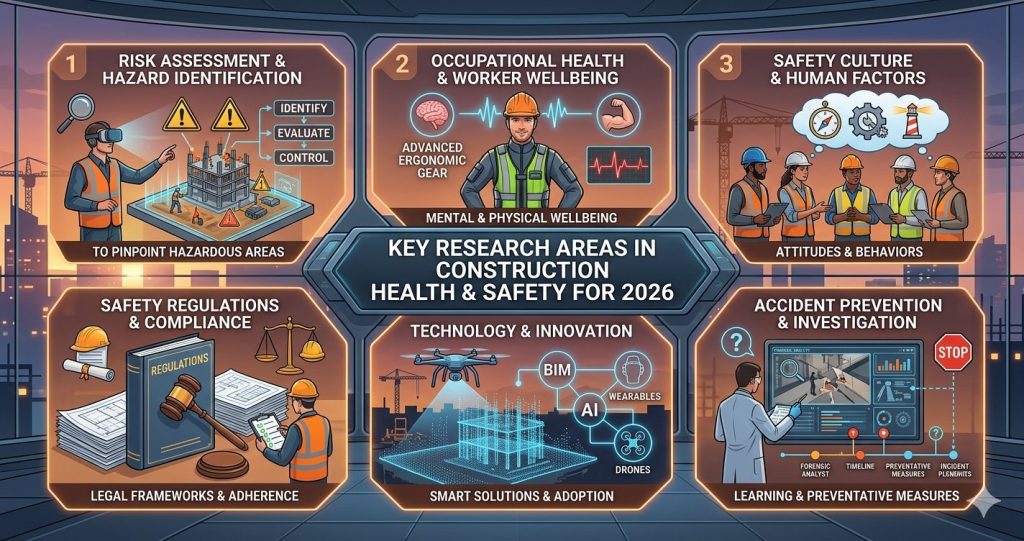
The field of construction health and safety is broad, but it can be divided into several well-established research domains. Understanding these areas will help you identify where your interests lie and where there is genuine scope for original contribution.
Risk Assessment and Hazard Identification
This area examines how risks are identified, evaluated, and controlled on construction sites. It covers methodological approaches such as job safety analysis, fault tree analysis, and dynamic risk assessment. Research here often explores how effectively these tools are implemented in practice and where gaps remain.
Occupational Health and Worker Wellbeing
Occupational health research goes beyond physical injury prevention to include mental health, musculoskeletal disorders, noise-induced hearing loss, respiratory conditions, and the long-term health effects of construction work. This area has grown significantly in recent years and offers rich opportunities for both quantitative and qualitative research.
Safety Culture and Human Factors
Safety culture examines the attitudes, beliefs, and behaviours that workers and managers bring to safety on site. Research in this area investigates leadership styles, communication practices, worker engagement, and the psychological factors that influence safe or unsafe behaviour.
Safety Regulations and Compliance
Regulatory research focuses on the development, implementation, and enforcement of construction safety law. Topics here might explore how regulations such as the Construction (Design and Management) Regulations are understood and followed on site, or how regulatory reform affects accident rates.
Technology and Innovation in Site Safety Management
Digital tools including Building Information Modelling (BIM), wearable sensor technology, drones, and artificial intelligence are transforming site safety management. Research in this area examines how these technologies are adopted, what barriers exist, and whether they genuinely reduce harm.
Accident Prevention and Investigation
This area covers the methods used to prevent accidents and to investigate those that do occur. It includes the analysis of near-miss reporting systems, learning from incidents, the effectiveness of toolbox talks and induction training, and how lessons from major incidents inform future practice.
Construction Safety Dissertation Topics With Examples: Aims and Objectives
Understanding how to structure a dissertation topic is just as important as choosing one. Below are five examples of strong construction health and safety dissertation topics, each with a research aim and supporting objectives. These examples show how a topic moves from a broad idea to a focused, researchable question.
Example 1: Near-Miss Reporting Culture on UK Construction Sites
Research Aim
To investigate the factors that influence whether construction workers report near-miss incidents and how reporting culture affects accident prevention outcomes.
Research Objectives
- To identify the personal, organisational, and cultural barriers to near-miss reporting on UK construction sites.
- To evaluate the effectiveness of existing near-miss reporting systems in promoting a proactive safety culture.
- To recommend improvements to reporting frameworks that can be practically implemented by site managers.
Example 2: The Impact of Wearable Technology on Hazard Identification
Research Aim
To assess how wearable sensor technology contributes to real-time hazard identification and worker safety on large construction projects.
Research Objectives
- To review the current landscape of wearable safety technology available for construction environments.
- To examine how wearables are being integrated into site safety management plans on infrastructure projects.
- To assess worker acceptance of wearable devices and identify privacy concerns that may limit adoption.
Example 3: Mental Health Challenges Among Construction Workers in the Post-Pandemic Period
Research Aim
To explore the mental health challenges experienced by construction workers following the COVID-19 pandemic and assess how employers are responding.
Research Objectives
- To identify the key mental health pressures faced by construction workers in the current economic and social context.
- To evaluate the adequacy of mental health support provisions offered by construction employers in the UK.
- To recommend evidence-based strategies for improving occupational mental health outcomes in the sector.
Example 4: CDM Regulations and Principal Contractor Compliance on SME Projects
Research Aim
To evaluate compliance with the Construction (Design and Management) Regulations 2015 among principal contractors working on small and medium-sized projects.
Research Objectives
- To assess the extent to which small and medium-sized contractors understand their legal duties under CDM 2015.
- To identify the most common areas of non-compliance and the reasons behind them.
- To explore how regulatory bodies can better support SMEs in meeting their safety obligations.
Example 5: The Role of Safety Leadership in Reducing Accidents on High-Rise Construction Projects
Research Aim
To investigate how the leadership styles of site managers influence safety behaviour and accident rates on high-rise construction projects.
Research Objectives
- To review the existing literature on transformational and transactional leadership models within construction safety contexts.
- To analyse the relationship between leadership style, safety climate, and accident frequency on high-rise sites.
- To identify leadership development practices that most effectively improve safety outcomes at height.
80 Construction Health and Safety Dissertation Topics for 2026
The following 80 dissertation topics have been developed to reflect current research gaps, regulatory developments, and emerging industry challenges. They are organised by subfield and suitable for undergraduate, master’s, and PhD research. Each topic is focused, original, and aligned with 2026-level academic expectations.
Students searching for the latest construction health and safety research topics will find this list particularly useful for narrowing their focus before beginning a formal research proposal. Those who require structured support with the writing process may also benefit from a professional construction dissertation writing service to guide them through methodology and literature review.
Risk Assessment and Hazard Identification
- The effectiveness of dynamic risk assessment training in reducing on-site injuries among newly qualified construction operatives.
- A critical evaluation of residual risk management strategies used during the demolition of pre-1980 industrial buildings.
- Hazard identification accuracy among construction workers: a comparison between experienced operatives and recent apprenticeship graduates.
- The application of bowtie methodology in assessing multi-causal risks on complex civil engineering projects.
- Predicting unplanned work-at-height incidents using machine learning models trained on historical site inspection data.
- Comparing the reliability of manual and digital risk registers across UK housebuilding projects of varying scale.
- The influence of subcontractor fragmentation on the quality of risk assessments submitted under CDM 2015 projects.
- Risk perception differences between site managers and operatives on urban high-rise residential construction projects.
- Assessing the adequacy of pre-construction phase risk planning on infrastructure projects delivered through public-private partnerships.
- The role of Building Information Modelling in identifying structural hazards during the design stage of commercial builds.
Occupational Health and Worker Wellbeing
- Mental health stigma in the construction industry: barriers to help-seeking behaviour among male trade workers in England.
- Prevalence and management of work-related musculoskeletal disorders among bricklayers employed on residential projects.
- The long-term respiratory health outcomes of construction workers with prolonged exposure to silica dust.
- Fatigue as an occupational hazard: patterns of overtime working and their relationship to injury risk in groundwork trades.
- Access to occupational health services among self-employed construction workers in the UK gig economy.
- Noise-induced hearing loss prevention: evaluating the uptake of hearing protection among scaffold erectors on major projects.
- The impact of shift patterns and irregular working hours on the psychological wellbeing of construction site supervisors.
- Thermal stress management on UK construction sites during summer months: current practice and worker experience.
- Substance use and construction site safety: examining employer awareness and the adequacy of drug and alcohol policies.
- Evaluating the effectiveness of employee assistance programmes in supporting mental health recovery among construction workers.
Safety Culture and Human Factors
- The relationship between psychological safety and incident reporting willingness among construction site operatives.
- How leadership visibility on site influences safety climate scores measured over a 12-month project lifecycle.
- The influence of peer pressure on personal protective equipment compliance among young construction apprentices.
- Cross-cultural safety communication challenges on multinational construction sites in post-Brexit Britain.
- Measuring the maturity of safety culture in tier-one construction contractors using established culture assessment frameworks.
- The effect of positive behavioural safety programmes on injury frequency rates across medium-sized construction firms.
- Decision fatigue among construction project managers and its impact on safety-critical choices during project close-out phases.
- Communicating safety risk to non-English-speaking workers: methods, effectiveness, and the role of visual safety information.
- The role of toolbox talks in embedding safety values: a longitudinal study across housebuilding sites in the Midlands.
- Normalisation of deviance in construction: how accepted shortcuts lead to increased site accident risk over time.
Safety Regulations and Legal Compliance
- Principal designer competency under CDM 2015: an analysis of compliance gaps in domestic construction projects.
- HSE inspection frequency and its correlation with self-reported safety compliance rates in the UK civil engineering sector.
- The impact of safety regulations introduced after the Grenfell Tower fire on site safety management in residential high-rise projects.
- How the revised Work at Height Regulations are being interpreted and applied on temporary structure projects.
- Legal liability distribution in multi-contractor construction projects following serious workplace accidents.
- Comparing construction safety regulatory frameworks across the UK, Germany, and Australia: lessons for reform.
- The effectiveness of improvement notices issued by the HSE in driving sustainable safety improvements among repeat offenders.
- Construction site safety obligations for clients: how well do non-specialist project clients understand their CDM duties?
- The enforceability of safety conditions embedded in planning permissions on large urban regeneration projects.
- Post-Brexit divergence in construction safety regulations between Great Britain and Northern Ireland: implications for cross-border contractors.
Technology and Digital Tools in Site Safety Management
- Artificial intelligence in construction safety: evaluating the accuracy of AI-powered hazard detection systems on live sites.
- Drone surveillance for real-time site safety monitoring: adoption barriers and practical implementation challenges.
- Virtual reality safety induction training compared with traditional classroom methods: outcomes and worker retention rates.
- The integration of safety data from IoT wearable devices into construction project management information systems.
- Using predictive analytics to identify high-risk periods during the construction programme lifecycle before incidents occur.
- BIM level 2 adoption and its effect on pre-construction safety planning on NHS infrastructure projects.
- The role of mobile safety management apps in improving subcontractor compliance with site safety plans.
- Evaluating proximity warning systems for plant and pedestrian collision prevention on busy city-centre construction sites.
- RFID and access control technology as tools for managing site-wide occupational health and safety documentation.
- Digital twins and their application in proactive safety planning for complex, phased demolition and rebuild projects.
Accident Prevention and Incident Investigation
- Root cause analysis of fatal falls from height in the UK construction sector between 2019 and 2024.
- The effectiveness of safety observation programmes in reducing struck-by incidents involving mobile plant on infrastructure sites.
- Learning from near misses: a thematic analysis of near-miss reports submitted across a national housebuilder’s project portfolio.
- Manual handling injuries in the fit-out sector: causes, frequency, and the adequacy of current accident prevention training.
- The contribution of inadequate induction training to first-month accidents among new construction site starters.
- Permit-to-work system failures and their role in serious injuries during confined space work on sewer construction projects.
- Electrocution risks in residential construction: an analysis of accident patterns and the effectiveness of current preventative measures.
- The under-reporting of minor injuries in construction and its impact on organisational accident prevention strategies.
- Scaffolding collapse incidents: a structured review of causation patterns and the adequacy of current inspection regimes.
- Contractor competency verification and its relationship to accident rates on UK building projects procured through competitive tender.
Workforce Diversity and Inclusion in Safety Management
- Gender-specific safety challenges for women working in trade roles on UK construction sites.
- Older worker safety on construction sites: age-related health decline and the need for tailored risk controls.
- The safety experiences of migrant workers on large infrastructure projects and the barriers they face in reporting hazards.
- Apprentice safety training on construction sites: are induction programmes meeting the needs of young and inexperienced workers?
- Disability and construction site safety: accessibility barriers for workers with mobility impairments in site welfare provision.
- The impact of zero-hours contracts on safety reporting culture among temporary construction workers.
- Site welfare standards and their relationship to worker dignity, retention, and occupational health outcomes in the construction sector.
- How construction firms are responding to the mental health needs of LGBTQ+ workers in a traditionally male-dominated industry.
- The role of diversity and inclusion policies in shaping safety culture on multi-trade commercial construction projects.
- Veterans entering the construction workforce: an evaluation of transferable safety skills and resettlement support programmes.
Sustainability, Climate, and Emerging Safety Challenges
- Health and safety implications of the shift to low-carbon construction methods: risks associated with new materials and techniques.
- Managing safety risks during retrofitting work on occupied residential buildings to meet net-zero energy targets.
- The health and safety challenges of modern methods of construction: offsite manufacturing and volumetric modular assembly.
- Climate adaptation and outdoor worker safety: managing extreme heat, flooding, and storm risks on UK construction sites.
- Safety risks associated with the installation of solar panels and battery storage systems on domestic rooftops.
- Asbestos exposure risk during the refurbishment of pre-1999 public sector buildings: current controls and residual dangers.
- Construction site noise pollution: cumulative hearing damage risks and the limitations of current exposure action values.
- Safe use of autonomous construction machinery: identifying the human interface risks presented by semi-autonomous equipment.
- Emergency response preparedness on construction sites: evaluating the quality of fire safety plans on urban residential projects.
- The safety implications of compressed project timescales in design and build contracts: pressure, error, and incident risk.
Conclusion: Approaching Your Dissertation With Confidence
Selecting the right dissertation topic in construction health and safety is the foundation of a successful research project. Throughout this post, you have seen how the field divides into distinct and researchable domains, from risk assessment and safety regulations to emerging digital technologies and workforce diversity. Each of these areas offers genuine opportunities to produce original, relevant academic work.
The 80 construction health and safety research topics listed above reflect current issues that matter to both academia and industry. Whether you are completing an undergraduate dissertation or a master’s thesis, there is a topic on this list that can be shaped to suit your level, interests, and available resources.
Approaching your dissertation with academic integrity means choosing a topic you can defend, a methodology that is appropriate for your question, and a level of analysis that reflects genuine scholarship. Do not rush this stage. A thoughtful topic selection process will save you considerable time and stress later in the research journey.
If you feel uncertain about your direction, remember that construction health and safety dissertation help is available through your university’s academic support services, and through specialist academic guidance platforms that can assist with everything from topic refinement to literature review strategy. The goal is not to find the perfect topic immediately but to find a topic you can work with rigorously and honestly. You already have the curiosity to get here. Trust it.
