


Criminology Dissertation Topics for 2026

Questions Students Are Asking About Criminology Dissertation Topics
The following questions have been gathered from student forums, university discussion boards, and academic Q&A platforms. They reflect the real concerns students face when choosing a criminology dissertation topic.
- What are the best criminology dissertation topics for 2026?
- How do I choose a criminology research topic that is both relevant and manageable?
- Are there criminology dissertation topics suitable for undergraduates, or are they too complex?
- What is the difference between a criminology thesis topic and a criminal justice dissertation topic?
- How do I narrow down my interest area in criminology for a postgraduate dissertation?
- What crime research topics are considered fresh and academically relevant right now?
- Can you give me criminology dissertation topics with examples that include aims and objectives?
- Where can I find masters criminology dissertation topics that align with current academic trends?
Why Choosing the Right Criminology Dissertation Topic Matters
Criminology sits at the crossroads of law, sociology, psychology, and public policy. It is one of the most dynamic fields in the social sciences, and choosing the right dissertation topic can make a significant difference to both the quality of your research and your academic outcomes.
A well-chosen topic gives your research direction. It allows you to engage meaningfully with existing literature, form a clear argument, and contribute something original to the field. A poorly chosen topic, however, can leave you stuck, overwhelmed, or producing work that does not meet your institution’s academic standards.
The challenge is real. Many students begin their dissertation journey unsure of where to start. They know they are interested in criminology, but the field is vast. Cybercrime, youth crime, policing, gender-based violence, criminal justice reform — these are just a fraction of the areas available. Without clear guidance, students can feel paralysed by the sheer number of options.
This post is designed to help. Whether you are an undergraduate looking for your first research project or a postgraduate student preparing a rigorous PhD proposal, the topics and guidance here will support you at every stage. If you need additional support along the way, accessing reliable criminology dissertation help early in the process can save considerable time and stress.
Download Criminology Dissertation Topics PDF
Many students prefer to save their topic options and review them offline, particularly when discussing ideas with a supervisor or academic adviser. A downloadable PDF containing a personalised list of criminology dissertation topics — curated by academic experts with postgraduate research experience — is available to students upon completing a short form. The PDF is tailored to your academic level and research interests, making it a practical starting point for your proposal.
Key Research Areas in Criminology for 2026
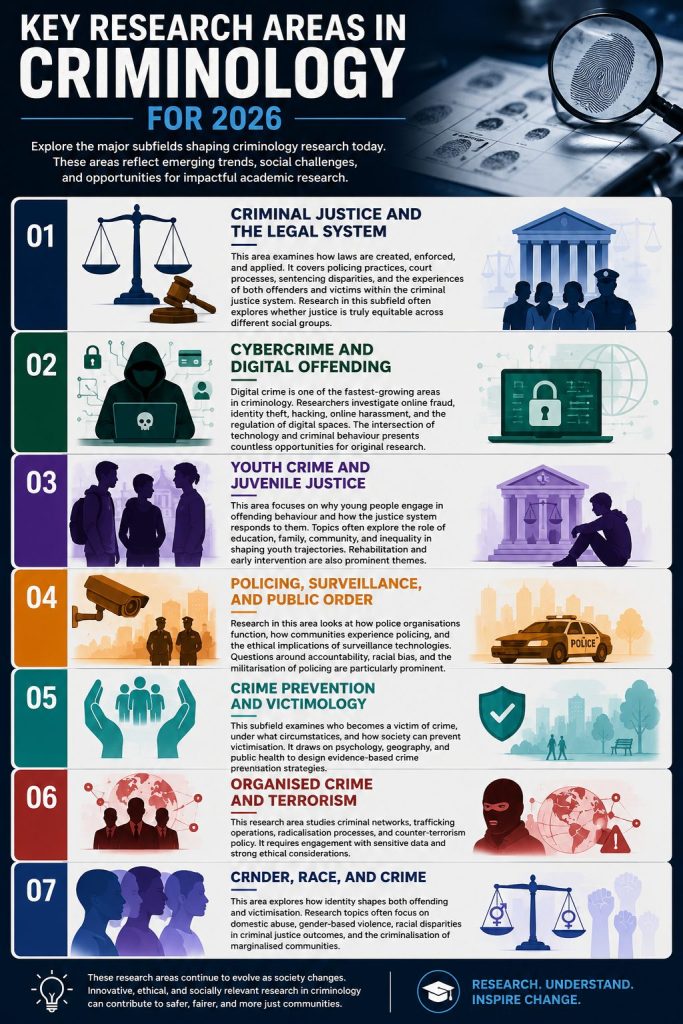
Before exploring specific criminology research topics, it helps to understand the major subfields that shape the discipline. These areas are grounded in established academic traditions and reflect the direction that contemporary research is taking.
Criminal Justice and the Legal System
This area examines how laws are created, enforced, and applied. It covers policing practices, court processes, sentencing disparities, and the experiences of both offenders and victims within the criminal justice system. Research in this subfield often explores whether justice is truly equitable across different social groups.
Cybercrime and Digital Offending
Digital crime is one of the fastest-growing areas in criminology. Researchers investigate online fraud, identity theft, hacking, online harassment, and the regulation of digital spaces. The intersection of technology and criminal behaviour presents countless opportunities for original research.
Youth Crime and Juvenile Justice
This area focuses on why young people engage in offending behaviour and how the justice system responds to them. Topics often explore the role of education, family, community, and inequality in shaping youth trajectories. Rehabilitation and early intervention are also prominent themes.
Policing, Surveillance, and Public Order
Research in this area looks at how police organisations function, how communities experience policing, and the ethical implications of surveillance technologies. Questions around accountability, racial bias, and the militarisation of policing are particularly prominent.
Crime Prevention and Victimology
This subfield examines who becomes a victim of crime, under what circumstances, and how society can prevent victimisation. It draws on psychology, geography, and public health to design evidence-based crime prevention strategies.
Organised Crime and Terrorism
This research area studies criminal networks, trafficking operations, radicalisation processes, and counter-terrorism policy. It requires engagement with sensitive data and strong ethical considerations.
Gender, Race, and Crime
This area explores how identity shapes both offending and victimisation. Research topics often focus on domestic abuse, gender-based violence, racial disparities in criminal justice outcomes, and the criminalisation of marginalised communities.
Criminology Dissertation Topics With Examples: Aims and Objectives
Understanding how a dissertation topic is structured academically is just as important as selecting the topic itself. Below are five examples of criminology dissertation topics with examples of how you might frame the research aim and objectives.
Example 1: Racial Disparities in Stop and Search Policing in England and Wales
Research Aim: To critically analyse the extent to which racial disparities exist in stop and search policing and to evaluate the effectiveness of current oversight mechanisms.
Research Objectives:
- To examine statistical data on stop and search outcomes across different ethnic groups between 2018 and 2024.
- To evaluate the role of unconscious bias training in reducing racially disproportionate policing.
- To assess community perceptions of fairness and legitimacy within heavily policed minority neighbourhoods.
Example 2: The Psychological Impact of Social Media on Adolescent Cyberbullying Behaviour
Research Aim: To investigate the psychological drivers of cyberbullying among adolescents and to assess how platform design contributes to harmful online behaviour.
Research Objectives:
- To identify the psychological characteristics most commonly associated with adolescent cyberbullying perpetration.
- To explore whether anonymity features on social media platforms increase instances of online harassment.
- To evaluate the effectiveness of school-based digital literacy programmes in reducing cyberbullying incidents.
Example 3: Recidivism Among Female Offenders Following Community-Based Rehabilitation Programmes
Research Aim: To assess the long-term effectiveness of community-based rehabilitation programmes in reducing reoffending rates among female offenders in the UK.
Research Objectives:
- To compare recidivism rates between female offenders who completed community programmes and those who served custodial sentences.
- To identify the structural barriers that prevent women from successfully completing rehabilitation programmes.
- To examine how trauma-informed care approaches affect long-term behavioural outcomes.
Example 4: Knife Crime Among Young Males in Urban Areas: Risk Factors and Prevention Strategies
Research Aim: To identify the social and environmental risk factors associated with knife crime among young urban males and to evaluate current crime prevention strategies.
Research Objectives:
- To analyse demographic and socioeconomic data linked to knife crime hotspots in selected UK cities.
- To evaluate whether youth outreach programmes have measurable impact on knife-related offending.
- To explore the role of gang affiliation and peer influence in shaping attitudes towards knife carrying.
Example 5: The Effectiveness of Restorative Justice in Schools for Reducing Exclusion Rates
Research Aim: To evaluate the impact of restorative justice practices in secondary schools on reducing exclusion and the school-to-prison pipeline.
Research Objectives:
- To compare exclusion rates before and after the implementation of restorative justice programmes in selected UK secondary schools.
- To assess teacher and student perceptions of fairness and effectiveness in restorative approaches.
- To determine whether restorative justice correlates with longer-term reductions in youth offending post-exclusion.
80 Criminology Dissertation Topics for 2026
The following criminology thesis topics are organised by subfield. Each topic is narrow in focus, academically sound, and suitable for undergraduate, master’s, or PhD research proposals. Students looking for the latest criminology research topics will find these particularly relevant.
Policing, Accountability, and Public Order
- The effectiveness of body-worn cameras in reducing police use of force in England and Wales.
- Civilian oversight boards and their impact on police accountability in urban areas.
- A critical analysis of predictive policing models and their implications for civil liberties.
- How police legitimacy affects community cooperation in crime reporting in diverse neighbourhoods.
- The impact of austerity-driven police budget cuts on public order management in the UK.
- Examining the gendered experiences of female police officers in frontline roles.
- Police responses to mental health crises: an evaluation of co-response models in London.
- The effectiveness of de-escalation training in reducing use-of-force incidents.
- Racial profiling in traffic stops: a comparative analysis across three UK constabularies.
- How counter-terrorism policing strategies affect Muslim communities in post-Brexit Britain.
Cybercrime and Digital Offending
- The role of the dark web in facilitating drug distribution networks in the UK.
- Ransomware attacks on NHS infrastructure: vulnerabilities, impacts, and legal responses.
- Online grooming tactics and the limitations of current child protection legislation.
- How cryptocurrency regulation challenges traditional money laundering prosecution.
- The criminalisation of revenge pornography in England and Wales: legislative effectiveness.
- Examining state-sponsored cyberattacks and the limits of international criminal law.
- Social engineering and phishing: why older adults remain disproportionately targeted.
- How gaming platforms are exploited for radicalisation and extremist recruitment.
- The adequacy of GDPR as a regulatory tool for addressing data theft offences.
- Online hate crime: reporting barriers faced by victims from minority ethnic communities.
Youth Crime and Juvenile Justice
- The school-to-prison pipeline: how school exclusions contribute to juvenile offending.
- The effectiveness of the Youth Offending Team model in reducing first-time entrants to the criminal justice system.
- Gang membership among care-experienced young people: pathways and protective factors.
- How early adverse childhood experiences predict delinquent behaviour in adolescence.
- Restorative approaches in youth justice: a comparative evaluation across England, Wales, and Scotland.
- The impact of community sport programmes on reducing youth offending in deprived urban areas.
- Peer mentoring as a crime prevention strategy for young people at risk of county lines involvement.
- Child criminal exploitation: why current legislation fails to adequately protect young victims.
- The effectiveness of knife crime education programmes delivered in secondary schools.
- Persistent young offenders: exploring the failure of rehabilitation within custodial settings.
Gender, Identity, and Crime
- Coercive control: understanding why victims delay reporting in intimate partner violence cases.
- The underreporting of male victims of domestic abuse and its implications for service provision.
- Femicide in England and Wales: a review of institutional failures in high-risk cases.
- How gender affects sentencing outcomes in the Crown Court: an empirical analysis.
- The experiences of transgender individuals within the prison estate in England and Wales.
- Sexual violence conviction rates: why the attrition rate remains persistently high.
- How rape myth acceptance affects jury decision-making in sexual offence trials.
- Female offending trajectories: the role of victimisation in the pathway to crime.
- Gendered experiences of human trafficking: a comparison between labour and sexual exploitation.
- The criminalisation of sex work and its impact on the safety of women involved in street-based prostitution.
Race, Ethnicity, and Criminal Justice
- Racial disparities in remand decisions: an analysis of pre-trial detention in England and Wales.
- The over-representation of Black males in stop and search statistics: causes and consequences.
- Hate crime targeting South Asian communities post-pandemic: trends and policing responses.
- The experiences of Black and minority ethnic defendants within the Crown Prosecution Service.
- Islamophobia as a driver of religiously motivated hate crime in post-Brexit Britain.
- Institutional racism in probation: how supervisory practices differ across ethnic groups.
- The impact of race on parole decision-making in the English and Welsh prison system.
- Black, Asian, and minority ethnic representation within the criminal justice workforce.
- How media framing of knife crime reinforces racial stereotypes in public perception.
- The lived experiences of racially marginalised individuals within stop and search encounters.
Organised Crime and Terrorism
- County lines drug networks: how criminal exploitation operates across rural and urban boundaries.
- The effectiveness of Serious Organised Crime Group Notices (SOCGNs) in disrupting drug supply chains.
- Human trafficking for domestic servitude: detection challenges and prosecution failures.
- The financing of far-right extremist groups in the UK: funding channels and regulatory gaps.
- Online radicalisation pathways and the adequacy of the Prevent strategy.
- The role of financial intelligence in dismantling organised crime networks.
- Examining the use of unexplained wealth orders against organised crime figures in the UK.
- How proscription of terrorist organisations affects free speech and civil liberties.
- Child soldiers as victims and offenders: how international criminal law navigates responsibility.
- Environmental crime and wildlife trafficking: the case for stronger international cooperation.
Crime Prevention and Victimology
- Situational crime prevention theory applied to reducing retail theft in post-pandemic high streets.
- Crime mapping and hotspot policing: evaluating the ethical dimensions of geographic profiling.
- Vulnerability and repeat victimisation: what factors predict secondary victimisation?
- The effectiveness of multi-agency safeguarding hubs in protecting high-risk domestic abuse victims.
- Victim-blaming attitudes in sexual offence cases: implications for support service design.
- The psychological long-term impact of burglary on elderly victims in rural communities.
- Community crime prevention initiatives: evaluating Neighbourhood Watch in contemporary Britain.
- Restorative justice as a tool for victim recovery: perspectives from participants in England and Wales.
- How trauma-informed practice is changing the landscape of victim support services.
- Social media as a tool for crime prevention campaigns: effectiveness and limitations.
Prisons, Rehabilitation, and Reintegration
- The mental health crisis in English and Welsh prisons: prevalence, causes, and systemic failures.
- Overcrowding in the prison estate: how capacity pressures undermine rehabilitation outcomes.
- Through-the-gate services and the gap between release planning and lived reintegration.
- How prison education programmes affect recidivism among adult male offenders.
- The effectiveness of Thinking Skills Programmes delivered within UK custodial settings.
- Drug-free wings: evaluating their impact on substance misuse behaviour within prisons.
- Solitary confinement and its psychological effects on prisoners in segregation units.
- Peer support programmes inside prisons: reducing self-harm and suicide through community.
- The role of stable housing in preventing reoffending following release from custody.
- Licence conditions and compliance: how probation supervision affects post-release outcomes.
How to Select the Right Criminology Dissertation Topic for Your Level
Choosing a topic that matches your academic level is essential. Many students make the mistake of selecting a topic that is too broad for undergraduate research or too narrow for a PhD investigation. Here is a straightforward guide.
Undergraduate students should focus on topics that are well supported by existing literature and do not require primary research with difficult-to-access populations. Topics in policing, youth crime, and crime prevention tend to work well at this level.
Master’s students are expected to make a more original contribution. This might mean applying an existing theoretical framework to a new context, combining two underexplored research areas, or using mixed methods to generate new insight. Many of the criminal justice dissertation topics listed above are well suited for this level.
PhD researchers need to identify a genuine gap in knowledge. This requires a comprehensive review of existing criminological literature and a clear justification for why new empirical research is needed. Students pursuing this level of research may benefit from professional criminology assignment help during the proposal stage, particularly when framing their contribution to the field.
Conclusion: Approaching Your Criminology Dissertation With Confidence
Choosing a dissertation topic in criminology is one of the most important academic decisions you will make. The right topic does not just determine what you write about. It shapes how you think about crime, justice, and society throughout your academic career.
The 80 criminology dissertation topics presented in this post span the full breadth of the discipline. They are academically grounded, research-ready, and forward-looking. Whether your interest lies in policing accountability, digital crime, gender-based violence, or prison reform, there is a suitable starting point here.
The most important thing to remember is that no topic is too complex if it is approached systematically. Start with what genuinely interests you. Narrow it down using the academic literature. Frame it with a clear aim and measurable objectives. Then seek guidance from your supervisor or, where needed, from trusted academic support services.
Criminology is a discipline that has real-world consequences. The research students conduct feeds into policy debates, informs justice reform, and can ultimately change lives. Approach your dissertation with that sense of purpose, and your academic work will reflect it.
