


Managerial Economics Dissertation Topics for 2026

Questions Students Are Asking About Managerial Economics Dissertations
The following questions reflect real concerns gathered from student forums, academic discussion boards, and university Q&A platforms. If you have asked any of these yourself, this post is written for you.
- What are the best managerial economics dissertation topics I can actually research in 2026?
- How do I know if a topic is suitable for my undergraduate or master’s level?
- Which areas of managerial economics are considered relevant and current right now?
- Can you give me examples of dissertation topics with research aims and objectives?
- What makes a managerial economics topic strong enough for a university dissertation?
- Are there topics that combine managerial economics with current issues like sustainability or digital markets?
- Where can I get a list of managerial economics dissertation topics with examples?
These are exactly the kinds of questions this post will answer, clearly and in full.
Introduction: Why Your Dissertation Topic in Managerial Economics Matters
Choosing the right dissertation topic is one of the most important academic decisions a student makes. In a field like managerial economics, where business strategy meets economic theory, a well-chosen topic can open doors to real academic contribution and career relevance.
Managerial economics applies economic principles to business decision-making. It connects supply and demand, pricing strategies, cost behaviour, market structures, and risk analysis to management practice. This makes it a rich and versatile field, but also one where students can easily feel overwhelmed by how broad it is.
A good dissertation topic must be specific enough to be researchable, current enough to be relevant, and focused enough to produce a meaningful academic argument. This post gives you 80 carefully selected managerial economics research topics, structured by subfield, to help you move from confusion to clarity.
If you are searching for online dissertation help at any point in your research journey, understanding how to choose a solid topic is always the right first step.
Download Managerial Economics Dissertation Topics PDF
Many students find it useful to have a curated list they can save, annotate, and share with their supervisor. A downloadable PDF containing a personalised selection of dissertation topics, prepared by academic subject specialists, is available for students who complete a short academic preferences form. The form helps match topics to your level of study, area of interest, and university guidelines. The PDF is sent directly and is free to access.
Why Choosing the Right Managerial Economics Research Topic Matters
The topic you choose shapes everything: your research design, your data sources, your methodology, and ultimately your academic grade. In managerial economics, the wrong topic can leave you with too little existing literature, too broad a scope, or a research question that cannot be answered with available data.
Managerial economics sits at the intersection of several disciplines, including microeconomics, industrial organisation, behavioural economics, and strategic management. This is both an advantage and a challenge. The advantage is that you have many directions to explore. The challenge is that without focus, students often pick topics that are too vague or too ambitious.
The strongest managerial economics thesis topics are those that reflect a genuine gap in current knowledge. They are narrow, focused, and connected to real business or policy questions. They also align with academic methods your institution supports, whether that means quantitative modelling, qualitative case studies, or mixed methods.
Choosing a relevant topic also signals to your examiner that you understand the discipline and follow current academic debates. This matters particularly in 2026, when issues like digital market regulation, algorithmic pricing, and sustainable business models are reshaping what managerial economics covers.
Key Research Areas in Managerial Economics for 2026
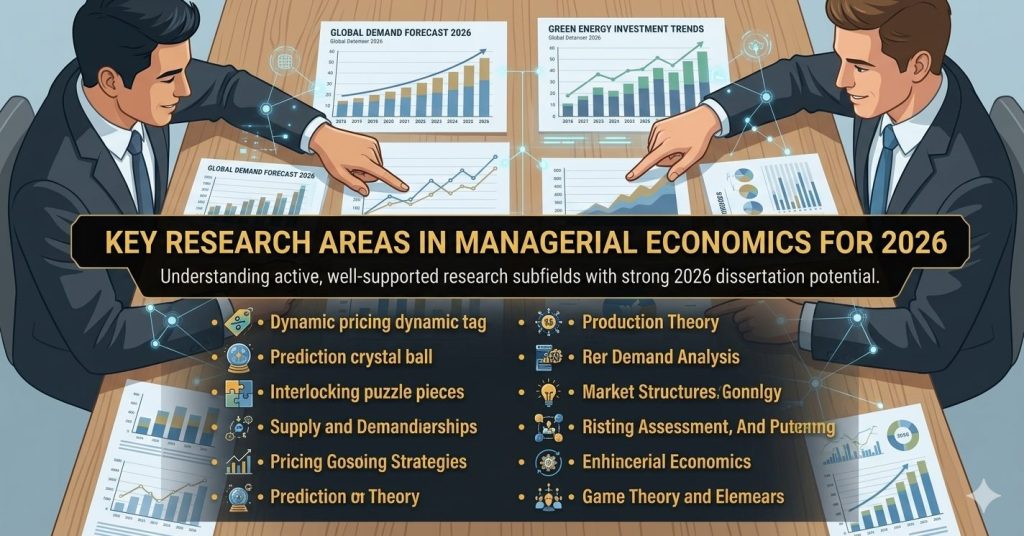
Before jumping into specific topics, it helps to understand which research areas are currently active and well-supported by academic literature. The following subfields are well established within managerial economics and offer strong dissertation potential:
- Pricing and market strategy – covering price discrimination, dynamic pricing, and competitive pricing behaviour
- Demand analysis and forecasting – examining consumer behaviour, elasticity, and predictive modelling
- Game theory and strategic interaction – applied to oligopoly markets, contract design, and business negotiations
- Cost and production analysis – including economies of scale, efficiency measurement, and supply chain economics
- Market structures and competition – exploring monopoly power, market entry, and antitrust economics
- Behavioural economics in management – studying bounded rationality, nudges, and cognitive bias in business decisions
- Environmental and sustainability economics – looking at carbon pricing, green investment, and ESG frameworks
- Digital markets and platform economics – covering data-driven pricing, network effects, and tech market power
- Public policy and regulation – examining regulatory frameworks, market failure, and government intervention
- International trade and multinational firm behaviour – analysing trade costs, foreign direct investment, and global supply chains
Each of these areas has substantial academic literature and real-world relevance for 2026-level research.
Five Managerial Economics Dissertation Topics with Research Aims and Objectives
H2 Section
The following examples show how a strong dissertation topic is structured. Each includes a clear aim and focused objectives to help you understand what a well-scoped proposal looks like.
Example 1: Algorithmic Pricing in E-Commerce Markets
Research Aim: To examine how algorithmic pricing strategies affect consumer welfare and competitive market behaviour in UK e-commerce.
Objectives:
- To analyse the pricing mechanisms used by major UK online retailers
- To assess the impact of dynamic pricing on consumer purchasing decisions
- To evaluate whether current regulatory frameworks adequately address algorithmic pricing risks
Example 2: Game Theory Applications in Oligopolistic Industries
Research Aim: To apply game theory models to understand strategic decision-making in the UK telecommunications sector.
Objectives:
- To review Nash equilibrium and Bertrand competition models in telecoms markets
- To assess how firms set prices and output levels under strategic interdependence
- To determine whether cooperative behaviour or competitive rivalry dominates current market outcomes
Example 3: ESG Investment and Firm Profitability
Research Aim: To investigate the relationship between ESG (environmental, social, and governance) commitments and financial performance in FTSE 350 firms.
Objectives:
- To measure ESG scores and their correlation with firm-level profitability indicators
- To identify which ESG dimensions most strongly predict financial returns
- To assess whether ESG investment represents a genuine managerial strategy or reputational signalling
Example 4: Market Power and Digital Platform Regulation
Research Aim: To evaluate the effectiveness of competition policy in controlling market power held by large digital platforms in the European Union.
Objectives:
- To document instances of anticompetitive behaviour among major digital platforms
- To compare the EU Digital Markets Act framework with traditional antitrust tools
- To identify gaps in regulatory approaches that fail to address platform-specific market failures
Example 5: Behavioural Biases in Managerial Decision Making
Research Aim: To assess the extent to which cognitive biases affect capital investment decisions among senior managers in UK manufacturing firms.
Objectives:
- To identify the most common cognitive biases reported in managerial decision-making literature
- To collect survey evidence on self-reported bias awareness among managers
- To evaluate whether formal decision-support tools reduce the influence of bias in capital allocation
80 Managerial Economics Dissertation Topics for 2026
H2 Section
The following topics are organised by subfield and are suitable for undergraduate, master’s, and PhD-level research. They are numbered in fixed ranges to make navigation easy.
Pricing Strategies and Market Behaviour
- How dynamic pricing in UK airline markets affects consumer surplus and firm revenue
- The role of price discrimination in streaming service subscription markets
- Price signalling and competitive responses in the UK supermarket industry
- Third-degree price discrimination and its welfare implications in pharmaceutical markets
- Algorithmic collusion and its detection challenges in digital retail environments
- Penetration pricing strategies and long-run profitability in emerging fintech firms
- Peak-load pricing models in UK energy markets and their impact on demand patterns
- Bundle pricing strategies and consumer willingness to pay in software markets
- Transfer pricing practices and profit shifting in multinational corporations
- The economics of freemium pricing models in mobile application markets
Demand Analysis and Consumer Behaviour
- Price elasticity of demand for electric vehicles in the UK and its policy implications
- Demand forecasting accuracy using machine learning versus traditional econometric methods
- Consumer response to calorie labelling policies in UK fast food chains
- Cross-price elasticity and substitution effects in plant-based versus conventional food markets
- The effect of reference pricing on pharmaceutical demand in NHS procurement
- Demand analysis for renewable energy adoption among small and medium enterprises
- How loyalty programmes distort demand behaviour in UK retail banking
- Income elasticity of demand for private healthcare services post-pandemic
- Advertising elasticity and its diminishing returns in digital marketing campaigns
- Consumer demand for sustainable fashion: a behavioural demand analysis
Game Theory and Strategic Interaction
- A game theory analysis of Brexit trade negotiations between the UK and the EU
- Strategic entry deterrence in the UK broadband provider market
- Nash equilibrium applications in competitive bidding for government contracts
- Repeated game models and cooperation in OPEC output decisions
- The prisoner’s dilemma framework applied to corporate carbon emission pledges
- Bertrand competition and price wars in the UK low-cost airline sector
- Auction theory and spectrum allocation in UK 5G licence bidding
- Strategic complementarity in platform ecosystems: Apple versus Google
- Game theory applications in wage bargaining between trade unions and employers
- Stackelberg leadership models and first-mover advantage in pharmaceutical R&D
Cost, Production, and Efficiency Analysis
- Economies of scale in NHS hospital trusts and their effect on service quality
- Total factor productivity measurement in UK manufacturing post-Brexit
- Cost efficiency analysis in UK higher education institutions using data envelopment analysis
- The impact of automation on marginal cost structures in logistics firms
- Short-run versus long-run cost behaviour in small and medium enterprises during economic downturns
- Supply chain disruption costs and firm-level resilience strategies post-COVID-19
- Economies of scope in diversified financial services firms in the UK
- Learning curve effects and cost reduction in the electric vehicle battery manufacturing sector
- Production function estimation for UK agricultural firms under climate variability
- The cost of managerial inefficiency: evidence from UK retail banking
Market Structures and Competition Policy
- Market concentration in UK grocery retail and its implications for consumer welfare
- The effectiveness of the Competition and Markets Authority in digital market regulation
- Natural monopoly characteristics of broadband infrastructure and the case for public ownership
- Barriers to entry in the UK private dental care market and their welfare implications
- Monopolistic competition and product differentiation in the UK craft beer industry
- Market power measurement in data-driven industries: methodological challenges
- The impact of mergers and acquisitions on market competition in UK financial services
- Contestable market theory and airline route competition in regional UK airports
- Oligopoly and price leadership in UK petrol retail markets
- Assessing market failure in UK social housing and the role of public intervention
Behavioural Economics and Managerial Decision Making
- Overconfidence bias and its effect on CEO investment decisions in FTSE 100 firms
- Nudge theory applications in employee pension enrolment in UK workplaces
- Loss aversion and risk-taking behaviour in venture capital funding decisions
- The sunk cost fallacy and project continuation decisions in UK construction firms
- Status quo bias and resistance to digital transformation in traditional banking
- Bounded rationality and satisficing behaviour in procurement decision-making
- Present bias and under-investment in employee training by UK SMEs
- Anchoring effects and salary negotiation outcomes in graduate recruitment
- Framing effects in consumer credit decisions in the UK personal lending market
- Mental accounting and household financial decision-making during the cost-of-living crisis
Environmental Economics and Sustainability
- Carbon pricing mechanisms and their effect on corporate investment decisions in UK energy firms
- The economics of net-zero commitments: real investment or strategic signalling?
- Environmental compliance costs and their impact on SME competitiveness in the UK
- Green bond issuance and firm value: evidence from FTSE 350 companies
- The economic case for circular economy adoption in UK manufacturing
- Water pricing policy and demand management in drought-prone regions
- Cost-benefit analysis of rewilding as a climate mitigation strategy in Scotland
- ESG disclosure quality and its relationship to institutional investor behaviour
- Deforestation externalities and land-use decision-making in agribusiness supply chains
- The managerial economics of biodiversity offsetting under the UK Environment Act 2021
Digital Markets, Platform Economics, and Technology
- Network effects and market tipping in UK ride-hailing platform markets
- Data monetisation strategies and the economics of consumer privacy in digital markets
- Multi-sided platform pricing: evidence from food delivery applications in the UK
- The economics of gig work: labour supply decisions on digital labour platforms
- Artificial intelligence adoption and productivity gains in UK financial services firms
- Subscription model economics and churn rate management in streaming platforms
- Winner-takes-all dynamics in social media platform competition
- The economic regulation of app stores: market power and developer welfare
- Fintech disruption and incumbent bank response strategies: a market structure analysis
- Blockchain adoption costs and their effect on supply chain efficiency in retail logistics
How to Choose the Right Topic from This List
With 80 options in front of you, narrowing down your choice can still feel difficult. Here are some straightforward questions to guide your decision.
Ask yourself:
- Does this topic connect to a real academic debate you find genuinely interesting?
- Is there enough published literature to support a literature review?
- Can you access the data or case studies needed to answer the research question?
- Is the scope manageable within your word count and timeline?
- Does the topic match your level: undergraduate, MSc, or PhD?
For undergraduate students, topics in the 11–20 and 31–40 ranges often work well because they draw on accessible data and established methods. MSc managerial economics dissertation topics benefit from greater theoretical depth, so ranges like 21–30 (game theory) and 51–60 (behavioural economics) are particularly suitable. PhD-level researchers should look for topics where there is a clear gap in the literature, particularly in digital markets, platform regulation, and ESG economics.
If you need further support with shortlisting, narrowing, or refining your topic, economics dissertation writing service options are available through reputable academic support providers who work within university ethical guidelines.
Conclusion
Selecting a dissertation topic in managerial economics is not just a procedural step. It is an intellectual commitment that shapes your entire research journey. The topics listed in this post cover the breadth of the field while remaining specific, current, and academically grounded.
The most important thing to remember is that a good topic serves your research, not the other way around. It should interest you enough to sustain your attention for months, be narrow enough to answer properly, and be relevant enough to contribute to academic knowledge in 2026 and beyond.
Whether you are exploring pricing strategies, applying demand analysis, or investigating the economics of digital platforms, managerial economics offers rich and rewarding research territory. Approach your dissertation with intellectual curiosity, a clear methodology, and a commitment to honest academic inquiry.
The 80 topics in this post are a starting point, not a final answer. Use them to spark ideas, refine your interests, and begin productive conversations with your supervisor. The right topic for you is the one that genuinely connects your academic knowledge to a question worth answering.
