


Business Economics Dissertation Topics for 2026

Questions Students Are Asking Right Now
The questions below have been gathered from student forums, academic discussion boards, and postgraduate support communities. They reflect the real concerns that students face when trying to choose a dissertation topic in business economics.
- What are the best business economics dissertation topics for 2026?
- How do I choose a dissertation topic that is both original and academically credible?
- What business economics research topics are suitable for undergraduate students?
- Which masters business economics dissertation topics are trending right now?
- How do I align my topic with current issues like inflation, digital markets, or global trade shifts?
- Can I get business economics dissertation topics with examples to understand the structure better?
- What are the latest business economics research topics 2026 that relate to sustainability or technology?
- How narrow should my dissertation topic be at PhD level?
Choosing the right dissertation topic in business economics is one of the most important academic decisions a student will make. A well-chosen topic gives your research direction, keeps your argument focused, and demonstrates your academic maturity to your supervisors and examiners.
Business economics sits at the intersection of economic theory and real-world business practice. It covers everything from market behaviour and corporate finance to pricing strategies and supply chain dynamics. This breadth means students have a wide range of research areas to explore, but it can also make topic selection feel overwhelming.
This post is designed to help you move from uncertainty to clarity. Whether you are an undergraduate writing your first extended research project, a postgraduate developing a master’s thesis, or a doctoral researcher looking for a gap in the literature, you will find structured guidance and 80 ready-to-use topic ideas here. If you need personalised support at any stage, accessing online dissertation help from qualified academic professionals can make a significant difference to both your confidence and your final submission.
Download Business Economics Dissertation Topics PDF
For students who prefer a ready-made reference, a downloadable PDF containing a curated list of business economics dissertation topics is available. The list is compiled by academic experts who understand the expectations of UK and international universities at undergraduate, master’s, and PhD levels.
Students can access this PDF by completing a short form. The topics included are tailored to suit different academic levels and research interests, making it easier to shortlist ideas that are genuinely relevant to your programme and field of study.
Why Choosing the Right Business Economics Dissertation Topic Matters
In business economics, your dissertation topic shapes the entire research process. A topic that is too broad will leave you unable to draw clear conclusions. A topic that is too narrow may lack sufficient literature to support a rigorous argument. Getting this balance right from the start saves time, reduces stress, and produces stronger academic work.
Your topic also signals your understanding of the discipline to your supervisor. A focused, well-grounded topic shows that you understand how business economics operates as a research field. It reflects your ability to connect theoretical frameworks, such as resource allocation models or supply and demand analysis, with real-world problems that businesses and policymakers are actively dealing with.
For 2026, the academic landscape in business economics is shaped by several converging forces: post-pandemic economic restructuring, digital transformation of markets, growing interest in behavioural economics, and increasing pressure on firms to address sustainability. Students who choose topics linked to these areas are more likely to produce research that is both timely and academically significant.
Key Research Areas in Business Economics for 2026
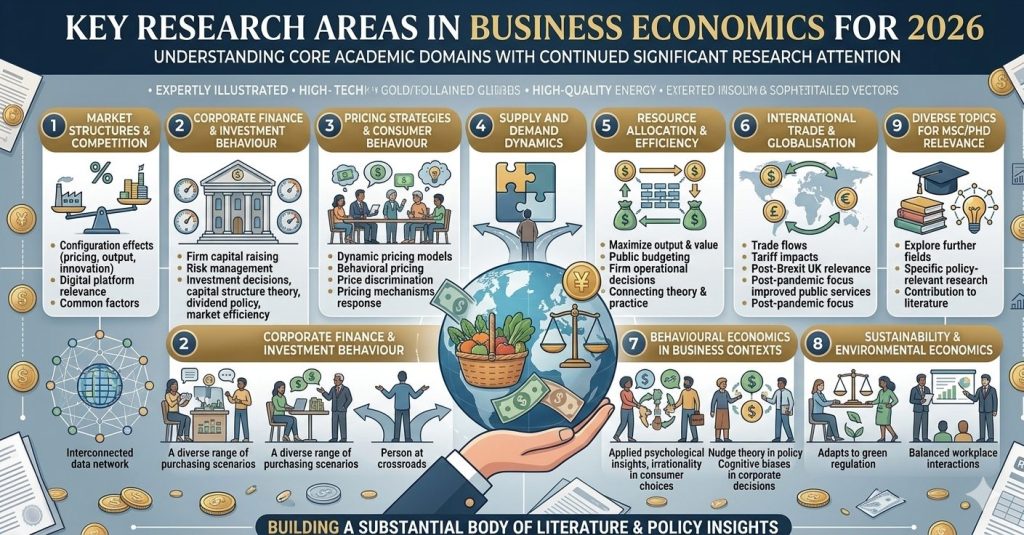
Business economics is a multi-disciplinary field that draws from microeconomics, macroeconomics, finance, management science, and behavioural theory. Below are the established academic domains within which students can develop credible dissertation topics.
Market Structures and Competition
Research in this area explores how different market configurations (monopoly, oligopoly, perfect competition) affect pricing, output, and innovation. It is particularly relevant given the growth of digital platform economies.
Corporate Finance and Investment Behaviour
This domain covers how firms raise capital, manage risk, and make investment decisions. Topics here often engage with concepts such as capital structure theory, dividend policy, and financial market efficiency.
Pricing Strategies and Consumer Behaviour
Pricing is one of the most active areas of applied business economics. Research can examine dynamic pricing models, behavioural pricing, price discrimination, and how consumers respond to different pricing mechanisms.
Supply and Demand Dynamics
This foundational area remains highly relevant when applied to contemporary markets such as housing, energy, healthcare, and digital goods. Applying traditional supply and demand frameworks to new contexts generates strong dissertations.
Resource Allocation and Efficiency
From public sector budgeting to firm-level operational decisions, resource allocation research examines how organisations use scarce inputs to maximise output and value. This area connects well with both microeconomic theory and management practice.
International Trade and Globalisation
Topics in this area explore trade flows, tariff impacts, trade agreements, and the effects of globalisation on domestic industries. These remain highly relevant in the post-Brexit UK and post-pandemic global economy.
Behavioural Economics in Business Contexts
Behavioural economics applies psychological insights to economic decision-making. Dissertation topics here might explore irrationality in consumer choices, nudge theory in policy, or cognitive biases in corporate decision-making.
Sustainability and Environmental Economics
This fast-growing area looks at how economic models account for environmental costs, how firms adapt to green regulation, and how sustainability-linked strategies affect financial performance.
Business Economics Dissertation Topics With Examples: Research Aims and Objectives
Understanding how to frame a dissertation topic academically is just as important as selecting one. The examples below show how a strong topic is structured with a clear research aim and focused objectives. These serve as models that students can adapt when developing their own business economics dissertation ideas.
Example 1: Dynamic Pricing and Consumer Trust in UK E-Commerce Markets
Research Aim
To examine how dynamic pricing strategies used by UK e-commerce platforms affect consumer trust and repeat purchase behaviour.
Research Objectives
- To identify the most commonly used dynamic pricing models among UK online retailers.
- To assess consumer awareness and perception of dynamic pricing in online shopping environments.
- To evaluate the relationship between price transparency and long-term customer loyalty.
Example 2: The Effect of Market Concentration on SME Innovation in the UK Financial Services Sector
Research Aim
To investigate how increasing market concentration in the UK financial services industry affects innovation activity among small and medium-sized enterprises.
Research Objectives
- To map the degree of market concentration in the UK retail banking and insurance sectors between 2018 and 2024.
- To examine how SME access to capital changes as market structures shift from competitive to oligopolistic.
- To analyse the relationship between reduced competitive pressure and research and development investment by smaller financial firms.
Example 3: Carbon Pricing and Corporate Investment Decisions in the UK Manufacturing Sector
Research Aim
To evaluate how carbon pricing mechanisms influence long-term capital investment decisions in UK manufacturing firms.
Research Objectives
- To review the structure and evolution of the UK Emissions Trading Scheme and its cost implications for manufacturing firms.
- To identify how different sizes of manufacturing firms adjust capital expenditure in response to carbon price signals.
- To assess whether carbon pricing creates competitive disadvantages for UK manufacturers relative to firms in non-priced international markets.
Example 4: Wage Inequality and Labour Market Outcomes in the UK Gig Economy
Research Aim
To analyse how the growth of gig economy employment has contributed to wage inequality and altered labour market outcomes for low-income workers in the United Kingdom.
Research Objectives
- To examine the proportion of UK workers engaged in gig economy platforms and the income distribution across this workforce.
- To compare wage stability, job security, and access to benefits between gig workers and traditionally employed counterparts.
- To evaluate the role of government regulation in reducing wage inequality within platform-based labour markets.
Example 5: Behavioural Biases in Capital Budgeting Decisions Among UK Mid-Sized Firms
Research Aim
To explore how cognitive biases identified in behavioural economics influence capital budgeting decisions made by financial managers in UK mid-sized enterprises.
Research Objectives
- To identify the most prevalent cognitive biases, including overconfidence and anchoring, that affect investment appraisal processes.
- To assess the extent to which these biases lead to systematic errors in discounted cash flow and net present value calculations.
- To propose decision-making frameworks that organisations can adopt to reduce the influence of behavioural biases in financial planning.
80 Business Economics Dissertation Topics for 2026
The following 80 topics are organised under key subfields in business economics. Each topic is designed to be narrow enough for a focused dissertation while remaining broad enough to support a thorough literature review. They are suitable for undergraduate, master’s, and PhD-level research, and all reflect current academic and real-world concerns entering 2026.
Pricing Strategies and Market Behaviour
1. The impact of algorithmic pricing on consumer welfare in the UK online grocery market.
2. Price discrimination strategies used by UK streaming platforms and their effect on subscription retention.
3. The effectiveness of psychological pricing tactics in UK fast fashion retail.
4. Dynamic pricing in the UK airline industry: a study of revenue optimisation versus consumer fairness.
5. How surge pricing in ride-hailing platforms affects demand elasticity in urban UK markets.
6. The relationship between product bundling strategies and profit margins in UK telecoms.
7. Penetration pricing versus skimming pricing in the UK SaaS market: a comparative analysis.
8. The role of price anchoring in consumer decision-making in UK supermarkets.
9. How price transparency regulations affect firm behaviour and consumer trust in UK financial services.
10. The economics of freemium pricing models in UK digital markets.
Market Structures and Competition Policy
11. The effect of platform monopolies on innovation incentives in the UK digital economy.
12. How market concentration in the UK grocery sector affects consumer prices and supplier bargaining power.
13. The role of the Competition and Markets Authority in regulating mergers in high-tech sectors.
14. Oligopolistic collusion risks in the UK energy market and their welfare implications.
15. Entry barriers in the UK private healthcare market and their effect on competition.
16. Market structure and pharmaceutical pricing: evidence from post-Brexit UK drug procurement.
17. The influence of network effects on market dominance in UK fintech platforms.
18. Competition dynamics in the UK broadband market following infrastructure deregulation.
19. How vertical integration strategies in UK media conglomerates affect content diversity.
20. The economics of two-sided markets: a study of UK platform businesses and their pricing implications.
Corporate Finance and Investment Decisions
21. The determinants of capital structure decisions among FTSE 250 companies between 2019 and 2024.
22. How ESG investment criteria are reshaping corporate finance decisions in UK listed firms.
23. The impact of interest rate volatility on small business borrowing behaviour in the UK.
24. Dividend policy and shareholder value: evidence from UK retail sector firms.
25. Private equity buyouts and operational efficiency: a study of UK mid-market transactions.
26. The role of venture capital in scaling UK deep-tech startups and its effect on valuation.
27. How post-pandemic cash management strategies have affected corporate liquidity in UK firms.
28. The relationship between corporate governance structures and financial risk-taking in UK banks.
29. Green bonds and corporate financing: adoption patterns and financial outcomes in the UK.
30. Share buybacks versus dividends: a study of capital return strategies in UK FTSE 100 firms.
Supply and Demand Dynamics in Contemporary Markets
31. The determinants of housing supply shortfalls in Greater London and their economic consequences.
32. How post-Brexit trade friction has altered import demand patterns in UK manufacturing.
33. Supply chain disruptions and demand forecasting accuracy in the UK automotive industry.
34. The economics of food bank demand growth in the UK: a supply and demand analysis.
35. How renewable energy expansion is reshaping electricity supply and demand in the UK grid.
36. Demand-side management policies and consumer behaviour in the UK water sector.
37. The impact of university tuition fee increases on demand for higher education in England.
38. Ticket pricing and demand elasticity in UK Premier League football: a revenue management study.
39. Labour supply responses to minimum wage increases among part-time workers in the UK.
40. How remote working trends have shifted demand for commercial and residential property in UK cities.
Resource Allocation and Organisational Efficiency
41. NHS resource allocation models and their efficiency outcomes: a health economics perspective.
42. How UK local councils allocate budgets under fiscal austerity and its effect on service delivery.
43. Resource misallocation and productivity gaps in UK small and medium-sized enterprises.
44. The economics of talent allocation in UK professional services firms.
45. How algorithmic decision-making is changing resource allocation in UK retail supply chains.
46. Land use allocation and economic efficiency in UK agricultural policy post-Brexit.
47. Capital allocation efficiency in UK pension funds: an analysis of investment decision frameworks.
48. The role of public procurement policy in directing resources towards innovation in the UK.
49. Inefficiencies in regional transport infrastructure investment and their economic impact on Northern England.
50. How universities allocate research funding and its effect on commercialisation outcomes in the UK.
International Trade and Global Business Economics
51. The economic consequences of UK-EU trade barriers on the British food and drink export industry.
52. How preferential trade agreements post-Brexit are reshaping UK export competitiveness.
53. The effect of US tariff policies under the current administration on UK manufacturing exporters.
54. Trade diversion and trade creation effects of UK bilateral trade deals with the Asia-Pacific region.
55. Currency volatility and its impact on UK export pricing strategies between 2022 and 2025.
56. The economics of nearshoring: how UK firms are relocating supply chains closer to home.
57. Foreign direct investment patterns in the UK post-Brexit: sectoral analysis and economic outcomes.
58. How global commodity price shocks transmit into UK producer prices and inflation.
59. The role of trade credit in supporting UK SME export activity in emerging markets.
60. Digital trade and its growing contribution to UK services export revenues.
Behavioural Economics in Business and Policy
61. The effectiveness of default enrolment nudges on pension savings rates among UK employees.
62. How loss aversion affects consumer response to price increases in UK subscription services.
63. Behavioural drivers of impulse purchasing in UK online retail environments.
64. The influence of social proof on investment decisions among retail investors in the UK.
65. How anchoring effects shape salary negotiation outcomes in UK corporate recruitment.
66. The role of present bias in UK consumer debt accumulation and its policy implications.
67. Nudge theory and its application to reducing energy consumption among UK households.
68. Behavioural economics explanations for underinsurance among UK self-employed workers.
69. How framing effects in financial product marketing influence consumer choices in the UK.
70. The economics of procrastination: decision-making delays in UK small business tax compliance.
Sustainability, Environmental Economics and Green Business
71. The economic viability of net-zero commitments for UK listed companies in the 2026 policy environment.
72. How carbon border adjustment mechanisms affect the competitive position of UK exporters.
73. The business economics of circular economy adoption in the UK plastics manufacturing sector.
74. Green washing and its economic consequences: a study of consumer trust in UK sustainability claims.
75. The return on investment of energy efficiency upgrades in UK commercial real estate.
76. How environmental regulation affects profitability among UK chemical manufacturing firms.
77. The economics of biodiversity offsetting in UK infrastructure development planning.
78. Renewable energy subsidies and their effect on UK electricity market competition.
79. How sustainability reporting requirements affect capital costs for UK firms in the FTSE 350.
80. The economic impact of the UK’s Extended Producer Responsibility scheme on the packaging industry.
How to Choose the Right Business Economics Dissertation Topic
Selecting a topic is not simply about picking a subject that sounds interesting. A strong dissertation topic in business economics must meet several academic criteria before you commit to it. Working through these criteria before you finalise your choice will save considerable time during the research and writing phases.
Match Your Topic to Your Academic Level
Undergraduate dissertations in business economics generally require a clear theoretical framework applied to a specific industry or case. Business economics dissertation topics for undergraduate students should be narrow, well-defined, and supported by accessible secondary data. Master’s level research is expected to go further, demonstrating critical engagement with existing literature and an ability to apply advanced economic models. PhD research must contribute new knowledge, identify a genuine gap in the literature, and sustain a rigorous methodology across a significantly larger body of work.
Check for Available Data and Literature
Before finalising any topic, check that sufficient published research and accessible data exist. In business economics, many topics can be examined using publicly available datasets from the ONS, World Bank, IMF, Companies House, or sectoral regulatory bodies. If your topic relies on primary data collection through surveys or interviews, ensure this is feasible within your timeframe and ethics approval process.
Align Your Topic With Contemporary Issues
The most compelling business economics research topics for 2026 are those that engage with real, ongoing economic debates. Topics connected to inflation management, digital market regulation, climate economics, and labour market transformation are all areas where academic research has direct policy and business relevance. Aligning your topic with these areas increases its contribution and makes it easier to justify your research rationale.
Tips for Writing a Strong Business Economics Research Proposal
Once you have selected a topic, the next step is turning it into a research proposal that your supervisor will approve. The following tips apply whether you are writing a proposal for an undergraduate dissertation, a master’s thesis, or a doctoral research plan.
- State your research problem clearly in the opening paragraph. Avoid vague or overly broad problem statements.
- Justify the relevance of your topic using evidence from the current literature. Explain what is missing in existing research and why your study addresses that gap.
- Define your methodology early. Whether you are conducting econometric analysis, case study research, systematic literature reviews, or mixed-methods analysis, your supervisor needs to see that your approach is appropriate for the research question.
- Set realistic and measurable research objectives. Each objective should represent a step in answering your central research question.
- Demonstrate familiarity with the key theoretical frameworks in your chosen area, whether that involves market structure models, agency theory, behavioural economic theories, or environmental valuation methods.
- Consider the limitations of your study from the outset. Acknowledging constraints around data availability, sample size, or methodological scope strengthens rather than weakens your proposal.
Students who find the proposal stage particularly challenging often benefit from economics dissertation writing service support, where an experienced academic can review your draft proposal and provide structured feedback before you submit to your supervisor.
Final Thoughts on Choosing Business Economics Dissertation Topics for 2026
Selecting the right dissertation topic is a meaningful academic act. It defines the scope of your contribution to knowledge, reflects your grasp of the discipline, and sets the trajectory for months of focused research. In business economics, the choices available to you in 2026 are genuinely rich. The field sits at the centre of some of the most pressing debates in society: how markets should be regulated, how firms manage uncertainty, how resource allocation shapes economic outcomes, and how economic behaviour responds to incentives and constraints.
The 80 business economics thesis topics provided in this post cover a wide range of subfields, from corporate finance and pricing strategies to behavioural economics and sustainability. Each one is grounded in established academic theory and linked to real-world questions that researchers and policymakers are actively investigating.
Use the structured examples in this post to understand how aims and objectives should be written. Use the subfield overviews to locate the area that best fits your academic background and interests. And approach the selection process with the seriousness it deserves. A strong topic is the foundation of a strong dissertation.
If you are still feeling uncertain about your direction, remember that seeking support is a sign of academic maturity, not weakness. Many successful dissertations begin with a student who was unsure of where to start and found clarity through structured guidance and constructive academic dialogue.
