


Dentistry Dissertation Topics for 2026

Questions Students Are Asking About Dentistry Dissertations
The following questions have been gathered from student forums, academic discussion boards, and peer communities where dentistry students openly share their concerns about dissertation topic selection. If you have asked any of these questions yourself, you are not alone.
- What are the best dentistry dissertation topics for 2026?
- How do I choose a dental dissertation topic that is both original and achievable?
- Which oral health dissertation topics are suitable for undergraduate level?
- What are the most relevant masters dentistry dissertation topics right now?
- Are there any dentistry dissertation topics that focus on emerging technologies like AI or digital dentistry?
- How narrow should my dental research topic be for a PhD?
- Can I find dentistry dissertation topics with examples to understand the structure better?
- What areas in dentistry are currently under-researched and worth exploring?
- How do I align my dissertation topic with current NHS or global oral health priorities?
- Where can I get dentistry dissertation help if I am struggling with topic selection?
Introduction: Why Your Dissertation Topic in Dentistry Matters
Choosing the right dissertation topic is one of the most consequential decisions you will make during your academic journey. In dentistry, this decision carries even greater weight because your research must connect clinical relevance with academic rigour. The field is evolving rapidly, driven by advances in digital imaging, preventive care strategies, implantology, and public health priorities, and your topic must reflect awareness of where the discipline stands today.
A well-chosen topic demonstrates to your supervisor and your institution that you understand the field, that you can identify a genuine gap in existing research, and that you are ready to contribute meaningfully to dental science. This post brings together 80 original dentistry dissertation topics for 2026, structured by subfield, and supported by guidance on how to frame your research aim and objectives. Whether you are at undergraduate, master’s, or doctoral level, there is something here to help you move forward with confidence.
If you are finding topic selection overwhelming, you are not alone. Many students at this stage benefit from expert guidance, and professional online dissertation help can make the process significantly more manageable.
Download Dentistry Dissertation Topics PDF
For students who want a personalised and ready-to-use resource, a downloadable PDF version of curated dentistry dissertation topics is available. This PDF is compiled by academic experts who specialise in dental research and higher education, and it includes topic suggestions tailored to your study level and area of interest.
To receive the PDF, students are asked to complete a short form. Once submitted, the relevant topic list is sent directly to you based on your academic level and the subfield you are exploring. This is a free resource designed to support students in the early stages of dissertation planning.
Why Choosing the Right Dental Dissertation Topic Matters
Your dissertation topic is the foundation of your entire research project. It shapes your literature review, your methodology, your data collection strategy, and ultimately, your conclusions. In dentistry, the topic you choose signals your academic priorities to your supervisor, your institution, and the wider research community.
A topic that is too broad makes it impossible to produce focused, credible research. A topic that is too narrow may leave you with insufficient literature or data to draw meaningful conclusions. The ideal dissertation topic sits in the middle: specific enough to be original, broad enough to have a solid body of existing scholarship to engage with.
Beyond scope, your topic must align with current academic and clinical priorities. Dental research in 2026 is shaped by concerns around preventive care, digital health technologies, health inequalities, and the long-term effects of systemic diseases on oral health. Choosing a topic that speaks to these priorities gives your work immediate relevance and makes it easier to argue why your research matters.
Finally, your topic must be researchable within your timeframe and with the resources available to you. Even the most intellectually exciting research idea is only valuable if it can actually be carried out. For those who feel uncertain about this stage of the process, dental assignment help from experienced academic researchers can provide the clarity needed to move forward effectively.
Key Research Areas in Dentistry for 2026
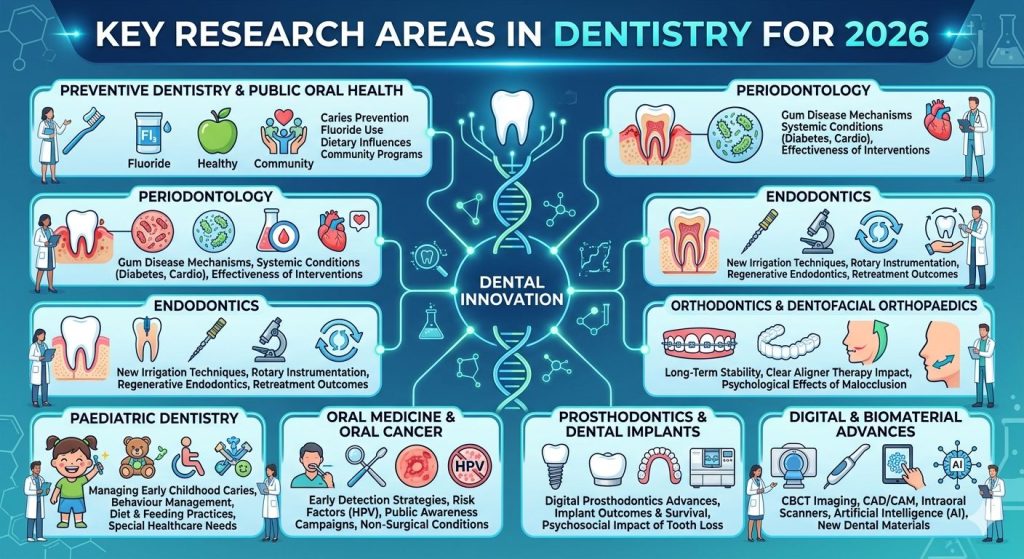
Dentistry is a broad discipline with several well-established and emerging subfields. Understanding where the major research activity is concentrated will help you identify a relevant and timely topic. Below are the primary areas where dental research is currently active and academically productive.
Preventive Dentistry and Public Oral Health
This area examines how oral diseases can be prevented at both individual and population levels. It includes research on fluoride use, dietary influences, oral hygiene practices, and community-based health promotion programmes. With rising levels of dental caries across age groups, preventive strategies remain a critical area of inquiry.
Periodontology
Periodontal disease affects a significant proportion of the global population and has well-documented associations with systemic conditions such as diabetes, cardiovascular disease, and adverse pregnancy outcomes. Research in this field addresses both the biological mechanisms of disease and the effectiveness of clinical interventions.
Endodontics
Endodontics focuses on the diagnosis, treatment, and prevention of diseases of the dental pulp and periapical tissues. Current research explores new irrigation techniques, rotary instrumentation, regenerative endodontics, and the outcomes of retreatment procedures.
Orthodontics and Dentofacial Orthopaedics
This subfield examines the correction of dental and skeletal irregularities. Current research interests include the long-term stability of orthodontic treatment, the impact of clear aligner therapy, and the psychological effects of malocclusion on young people.
Prosthodontics and Dental Implants
The replacement of missing teeth remains a central concern in modern dentistry. Research in this area covers the outcomes of dental implants in different patient populations, advances in digital prosthodontics, implant survival rates, and the psychosocial impact of tooth loss.
Oral Medicine and Oral Cancer
Oral cancer continues to carry a poor prognosis when diagnosed late. Research in this area includes early detection strategies, risk factor analysis, the role of human papillomavirus (HPV), and the effectiveness of public awareness campaigns. Oral medicine more broadly addresses the diagnosis and management of non-surgical oral conditions.
Paediatric Dentistry
Children’s oral health is a persistent public health challenge. Research areas include the management of early childhood caries, behaviour management in young patients, the effects of diet and feeding practices, and the dental outcomes of children with special healthcare needs.
Digital and Biomaterial Advances in Dentistry
The integration of digital technologies such as CBCT imaging, CAD/CAM systems, intraoral scanners, and artificial intelligence is transforming dental practice and research. Studies in this area assess the accuracy, efficiency, and patient outcomes associated with these technologies.
Dentistry Dissertation Topics with Examples: Five Structured Models
One of the most effective ways to understand how a dissertation topic should be framed is to see worked examples. Each of the following includes a topic title, a research aim, and two to three research objectives that reflect the kind of academic depth expected at university level. These are designed to help you understand how your own topic can be structured before you start writing your research proposal.
Example 1: Preventive Dentistry
Topic: The Effectiveness of School-Based Fluoride Varnish Programmes in Reducing Dental Caries Among Children Aged 5 to 11 in England
Research Aim: This study aims to evaluate the clinical effectiveness of fluoride varnish application programmes delivered in primary school settings in reducing the prevalence of dental caries in children between the ages of 5 and 11.
Research Objectives:
- To review the existing literature on school-based preventive dentistry interventions targeting dental caries in early childhood.
- To compare caries prevalence data before and after the implementation of fluoride varnish programmes in selected English primary schools.
- To assess the role of socioeconomic deprivation as a moderating factor in the effectiveness of school-based preventive dental programmes.
Example 2: Periodontology
Topic: The Association Between Periodontal Disease Severity and Glycaemic Control in Adults with Type 2 Diabetes: A Systematic Review
Research Aim: This study aims to critically examine the evidence for a bidirectional relationship between periodontal disease severity and glycaemic control in adults with a confirmed diagnosis of type 2 diabetes.
Research Objectives:
- To conduct a systematic search of peer-reviewed databases to identify studies examining the periodontal disease and diabetes relationship published between 2015 and 2025.
- To analyse the quality and consistency of evidence for glycaemic improvement following periodontal treatment.
- To identify gaps in current research and recommend directions for future clinical trials.
Example 3: Oral Cancer Awareness
Topic: Awareness of Oral Cancer Risk Factors Among Adult Tobacco Users in Urban Pakistani Communities
Research Aim: This study aims to assess the level of awareness of oral cancer risk factors, particularly tobacco and betel nut use, among adult populations in selected urban communities in Pakistan.
Research Objectives:
- To determine the current level of knowledge about oral cancer signs and risk factors among adult tobacco users through a structured survey instrument.
- To identify the primary sources from which participants receive health information about oral cancer.
- To evaluate whether demographic variables such as age, education level, and income are associated with varying levels of oral cancer awareness.
Example 4: Dental Implants
Topic: Implant Survival Rates in Patients with a History of Periodontal Disease: A Longitudinal Analysis
Research Aim: This study aims to compare the five-year survival rates of dental implants in patients with a documented history of periodontal disease against those without such a history.
Research Objectives:
- To review published clinical evidence on implant outcomes in periodontally compromised patients from 2010 to 2025.
- To identify the clinical factors most strongly associated with implant failure in this patient population.
- To produce evidence-based recommendations for pre-implant assessment and aftercare protocols in periodontally susceptible patients.
Example 5: Paediatric Dentistry
Topic: Parental Knowledge and Attitudes Towards Early Childhood Caries Prevention in Low-Income Households in the UK
Research Aim: This study aims to examine the relationship between parental knowledge about early childhood caries, household income, and the adoption of preventive oral hygiene behaviours in children under five.
Research Objectives:
- To measure parental awareness of the risk factors and preventive strategies associated with early childhood caries using a validated questionnaire.
- To explore how socioeconomic status influences parental health behaviours related to their children’s oral hygiene.
- To provide actionable recommendations for dental health educators working with low-income families.
80 Unique Dentistry Dissertation Topics for 2026
The following 80 dentistry research topics have been developed specifically for 2026-level academic research. Each topic is designed to be narrow, original, and aligned with current developments in dental science and oral health policy. They are organised under subfield headings and numbered in fixed ranges so you can navigate easily to the area most relevant to your study.
Preventive Dentistry and Public Oral Health
- The impact of sugar-sweetened beverage taxation on dental caries incidence among school-age children in England.
- Evaluating the long-term effectiveness of community water fluoridation programmes on adult oral health outcomes in the West Midlands.
- The role of dental health educators in improving oral hygiene compliance among elderly residents in care homes.
- A comparative analysis of supervised toothbrushing programmes across different local authority areas in Wales and their impact on childhood caries rates.
- Barriers to accessing NHS dental services among asylum seekers and refugees in the United Kingdom.
- The influence of maternal oral health literacy on the dental health behaviours of children under five.
- Dental caries prevention strategies in children with autism spectrum disorder: a qualitative study of parental experiences.
- The effectiveness of motivational interviewing as a behaviour change tool in preventive dental consultations.
- Ethnic disparities in oral health outcomes in England: a mixed-methods investigation into structural and cultural factors.
- Assessing the oral health impact of food insecurity among adults attending food bank services in urban areas.
Dental Caries and Restorative Dentistry
- The clinical effectiveness of silver diamine fluoride as an alternative to conventional restorative treatment for managing dental caries in primary teeth.
- Early childhood dental caries prevalence and associated risk factors among children attending nursery schools in deprived urban wards.
- Patient-reported outcomes following treatment of deep dentinal caries using selective carious tissue removal techniques.
- Comparing the longevity of composite resin versus amalgam restorations in posterior teeth: a ten-year retrospective review.
- The effectiveness of caries risk assessment tools in primary care dental practice: a systematic review.
- A clinical audit of minimally invasive dentistry adoption in NHS dental practices in Northern England.
- The relationship between frequency of sugar consumption and caries increment in adolescents aged 12 to 18.
- Dentinal hypersensitivity following restorative treatment: patient experiences and clinical management strategies.
- The impact of salivary flow rate on dental caries susceptibility in patients undergoing radiotherapy to the head and neck.
- Evaluating the accuracy of radiographic caries detection compared to clinical examination in mixed dentition patients.
Periodontology
- The efficacy of locally delivered antimicrobials as adjuncts to non-surgical periodontal treatment: a randomised controlled trial review.
- Periodontal disease and adverse pregnancy outcomes: a systematic review of evidence published between 2015 and 2025.
- Patient compliance with maintenance periodontal therapy: identifying psychological and social predictors of adherence.
- The relationship between periodontal disease and rheumatoid arthritis: exploring shared pathogenic mechanisms.
- Comparing clinical outcomes of hand versus machine-driven scaling and root planing in stage III periodontitis patients.
- Gingival recession prevalence and associated risk factors among adults aged 35 to 55 in a multi-ethnic UK cohort.
- The effectiveness of photodynamic therapy as an adjunct to periodontal debridement: a critical review of current evidence.
- Bone regenerative outcomes following guided tissue regeneration in intrabony defects: a five-year longitudinal study review.
- Periodontal status among patients with inflammatory bowel disease: a cross-sectional investigation.
- The influence of tobacco smoking on the response to non-surgical periodontal therapy in stage II periodontitis.
Endodontics
- Clinical outcomes of single-visit versus multiple-visit root canal treatment in teeth with irreversible pulpitis: a comparative study.
- The role of cone-beam computed tomography in the detection of missed canals during primary root canal treatment.
- The effectiveness of regenerative endodontic procedures in immature permanent teeth with necrotic pulps: a systematic review.
- Apical periodontitis resolution rates following non-surgical root canal retreatment: a retrospective clinical analysis.
- Evaluating the cytotoxicity and biocompatibility of contemporary root canal sealers: a laboratory-based review.
- The influence of irrigant activation techniques on the reduction of intracanal bacterial load in curved root canals.
- Patient-reported pain and anxiety following single-visit root canal treatment under local anaesthesia in a primary care setting.
- Fracture resistance of endodontically treated teeth restored with different post and core systems: a laboratory investigation review.
- Long-term prognosis of teeth with periapical lesions treated by endodontic surgery: a ten-year follow-up review.
- Accuracy of electronic apex locators in working length determination under varying moisture conditions in extracted teeth.
Orthodontics
- Long-term stability of lower incisor alignment following fixed orthodontic treatment: a ten-year retrospective study.
- Patient satisfaction and treatment outcomes with clear aligner therapy compared to traditional fixed appliances in adult patients.
- The psychological impact of malocclusion on self-esteem and social confidence in adolescents aged 13 to 17.
- Evaluating the accuracy of digital treatment planning software in predicting tooth movement outcomes with clear aligners.
- Root resorption associated with orthodontic treatment in patients with pre-existing root anomalies: a case series review.
- The influence of retention protocol design on relapse rates following comprehensive orthodontic treatment.
- A qualitative study of patient experiences and decision-making processes in adult orthodontic treatment uptake.
- Skeletal and dental effects of early functional appliance therapy for Class II malocclusion in growing patients.
- The relationship between nasal airway obstruction and malocclusion development in children: a literature review.
- Compliance levels and outcomes in patients using removable retainers following fixed orthodontic treatment: a cohort study review.
Dental Implants and Prosthodontics
- Five-year survival rates of single-tooth implants placed immediately after extraction versus delayed placement protocols.
- The psychosocial impact of tooth loss and implant rehabilitation on quality of life in edentulous older adults.
- Patient-reported outcomes of implant-retained overdentures versus conventional complete dentures in the mandible.
- Peri-implantitis prevalence and risk factors in patients with a history of treated chronic periodontitis.
- The accuracy of digital versus conventional impression techniques for implant-supported fixed prostheses.
- Short implants as an alternative to bone augmentation in the atrophic posterior maxilla: a systematic review of survival data.
- Aesthetic outcomes and patient satisfaction following ceramic versus metal-ceramic implant crowns in the anterior zone.
- The impact of osseointegration on bone density around dental implants in patients with osteoporosis: a systematic review.
- Evaluating the clinical performance of zirconia abutments in implant-supported restorations over a five-year period.
- All-on-four treatment concept for full-arch rehabilitation: a review of clinical outcomes and patient satisfaction data.
Oral Cancer and Oral Medicine
- General dental practitioners’ confidence and training needs in the early detection of oral cancer: a survey of GDPs in England.
- The association between human papillomavirus infection and oropharyngeal squamous cell carcinoma: a literature synthesis.
- Public awareness of oral cancer risk factors among adults in South Asian communities in Bradford.
- Evaluating the sensitivity and specificity of adjunctive screening tools for oral potentially malignant disorders in primary care.
- The role of diet and nutritional factors in the prevention of oral squamous cell carcinoma: a systematic review.
- Psychological impact of an oral cancer diagnosis on patients and their caregivers: a qualitative exploration.
- Diagnostic delays in oral cancer referral pathways in England: a retrospective audit of two-week wait referrals.
- Oral mucosal changes associated with long-term use of inhaled corticosteroids in asthmatic patients.
- The prevalence and clinical features of oral lichen planus in a secondary care UK dental population.
- The effectiveness of photobiomodulation therapy in managing oral mucositis in patients undergoing head and neck radiotherapy.
Paediatric Dentistry
- The effectiveness of fissure sealants in preventing pit and fissure caries in first permanent molars: a clinical review.
- Parental attitudes towards general anaesthesia for dental treatment in children with high decay levels.
- Behaviour management techniques in paediatric dental settings: a survey of paediatric dentists practising in the UK.
- The oral health impact of prolonged dummy use and night feeding on primary dentition in children aged 0 to 3.
- Dental anxiety in children aged 5 to 12 attending primary dental care: prevalence, triggers, and management approaches.
- Early dental visiting habits and their long-term impact on oral health outcomes in children across different socioeconomic groups.
- Oral health status and treatment needs among children with congenital heart disease attending a specialist paediatric dental unit.
- Paediatric dental trauma: a retrospective study of the incidence, type, and management of injuries in children attending a hospital emergency department.
- The effectiveness of xylitol-containing products in reducing cariogenic bacterial colonisation in early childhood: a systematic review.
- Improving the oral health of children in care: a review of current policy provisions and recommendations for dental service design.
Conclusion: Moving Forward with Your Dentistry Dissertation
Selecting a dissertation topic in dentistry is not simply an administrative step in your academic journey. It is an intellectual decision that will define the depth of your engagement with the field and the quality of the work you produce. The 80 latest dentistry research topics presented in this post represent a broad cross-section of the discipline, from preventive strategies and periodontal disease to oral cancer screening and digital technologies.
Regardless of which area interests you most, the key to a successful dissertation lies in choosing a topic that is narrow and focused, grounded in real clinical or academic questions, and achievable within your resources and timeframe. Use the structured examples in this post as a guide for how to frame your research aim and objectives, and do not hesitate to revisit your topic choice as your reading deepens.
Academic integrity must guide every stage of your research process. From the way you design your methodology to how you interpret and report your findings, your dissertation should reflect honest, careful, and ethically responsible scholarship. This is particularly important in a clinical field like dentistry, where research findings can have a direct impact on patient care.
You now have the tools to approach your dissertation topic selection with greater clarity and confidence. Use this post as a starting point, engage seriously with the literature in your chosen area, and take your time in refining your focus. A thoughtfully chosen dentistry dissertation topic is the first and most important step towards producing research that genuinely matters.
