


Childhood Studies Dissertation Topics for 2026

Questions Students Are Asking About Childhood Studies Dissertations
The following questions have been gathered from student forums, academic discussion boards, and higher education support communities. They reflect the real concerns and searches of students at all levels who are preparing to write their dissertations in childhood studies.
- What are the best childhood studies dissertation topics for 2026?
- How do I find an early childhood studies dissertation topic that is narrow enough to research properly?
- Are there child development dissertation topics suitable for undergraduate students?
- What childhood studies research topics are relevant to current academic debates?
- Can I find childhood education topics that align with both policy and practice?
- What are some masters childhood studies dissertation topics that will stand out?
- How do I structure a dissertation topic with a clear aim and objectives?
- Where can I find the latest childhood studies research topics that reflect current issues?
If any of these questions sound familiar, this post is written specifically for you.
Introduction: Why Your Dissertation Topic in Childhood Studies Matters
Choosing the right dissertation topic is one of the most important academic decisions you will make during your degree. In childhood studies, this choice carries even greater weight because the field sits at the intersection of education, psychology, sociology, health, and policy. A well-chosen topic does not just satisfy your university requirements. It contributes to a broader conversation about the lives and futures of children.
Many students feel overwhelmed at this stage. They either choose topics that are too broad to research meaningfully or they pick areas they find personally interesting without checking whether sufficient academic literature exists. This post is designed to help you avoid both of those mistakes.
Whether you are looking for childhood studies dissertation topics with examples or simply trying to understand which research areas are active and credible in 2026, you will find structured, reliable guidance here.
Download Childhood Studies Dissertation Topics PDF
Students who want a personalised set of dissertation topics curated by academic specialists can access a downloadable PDF version of these topics. The PDF is prepared by experienced writers familiar with undergraduate, master’s, and PhD-level expectations in childhood studies. You can receive your copy by completing a short form, after which the list is sent directly to you. This is especially useful if you need topics aligned with a specific module, institution type, or research methodology.
Why Choosing the Right Childhood Studies Dissertation Topic Matters
The right dissertation topic does more than give you something to write about. It shapes your entire research journey. In childhood studies, a well-defined topic helps you identify appropriate theoretical frameworks, locate relevant empirical data, and engage meaningfully with current policy and practice.
A topic that is too broad leads to shallow analysis. A topic that is too narrow may leave you with insufficient literature to draw on. The goal is to find the middle ground: a focused, researchable question that reflects genuine academic curiosity and addresses a real gap in knowledge.
Choosing carefully also signals academic maturity. Supervisors and examiners can immediately tell whether a student has engaged thoughtfully with the field or simply selected the first idea that came to mind. If you are considering online dissertation help, working with subject specialists can support this process significantly.
Key Research Areas in Childhood Studies for 2026
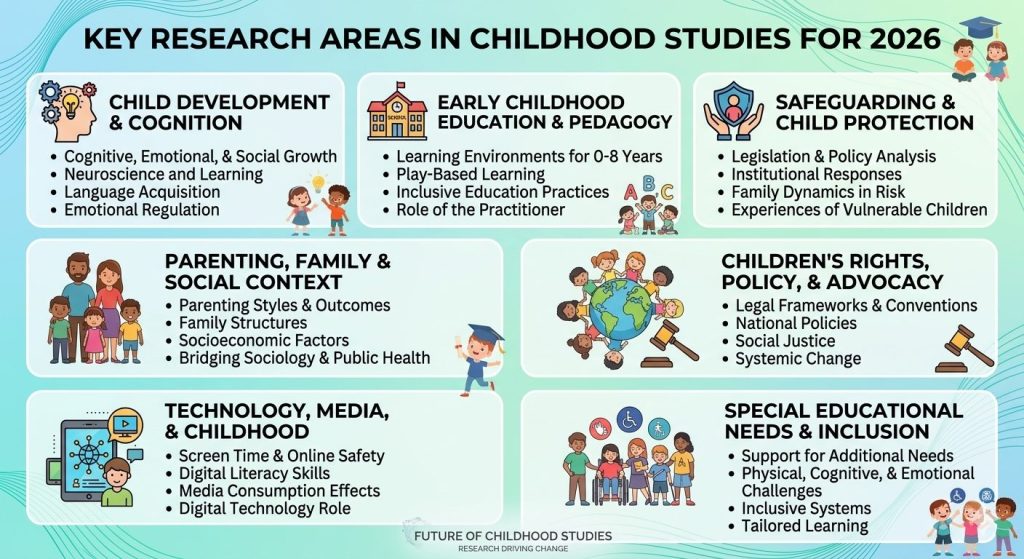
Before exploring specific topics, it helps to understand the major subfields and research directions within childhood studies. These areas reflect both established academic domains and directions that are currently active in peer-reviewed journals and policy debates.
Child Development and Cognition This area examines how children develop cognitively, emotionally, and socially from birth through adolescence. It draws on developmental psychology and neuroscience to explore learning, language acquisition, and emotional regulation.
Early Childhood Education and Pedagogy This area focuses on learning environments, teaching practices, and curriculum approaches for children from birth to eight years old. Play-based learning, inclusive education, and the role of the practitioner are central themes here.
Safeguarding and Child Protection This is one of the most practically significant areas in childhood studies. Research in this domain examines legislation, institutional responses, family dynamics, and the experiences of children in vulnerable situations.
Parenting, Family, and Social Context Parenting styles, family structures, and socioeconomic factors all shape children’s outcomes. Research in this area often bridges sociology, psychology, and public health.
Children’s Rights, Policy, and Advocacy This area focuses on how legal frameworks, national policies, and international conventions affect the lived experiences of children. It is particularly relevant for students interested in social justice and systemic change.
Technology, Media, and Childhood With the growing role of digital technology in children’s lives, this area examines screen time, online safety, digital literacy, and the relationship between media consumption and child development.
Special Educational Needs and Inclusion This subfield explores how educational systems support children with additional needs, including those with physical, cognitive, or emotional challenges.
Five Dissertation Topic Examples with Aims and Objectives
These examples are designed to show you how a well-structured dissertation topic looks at an academic level. Each includes a clear research aim and two to three focused objectives.
Example 1: Digital Technology and Cognitive Development in Early Childhood
Research Aim: To examine the relationship between daily screen time and cognitive development outcomes in children aged three to six years.
Research Objectives:
- To review existing literature on screen time guidelines and their basis in developmental science.
- To analyse how different types of digital content affect attention and language development.
- To evaluate the role of parental mediation in moderating the impact of screen exposure.
Example 2: Play-Based Learning in Reception Classes
Research Aim: To investigate how structured and unstructured play supports literacy and numeracy development in children aged four to five years in UK reception settings.
Research Objectives:
- To identify how teachers in reception classes conceptualise play-based learning within the Early Years Foundation Stage.
- To compare literacy outcomes in settings that use structured versus unstructured play approaches.
- To assess practitioner confidence in delivering play-based curricula under current policy frameworks.
Example 3: Adverse Childhood Experiences and Long-Term Educational Outcomes
Research Aim: To explore the relationship between adverse childhood experiences (ACEs) and educational disengagement in secondary school students.
Research Objectives:
- To review the academic literature on ACEs and their documented impact on school attendance and attainment.
- To examine how UK schools currently identify and support students affected by ACEs.
- To propose evidence-based recommendations for trauma-informed practice in secondary education.
Example 4: Parenting Styles and Emotional Regulation in Middle Childhood
Research Aim: To investigate the influence of authoritative, authoritarian, and permissive parenting styles on emotional self-regulation in children aged seven to ten years.
Research Objectives:
- To compare theoretical models of parenting and their predicted effects on emotional development.
- To analyse self-report and observational data on children’s emotional responses in family contexts.
- To identify which parenting characteristics most consistently support healthy emotional regulation.
Example 5: Inclusive Education for Children with Autism Spectrum Disorder
Research Aim: To evaluate the effectiveness of inclusive classroom strategies for supporting children with autism spectrum disorder (ASD) in mainstream primary schools.
Research Objectives:
- To examine current inclusion policies and their implementation in primary settings across England.
- To assess the experiences of teaching assistants in supporting children with ASD in mixed-ability classrooms.
- To identify gaps between inclusion policy intentions and classroom-level practice.
80 Childhood Studies Dissertation Topics for 2026
The following childhood studies dissertation topics are organised under thematic subheadings. All topics are original, academically focused, and suitable for undergraduate, master’s, or PhD research proposals.
Child Development and Cognitive Growth
- The effect of bilingual home environments on phonological awareness in children aged three to five years.
- How early attachment patterns influence peer relationship quality during middle childhood.
- The role of executive function in academic readiness among children entering primary school.
- Differences in spatial reasoning development between children raised in urban and rural environments.
- The impact of sleep duration on memory consolidation and learning performance in children aged six to ten.
- How pretend play contributes to theory of mind development in children aged four to seven.
- The relationship between gross motor development and self-confidence in early years settings.
- Effects of maternal stress during pregnancy on infant cognitive development outcomes.
- How musical training influences language acquisition in children aged three to eight years.
- The link between emotional intelligence and academic performance in primary school children.
Early Childhood Education and Pedagogy
- The influence of practitioner qualifications on child outcomes in private nursery settings.
- How the Reggio Emilia approach to early learning compares with the EYFS framework in practice.
- The role of outdoor education in developing problem-solving skills in children aged three to six.
- How key person relationships in nursery settings support children’s transitions into reception.
- The impact of mixed-age grouping on social development in early years classrooms.
- Practitioner perspectives on implementing child-led learning in structured early years curricula.
- The relationship between home learning environments and language development at school entry.
- How story-based pedagogy supports early literacy in children from low-income households.
- The effectiveness of forest school programmes in developing resilience in early childhood.
- Teacher confidence and competence in identifying speech, language, and communication needs in nursery settings.
Childhood Education Topics in Primary and Secondary Settings
- The impact of classroom design on concentration and learning outcomes in Key Stage 1 pupils.
- How formative assessment practices affect motivation and self-efficacy in primary school children.
- The role of school meals in supporting cognitive performance and attendance in disadvantaged areas.
- How arts integration in primary curricula affects engagement among children with learning difficulties.
- The relationship between teacher expectations and attainment gaps in primary schools in England.
- How peer mentoring programmes reduce anxiety and improve school belonging in transition from primary to secondary.
- The influence of extracurricular activities on self-esteem and academic outcomes in children aged eight to twelve.
- How character education programmes affect prosocial behaviour in primary school children.
- The impact of homework policies on family stress and child wellbeing in Key Stage 2.
- How school-based mindfulness programmes support emotional regulation in children aged nine to thirteen.
Safeguarding Children and Child Protection
- How multi-agency safeguarding hubs improve identification and referral outcomes for at-risk children.
- The experiences of children in foster care when transitioning between placements.
- How domestic abuse in the home affects children’s behaviour and academic performance.
- The effectiveness of child protection training for early years practitioners in private settings.
- How children’s voices are represented in safeguarding case reviews in England.
- The role of school pastoral systems in identifying emotional abuse in primary-age children.
- Online grooming patterns and the limitations of current digital safeguarding education in schools.
- How socioeconomic deprivation intersects with child neglect identification and reporting.
- The impact of parental substance misuse on children’s social and emotional development.
- How looked-after children experience identity and belonging in residential care settings.
Parenting Styles and Family Dynamics
- How helicopter parenting influences autonomy and decision-making in adolescents aged thirteen to sixteen.
- The relationship between single-parent household structures and educational attainment in primary school children.
- How co-parenting quality following separation affects children’s emotional adjustment.
- The influence of grandparent involvement on child wellbeing in multigenerational households.
- How parenting confidence programmes affect child behaviour outcomes in early years settings.
- The role of paternal engagement in language development during the first three years of life.
- How cultural differences in parenting styles influence school readiness in minority ethnic communities.
- The impact of parental digital literacy on children’s safe internet use at home.
- How financial stress within families affects parenting quality and children’s emotional outcomes.
- The relationship between authoritative parenting and academic self-regulation in middle childhood.
Children’s Rights, Policy, and Advocacy
- How the United Nations Convention on the Rights of the Child is embedded in primary school PSHE curricula in England.
- The gap between children’s rights policy intentions and classroom-level practice in maintained schools.
- How school councils support or undermine genuine pupil participation in decision-making.
- The impact of Universal Credit reforms on child poverty and educational access in deprived areas.
- How youth justice policies in England compare with child-focused approaches in Scandinavian countries.
- The experiences of unaccompanied asylum-seeking children within UK educational support systems.
- How children with disabilities experience rights-based advocacy in mainstream educational settings.
- The effectiveness of children’s rights education in empowering young people to report abuse.
- How pandemic-era school closures affected the realisation of children’s right to education in England.
- The role of local authorities in upholding children’s rights in home-educated populations.
Technology, Media, and Digital Childhood
- How social media use affects body image and self-esteem in girls aged ten to fourteen years.
- The relationship between gaming frequency and attention difficulties in children aged eight to twelve.
- How primary schools deliver online safety education and whether children retain key messages.
- The impact of educational apps on early mathematics learning in children aged four to seven.
- How children aged six to ten years understand and navigate privacy in digital environments.
- The role of parental controls in managing screen time and content exposure in middle childhood.
- How cyberbullying affects school attendance and mental health in children aged eleven to fourteen.
- The relationship between passive screen consumption and reduced physical activity in children under eight.
- How children in rural areas experience digital exclusion and its effect on learning outcomes.
- The influence of YouTube content consumption on brand awareness and materialism in children aged seven to ten.
Special Educational Needs, Inclusion, and Wellbeing
- How early identification of dyslexia affects reading intervention outcomes in primary school children.
- The experiences of children with ADHD navigating daily routines in mainstream primary classrooms.
- How teaching assistants perceive their role in supporting children with education, health, and care plans.
- The impact of sensory integration approaches on behaviour and learning in children with autism.
- How speech and language therapy provision in schools varies across deprivation levels in England.
- The relationship between unmet special educational needs and school exclusion in secondary settings.
- How children with visual impairments experience social inclusion in mainstream primary classrooms.
- The effectiveness of nurture groups in supporting social, emotional, and mental health needs in primary schools.
- How children with chronic health conditions experience belonging and participation in school life.
- The role of child and adolescent mental health services (CAMHS) in supporting school reintegration after long-term absence.
How to Choose the Right Topic for Your Level
Not every topic on this list will suit your academic level or research context. Here is a brief guide to help you match topics to your stage of study.
Undergraduate students should look for topics that are well-supported by existing literature and can be addressed through a focused literature review or small-scale qualitative study. Topics in the early childhood education, parenting, and child development sections are often well-suited for this level.
Master’s students are expected to demonstrate original analytical thinking. Topics that involve policy critique, comparative analysis, or conceptual development are appropriate here. Many of the rights-based, technology-focused, or safeguarding topics in this list are suitable for masters childhood studies dissertation topics.
PhD researchers need topics with a genuine theoretical or empirical gap. Topics that challenge existing models, propose new frameworks, or draw on under-researched populations are most appropriate at doctoral level.
If you are still unsure, working with an education dissertation writing service staffed by subject specialists can help you assess whether your chosen topic is realistic, researchable, and appropriately pitched for your level.
Conclusion
Selecting a dissertation topic in childhood studies is not simply a task to complete before the real work begins. It is the foundation on which everything else rests. A thoughtful, well-defined topic signals to your supervisor and examiners that you have engaged seriously with the field and that you understand what good research looks like.
This post has offered a wide range of child development dissertation topics, early childhood education ideas, and broader childhood studies research topics covering safeguarding, family dynamics, technology, rights, and inclusion. Across all 80 options, the aim has been the same: to give you a starting point that is grounded, specific, and genuinely researchable within a 2026 academic context.
As you move forward, remember that a strong topic is only the beginning. You will need to engage critically with literature, select an appropriate methodology, and frame your findings with academic rigour. Approach the whole process with honesty, intellectual curiosity, and care for the children whose lives your research ultimately concerns. That mindset is what separates a competent dissertation from an outstanding one.
