


Construction Management Dissertation Topics for 2026

The following questions reflect what students commonly ask on academic forums, Reddit threads, and university discussion boards when they feel stuck on their dissertation topic. If any of these sound familiar, you are in the right place.
- What are the best construction management dissertation topics for 2026?
- How do I choose a construction project management dissertation topic that is original and researchable?
- What construction management research topics are suitable for a master’s level dissertation?
- Are there any construction management dissertation topics with examples I can refer to?
- What are the latest construction management research topics that supervisors will find relevant?
- Can I find construction management dissertation topics for undergraduate students that are straightforward but academically credible?
- What subfields within construction management offer the most scope for original research in 2026?
Why Choosing the Right Construction Management Dissertation Topic Matters
Selecting the right dissertation topic is one of the most significant decisions you will make throughout your academic journey. In a discipline as applied and fast-evolving as construction management, a well-chosen topic does more than satisfy university requirements. It positions you as a researcher who understands the real challenges facing the built environment sector today.
Construction management sits at the crossroads of engineering, business, sustainability, and technology. With major shifts happening across the industry, from digital transformation to the push for net-zero buildings, the research opportunities in 2026 are broader and more exciting than ever before.
A focused dissertation topic helps you demonstrate original thinking, apply research methods effectively, and make a meaningful contribution to academic or professional knowledge. Students who invest time in choosing wisely tend to produce higher-quality work and experience less difficulty during the writing process. If you are feeling uncertain, accessing online dissertation help early can give you a head start.
The sections below will walk you through key research areas, sample topic structures, and a comprehensive list of 80 construction project dissertation topics ready for 2026.
Download Construction Management Dissertation Topics PDF
Many students find it helpful to have a curated list of dissertation topics available offline as they plan their research. You can receive a personalised PDF containing construction management dissertation topics selected by academic subject specialists. The list is tailored based on your level of study, research interests, and the current academic landscape.
Students receive this PDF after completing a short online form. The topics included are vetted for academic suitability and are updated to reflect current priorities in the construction and built environment sector for 2026.
Key Research Areas in Construction Management for 2026
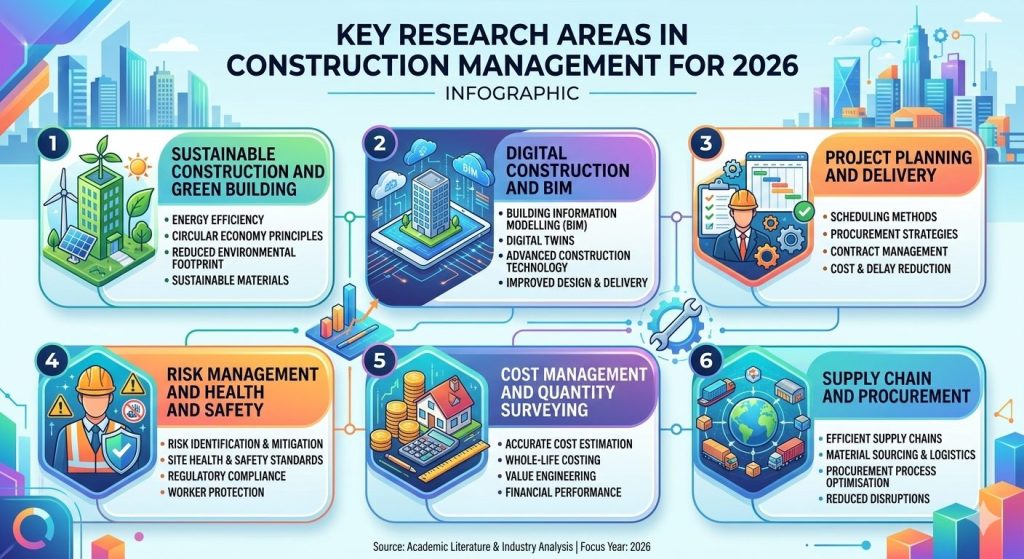
Before you settle on a specific topic, it is important to understand the broader subfields available within construction management. Each area below represents an established domain with active academic literature and genuine industry relevance.
1. Sustainable Construction and Green Building
Research in this area examines how the industry can reduce its environmental footprint. Topics often explore energy efficiency, circular economy principles, embodied carbon, and the use of sustainable materials in new developments.
2. Digital Construction and BIM
Building Information Modelling, digital twins, and construction technology are reshaping how projects are designed, managed, and delivered. This subfield is growing rapidly and offers rich opportunities for both qualitative and quantitative research.
3. Project Planning and Delivery
Research in project planning covers scheduling methods, procurement strategies, contract management, and project lifecycle analysis. These topics are perennially relevant because delays and cost overruns remain persistent industry challenges.
4. Risk Management and Health and Safety
Risk management research investigates how organisations identify, assess, and mitigate risks across construction projects. Health and safety research explores the human and regulatory dimensions of site management.
5. Cost Management and Quantity Surveying
Topics in this area focus on cost estimation, whole-life costing, value engineering, and financial performance of construction projects. They are particularly well-suited to students with a commercial or financial background.
6. Supply Chain and Procurement
Research here looks at procurement strategies, supplier relationships, offsite manufacturing, and supply chain resilience, all areas of increasing importance in a post-pandemic construction landscape.
7. Housing, Infrastructure, and Urban Development
This area connects construction management with planning, policy, and social outcomes. Topics may examine affordable housing delivery, infrastructure investment, or the management of large-scale public projects.
Construction Management Dissertation Topics with Examples
Below are five sample topics designed to help you understand how a well-structured dissertation topic is framed. Each example includes a research aim and two to three objectives.
Example 1: The Impact of BIM Adoption on Project Delivery Timelines in UK Residential Construction
Research Aim: To investigate how the adoption of Building Information Modelling (BIM) influences project delivery timelines in residential construction projects across the United Kingdom.
Research Objectives:
- To evaluate the current levels of BIM adoption among residential contractors in the UK.
- To assess the relationship between BIM usage and schedule performance outcomes.
- To identify barriers that prevent wider BIM implementation in small to medium residential projects.
Example 2: Risk Management Strategies in High-Rise Construction Projects in Emerging Economies
Research Aim: To examine the risk management frameworks applied in high-rise construction projects in rapidly urbanising regions, with a focus on Sub-Saharan Africa and South-East Asia.
Research Objectives:
- To document the most common risk categories reported in high-rise construction projects in emerging markets.
- To compare risk management practices between locally managed and internationally managed projects.
- To recommend improvements to risk frameworks based on comparative findings.
Example 3: Cost Overruns in Public Infrastructure Projects: A Case Study of UK Road Schemes
Research Aim: To identify the primary causes of cost overruns in publicly funded road infrastructure projects in the United Kingdom and assess current mitigation strategies.
Research Objectives:
- To review documented cases of cost overruns in UK National Highways projects over the past decade.
- To examine the role of procurement methods in contributing to or reducing cost escalation.
- To propose evidence-based recommendations for cost management improvement.
Example 4: The Role of Offsite Manufacturing in Addressing the UK Housing Shortage
Research Aim: To evaluate the contribution of offsite manufacturing (OSM) methods to addressing housing supply constraints in England.
Research Objectives:
- To assess the delivery speed and cost efficiency of OSM compared to traditional construction methods.
- To investigate barriers to wider OSM adoption among housing developers.
- To evaluate the policy landscape supporting or hindering OSM growth in England.
Example 5: Health and Safety Culture on Large Construction Sites: A Comparative Study
Research Aim: To compare health and safety cultures on large-scale construction sites managed under different contractual frameworks in the UK.
Research Objectives:
- To measure safety culture indicators across projects procured under traditional and design-and-build contracts.
- To identify how site management structures influence safety behaviours.
- To develop recommendations for embedding stronger safety culture across procurement types.
80 Construction Management Dissertation Topics for 2026
The topics below are organised by subfield. Each one is narrow in scope, academically viable, and suitable for undergraduate, master’s, or doctoral research. Students seeking construction dissertation writing service support will also find these useful as a starting framework for discussions with their academic advisor.
Sustainable Construction and Environmental Performance
1. Evaluating the effectiveness of BREEAM certification in reducing operational carbon in UK commercial buildings.
2. Whole-life carbon assessment methodologies for residential new builds: a comparative analysis.
3. The integration of circular economy principles into demolition waste management practices.
4. Embodied carbon reduction strategies in structural steel versus reinforced concrete frames.
5. Barriers to the adoption of green building standards among small construction firms in rural England.
6. The role of passive design in achieving net-zero energy performance in social housing.
7. Life cycle assessment of mass timber construction compared to conventional concrete structures.
8. How construction contractors report environmental performance: a content analysis of sustainability reports.
9. The impact of urban heat island effect on site planning decisions in dense city developments.
10. Sustainability ratings systems and their influence on procurement decisions in public sector construction.
Digital Construction, BIM, and Emerging Technologies
11. The influence of BIM Level 2 compliance on collaboration between design and construction teams.
12. Barriers to digital twin adoption in the UK infrastructure sector: a qualitative investigation.
13. How artificial intelligence is being applied to construction progress monitoring on live sites.
14. The use of drone technology for quantity surveying and site measurement tasks on large-scale projects.
15. Evaluating the accuracy of 4D BIM simulations in predicting programme performance on commercial projects.
16. Augmented reality applications in construction quality inspection: a feasibility study.
17. How construction SMEs perceive and respond to the digital transformation agenda in post-Brexit Britain.
18. Integration of Internet of Things (IoT) sensors in site management for real-time safety monitoring.
19. Machine learning approaches to construction cost forecasting: accuracy and practical limitations.
20. The impact of cloud-based collaboration platforms on information management in multidisciplinary project teams.
Project Planning, Scheduling, and Delivery
21. The effectiveness of Last Planner System in improving schedule reliability on complex construction projects.
22. Lean construction principles and their adoption rate among tier-one contractors in the UK.
23. Programme delay causation in hospital construction: a critical path analysis.
24. Comparing agile project management approaches with traditional scheduling in fit-out and refurbishment projects.
25. The role of early contractor involvement (ECI) in reducing programme overruns on public infrastructure schemes.
26. How design freeze milestones affect delivery performance on design-and-build contracts.
27. Productivity factors affecting labour output on UK construction sites: a quantitative study.
28. The impact of concurrent design and construction on project complexity and management demands.
29. Client-side project management capabilities and their relationship with project outcome performance.
30. Evaluating the effectiveness of programme recovery strategies following major weather-related delays.
Risk Management in Construction
31. Quantitative risk assessment methods in offshore wind farm construction: a comparative study.
32. How geotechnical risk is allocated in NEC4 contracts versus JCT contracts.
33. Political risk management strategies for UK construction companies operating in developing markets.
34. The relationship between contractor risk culture and project outcomes on design-and-build schemes.
35. Evaluating force majeure clauses in construction contracts following COVID-19 disruptions.
36. Supply chain risk and resilience strategies adopted by UK main contractors after Brexit.
37. Risk transfer mechanisms in private finance initiative (PFI) contracts: a retrospective analysis.
38. How integrated project insurance (IPI) changes risk behaviour among project teams.
39. The use of Monte Carlo simulation in construction project risk quantification: practitioner perceptions.
40. Identifying and managing reputational risk in construction firm-level decision-making.
Cost Management and Quantity Surveying
41. The accuracy of early-stage cost estimates in UK rail infrastructure projects: a historical review.
42. Value engineering outcomes on public sector building projects: case study evidence from England.
43. How inflation in construction materials has affected procurement strategies since 2022.
44. Whole-life costing frameworks in PFI hospital projects: are original projections being met?
45. The role of quantity surveyors in managing scope creep on mixed-use development projects.
46. Benchmarking cost performance metrics in UK housebuilding: a sector-wide analysis.
47. Target cost contracting and its effect on collaborative behaviour between clients and contractors.
48. The impact of fluctuation clauses on contract financial performance during high-inflation periods.
49. Artificial intelligence tools for automated bill of quantities preparation: accuracy and adoption barriers.
50. How post-occupancy evaluations inform future cost planning decisions in commercial property development.
Procurement, Supply Chain, and Offsite Construction
51. The effectiveness of two-stage tendering in reducing adversarial procurement dynamics.
52. How the UK government’s construction pipeline influences supplier capacity planning.
53. Supplier development programmes and their effect on subcontractor performance on major projects.
54. Modular construction uptake in the private rented sector: barriers and enablers.
55. Evaluating the procurement of modern methods of construction (MMC) under the NHS framework.
56. The role of framework agreements in improving social value delivery in public procurement.
57. Supply chain transparency and ethical sourcing in UK construction: a gap analysis.
58. How main contractor payment practices affect subcontractor financial stability and retention.
59. The impact of off-site manufacturing on labour requirements and skills demand in UK housebuilding.
60. Collaborative procurement models and their influence on innovation adoption among supply chain partners.
Health, Safety, and Wellbeing on Construction Sites
61. Mental health disclosure rates among construction workers and the effectiveness of current support programmes.
62. The influence of site culture on near-miss reporting behaviour among operative-level workers.
63. Comparing safety performance outcomes under principal designer versus traditional clerk of works models.
64. How COVID-19 site protocols reshaped health and safety management practices in the long term.
65. Women in construction site management: experiences of safety culture and inclusion.
66. The relationship between working hours, fatigue, and accident rates on large civil engineering sites.
67. Evaluating pre-task planning (PTP) briefings as a tool for reducing operative errors on live sites.
68. The effectiveness of mandatory mental health first aid training in reducing psychological harm in construction.
69. BIM and health and safety planning: can 4D modelling improve pre-construction hazard identification?
70. How enforcement activity by the Health and Safety Executive influences contractor safety investment decisions.
Housing, Infrastructure, and Urban Development
71. Analysing the delivery performance of affordable housing through section 106 obligations in England.
72. The impact of planning policy reform on housing delivery speed in high-demand urban areas.
73. Public transport-led development and its influence on construction activity in regional city centres.
74. How community land trusts manage the interface between development viability and affordability targets.
75. Construction management challenges specific to listed building refurbishment in conservation areas.
76. The management of utility diversions in urban infrastructure renewal: lessons from recent HS2 enabling works.
77. Flood resilience design and its integration into new residential development in high-risk zones.
78. Evaluating the construction and management of build-to-rent schemes against traditional private sale models.
79. How carbon offsetting schemes affect the planning and construction of large logistics and warehousing facilities.
80. The management of stakeholder expectations during regeneration projects in post-industrial urban areas.
Conclusion
Choosing the right construction management dissertation topic in 2026 requires more than a quick search. It demands that you understand the current landscape of the industry, align your interests with existing academic literature, and frame a research question that is specific, manageable, and meaningful.
The 80 construction management thesis topics presented in this post span a wide range of subfields, from digital construction and sustainability to procurement and site safety. Whether you are at undergraduate, master’s, or doctoral level, there is a topic here that can be shaped to suit your academic context and research experience.
Taking time at the beginning to select the right area will save you considerable difficulty later. A clear research aim and well-defined objectives, as shown in the examples above, provide the academic scaffolding that supports a coherent and well-executed dissertation.
Approach your dissertation with curiosity and rigour. Use the topics in this post as a springboard, not a final answer. Refine them, discuss them with your supervisor, and make them your own. The most successful dissertations begin with a student who is genuinely interested in finding an answer to a question that matters.
