


Marketing Management Dissertation Topics for 2026

Questions Students Are Asking About Marketing Management Dissertations
The following questions have been gathered from student forums, academic discussion platforms, and university Q&A communities. They reflect what real students search for when they are unsure how to approach their dissertation in marketing management.
- Are there any potential master thesis topics focusing on Marketing Management in the UK?
- What are the best research proposal ideas for a PhD in Marketing Management?
- Can you provide dissertation topics on Marketing Management for my MBA thesis in 2026?
- How do I choose a dissertation topic for marketing management that is both original and researchable?
- Which topic is best for marketing management at the postgraduate level right now?
- What are the current and future-focused research topics in marketing management?
- How can I make sure my dissertation topic aligns with my academic level and supervisor’s expectations?
If any of these questions sound familiar, you are in the right place. This post is designed to answer each of them clearly and thoroughly.
Why Choosing the Right Dissertation Topic in Marketing Management Matters
Marketing management sits at the intersection of business strategy, consumer psychology, digital innovation, and global commerce. It is one of the most rapidly evolving disciplines in the academic world, and your dissertation topic needs to reflect that pace.
Choosing a topic that is too broad will leave your research without direction. Choosing one that is too narrow without a clear research gap will make it difficult to find sources and build a convincing argument. The right topic is specific, academically grounded, and forward-looking enough to contribute something meaningful to the existing body of knowledge.
For students in the United Kingdom and across the world, the pressure to select a strong topic is real. Many students delay starting their dissertation simply because they cannot decide what to write about. This post removes that barrier by offering a structured, comprehensive, and up-to-date list of best marketing management dissertation topics to give you a confident starting point.
Whether you are writing an undergraduate dissertation, an MBA thesis, or a doctoral research proposal, the topic you choose will shape everything that follows. A well-chosen topic makes your methodology clearer, your literature review more focused, and your findings more valuable. This is not just an academic formality. It is the foundation of your entire research journey.
If you are currently feeling overwhelmed, you are not alone. Thousands of students seek online dissertation help every year precisely because this stage of the process is genuinely challenging. The goal here is to equip you with the knowledge to make a confident, informed decision.
Download Marketing Management Dissertation Topics PDF
Students who want a personalised and curated list of dissertation topics in marketing management can access a downloadable PDF prepared by academic experts. This resource is designed to support students at all levels, from undergraduate through to PhD, and includes topics tailored to current research trends and UK university expectations.
The PDF is made available to students after completing a short form. It offers a focused, expert-reviewed selection of the best marketing management dissertation topics to help narrow down your choices based on your academic level, area of interest, and research capacity.
Key Research Areas in Marketing Management
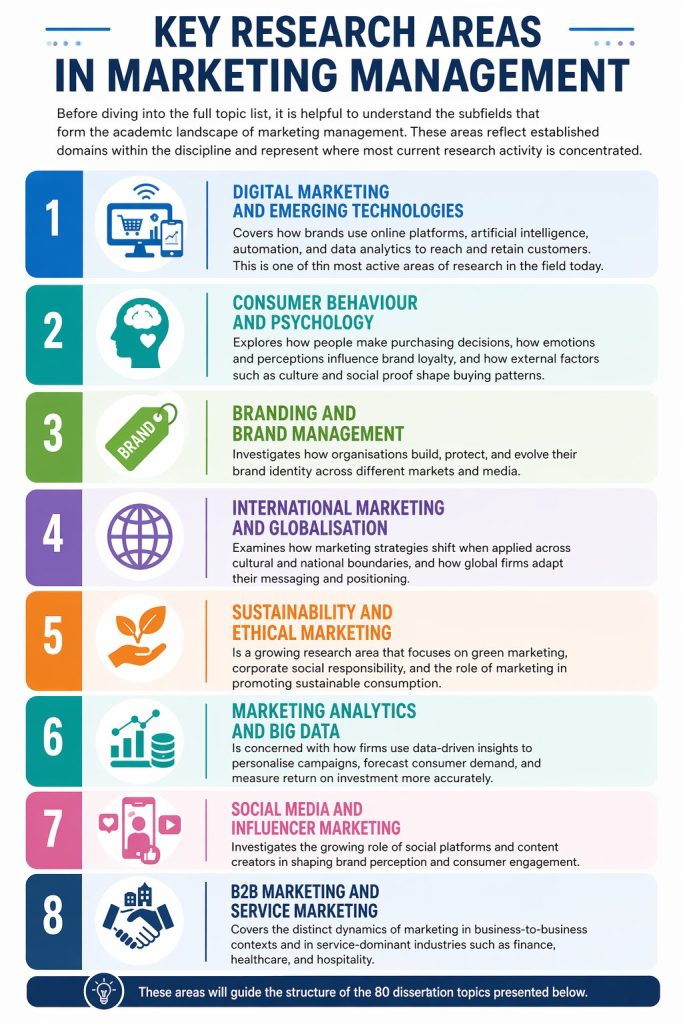
Before diving into the full topic list, it is helpful to understand the subfields that form the academic landscape of marketing management. These areas reflect established domains within the discipline and represent where most current research activity is concentrated.
Digital Marketing and Emerging Technologies covers how brands use online platforms, artificial intelligence, automation, and data analytics to reach and retain customers. This is one of the most active areas of research in the field today.
Consumer Behaviour and Psychology explores how people make purchasing decisions, how emotions and perceptions influence brand loyalty, and how external factors such as culture and social proof shape buying patterns.
Branding and Brand Management investigates how organisations build, protect, and evolve their brand identity across different markets and media.
International Marketing and Globalisation examines how marketing strategies shift when applied across cultural and national boundaries, and how global firms adapt their messaging and positioning.
Sustainability and Ethical Marketing is a growing research area that focuses on green marketing, corporate social responsibility, and the role of marketing in promoting sustainable consumption.
Marketing Analytics and Big Data is concerned with how firms use data-driven insights to personalise campaigns, forecast consumer demand, and measure return on investment more accurately.
Social Media and Influencer Marketing investigates the growing role of social platforms and content creators in shaping brand perception and consumer engagement.
B2B Marketing and Service Marketing covers the distinct dynamics of marketing in business-to-business contexts and in service-dominant industries such as finance, healthcare, and hospitality.
These areas will guide the structure of the 80 dissertation topics presented below.
Five Example Dissertation Topics With Research Aims and Objectives
These examples demonstrate how a strong marketing management dissertation topic should be structured. Each includes a clear research aim and two to three research objectives.
Example 1: The Impact of Artificial Intelligence on Personalised Marketing Campaigns in UK Retail
Research Aim: To evaluate how artificial intelligence tools are being used to personalise marketing campaigns in the UK retail sector and assess their effectiveness on consumer engagement.
Research Objectives:
- To critically review existing literature on AI-driven personalisation in retail marketing.
- To analyse the extent to which AI personalisation improves customer engagement metrics in selected UK retail brands.
- To identify the ethical considerations and data privacy challenges associated with AI personalisation in marketing.
Example 2: The Role of Green Marketing in Shaping Consumer Purchase Intentions Among UK Millennials
Research Aim: To examine whether green marketing strategies effectively influence the purchase intentions of millennial consumers in the United Kingdom.
Research Objectives:
- To explore the key drivers of environmentally conscious purchasing behaviour among UK millennials.
- To assess the effectiveness of specific green marketing messages in influencing purchase decisions.
- To identify the gap between stated environmental values and actual purchasing behaviour in this demographic.
Example 3: Social Media Influencer Marketing and Its Effect on Brand Trust in the UK Fashion Industry
Research Aim: To investigate the relationship between influencer marketing and consumer brand trust within the UK fashion sector.
Research Objectives:
- To examine how authenticity and transparency in influencer content affect consumer trust levels.
- To compare the trust outcomes of micro-influencer versus macro-influencer marketing campaigns.
- To evaluate how UK fashion brands currently measure the return on investment of influencer partnerships.
Example 4: The Effectiveness of Content Marketing Strategies in Generating B2B Lead Acquisition
Research Aim: To determine how content marketing strategies contribute to lead generation outcomes in business-to-business marketing environments.
Research Objectives:
- To review existing academic and industry literature on content marketing effectiveness in B2B contexts.
- To analyse how different content formats (video, white papers, blogs) perform across B2B buyer journey stages.
- To assess how UK-based B2B firms measure and optimise their content marketing performance.
Example 5: The Influence of Pricing Perception on Consumer Loyalty in the UK Supermarket Sector
Research Aim: To explore how consumer perceptions of pricing fairness influence brand loyalty among UK supermarket customers.
Research Objectives:
- To examine the psychological mechanisms through which price perception affects consumer loyalty.
- To compare pricing transparency strategies across major UK supermarket chains.
- To investigate how promotional pricing tactics influence long-term loyalty versus short-term sales uplift.
80 Marketing Management Dissertation Topics for 2026
The following 80 topics are organised under eight H3 subheadings, each representing a key subfield within marketing management. All topics are original, researchable, and suitable for undergraduate, master’s, or PhD-level work.
Consumer Behaviour and Decision-Making
- How subscription fatigue affects consumer retention strategies among UK streaming service brands.
- The role of cognitive biases in impulsive online purchasing decisions among UK Generation Z consumers.
- How social proof mechanisms on e-commerce platforms influence first-time purchase behaviour.
- The effect of cultural background on brand loyalty formation among ethnic minority consumers in the UK.
- How post-purchase dissonance affects repeat buying behaviour in the UK fashion e-commerce market.
- The influence of peer recommendation on consumer choice in the UK food delivery sector.
- How scarcity messaging in online retail affects consumer urgency and purchase completion rates.
- The role of emotional attachment in sustaining brand loyalty during economic downturns.
- How perceived product authenticity influences consumer willingness to pay a premium in the UK luxury market.
- The impact of digital nudging techniques on consumer behaviour in sustainable product categories.
Digital Marketing Strategies and Emerging Technologies
- The role of artificial intelligence chatbots in improving customer service outcomes for UK e-commerce brands.
- How programmatic advertising influences brand recall compared to traditional display advertising.
- The effectiveness of omnichannel marketing strategies in reducing cart abandonment rates in UK retail.
- How voice search optimisation is reshaping content strategy for UK digital marketers.
- The impact of augmented reality features on consumer engagement in mobile shopping applications.
- How predictive analytics tools support customer lifetime value management in UK subscription businesses.
- The effectiveness of automated email personalisation in improving open rates and conversion for UK SMEs.
- How blockchain technology is being used to improve transparency in digital advertising supply chains.
- The role of first-party data strategies in UK marketing following the decline of third-party cookies.
- How real-time data analytics changes campaign optimisation practices in performance marketing teams.
Social Media Marketing and Influencer Dynamics
- The relationship between influencer authenticity and consumer purchase intent in the UK beauty industry.
- How TikTok’s algorithm-driven content discovery changes brand exposure strategies for SMEs.
- The effectiveness of micro-influencer campaigns versus celebrity endorsements in the UK fitness sector.
- How user-generated content on Instagram affects brand credibility among UK Gen Z consumers.
- The role of social listening tools in shaping real-time brand response strategies on social media.
- How live commerce on social media platforms is changing consumer engagement in the UK retail market.
- The impact of brand transparency in social media communication on consumer trust recovery after a crisis.
- How algorithmic changes on Meta platforms affect organic reach for UK small business marketers.
- The effectiveness of LinkedIn as a B2B brand-building platform for UK professional services firms.
- How social media community management practices influence long-term brand advocacy.
Branding, Brand Management, and Identity
- How brand purpose communication affects consumer perception among ethically conscious UK shoppers.
- The role of employer branding in attracting talent for UK marketing-led organisations.
- How rebranding initiatives affect consumer loyalty among long-established UK financial services firms.
- The impact of brand consistency across digital and physical touchpoints on customer trust in UK retail.
- How co-branding partnerships affect brand equity for UK food and beverage companies.
- The relationship between brand personality and consumer self-concept in luxury goods purchasing.
- How cultural alignment in brand messaging affects reception among South Asian consumers in the UK.
- The role of visual identity evolution in sustaining brand relevance in fast-moving consumer goods.
- How UK heritage brands navigate the tension between tradition and modernisation in their brand strategy.
- The effectiveness of cause-related marketing campaigns in enhancing brand equity for UK charities.
International Marketing and Global Strategy
- How international marketing management dissertation topics relate to the adaptation versus standardisation debate in global brand strategy.
- The impact of post-Brexit trade regulations on international marketing strategies for UK exporters.
- How cultural intelligence shapes the effectiveness of cross-border marketing campaigns for UK brands.
- The role of localisation in digital marketing strategies for UK firms entering emerging markets.
- How geopolitical tensions influence international brand positioning strategies for multinational corporations.
- The effectiveness of global versus localised influencer marketing campaigns in ASEAN markets.
- How UK universities use international marketing strategies to attract postgraduate students from Asia.
- The impact of digital trade platforms on the international marketing capabilities of UK SMEs.
- How language localisation in social media content affects consumer engagement in non-English markets.
- The role of country-of-origin effects in shaping consumer attitudes towards UK food exports.
Sustainability, Ethics, and Green Marketing
- How greenwashing claims undermine consumer trust in sustainability-focused UK brands.
- The effectiveness of circular economy messaging in marketing campaigns for UK consumer electronics brands.
- How sustainability certifications influence purchase decisions among eco-conscious UK grocery shoppers.
- The role of corporate social responsibility reporting in shaping brand reputation in the UK financial sector.
- How UK Gen Z consumers respond to ethical marketing communications compared to older demographics.
- The impact of supply chain transparency marketing on consumer loyalty in the UK apparel sector.
- How environmental labelling on food packaging affects purchasing behaviour in UK supermarkets.
- The role of purpose-driven marketing in building community engagement for UK social enterprises.
- How carbon-neutral claims in advertising influence UK consumer attitudes towards energy brands.
- The effectiveness of ethical sourcing narratives in differentiation strategy for UK premium food brands.
Marketing Analytics, Big Data, and Personalisation
- How customer data platforms improve segmentation accuracy in UK multichannel marketing campaigns.
- The role of sentiment analysis in improving brand monitoring and reputation management for UK firms.
- How A/B testing methodologies enhance conversion optimisation in UK digital retail marketing.
- The impact of personalisation depth on customer satisfaction scores in UK e-commerce environments.
- How marketing attribution modelling affects budget allocation decisions in UK performance marketing.
- The effectiveness of AI-driven recommendation engines in increasing average order value for UK online retailers.
- How real-time personalisation in email marketing affects churn reduction for UK subscription services.
- The role of customer journey analytics in identifying high-value touchpoints for UK B2C brands.
- How data ethics frameworks influence consumer willingness to share personal data with UK marketers.
- The impact of privacy regulation compliance on personalised marketing effectiveness for UK firms.
B2B Marketing, Service Marketing, and Niche Sectors
- How thought leadership content strategies generate qualified leads for UK professional services firms.
- The role of account-based marketing in improving client retention for UK technology companies.
- How service quality perceptions affect word-of-mouth marketing in the UK private healthcare sector.
- The impact of relationship marketing on long-term contract renewal rates in UK B2B technology sales.
- How UK higher education institutions use digital marketing to differentiate themselves in a competitive global market.
- The effectiveness of experiential marketing events in building brand affinity for UK financial services brands.
- How marketing automation tools affect the sales pipeline velocity for UK SaaS companies.
- The role of community marketing in fostering brand loyalty within UK niche sports and fitness brands.
- How pricing communication strategies in service marketing influence perceived value among UK SME clients.
- The impact of integrated marketing communications on stakeholder engagement in UK public sector organisations.
Conclusion
Choosing the right dissertation topic in marketing management is one of the most important decisions you will make as a student. The topic shapes your research questions, determines your methodology, guides your literature review, and ultimately defines the academic contribution your dissertation will make.
The 80 research topics in marketing management presented in this post span the most relevant and active subfields in the discipline. Whether your interest lies in digital strategy, consumer psychology, international markets, sustainability, or data analytics, there is a research direction here that can be developed into a focused and credible dissertation.
The example topics and structured objectives included in this post are designed to show you what strong academic framing looks like. You do not need to use them verbatim. Instead, use them as a model for how to take a broad area of interest and narrow it into a specific, researchable question with clear and measurable objectives.
Students who approach this process with academic integrity, curiosity, and a willingness to engage deeply with their chosen area will produce work they can be genuinely proud of. The field of marketing management offers remarkable scope for original thinking, and your 2026 dissertation has the potential to contribute to that ongoing conversation in a meaningful way.
If you are still uncertain about which direction to take, seeking online dissertation help from experienced academic professionals can provide the guidance and reassurance you need to move forward with confidence. You are not expected to have all the answers before you begin. You are expected to ask the right questions, and this post has helped you start doing exactly that.
