


Portfolio Management Dissertation Topics for 2026

Student Perspective: Common Questions Before Choosing a Topic
These are common questions gathered from student forums and academic discussion platforms where learners openly share their confusion before starting their dissertation journey:
- How do I choose suitable portfolio management dissertation topics for my academic level?
- What are the most relevant areas in portfolio management research for 2026?
- Which topics are manageable for undergraduate vs master’s vs PhD research?
- How do I make sure my topic is both original and academically acceptable?
- What are the current trends shaping portfolio management research globally?
- How can I narrow down a broad idea into a focused research problem?
These questions reflect real uncertainty students face when beginning their research journey, especially in finance-related disciplines where topic selection directly impacts dissertation quality.
Introduction
Portfolio management dissertation topics for 2026 are becoming increasingly important as financial markets evolve rapidly due to technology, global uncertainty, and changing investor behaviour. Choosing the right topic is not just an academic requirement; it is the foundation of a successful research journey that determines clarity, depth, and final grades.
Many students struggle because they either choose overly broad ideas or topics that lack available data. A well-selected dissertation topic in portfolio management helps you connect theory with real-world financial decision-making, making your research more valuable and credible.
This guide is designed to help students at undergraduate, master’s, and PhD levels understand how to select strong, researchable, and modern topics aligned with academic expectations for 2026.
Why Choosing the Right Portfolio Management Dissertation Topic Matters
Selecting the right dissertation topic in portfolio management is critical because it directly affects your research direction, methodology, and final outcomes. A strong topic ensures you can access data, apply financial models correctly, and produce meaningful insights.
A weak topic often leads to confusion, limited resources, and incomplete analysis. On the other hand, a focused topic allows you to demonstrate analytical skills, financial understanding, and academic depth, which universities highly value.
Students who invest time in refining their topic early usually perform better in research design and data interpretation.
Download Portfolio Management Dissertation Topics PDF
Students often prefer having a structured and curated list of dissertation topics in a downloadable format for easier reference during proposal development. A professionally prepared PDF version of portfolio management topics is available, designed to help students explore refined, research-ready ideas aligned with academic standards for 2026.
This resource is typically accessed after completing a short academic request process and is tailored to different study levels, including undergraduate, master’s, and doctoral research requirements.
Key Research Areas in Portfolio Management
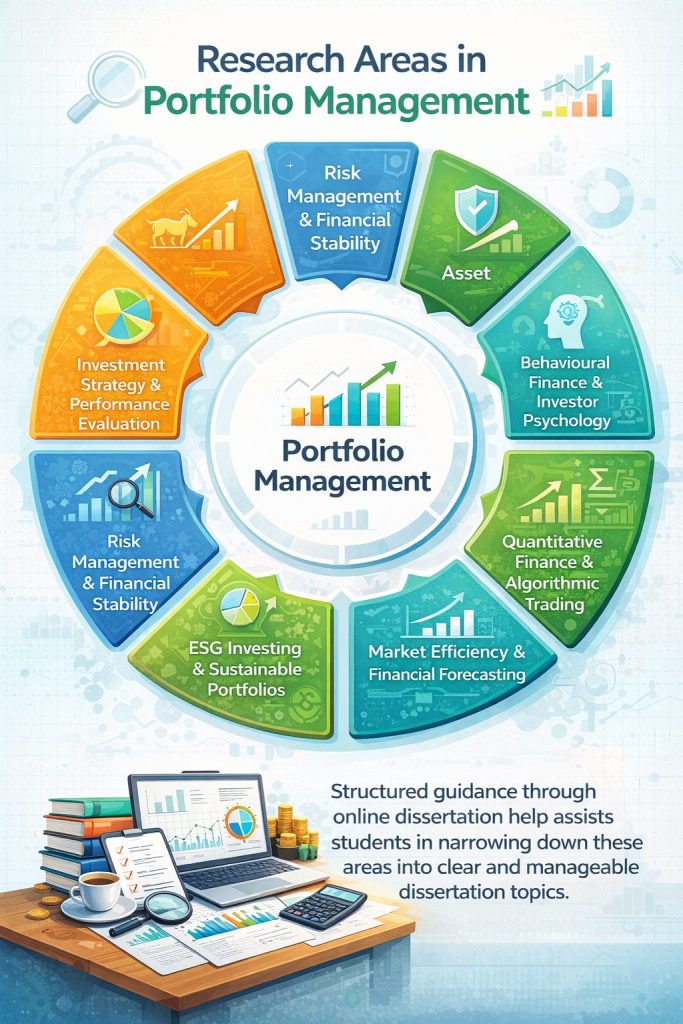
Portfolio management is a broad academic field, but most dissertation topics fall into structured research domains. Understanding these areas helps students choose more focused and realistic research questions.
Common research areas include:
- Investment strategy and performance evaluation
- Risk management and financial stability
- Asset allocation models
- Behavioural finance and investor psychology
- Quantitative finance and algorithmic trading
- Market efficiency and financial forecasting
- ESG investing and sustainable portfolios
- Fintech applications in portfolio optimisation
Many students also seek structured guidance through online dissertation help when narrowing down these research areas into a clear and manageable dissertation topic.
Structured Academic Support in Topic Selection
Many students underestimate how difficult topic refinement can be until they begin their proposal. This is where academic guidance becomes essential.
Online dissertation help is often used by students who need clarity on narrowing down research questions, selecting methodologies, and aligning their topic with academic standards. It helps bridge the gap between idea generation and academic execution.
With proper guidance, students can avoid common mistakes such as choosing outdated datasets, overly complex models, or topics with limited academic contribution.
Portfolio Management Topic Refinement Support
At advanced levels of study, students are expected to demonstrate originality and analytical depth. However, many struggle to transform general ideas into structured dissertation topics.
Online dissertation help is also used by postgraduate students who need assistance in refining research gaps, developing hypotheses, and ensuring their topic aligns with current financial market trends.
This support is particularly useful when working with quantitative models or large financial datasets.
Five Example Dissertation Topics with Aims and Objectives
1. Impact of Market Volatility on Portfolio Performance
Aim:
To analyse how market volatility affects portfolio returns in emerging economies.
Objectives:
- To examine volatility patterns in financial markets
- To evaluate portfolio risk-adjusted returns
- To suggest strategies for volatility management
2. Role of Artificial Intelligence in Portfolio Optimisation
Aim:
To explore how AI improves investment decision-making in portfolio management.
Objectives:
- To study AI-based trading models
- To assess accuracy in portfolio prediction systems
- To evaluate efficiency improvements in asset allocation
3. ESG Investing and Portfolio Performance
Aim:
To investigate the impact of ESG factors on long-term portfolio returns.
Objectives:
- To analyse ESG scoring systems
- To compare ESG vs non-ESG portfolios
- To assess investor behaviour towards sustainable investing
4. Behavioural Biases in Investment Decisions
Aim:
To study how behavioural biases affect portfolio diversification decisions.
Objectives:
- To identify common investor biases
- To analyse their impact on portfolio risk
- To propose mitigation strategies
5. Cryptocurrency Integration in Traditional Portfolios
Aim:
To evaluate the role of cryptocurrencies in modern diversified portfolios.
Objectives:
- To assess volatility of crypto assets
- To compare crypto and traditional asset performance
- To analyse diversification benefits
List of Portfolio Management Dissertation Topics (2026)
Portfolio Management Dissertation Topics in Investment Strategies
- Active vs passive investment strategies in modern portfolios
- Impact of inflation on long-term investment portfolios
- Dynamic asset allocation strategies in volatile markets
- Role of hedge funds in portfolio diversification
- Strategic vs tactical asset allocation performance comparison
- Factor-based investing in equity portfolios
- Income-focused investment strategies in retirement portfolios
- Impact of global interest rates on investment strategy
- Multi-asset portfolio strategy effectiveness
- Value investing vs growth investing performance analysis
Portfolio Management Thesis Topics on Risk Managemen
- Risk-adjusted return evaluation using Sharpe ratio
- Credit risk impact on fixed-income portfolios
- Risk mitigation strategies in emerging markets
- Portfolio stress testing under economic shocks
- Value-at-risk models in modern portfolio management
- Systemic risk and global portfolio stability
- Liquidity risk in institutional investment portfolios
- Risk diversification in multi-asset portfolios
- Financial crises impact on portfolio risk structure
- Risk management frameworks in pension funds
Emerging Trends in Portfolio Management Research
- Robo-advisors and automated portfolio management
- Machine learning applications in portfolio optimisation
- Big data analytics in investment decision-making
- Blockchain integration in portfolio tracking systems
- Digital transformation in asset management
- Fintech disruption in traditional portfolio management
- Cloud computing in financial portfolio analysis
- Real-time data usage in portfolio decisions
- Algorithmic trading impact on portfolio returns
- AI-driven investment advisory systems
Research Proposal Ideas for Portfolio Optimisation
- Modern portfolio theory limitations in volatile markets
- Mean-variance optimisation in asset allocation
- Multi-objective optimisation in investment portfolios
- Genetic algorithms in portfolio selection
- Linear programming approaches in portfolio optimisation
- Constraint-based optimisation models
- Portfolio rebalancing frequency impact analysis
- Optimisation under uncertainty models
- Sustainable portfolio optimisation techniques
- High-frequency trading optimisation strategies
Thesis Topics in Portfolio Management and Asset Allocation
- Strategic asset allocation in institutional portfolios
- Asset allocation models in pension funds
- Geographic diversification in global portfolios
- Sector-based asset allocation performance
- Tactical asset allocation in hedge funds
- Real estate inclusion in mixed portfolios
- Bond-equity allocation strategies
- Commodity integration in diversified portfolios
- Multi-currency portfolio allocation risks
- Long-term vs short-term asset allocation performance
Portfolio Management Research Questions for Graduate Students
- How do macroeconomic indicators influence portfolio returns?
- What drives investor behaviour in portfolio selection?
- How effective is diversification in reducing risk?
- What is the role of inflation in portfolio restructuring?
- How does market sentiment affect portfolio decisions?
- What determines optimal portfolio rebalancing frequency?
- How do financial crises reshape investment portfolios?
- What is the impact of exchange rates on global portfolios?
- How do ESG factors influence institutional investors?
- What role does technology play in portfolio management efficiency?
Technology Impact on Portfolio Management Topics
- Artificial intelligence in predictive portfolio analytics
- Blockchain transparency in asset management systems
- Cloud-based portfolio management platforms
- Cybersecurity risks in digital investment portfolios
- Mobile trading apps and investor behaviour
- Automation in wealth management services
- Data science applications in financial forecasting
- Digital currencies and portfolio diversification
- Fintech innovations in risk assessment
- Smart contracts in investment portfolios
Portfolio Diversification and Case Study Topics
- Diversification benefits in emerging markets
- Cross-border portfolio diversification strategies
- Sectoral diversification and performance outcomes
- Case study of mutual fund diversification strategies
- Diversification in cryptocurrency portfolios
- Impact of diversification on risk reduction
- Portfolio concentration vs diversification trade-offs
- International diversification performance analysis
- Behavioural impact on diversification decisions
- Diversification strategies in institutional portfolios
Conclusion
Selecting the right dissertation topic in portfolio management is a decisive step that shapes your entire research journey. A well-defined topic improves clarity, strengthens methodology, and increases the academic value of your work.
Students should focus on relevance, data availability, and originality while ensuring their research aligns with current financial trends. With proper planning and structured thinking, portfolio management research becomes far more manageable and impactful.
Approaching your dissertation with clarity and academic discipline will help you produce work that meets university expectations and demonstrates real analytical capability.
