


Supply Chain Management Dissertation Topics for 2026

Questions Students Are Asking About Supply Chain Management Dissertations
The questions below have been gathered from student forums, academic discussion boards, and higher education communities. They reflect the real concerns students express when they are unsure how to start their dissertation journey.
- What are the best dissertation topics for supply chain management in 2025 and 2026?
- How do I find a research title for my MBA in SCM that is original and academically strong?
- Which supply chain management topics for thesis are suitable for undergraduate level?
- Are there PhD thesis topics in supply chain management that focus on sustainability or technology?
- How do I narrow down research ideas for a Master’s in Supply Chain Management?
- Can I get a supply chain management dissertation topics PDF with curated ideas?
- Which research topics in supply chain management are most relevant to current global challenges?
If you have asked any of these questions, you are in exactly the right place. This post will answer all of them clearly and guide you through the topic selection process step by step.
Introduction: Why Your Dissertation Topic Matters More Than You Think
Choosing the right dissertation topic in supply chain management is one of the most important academic decisions you will make. Supply chain management sits at the intersection of operations, logistics, technology, sustainability, and global trade. That breadth makes it exciting, but it also makes topic selection genuinely challenging.
A poorly chosen topic leads to research that feels vague, unsupported, or disconnected from real-world relevance. A well-chosen topic, on the other hand, allows you to demonstrate critical thinking, academic rigour, and practical understanding of the field. It also positions you well for future employment or further academic research.
This post presents 80 original, carefully developed supply chain management dissertation topics suitable for undergraduate, master’s, and PhD students in 2026. Each topic is grounded in current academic discourse and reflects where the field is heading, not just where it has been.
If you are feeling overwhelmed and need personalised guidance, exploring options for online dissertation help from qualified academic professionals can make the process significantly more manageable.
Download Supply Chain Management Dissertation Topics PDF
Many students prefer to save their shortlisted topics and review them offline or share them with their supervisors. A downloadable PDF containing a personalised list of supply chain management dissertation topics, curated by academic subject specialists, is available for students who complete a short academic preferences form. The topics in the PDF are matched to your level of study and research interests, giving you a focused starting point rather than an overwhelming list.
Why Choosing the Right Supply Chain Management Dissertation Topic Matters
Supply chain management is no longer just about moving goods from one place to another. It now involves digital infrastructure, environmental responsibility, geopolitical risk, and human rights accountability. Choosing a topic that genuinely reflects these dimensions gives your dissertation the academic weight it needs to succeed.
Universities in 2026 expect dissertation topics to be both original and connected to current challenges. Generic topics that lack a specific focus, such as “improving supply chains” or “logistics and efficiency,” rarely meet postgraduate standards. A strong topic must be narrow enough to be researchable within your time and resource constraints, yet broad enough to have academic and practical significance.
Selecting a topic that genuinely interests you also matters. Students who write about subjects they find meaningful tend to produce better research. It keeps motivation high during the long writing process and results in more authentic academic engagement.
Key Research Areas in Supply Chain Management for 2026
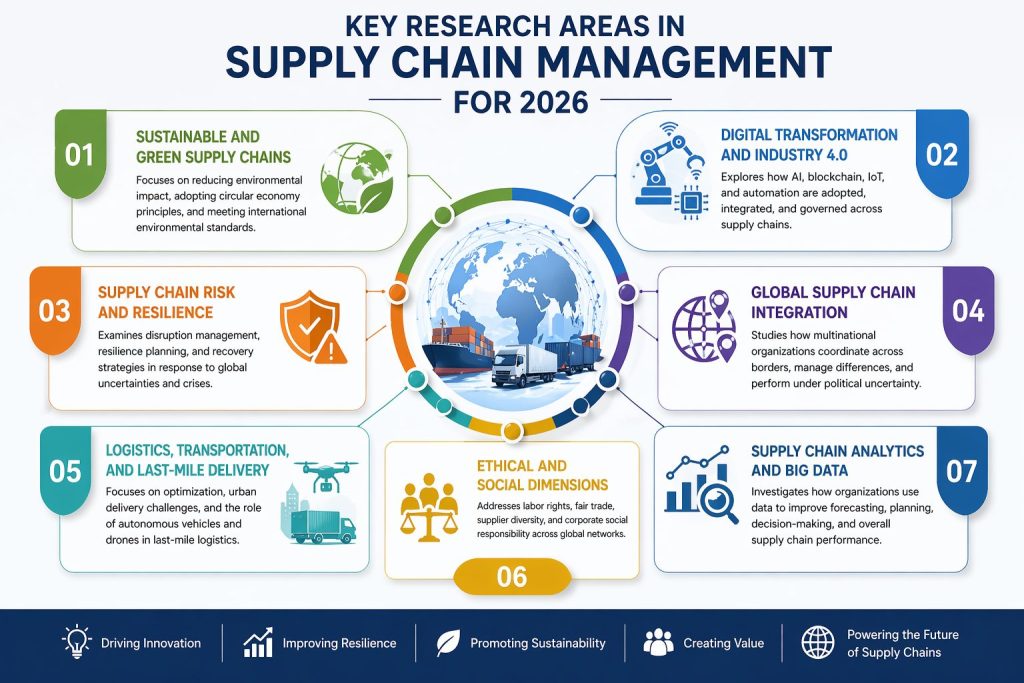
Before selecting a dissertation topic, it helps to understand the major research domains within supply chain management. These areas reflect both established academic disciplines and the directions in which the field is actively evolving.
Sustainable and Green Supply Chains Sustainability is now central to supply chain strategy. Research in this area examines how organisations reduce environmental impact, adopt circular economy principles, and meet international environmental standards.
Digital Transformation and Industry 4.0 Artificial intelligence, blockchain, the Internet of Things, and automation are reshaping supply chains at every level. Research here explores how these technologies are adopted, integrated, and governed.
Supply Chain Risk and Resilience Events such as the COVID-19 pandemic and geopolitical conflicts exposed critical vulnerabilities in global supply chains. Research in this area focuses on disruption management, resilience planning, and recovery strategies.
Global Supply Chain Integration This domain examines how multinational organisations coordinate supply chains across borders, manage cultural and regulatory differences, and maintain performance under political uncertainty.
Logistics, Transportation, and Last-Mile Delivery The rapid growth of e-commerce has placed enormous pressure on last-mile logistics. Research here looks at optimisation, urban delivery challenges, and the role of autonomous vehicles and drones.
Ethical and Social Dimensions Modern supply chain scholarship increasingly addresses labour rights, fair trade, supplier diversity, and corporate social responsibility across complex global networks.
Supply Chain Analytics and Big Data Data-driven decision making is now a competitive necessity. Research explores how organisations collect, interpret, and act on supply chain data to improve forecasting, planning, and performance.
Five Example Dissertation Topics With Research Aims and Objectives
These examples are designed to show you how a well-structured dissertation topic should look. Each includes a clear research aim and two to three specific objectives.
Example 1: The Role of Blockchain in Improving Transparency Within Food Supply Chains
Research Aim: To examine how blockchain technology improves traceability and transparency in food supply chains across the United Kingdom.
Research Objectives:
- To evaluate current traceability practices used by UK food retailers
- To assess the perceived and actual benefits of blockchain adoption in food logistics
- To identify barriers to large-scale blockchain implementation in the UK food sector
Example 2: Sustainability Reporting and Supplier Compliance in Fast Fashion Supply Chains
Research Aim: To analyse the effectiveness of sustainability reporting frameworks in driving supplier compliance within the fast fashion industry.
Research Objectives:
- To critically review existing sustainability reporting standards used in fashion supply chains
- To assess how large fashion brands communicate and enforce supplier compliance
- To explore the gap between reported sustainability goals and actual supplier behaviour
Example 3: The Impact of Artificial Intelligence on Demand Forecasting Accuracy in Retail Supply Chains
Research Aim: To investigate how AI-powered demand forecasting tools affect inventory management performance in UK retail supply chains.
Research Objectives:
- To compare AI-based forecasting accuracy against traditional statistical methods
- To evaluate the operational and financial impact of improved forecasting precision
- To identify the organisational capabilities required for successful AI adoption in retail logistics
Example 4: Reverse Logistics Strategies and Their Role in Supporting Circular Economy Goals
Research Aim: To examine how organisations design and implement reverse logistics systems to support circular economy objectives.
Research Objectives:
- To map existing reverse logistics models used by manufacturers in the electronics sector
- To assess the contribution of reverse logistics to waste reduction and resource recovery
- To identify policy and operational barriers that limit reverse logistics performance
Example 5: Supply Chain Vulnerability and Resilience During Geopolitical Disruption
Research Aim: To explore how multinational firms adapted their supply chain strategies in response to geopolitical disruptions between 2020 and 2025.
Research Objectives:
- To identify the types of geopolitical risks that most significantly affected global supply chains
- To evaluate the resilience strategies adopted by firms operating in high-risk regions
- To develop a framework for proactive supply chain risk assessment in politically unstable environments
80 Supply Chain Management Dissertation Topics for 2026
The topics below are organised into thematic subfields to help you identify which area best matches your interests and academic level. All topics are original, specific, and research-ready.
Sustainable Supply Chain Management
- The influence of carbon labelling on consumer purchasing behaviour and its implications for supply chain design
- How small and medium enterprises in the UK are integrating sustainability into supplier selection criteria
- The effectiveness of green procurement policies in reducing Scope 3 emissions across manufacturing supply chains
- Evaluating the adoption of biodegradable packaging in FMCG supply chains and its environmental outcomes
- Corporate sustainability targets and their alignment with actual supply chain environmental performance in the retail sector
- How sustainability pressures from institutional investors are reshaping procurement strategies in FTSE 100 companies
- The role of eco-design in reducing supply chain waste across the electronics industry
- Comparing sustainability performance between short local supply chains and extended global supply chains in the food sector
- The impact of environmental management systems on supplier performance assessment in automotive supply chains
- How climate-related financial disclosures are influencing supply chain decision-making in UK financial services firms
Supply Chain Risk Management and Resilience
- The effect of single-source dependency on supply chain vulnerability in pharmaceutical manufacturing
- How UK manufacturers assessed and responded to supply chain risks during the post-Brexit transition period
- Mapping supply chain disruption patterns across critical infrastructure sectors between 2020 and 2025
- The role of supply chain visibility tools in enabling faster recovery from operational disruptions
- Comparing risk mitigation strategies between agile and lean supply chain models in crisis conditions
- How natural disaster risk is incorporated into long-term supply chain network design decisions
- The relationship between supplier financial health and supply chain stability in the construction industry
- Cyber risk governance in digitally integrated supply chains: a case study of the UK logistics sector
- Evaluating the effectiveness of supply chain stress testing frameworks used by multinational manufacturers
- The role of insurance and financial hedging in supply chain risk management among global retailers
Digital Transformation in Supply Chain Management
- Assessing the readiness of UK logistics firms to adopt autonomous warehouse technologies
- How machine learning improves demand sensing accuracy in fast-moving consumer goods supply chains
- The adoption of digital twins in supply chain simulation and scenario planning
- Barriers to cloud-based supply chain platform adoption in small and medium manufacturing firms
- The impact of real-time data sharing on collaborative planning between retailers and their tier-one suppliers
- How robotic process automation is transforming procurement operations in large UK organisations
- The role of artificial intelligence in supplier risk scoring and qualification processes
- Evaluating the integration challenges of enterprise resource planning systems across multi-tier supply chains
- How predictive analytics is changing maintenance scheduling and parts procurement in aviation supply chains
- The governance of algorithmic decision-making tools in supply chain management: an ethical analysis
Blockchain in Supply Chain Management
- How blockchain technology is being used to verify ethical sourcing claims in the cocoa supply chain
- The scalability challenges of blockchain implementation in multi-party logistics networks
- Comparing permissioned and permissionless blockchain models for supply chain transparency applications
- The role of smart contracts in automating supplier payment processes and reducing transaction costs
- Blockchain adoption in pharmaceutical supply chains: regulatory compliance and traceability outcomes
- How consumer trust in product authenticity is affected by blockchain-enabled provenance systems
- The economic feasibility of blockchain integration for small suppliers in global manufacturing networks
- Evaluating interoperability challenges when multiple blockchain platforms operate within the same supply chain
- The role of decentralised autonomous organisations in reshaping supply chain governance structures
- How blockchain is being used to reduce fraud in cross-border customs and trade documentation
Supply Chain Analytics and Big Data
- How real-time supply chain dashboards influence strategic decision-making in global logistics companies
- The use of sentiment analysis in monitoring supplier reputation and early risk detection
- Evaluating the accuracy and cost-effectiveness of AI-driven inventory optimisation in e-commerce fulfilment centres
- How advanced analytics capabilities affect supply chain agility in rapidly changing consumer markets
- The role of geospatial data in optimising last-mile delivery networks in urban environments
- Predictive supplier performance modelling using historical procurement and quality data
- The impact of data governance frameworks on the reliability of supply chain analytics outcomes
- How demand forecasting accuracy improvements affect working capital efficiency in retail supply chains
- Analysing the relationship between data maturity and supply chain performance in UK manufacturing firms
- The use of natural language processing in automating procurement contract review and compliance monitoring
Green Supply Chains and Circular Economy
- How product-as-a-service business models are restructuring reverse logistics in the technology sector
- Evaluating take-back scheme effectiveness in reducing end-of-life waste in the consumer electronics industry
- The role of remanufacturing in extending product lifecycles and reducing raw material dependency
- How extended producer responsibility legislation is influencing packaging design and supply chain strategy
- The adoption of closed-loop supply chain models in the automotive aftermarket sector
- Measuring the carbon reduction potential of modal shift from road to rail in UK freight logistics
- How industrial symbiosis networks reduce resource waste and improve supply chain sustainability
- The contribution of urban consolidation centres to reducing last-mile emissions in UK city centres
- Evaluating supplier collaboration in developing shared circular economy initiatives within manufacturing clusters
- How green logistics certifications affect supplier selection and procurement decisions in the public sector
lobal Supply Chain Integration and Geopolitics
- How US-China trade tensions between 2018 and 2024 reshaped global electronics supply chain configurations
- The effect of nearshoring strategies on supply chain cost and resilience among European manufacturers
- How political risk assessment tools are being integrated into global supplier qualification frameworks
- Evaluating the impact of sanctions on supply chain network design in the energy sector
- The role of regional trade agreements in facilitating supply chain integration among developing economies
- How currency volatility affects procurement strategy and supplier contract design in multinational firms
- Managing cultural and institutional differences in cross-border supply chain partnerships in Asia-Pacific markets
- The impact of export controls on technology supply chains and the strategies firms use to manage compliance
- Evaluating supply chain decoupling strategies as a response to geopolitical fragmentation
- How multinational firms are redesigning supply networks to achieve dual-source resilience across political regions
Ethical Issues, Supplier Relationships, and Social Responsibility
- How modern slavery due diligence requirements are changing supplier audit practices in UK retail supply chains
- The effectiveness of supplier codes of conduct in improving labour standards in global garment supply chains
- Evaluating the relationship between supplier diversity programmes and supply chain innovation performance
- How fair trade certification affects supplier relationship management in agricultural commodity supply chains
- The role of supply chain transparency reports in shaping stakeholder trust and corporate reputation
- Examining gender inequality in supply chain leadership and its effect on organisational decision-making
- How responsible sourcing policies are assessed and enforced in multi-tier supplier networks
- The impact of whistleblower protection mechanisms on ethical compliance within supply chain organisations
- Evaluating the alignment between corporate social responsibility commitments and purchasing behaviour in large UK firms
- How community impact assessments are being incorporated into supply chain site selection and logistics planning
Conclusion: Choosing Your Topic With Confidence and Academic Integrity
Selecting a dissertation topic in supply chain management is not simply an administrative step. It is the foundation upon which your entire research project rests. The topic you choose will determine the sources you consult, the methodology you apply, and the conclusions you are able to draw.
The 80 topics presented in this post reflect current academic thinking and real-world challenges shaping supply chains in 2026. Whether your focus is sustainability, digital transformation, global risk, or ethical sourcing, there is a topic here that can support a rigorous and rewarding research project.
The most important thing is to choose a topic that aligns with your academic level, your available resources, and your genuine intellectual curiosity. A narrowly defined, well-supported research question will always produce stronger results than a broad topic that attempts to cover too much.
If you are a postgraduate student looking for structured guidance throughout the research process, accessing professional online dissertation help can give you the expert support needed to develop your ideas into a publishable academic work.
Approach your dissertation with confidence, clarity, and a commitment to academic integrity. The topic you choose today could define the contribution you make to supply chain management research for years to come.
