


Public Economics Dissertation Topics for 2026

Questions Students Are Asking About Public Economics Dissertations
The questions below are drawn from student forums, academic discussion boards, and online communities where students share their concerns about dissertation topic selection. If you have been wondering about any of these, you are in the right place.
- What are the most relevant public economics dissertation topics for 2026?
- How do I choose a public economics research topic that is narrow enough for a dissertation?
- What are good fiscal policy dissertation topics for undergraduate students?
- Are there any MSc public economics dissertation topics that focus on developing economies?
- How do I write a strong research aim and objectives for a public economics thesis?
- What current issues in government spending and taxation are worth researching?
- Where can I find public economics dissertation topics with examples to guide my writing?
Why Choosing the Right Dissertation Topic in Public Economics Matters
Public economics sits at the heart of how governments design tax systems, allocate public spending, manage public debt, and shape social welfare. Choosing the right dissertation topic in this field is not just an academic exercise. It is an opportunity to engage with real-world policy questions that affect millions of people.
A well-chosen topic signals to your supervisor that you understand the field. It also ensures your research is manageable, original, and grounded in current academic debate. Many students struggle because they select topics that are too broad or too vague to produce meaningful findings within their word limit.
If you are feeling unsure where to start, seeking online dissertation help from academic professionals can give you a useful head start before you meet with your supervisor.
Download Public Economics Dissertation Topics PDF
Students who want a head start can request a downloadable PDF containing a curated list of public economics dissertation topics developed by subject experts. The list is tailored to your academic level and research interests. You can access it by completing a short form, and the PDF will be sent directly to your inbox. This is a practical resource for students at all stages of the dissertation planning process.
Key Research Areas in Public Economics Students Can Explore
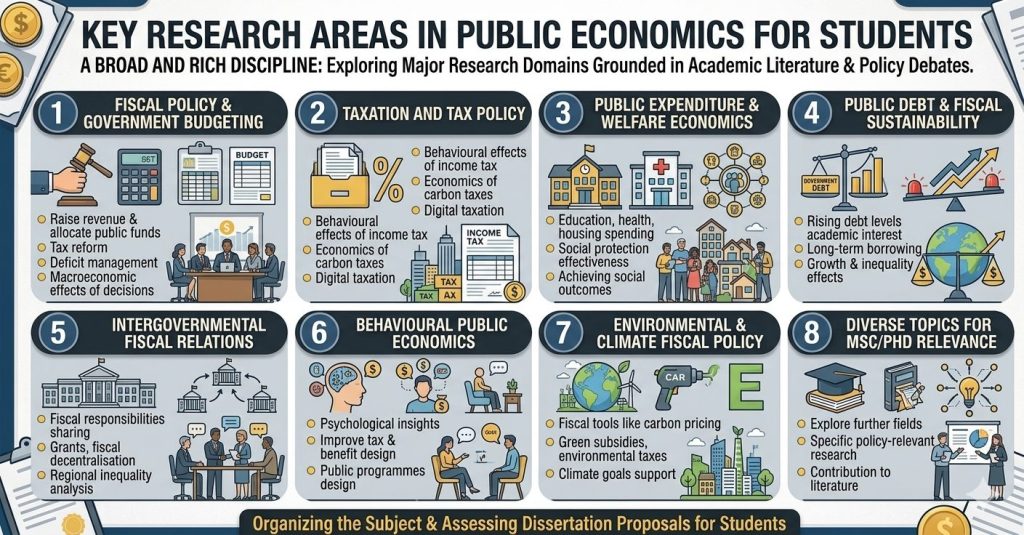
Public economics is a broad and rich discipline. Before you settle on a specific topic, it helps to understand the major research areas available to you. These areas are grounded in established academic literature and current policy debates.
Fiscal Policy and Government Budgeting This area examines how governments raise revenue and allocate public funds. Research in this space covers tax reform, deficit management, and the macroeconomic effects of fiscal decisions.
Taxation and Tax Policy Taxation remains one of the most active areas of public economics research. Topics range from the behavioural effects of income tax to the economics of carbon taxes and digital taxation.
Public Expenditure and Welfare Economics This area focuses on how public money is spent on education, health, housing, and social protection, and how effectively those funds achieve social outcomes.
Public Debt and Fiscal Sustainability With rising debt levels across many economies, there is growing academic interest in the long-term sustainability of government borrowing and its effects on growth and inequality.
Intergovernmental Fiscal Relations This covers how fiscal responsibilities are shared between central and local governments, including grants, fiscal decentralisation, and regional inequality.
Behavioural Public Economics This emerging area examines how psychological insights can improve the design of taxes, benefits, and public programmes.
Environmental and Climate Fiscal Policy Research here looks at how fiscal tools such as carbon pricing, green subsidies, and environmental taxes can support climate goals.
Five Example Public Economics Dissertation Topics With Research Aims and Objectives
Understanding how a dissertation topic is structured academically helps you build your own proposal with confidence. Below are five examples of public economics dissertation topics with examples of aims and objectives.
Example 1: The Effectiveness of Progressive Taxation in Reducing Income Inequality in the United Kingdom
Research Aim: To evaluate how progressive income tax structures in the UK have influenced income distribution between 2010 and 2024.
Research Objectives:
- To analyse changes in the UK income tax schedule and their distributional effects over the study period
- To assess the relationship between marginal tax rates and income inequality using secondary data
- To identify policy gaps in the current progressive tax system that limit its redistributive effectiveness
Example 2: Fiscal Decentralisation and Local Public Service Delivery in Sub-Saharan Africa
Research Aim: To examine whether fiscal decentralisation improves the delivery of essential public services at the local level in selected Sub-Saharan African countries.
Research Objectives:
- To review the academic literature on fiscal decentralisation and public service outcomes in developing economies
- To compare public service delivery indicators across centralised and decentralised fiscal systems
- To identify conditions under which decentralisation produces better outcomes for marginalised communities
Example 3: Carbon Tax Design and Household Welfare in Low-Income Communities
Research Aim: To investigate the welfare implications of carbon tax policies on low-income households in OECD countries.
Research Objectives:
- To examine the distributional impact of existing carbon tax schemes on households across income deciles
- To evaluate the effectiveness of revenue recycling mechanisms in offsetting regressive effects
- To propose design recommendations for a more equitable carbon tax framework
Example 4: Government Spending Efficiency in the Education Sector During Economic Recessions
Research Aim: To assess how recessions affect the efficiency of public education spending and student outcomes in European Union countries.
Research Objectives:
- To measure education spending efficiency using data envelopment analysis across EU member states
- To examine how spending cuts during recessions correlate with changes in educational attainment
- To identify fiscal strategies that protect education outcomes during periods of economic contraction
Example 5: Public Debt Sustainability and Economic Growth in Emerging Market Economies
Research Aim: To analyse the relationship between public debt levels and long-run economic growth in selected emerging market economies.
Research Objectives:
- To review empirical literature on public debt thresholds and growth effects in developing economies
- To test the relationship between debt-to-GDP ratios and growth performance using panel data methods
- To identify fiscal policy recommendations that balance debt sustainability with development goals
80 Public Economics Dissertation Topics for 2026
The topics below are original, academically grounded, and suitable for undergraduate, master’s, or PhD research. They are organised under meaningful subfield headings and numbered clearly for easy reference.
Fiscal Policy and Macroeconomic Stability
- The macroeconomic effects of fiscal consolidation in post-pandemic European economies
- Automatic stabilisers and their effectiveness during economic downturns in advanced economies
- Fiscal multipliers in small open economies: evidence from the Caribbean region
- The role of fiscal rules in constraining government borrowing in OECD countries
- Countercyclical fiscal policy and its limitations in commodity-dependent economies
- Expansionary fiscal policy and private investment crowding out in developing countries
- Fiscal policy coordination challenges within the Eurozone after the COVID-19 pandemic
- The impact of fiscal austerity on long-run potential output in Southern European economies
- Structural versus cyclical budget deficits: measurement challenges and policy implications
- Government consumption versus capital expenditure: which matters more for economic growth?
Taxation Policy and Tax Reform
- The behavioural response to income tax changes among self-employed workers in the United Kingdom
- Corporate tax competition between EU member states and its effects on public revenue
- Digital services taxes and their implications for international tax cooperation
- The optimal design of inheritance taxes from a welfare economics perspective
- Value-added tax compliance gaps and the role of e-invoicing in reducing tax evasion
- Flat tax versus progressive tax systems: distributional effects in Eastern European economies
- The revenue potential of wealth taxes in high-income countries
- Tobacco taxation and health outcomes: evaluating the effectiveness of sin taxes
- Tax expenditures and their hidden cost to government budgets in advanced economies
- Carbon border adjustment mechanisms and their fiscal and trade policy implications
Public Spending and Welfare Economics
- The long-run effects of cuts to public health spending on population health outcomes
- Social housing expenditure and housing affordability in major UK cities
- Universal basic income as a welfare reform: fiscal feasibility and distributional analysis
- The targeting efficiency of means-tested benefit programmes in low-income countries
- Public spending on early childhood education and its returns across income groups
- Disability benefit design and labour market participation: evidence from Scandinavia
- Government subsidies for renewable energy and the cost-effectiveness question
- Conditional cash transfer programmes and long-term human capital formation in Latin America
- Public expenditure on active labour market policies and employment outcomes
- Welfare state retrenchment and poverty rates in post-industrial economies
Public Debt and Fiscal Sustainability
- Sovereign debt restructuring and its social consequences in emerging market economies
- The fiscal space available to low-income countries during climate-related shocks
- Debt-to-GDP thresholds and growth: revisiting the empirical evidence after the pandemic
- Pension system liabilities and their contribution to long-term fiscal imbalances in Europe
- The role of independent fiscal councils in promoting debt sustainability
- Climate-related fiscal risks and their integration into national debt sustainability analyses
- Public debt management strategies in small island developing states
- The distributional effects of government debt accumulation across generations
- Contingent liabilities from state-owned enterprises and fiscal risk in developing economies
- Subnational government debt and fiscal oversight mechanisms in federal systems
Intergovernmental Fiscal Relations
- Fiscal equalisation grants and regional convergence in income across German Länder
- Revenue-sharing formulas and incentive effects on local tax effort in developing countries
- Fiscal decentralisation and corruption: evidence from South Asian economies
- The impact of local government autonomy on infrastructure provision in rural areas
- Intergovernmental transfers and the soft budget constraint problem
- Property tax reform as a tool for improving local government finance in Africa
- Fiscal federalism and healthcare delivery: lessons from Brazil and India
- The political economy of central government grants to politically aligned local authorities
- Local government debt accumulation in China and its systemic fiscal risks
- Decentralisation, accountability, and citizen satisfaction with public services
Behavioural Public Economics
- Nudge-based tax compliance interventions and their effectiveness in HMRC communications
- Loss aversion and household response to changes in pension contribution defaults
- Default enrolment in workplace savings schemes and long-term retirement income security
- The framing of benefit information and take-up rates among eligible households
- Present bias and public health insurance enrolment decisions in developing countries
- Behavioural insights in the design of energy efficiency subsidies for households
- Social norms and tax morale: what drives voluntary compliance beyond enforcement?
- Salience effects in consumption taxes and their implications for fiscal policy design
- Status quo bias in public sector procurement and its effects on spending efficiency
- Paternalistic fiscal policies and their ethical tensions with individual autonomy
Environmental and Climate Fiscal Policy
- The fiscal dividend of carbon pricing and its optimal use for green investment
- Environmental tax reform and employment effects in manufacturing-heavy economies
- Green public procurement and its role in achieving national net-zero commitments
- Climate adaptation financing gaps and the role of government expenditure in closing them
- Carbon taxes and energy poverty: evaluating household impact in the United Kingdom
- The effectiveness of feed-in tariffs compared to carbon pricing in promoting renewables
- Fiscal instruments for biodiversity conservation in tropical economies
- Land value taxation as a tool for financing urban climate adaptation
- Green bonds and sovereign debt management: risks and opportunities
- Pollution taxes in rapidly industrialising economies and their revenue and environmental outcomes
Public Economics of Health and Education
- The cost-effectiveness of publicly funded mental health services in high-income countries
- Education spending inequality across school districts and its effects on attainment gaps
- User fees in public healthcare and their impact on access in low-income countries
- Publicly funded universities and graduate earnings: evaluating the return to higher education spending
- The economics of vaccine procurement and public health insurance design
- Pharmaceutical price regulation and its fiscal implications for public health systems
- School funding formulas and their adequacy for supporting pupils with special educational needs
- Income-contingent student loans as a fiscal tool for expanding higher education access
- The long-term fiscal returns to public investment in preventive healthcare
- Teacher pay reform and public education quality: fiscal trade-offs in resource-constrained systems
How to Evaluate Whether a Topic Is Right for You
Selecting from a long list of public economics research topics can still feel overwhelming if you do not have a clear framework for assessment. Use these practical questions to evaluate your shortlisted ideas.
- Is the topic narrow enough to be addressed within your word limit?
- Is there sufficient published literature to support a literature review?
- Do you have access to the data or case studies your research requires?
- Does the topic connect to current academic debates or real policy problems?
- Can you articulate a clear research gap that your work would address?
If you answer yes to all five, you likely have a strong foundation for your proposal. If you are still uncertain, professional economics dissertation writing service providers can help you refine your idea before you submit it to your supervisor.
Conclusion
Choosing the right dissertation topic in public economics requires careful thought, academic awareness, and a clear understanding of what the field currently demands. The topics and examples in this post are designed to give you a strong starting point, whether you are at undergraduate, master’s, or doctoral level.
Public economics deals with some of the most pressing questions facing modern societies, from the fairness of tax systems to the sustainability of public debt and the design of welfare programmes. Your dissertation is an opportunity to contribute something meaningful to these conversations.
Approach your topic selection with intellectual honesty, choose a question that genuinely interests you, and ensure that your research is grounded in sound methodology. Informed topic selection is the first step towards a dissertation you can be proud of.
